Executive Overview
In the fast-paced, perpetually shifting landscape of contemporary global fashion, few young designers have managed to bridge the aesthetic chasm between London’s avant-garde subcultures and New York’s high-octane commercialism quite like Conner Ives. On a crisp September evening in Manhattan, at the historic Midtown bastion of power dining known as The Grill, Ives staged his inaugural New York Fashion Week (NYFW) presentation. Titled Across the Pond, the collection for Spring/Summer 2027 (SS27) was much more than a routine seasonal showcase; it was a deeply personal, unapologetically loud meditation on cultural identity, geographical migration, and the unyielding tenacity of the American spirit abroad.
Globally, the cultural stereotype of the American is one of excess—loud, unreserved, and, in the eyes of many European critics, "a bit much." Yet, for Ives, these very traits are not cultural liabilities to be sanded down, but rather the beating heart of his creative identity. "Passion and flamboyance are my most inherently American traits," Ives boldly declared in the show notes distributed to a packed room of international buyers, press, and industry insiders. "Flamboyance! The flamboyance of a homecoming… The flamboyance of thinking your homecoming means something, as only an American would."
This narrative of return and reconciliation forms the ideological bedrock of Across the Pond. Since graduating from the prestigious Central Saint Martins in London in 2020, Ives has carved out a unique space within the fashion ecosystem. He has cultivated a fiercely loyal, almost cult-like following through his explosive, tactile manipulation of colors, textures, and archival silhouettes. His SS27 collection serves as a physical manifestation of a modern tale of two cities: New York, the birthplace of his relentless ambition, and London, the crucible where his technical mastery and design philosophy were forged.
This comprehensive report examines the cultural resonance, structural evolution, and commercial trajectory of Conner Ives’s landmark NYFW debut. Through a detailed chronology of the event, deep context regarding his socio-political positioning within modern design, analysis of official statements, and an outlook on his future trajectory, we explore how Ives is redefining what it means to be a modern American designer working on the global stage.
Detailed Chronology: The Night at The Grill
Setting the Scene: The See-and-Be-Seen Sanctuary
To understand the impact of Conner Ives’s SS27 debut, one must first understand the symbolic weight of the venue. The Grill, occupying the ground floor of the iconic Seagram Building in Midtown Manhattan, has long been synonymous with mid-century American power, corporate opulence, and legendary New York nightlife. Choosing this historic, see-and-be-seen steakhouse as a runway backdrop was an intentional theatrical choice. It signaled a deliberate reclamation of high-society American spaces by a new generation of designers who refuse to play by traditional rules.
As flashbulbs illuminated the wood-paneled walls and leather booths, guests—comprising a who’s who of transatlantic style icons, editors, and musicians—settled in for a presentation that promised to blur the lines between theatrical spectacle and high-end ready-to-wear. The air was thick with anticipation; while Ives had established a formidable reputation across the Atlantic during London Fashion Week, this marked his formal, triumphant homecoming to the American calendar.
The Runway Unveiling: A Riot of Tactile Excess
As the first models emerged from the labyrinthine dining rooms into the main hall, it became immediately clear that minimalism had been left at the door. Ives delivered a masterclass in textural juxtaposition, sending a parade of boundary-pushing ensembles down the makeshift runway.
Electric pink feather boas cascaded over tailored shoulders, instantly setting a tone of joyous, unfiltered extravagance. They were paired with expertly cut, fur-trimmed smoking jackets that nodded to classic Americana menswear while subverting it through eccentric color palettes and irreverent styling. Slinky violet chiffon dresses glided effortlessly against the floor, catching the ambient restaurant lighting and introducing a fluid, weightless counter-balance to the heavier, more tactile outer layers.
Throughout the presentation, a distinctly tropical undercurrent pulsed through the collection. Intricate floral embroidering bloomed across denim and silk, while bold animal prints—ranging from leopard to zebra—interacted brazenly with vibrant, saturated hues of tangerine, lime, and cerulean. The clothing did not whisper; it shouted. It was a physical manifestation of the designer’s thesis statement: an embrace of unapologetic visibility.
The Statement Piece: "Bring Back Shame"
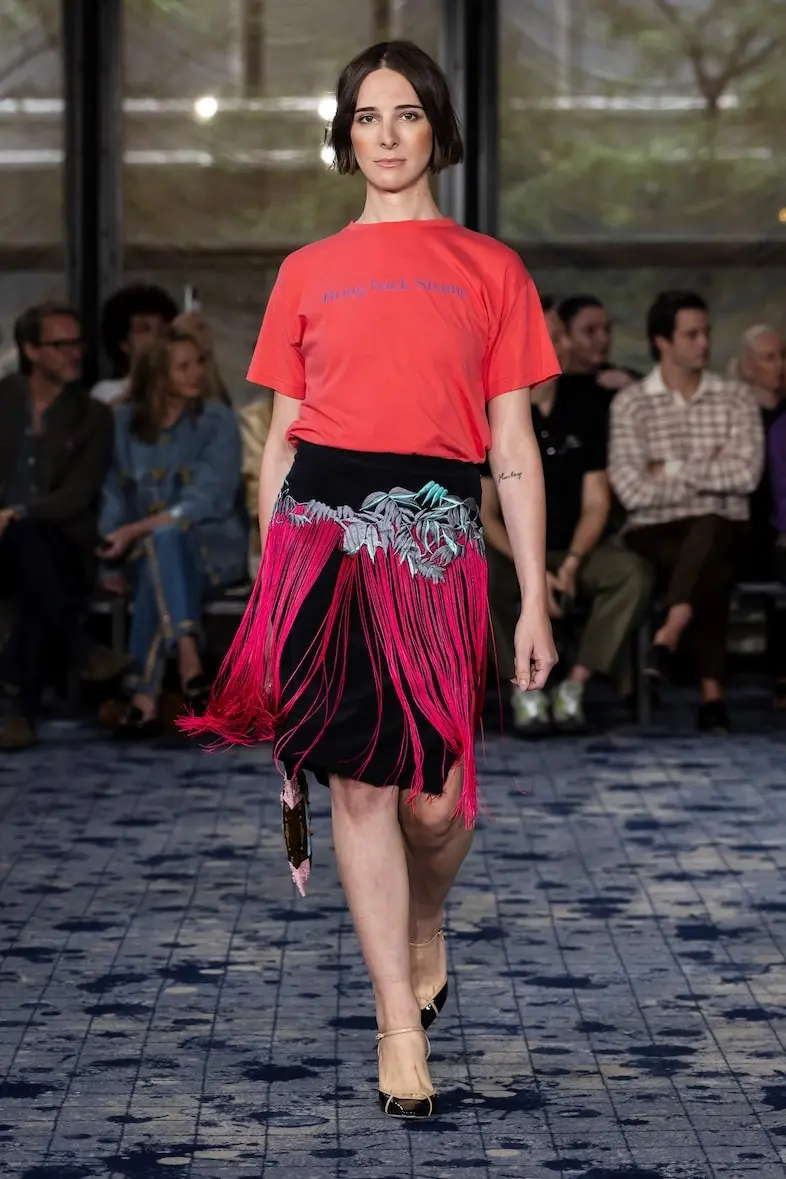
While the tailoring and the textiles drew immediate gasps of admiration from the front row, it was a piece of casualwear that encapsulated the socio-political pulse of the collection. Midway through the presentation, a model stepped out wearing a coral graphic t-shirt bearing a stark, provocative directive: “Bring back shame.”
The garment instantly sent ripples through the digital sphere, destined for viral ubiquity. For Ives, fashion has never existed in a political vacuum. He is the same creative mind behind the viral “Protect the Dolls” t-shirt, a grassroots campaign-turned-fashion statement that successfully raised hundreds of thousands of dollars for transgender rights charities. Never one to mince his words or shy away from cultural discourse, Ives used the runway as a platform for social commentary. The "Bring Back Shame" tee served as a satirical yet poignant critique of modern public culture, digital oversharing, and the erosion of societal accountability—delivered with the biting wit characteristic of a young designer who observes his homeland with both profound affection and critical detachment.
The show culminated in a grand finale walk that brought the entire room to its feet, cementing the evening not merely as a successful seasonal presentation, but as a defining cultural moment for American fashion in exile and return.
Supporting Context & Metrics: The Transatlantic Rise of Conner Ives
The Central Saint Martins Crucible and the 2020 Paradigm Shift
To fully appreciate the design vocabulary of Across the Pond, one must trace the trajectory of Ives’s education and early career. Enrolling at Central Saint Martins—an institution renowned for churning out some of the most disruptive creative geniuses of the past half-century, including Alexander McQueen, John Galliano, and Stella McCartney—Ives was immersed in a rigorous, conceptual approach to fashion design.
Graduating in the turbulent year of 2020 presented an unprecedented landscape for emerging designers. The global pandemic upended traditional retail models, supply chains, and fashion week schedules. Yet, paradoxically, this period of isolation catalyzed a digital revolution in how fashion was consumed and distributed. Ives leveraged this moment brilliantly. Working primarily with upcycled deadstock fabrics, vintage textiles, and archival reimagining, he built a sustainable, highly individualized brand ethos that resonated deeply with Gen Z and millennial consumers fatigued by mass-market homogeny.
Cult Following and Commercial Viability
Over the past four years, Conner Ives has evolved from a buzzy London graduate student into a bona fide commercial entity with a cult-like following. His garments—often characterized by their figure-hugging silhouettes, clever use of archival t-shirt patching, and nostalgic 1990s and Y2K aesthetic nods—have become staples in the wardrobes of global style icons, ranging from Rihanna to Adwoa Aboah.
According to preliminary retail metrics from stockists carrying his collections, Ives’s transition from bespoke, limited-run upcycled pieces to more structured seasonal ready-to-wear has yielded a significant surge in demand. His ability to maintain the artisanal, one-of-a-kind feel of his early upcycled work while scaling production for international wholesale partners has been a critical factor in his commercial success.
| Metric Category | Data Point / Indicator | Contextual Analysis |
|---|---|---|
| Brand Foundation | Est. 2020 (Post-CSM Graduation) | Rapid transition from student designer to independent label owner during a global retail crisis. |
| Market Positioning | High-End Contemporary / Sustainable Luxury | Blends upcycled deadstock integrity with accessible, highly covetable ready-to-wear pieces. |
| Activism Impact | Protect the Dolls T-Shirt Campaign | Raised hundreds of thousands of dollars for trans advocacy, proving commercial viability tied to social justice. |
| Geographic Footprint | Dual-Base: London & New York | Operates at the intersection of British tailoring/subculture and American commercial flamboyance. |
The Sociology of American Excess in British Eyes
Living and working in London provided Ives with a unique anthropological vantage point. In the United Kingdom, American tourists, expats, and cultural artifacts are frequently viewed through a lens of bemused detachment—typified by stereotypes of boundless optimism, hyper-extroversion, and a distinct lack of irony.
Rather than fleeing from this caricature, Ives leans into it with tactical brilliance. Across the Pond is an examination of what happens when an American absorbs the understated irony and historical weight of British style, only to filter it back through an uninhibited, loud, home-grown sensibility. The result is a hybrid aesthetic: the immaculate tailoring and structural discipline of London tailoring meets the unabashed, look-at-me theatricality of New York showmanship.
Official Statements & Design Philosophy
The intellectual framework of Across the Pond was articulated most clearly through Ives’s own words in the show notes and subsequent press interactions. The designer’s voice is distinct: articulate, self-aware, humorous, and deeply reflective.
"Passion and flamboyance are my most inherently American traits. Flamboyance! The flamboyance of a homecoming… The flamboyance of thinking your homecoming means something, as only an American would."
This quote encapsulates the core tension of the collection. It is simultaneously an earnest celebration of American pride and a tongue-in-cheek critique of American solipsism—the charming, albeit occasionally exasperating, belief that one’s personal milestones hold universal historical significance.
Furthermore, Ives positioned the collection as a personal retrospective on his own maturation. As noted in the show’s concluding manifesto, Ives views himself, through all the critical acclaim and commercial growth, as simply remaining "a flamboyant kid who loves to put on a good show." This rejection of corporate sterility in favor of raw, emotional entertainment is what continues to endear him to both critics and consumers.
In interviews following the show, Ives elaborated on the dual identity that inspired the SS27 collection:
- "When you live in London, you learn to appreciate nuance, history, and the quiet power of understatement," Ives noted. "But when you come back to New York, you remember the sheer electricity of people who aren’t afraid to take up space. I didn’t want to choose between the two. I wanted to smash them together."
Future Outlook: What’s Next for Conner Ives?
As the dust settles on his triumphant New York Fashion Week debut, the trajectory for Conner Ives points definitively upward. The success of Across the Pond raises critical questions regarding the designer’s next strategic moves in an increasingly volatile global fashion economy.
1. Scaling the Brand Without Losing the Soul
The primary challenge facing independent designers who achieve viral and critical acclaim is the delicate dance of commercial scaling. Ives has built his reputation on the tactile, bespoke nature of his garments—particularly his innovative use of upcycling and deadstock textiles. As international stockists clamor for larger volume orders, the designer will need to navigate supply chain expansions while preserving the handcrafted ethos that won him his cult following in the first place.
2. Deepening the Intersection of Fashion and Activism
With proven successes like the Protect the Dolls campaign and the thought-provoking “Bring Back Shame” tee for SS27, Ives has established himself as a designer unafraid of political and social discourse. In an era where consumers—particularly younger demographics—increasingly demand authenticity and ethical alignment from the brands they support, Ives’s vocal advocacy positions him as a moral leader for his generation. Future collections will likely continue to integrate socio-political commentary directly into the garment design, bridging the gap between wearable art and wearable activism.
3. Strengthening the Transatlantic Bridge
By successfully planting a flag on both sides of the Atlantic, Ives has created a dual-market pipeline that insulates him from regional economic downturns. Maintaining a creative footprint in London while tapping into the commercial dynamism of New York positions him uniquely among his peers. Observers anticipate potential permanent retail activations, pop-up installations, or targeted capsule collections in both global capitals in the coming years.
Conclusion
Conner Ives’s SS27 presentation at The Grill was far more than a seasonal fashion show; it was a cultural coming-of-age story told in silk, feathers, and denim. By embracing the very stereotypes of American excess that others attempt to conceal, Ives has turned his cultural heritage into his greatest design asset.
Across the Pond proved that fashion can be simultaneously deeply intellectual and wildly, unapologetically fun. As the young designer continues to write his transatlantic narrative, one thing remains abundantly clear: Conner Ives is not just putting on a good show—he is fundamentally redefining the playbook for the modern global designer.