Executive Overview
In the modern hyper-competitive landscape of business-to-business (B2B) software, marketing departments routinely allocate millions of dollars toward paid acquisition campaigns, sponsored content, and targeted enterprise advertising. Yet, some of the most potent brand amplification cannot be bought on an insertion order. It is earned through product excellence, unyielding technical support, and authentic, practitioner-driven advocacy.
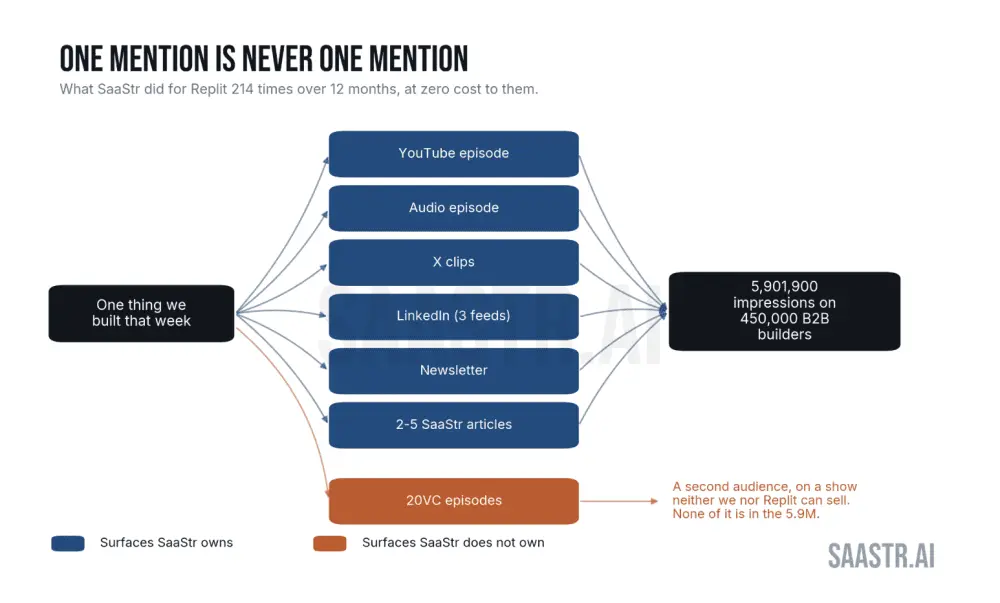
Over a twelve-month period, SaaStr AI delivered an astonishing metric for the cloud-based development platform Replit: 214 independent articles, over 40 podcast mentions, and approximately 5.9 million high-intent impressions targeting an elite audience of 450,000 global B2B executives, founders, and technical decision-makers. The aggregate cash value of these placements—calculated using conservative B2B cost-per-mille (CPM) pricing benchmarks—easily eclipses hundreds of thousands of dollars.
Remarkably, Replit paid $0 for this initial tidal wave of coverage. There was no pre-arranged contract, no marketing brief, no enforced message-tailoring, and no "partner content" disclaimers.
This deep-dive investigation examines how this unprecedented alignment of product utility, elite engineering support, and organic storytelling unfolded. It offers critical lessons for B2B tech leaders on how to identify, protect, and scale their most valuable—yet frequently invisible—advocates.
Detailed Chronology: From Unprompted Utility to Global Amplification
The relationship between SaaStr and Replit did not begin in a corporate boardroom or via an outbound enterprise sales pitch. It began where all transformative B2B success stories start: at the intersection of a genuine product capability and a user facing a tangible, high-stakes problem.
Phase 1: Building Without Boundaries
The foundational catalyst for the 214 articles was simple daily utility. Operating without a traditional engineering background, the SaaStr team utilized Replit to build real, production-ready software. Over the course of the year, leadership shipped more than ten production applications that ultimately accrued close to a million uses. Platforms like SaaStr.ai crossed 500,000 active users within its first 45 days of deployment—all built by individuals who cannot write a line of Python code from scratch.
Because writing publicly about current operational workflows and technical achievements forms the core of SaaStr’s daily output, every trial, tribulation, and deployment milestone naturally made its way into print. These accounts were raw, unfiltered, and deeply credible. They included embarrassing failures, such as AI agents accidentally deleting over 2,400 production records with zero change-detection alerts, or test frameworks returning fabricated 88% pass rates when the true metric hovered at 48%.
Because the storytelling exposed both the triumphs and the structural breakdowns of modern "vibe coding," readers instantly recognized the authenticity.
Phase 2: The Engineering Intervention
Recognizing an active, highly public user scaling their infrastructure, Replit leadership took a decisive operational step. Rather than routing SaaStr through standard ticketing queues or rotating customer success pools, CEO Amjad Masad assigned a dedicated, forward-deployed engineer named Kody.
Crucially, this support was not predicated on a massive seat count or an enterprise-tier contract. On paper, SaaStr was a modest account. In practice, however, they were operating as an influential laboratory within Replit’s exact Ideal Customer Profile (ICP). This dedicated technical liaison remained continuous—avoiding the classic enterprise pitfall of reassigning personnel after the initial onboarding window closed, thereby preserving institutional memory and deep stack familiarity.
Phase 3: The Flywheel Effect and Public Platforms
As the engineering partnership deepened, the advocacy expanded outward. Through weekly productions like The Agents—co-hosted by SaaStr Chief AI Officer Amelia Lerutte—production stack executions, localized app deployments, and real-time troubleshooting sessions were broadcast to thousands of active decision-makers. A single clip demonstrating the localization of an app into Spanish and Chinese within 20 minutes on Replit effortlessly swept across digital channels, generating tens of thousands of unprompted impressions.
Furthermore, this advocacy spilled over onto external platforms. On high-profile financial and entrepreneurial channels such as 20VC—hosted alongside Harry Stebbings and Rory O’Driscoll—Replit routinely surfaced as a headline topic. When evaluating foundational shifts in the software ecosystem, industry leaders highlighted Replit not as a paid sponsor, but as the operational engine making modern AI-assisted engineering possible.

Supporting Context & Metrics: Decoding the Media Math
To understand the true economic footprint of this organic partnership, industry operators must look past vanity metrics and examine the underlying media arithmetic.
+-------------------------------------------------------------------------+
|                  THE SAUSTR-REPLIT ADVOCACY IMPACT                      |
+-----------------------------------+-------------------------------------+
| Total Measured Impressions        | 5,901,900                           |
| Target Audience Demographics      | 450,000+ Top B2B Executives         |
| Core ICP Overlap                  | Near 100% (Founders, CEOs, CTOs)    |
| Baseline Media Value (at $100 CPM)| ~$590,000+ (Undervalued by Context) |
| Direct Financial Cost to Replit   | $0 (Initial Phase)                  |
+-----------------------------------+-------------------------------------+
The Credibility Multiplier
Traditional digital advertising relies on broad reach, where a significant percentage of impressions hit irrelevant eyeballs. If a B2B infrastructure company spends $300,000 on generic tech channels, perhaps two percent of those impressions reach an actual budget-holder.
In contrast, the 5.9 million impressions generated via SaaStr’s surfaces landed directly on approximately 450,000 of the world’s top B2B executives: founders, chief revenue officers, chief technology officers, and vice presidents of product. Every single viewer was either a builder themselves or controlled a budget dedicated to empowering builders.
When a trusted practitioner details the real-world performance of a development tool—including its flaws—it carries a credibility multiplier that sponsored content can never purchase. There is no agency, media buy, or ad network that can manufacture the authority of an active user publicly sharing production milestones built at midnight on a Tuesday.
Official Statements and Industry Insights
Reflecting on the dynamics of modern B2B growth, industry observers note a profound disconnect in how legacy organizations track customer value.
"Most B2B companies spend an enormous amount of energy trying to manufacture credibility they don’t have, and almost no energy protecting the credibility somebody already handed them for free."
Standard customer relationship management (CRM) systems are fundamentally misconfigured to capture this category of value. Modern CRMs fire alerts on demo requests, pricing page visits, trial signups, and support ticket escalations. They possess no native object, tag, or notification workflow to recognize when a prominent industry voice mentions the platform favorably for the fortieth time.
Consequently, organizations frequently funnel their most powerful unprompted brand advocates through standard, low-tier billing support workflows—a structural oversight that squanders enterprise leverage.
Future Outlook: Operationalizing Advocacy for the Enterprise
As artificial intelligence continues to compress software development cycles and alter the dynamics of enterprise tech stacks, the playbook for B2B growth is undergoing a paradigm shift. Companies that rely exclusively on outbound sales prospecting and programmatic ad spend will find themselves outpaced by organizations that foster deep, symbiotic relationships with high-leverage practitioners.
For B2B executive teams looking to operationalize these insights, the path forward requires deliberate structural changes:
- Build Intelligent Detection Stacks: Implement always-on monitoring agents to track unprompted brand mentions across podcasts, social platforms, and digital publications, assigning explicit internal ownership to manage these relationships.
- Prioritize Continuity in Engineering Support: When high-impact users or influential practitioners emerge, assign dedicated, top-tier technical resources—and ensure that institutional context is never lost through routine personnel rotation.
- Align Sponsorship with Authentic Engagement: When participating in industry events, move beyond passive banner placements and static booths. Invest in immersive, role-specific activations (such as live build workshops and collaborative technical spaces) where engineering teams can demonstrate product utility directly to qualified buyers.
Ultimately, the Replit and SaaStr case study serves as an enduring blueprint for the modern tech economy: when a product is powerful enough to solve hard problems for practitioners with a voice, the most valuable marketing asset a company can possess is the unvarnished truth told by its best users.