The landscape of modern cloud architecture and artificial intelligence underwent a significant paradigm shift today with the general availability of native vector search in Amazon DynamoDB. For years, developers building intelligent applications—ranging from Retrieval-Augmented Generation (RAG) pipelines and semantic search engines to agentic memory frameworks and personalized recommendation systems—faced a persistent architectural friction point. While operational databases like DynamoDB expertly handled high-throughput, low-latency relational or NoSQL transactional data, incorporating vector embeddings necessitated a fragmented approach. Engineering teams were forced to spin up and maintain separate, dedicated vector stores, orchestrating complex, fragile data synchronization pipelines between their operational databases and external vector indices.
This legacy approach introduced compounding layers of operational overhead: escalating data movement costs, separate licensing and infrastructure footprints, synchronization lag, and the perpetual engineering challenge of maintaining predictable, single-digit millisecond latencies at scale.
Amazon DynamoDB’s new native vector search completely eliminates this architectural divide. Developers can now store vector embeddings directly alongside their operational data within the same serverless DynamoDB tables. Operating natively on DynamoDB’s battle-tested infrastructure, the new capability delivers high-recall similarity searches—achieving upwards of 99% recall rates—with single-digit millisecond latencies, even when scaling to trillions of vectors. By unifying transactional data and vector embeddings under a single pay-per-request pricing model with zero infrastructure to provision, patch, or manage, AWS is lowering the barrier to entry for enterprise-grade generative AI applications.
Detailed Chronology: The Evolution of DynamoDB Toward Native AI
The journey toward native vector search within Amazon DynamoDB reflects a broader industry-wide realization: the artificial boundary between operational data and vector-based semantic data is counterproductive.
The Era of Siloed Architectures
When the generative AI boom accelerated, organizations rapidly adopted Large Language Models (LLMs) and vector embeddings to inject context into enterprise applications. Because traditional databases lacked native vector handling, the default design pattern relied on polyglot persistence. Developers stored user profiles, product catalogs, and transactional metadata in DynamoDB, while vector embeddings—derived from models such as Amazon Bedrock Titan Text Embeddings, Cohere, or OpenAI text-embedding models—were exported and indexed in external vector databases.
This dual-database strategy immediately triggered engineering liabilities:
Synchronization Bottlenecks: Real-time updates to operational records required dual-write patterns or asynchronous event streams (such as Amazon DynamoDB Streams coupled with AWS Lambda) to keep external vector stores synchronized.
Latency Degradation: Network hops between distributed systems introduced latency jitter, conflicting with the low-latency guarantees required for real-time user experiences.
Cost Multipliers: Maintaining separate provisioned throughput, storage capacity, and administrative oversight for secondary vector engines escalated cloud budgets.
The Engineering Breakthrough
Recognizing these operational bottlenecks, AWS engineers engineered a deeply integrated vector indexing engine directly into the core DynamoDB storage layer. Rather than treating vectors as an afterthought, DynamoDB now accommodates vector embeddings natively via standard list data types.
By leveraging native vector indexes, developers can execute mathematical distance calculations (Cosine, Euclidean, and Dot Product) directly on the storage nodes, completely bypassing the need for data replication. The release of this feature into general availability across all commercial and AWS GovCloud (US) Regions marks the culmination of rigorous performance tuning designed to deliver infinite horizontal scalability, inline filtering, and zero-downtime maintenance.
Supporting Context & Metrics: Architecture and Performance Under the Hood
To understand the engineering significance of DynamoDB’s native vector search, one must examine its underlying mechanics, structural limits, and performance profiles.
Technical Specifications and Scale
DynamoDB vector search has been architected to scale seamlessly alongside growing enterprise data stores without imposing artificial storage ceilings:
Dimensional Support: The service supports vector embeddings with up to 4,096 dimensions, accommodating high-dimensional models capable of capturing nuanced semantic relationships.
Distance Functions: Developers can choose from three primary distance metrics depending on their specific use case:
Cosine Similarity: Measures the angular separation between vectors in multi-dimensional space, making it the industry standard for semantic text matching and natural language retrieval.
Euclidean Distance: Calculates the straight-line distance between two points in vector space.
Dot Product: Evaluates the directional alignment and magnitude of vectors, frequently used in recommendation systems and normalized embeddings.
Recall and Latency: The system is engineered to deliver 99%+ recall accuracy while maintaining single-digit millisecond response times, even as underlying datasets scale into the trillions of vector elements.
Serverless Model: True to DynamoDB’s core philosophy, the vector search tier inherits a fully serverless operational model. There are no servers to provision, no maintenance windows, no version upgrades to manage, and zero-downtime maintenance operations.
Unifying Operational and Semantic Data
With the introduction of the new index type, vectors are stored as a standard list of floating-point numbers within a DynamoDB table attribute. Developers utilize familiar API operations like PutItem and UpdateItem to inject embeddings generated by their model of choice—such as Amazon Bedrock Titan Text Embeddings.
Once the attribute is populated, creating a vector index requires specifying the index name, the target vector attribute, dimensionality, and distance function. Furthermore, DynamoDB supports inline filtering, allowing engineers to supply non-vector attributes (such as category or marketplace) as exact-match filter conditions during query execution. This ensures that similarity searches are immediately scoped down to relevant subsets of data, dramatically accelerating query execution times and reducing unnecessary compute overhead.
Step-by-Step Implementation Walkthrough
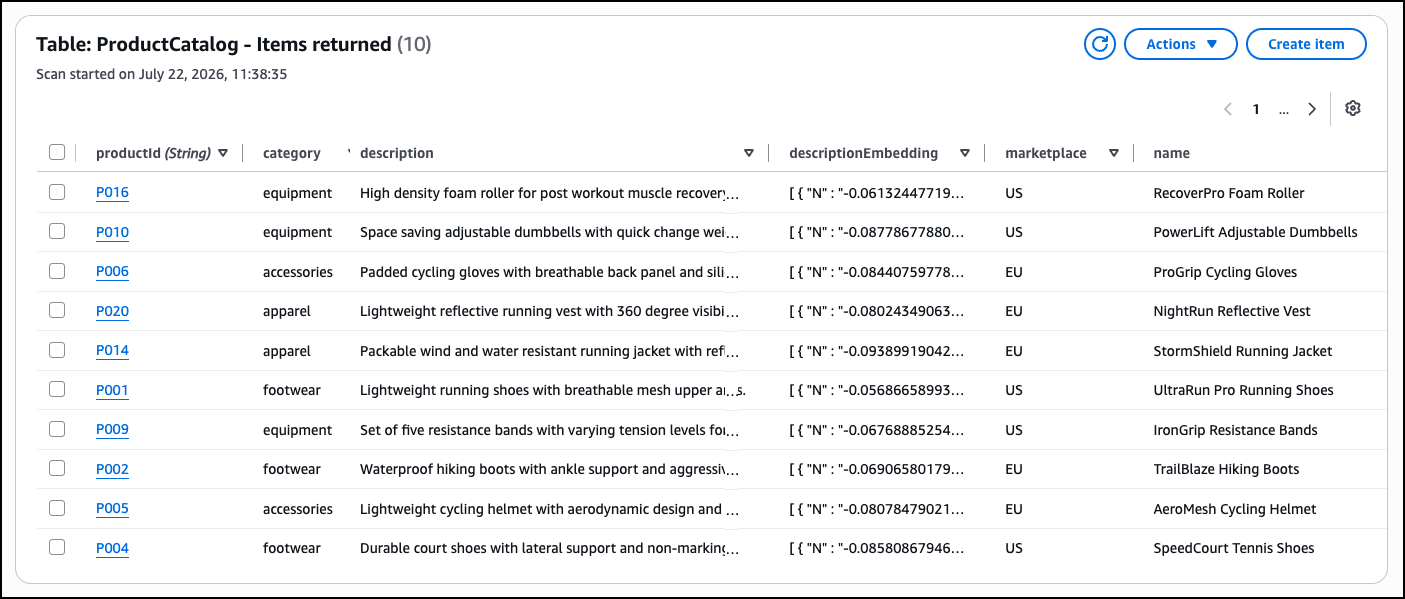
To illustrate how organizations can integrate native vector search into existing workflows, consider an online sporting goods retailer managing a high-volume ProductCatalog table. The primary objective is to transition from rigid, exact-keyword matching to fluid, natural-language semantic discovery (e.g., allowing shoppers to search for "lightweight running shoes for summer").
Step 1: Preparing the DynamoDB Table
The foundational step involves generating numerical vector representations of textual attributes (such as product descriptions) using a machine learning model. Because embeddings capture semantic intent, items with conceptually similar descriptions cluster closely together in vector space.
For an existing table like ProductCatalog, developers add these embeddings using an UpdateItem API call, storing them in a new attribute (e.g., descriptionEmbedding). Because DynamoDB leverages its native List data type—where each element represents a single float value—no disruptive schema migrations or complex data-type conversions are required.
Step 2: Creating the Vector Index
Navigating to the AWS Management Console, the database administrator accesses the ProductCatalog table, selects the Indexes tab, and initiates the creation of a Vector index.
Index Details: The administrator assigns an index name (ProductDescriptionIndex) and points it to the vector attribute (descriptionEmbedding).
Dimensionality & Distance: The dimension count is matched to the output of the embedding model (e.g., 1,536 or 3,048 dimensions), and Cosine is selected as the distance function due to its efficacy in comparing text semantics.
Partition Key Configuration: To optimize performance at scale, a partition key (such as marketplace) is defined. This ensures that vectors are distributed efficiently across partitions, allowing queries to target specific geographic or regional catalogs (e.g., searching exclusively within the US marketplace) without scanning the entire global index.
Inline Filtering: The category attribute is added as an inline filter, restricting search results to specific classifications (like footwear) at query time.
Step 3: Executing the Search
With the index status transitioned to Active, programmatic execution or console testing becomes immediately available via the SearchVectors API.
The application generates a query vector from a natural language string using the same embedding model. Passing this query vector, a Top K parameter (e.g., returning the top 5 results), partition constraints, and inline filters into the SearchVectors request yields a precise, similarity-ranked response. DynamoDB returns the matching items alongside their operational attributes (pricing, SKU, name, and similarity scores) in a single, unified JSON payload.
Official Statements and Industry Impact
Industry analysts and cloud architects have closely monitored the convergence of operational and analytical data stores. The launch of DynamoDB vector search represents a watershed moment for serverless architectures.
"By bringing vector search directly into Amazon DynamoDB, we are removing one of the most persistent architectural roadblocks in modern application development," noted engineering leadership within the AWS database organization. "Customers no longer need to choose between the operational agility of NoSQL and the intelligence of semantic retrieval. They can now build sophisticated AI-driven features—from hyper-personalized recommendation engines to intelligent agentic memory—on the same serverless infrastructure they already trust for mission-critical workloads, complete with pay-per-request pricing and enterprise-grade scale."
Early enterprise adopters participating in preview programs have echoed these sentiments, highlighting dramatic reductions in system complexity. By consolidating database estates, engineering teams report significant savings in operational overhead, reduced maintenance cycles, and the elimination of custom synchronization middleware.
Future Outlook: The Next Wave of Serverless AI
As artificial intelligence rapidly transitions from experimental chat interfaces to deeply integrated operational systems, the architectural expectations placed on cloud databases will continue to intensify. The introduction of native vector search in Amazon DynamoDB establishes a clear benchmark for how enterprise data stores must evolve.
Looking ahead, the convergence of vector indexing with fully serverless, pay-per-request paradigms paves the way for autonomous, self-optimizing agentic systems. Applications will increasingly rely on real-time operational state paired with instantaneous semantic context to make automated decisions in milliseconds. With vector search now generally available across all commercial and AWS GovCloud (US) Regions, organizations are well-equipped to accelerate their generative AI roadmaps, secure in the knowledge that their data layer can scale infinitely without sacrificing simplicity, performance, or cost-efficiency.