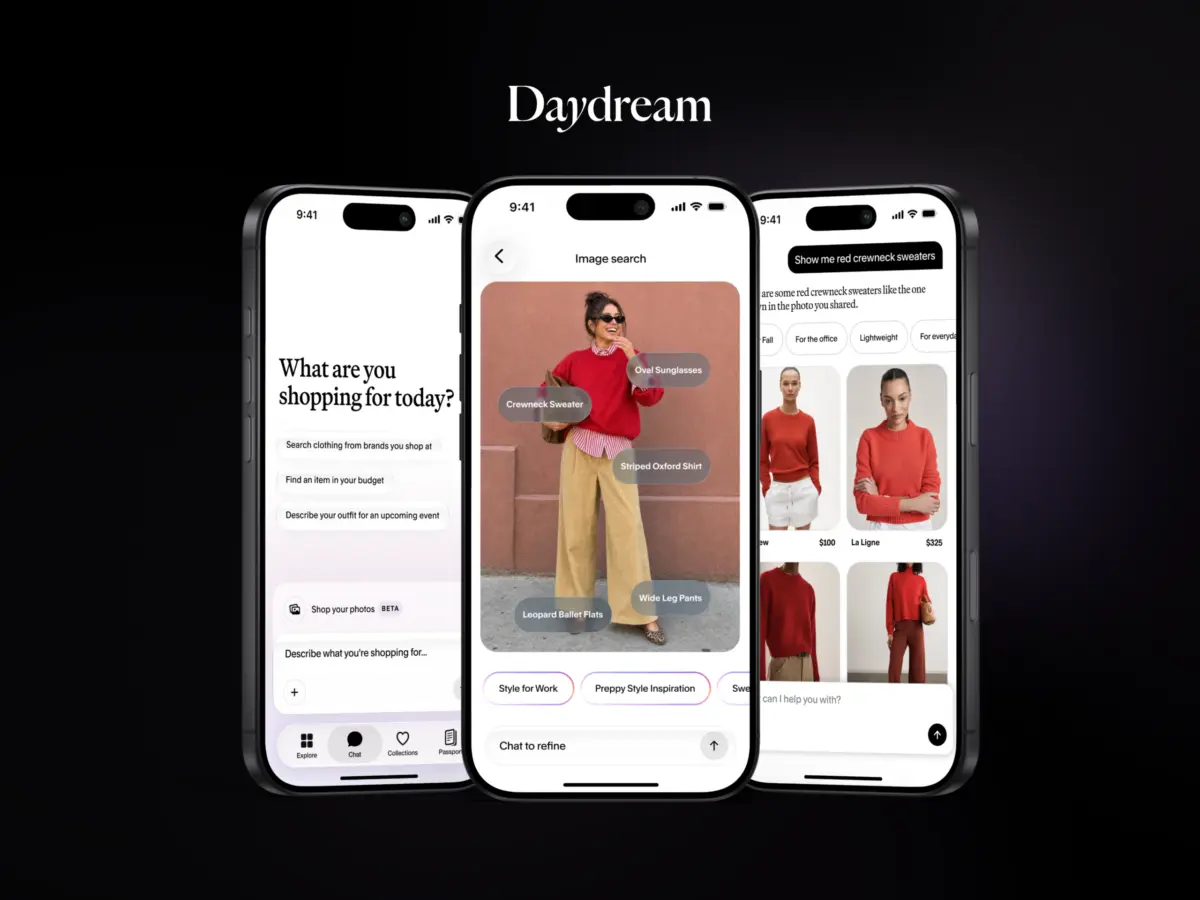
The landscape of digital commerce is undergoing a structural paradigm shift, moving away from traditional keyword-based query boxes toward contextual, ambient, and multimodal search experiences. At the vanguard of this evolution is Daydream, an AI-powered fashion discovery platform that recently announced the rollout of two pioneering features designed to seamlessly integrate fashion procurement into the daily smartphone habits of iOS users. Leveraging the newly released developer APIs of Apple’s iOS 27, Daydream has introduced capabilities that allow users to convert static, saved images within their local Photos app into fully shoppable inventories, and execute complex fashion queries directly through Siri without ever opening the host application.
This release marks a significant milestone in the monetization of on-device intelligence and visual context. By utilizing Apple’s advanced image-context frameworks and Siri’s deeply integrated natural-language processing (NLP) capabilities, Daydream bridges the historically fragmented gap between inspiration and transaction. Consumers who capture style inspiration on visually driven platforms like Instagram, Pinterest, or digital lookbooks can now bypass the friction of manual searching. Instead, they can utilize a cohesive, automated system that identifies, parses, and matches garments against a vast, curated retail index.
As major technology conglomerates like Google and Amazon deploy broad, horizontal computer-vision utilities, Daydream’s launch underscores a growing industry thesis: highly specialized, vertically integrated AI agents possess a distinct competitive advantage over general-purpose systems. By focusing exclusively on the stylistic nuances, inventory realities, and brand relationships of the fashion vertical, Daydream aims to establish a high-fidelity shopping ecosystem that prioritizes contextual precision over generic product retrieval.
Detailed Chronology and Technical Feature Breakdown
The deployment of Daydream’s new capabilities coincides with the official, wide-scale public release of Apple’s iOS 27 developer tools. To access these features, users must operate an iPhone running iOS 27 with Siri AI enabled and have the latest version of the free Daydream application installed. The integration relies on two primary technical pillars: on-device visual semantic analysis and system-wide conversational App Intents.
The first feature leverages Apple’s latest image-context capabilities to analyze images directly from the native iOS Photos application.
Multimodal Parsing Engine: When a user invokes Daydream’s analysis on an image—such as a screenshot of an outfit from an influencer’s social feed—the application’s underlying visual models segment the image into discrete, identifiable layers. Rather than processing the image as a single vector, the system isolates individual components of the ensemble, such as a knit sweater, tailored trousers, leather loafers, or accessories.
Dynamic Inventory Mapping: Once segmented, these items are cross-referenced with Daydream’s product database. If the exact SKU is active and available within the retail partner network, the system directs the user to the active merchant landing page. If the item is out of stock, discontinued, or from a non-partner boutique, Daydream’s semantic search engine retrieves highly similar alternatives based on cut, texture, color, and silhouette.
Interactive Semantic Modifiers: Crucially, the system supports natural language modifiers on visual inputs. If a user presents a photo of an emerald-green cable-knit sweater but prefers a different colorway, they can issue commands such as, "I like this sweater but want it in red." The system dynamically adjusts its search parameters, retaining the structural characteristics of the visual reference while shifting the color-space query to return matching inventory.
2. Hands-Free Siri Conversational Search
The second feature utilizes iOS 27’s system-level Siri integration, allowing users to initiate deep, personalized catalog queries via voice or text without launching the Daydream interface.
App Intents Architecture: By utilizing Apple’s updated App Intents framework, Daydream exposes its internal search architecture directly to Siri’s semantic parser. This enables the virtual assistant to execute complex, multi-variable queries across the application boundary.
Contextual Natural Language Queries: A user can issue conversational commands such as, "Hey, Siri, search Daydream for a cool blazer for my board meeting on Monday." The system interprets the semantic components of this request:
"blazer" defines the product category.
"cool" indicates a contemporary, style-forward aesthetic filter.
"board meeting on Monday" acts as a contextual vector, guiding the model toward professional, structured, and premium options rather than casual streetwear.
The "Style Passport" Personalization Layer: The utility of these conversational queries is enhanced by Daydream’s proprietary "Style Passport." This user-configured profile contains explicit preferences, including sizing profiles, favorite brands, budget limits, and general style inclinations. When Siri executes a query, Daydream automatically applies the Style Passport parameters as pre-filters, ensuring the voice-activated results are highly tailored to the user’s physical profile and purchasing habits.
Supporting Context and Competitive Metrics
The deployment of these features comes at a time of intense competition in the AI-assisted shopping landscape. Both established technology giants and venture-backed startups are racing to capture the market for search-and-discovery engines that bypass traditional text-entry search boxes.
Feature / Metric
Daydream
Google (Lens / Search)
Amazon (Lens Live)
Specialty Startups (Onton, Alta)
Catalog Depth
~3 Million Curated SKUs
Billions (Uncurated)
Millions (Amazon-Exclusive)
Niche / Variable
Primary Focus
Fashion & Accessories
General-Purpose Objects
Consumer Packaged Goods
Fashion / Style Discovery
OS Integration
Deep iOS 27 App Intents
Multi-platform / Browser-level
In-app / Fire OS
In-app Only
Personalization
Style Passport (Explicit)
Search History (Implicit)
Purchase History (Implicit)
Variable Profiles
Retailer Network
325+ Elite Merchants
Open Web
Amazon Marketplace
Curated Boutiques
Navigating the Technical Friction of Visual Search
The primary limitation of horizontal visual search platforms—such as Google Lens or Amazon’s visual tools—has historically been their lack of vertical domain expertise. While a general-purpose search engine can identify a chair or a breed of dog with high accuracy, it frequently struggles with the nuanced taxonomy of fashion.
General-purpose visual search engines often return inaccurate results from low-credibility marketplaces, index non-shoppable editorial images, or fail to understand the material composition and drape of a garment. Daydream addresses this limitation by indexing a curated catalog of roughly 3 million products sourced directly from over 325 premium retailers and 10,000 distinct brands. This network spans the retail spectrum, from accessible everyday brands to high-end luxury fashion houses, including:
Premium Department Stores & Retailers: Nordstrom, Anthropologie, J.Crew.
By restricting its search index to verified, active merchant inventory, Daydream ensures that every search result is actionable, in-stock, and purchase-ready, avoiding the dead-ends typical of open-web image searches.
Official Statements and Industry Perspectives
The strategic direction of Daydream is heavily informed by its leadership team’s extensive experience in the fashion e-commerce sector. Julie Bornstein, co-founder and CEO of Daydream—who previously held executive leadership roles at Stitch Fix, Sephora, and Nordstrom—emphasized that vertical-specific search quality is the primary differentiator for the platform.
In an interview with TechCrunch, Bornstein outlined the systemic flaws in current visual search offerings:
"Most visual search tools don’t have the fashion category expertise, so they return results that don’t feel accurate, from brands that aren’t credible, or they link you to nonshoppable images."
Bornstein’s critique highlights a critical challenge in e-commerce: consumer trust. When users are presented with counterfeit goods, broken links, or irrelevant product recommendations, they abandon visual search in favor of trusted, manually curated channels. By ensuring that every match is tied directly to a credible retail partner, Daydream aims to build a more reliable and satisfying user experience.
The Shift Toward Agentic Commerce
Furthermore, Bornstein framed the current iOS 27 integration not as an end-state utility, but as an incremental milestone toward a more ambitious architectural goal:
"This is one step toward the bigger vision, [which is] a shopping agent that understands someone’s style well enough to work across every surface in their life, not just on one surface. Expect us to keep going deeper into on-device intelligence and further into the everyday moments where people are already discovering things they want."
This perspective aligns with a broader shift in artificial intelligence from passive search tools to proactive, autonomous "agents." In the context of retail, an agent does not simply wait for a keyword query; it monitors user-approved touchpoints—such as photo libraries, calendar events, and local weather patterns—to anticipate consumer needs and present highly context-aware recommendations.
Future Outlook and Strategic Roadmaps
As Daydream continues to iterate on its on-device integration strategy, its roadmap points to several critical developments that could shape the broader future of retail technology.
1. Deepening On-Device Spatial Intelligence
With Apple’s continuous hardware advancements in neural processing units (NPUs) and on-device machine learning, future iterations of Daydream are expected to process complex visual tasks locally on the user’s device. This localized processing offers two distinct advantages:
Latency Reduction: By executing image segmentation and initial vector generation locally on the device, the system can deliver near-instantaneous search results, eliminating the round-trip latency of uploading high-resolution imagery to cloud servers.
Privacy-Centric Personalization: Local processing ensures that a user’s private photo library remains secure. The system can analyze saved screenshots locally and only transmit anonymized mathematical embeddings to Daydream’s servers to retrieve product matches. This addresses a major privacy concern associated with cloud-based visual search engines.
2. Proactive and Event-Driven Commerce
The integration of Siri and calendar data opens the door to proactive shopping assistance. Future versions of the platform could analyze a user’s upcoming itinerary—such as an upcoming wedding, business trip, or beach vacation—and automatically curate wardrobe recommendations that align with local weather forecasts and regional dress codes. This transition from reactive search to proactive curation represents the next major frontier in e-commerce personalization.
3. The Economics of the Agentic Ecosystem
As consumer interaction shifts from web browsers to ambient voice commands and system-level photo analysis, traditional digital advertising models will face significant disruption. Daydream’s model suggests a future where affiliate monetization and direct merchant API integrations replace traditional search engine marketing (SEM).
By positioning itself as the intelligent intermediary layer between the user’s daily digital activities and merchant inventories, Daydream is well-positioned to capture high-intent purchasing traffic at the exact moment of inspiration. For brands and retailers, partnering with such specialized, high-fidelity AI discovery engines will likely become essential for reaching consumers in an increasingly screen-agnostic digital landscape.