Date: September 23, 2026
Author: Catie Owen (Regional Content & Insights Lead)
Location: Shanghai, China
Executive Overview
As artificial intelligence rapidly transitions from experimental enterprise pilots to ubiquitous, autonomous agent-driven ecosystems, the underlying digital architecture of the global internet is facing an unprecedented stress test. On September 17, 2026, industry leaders, infrastructure architects, and technology analysts gathered in Shanghai for HUAWEI CONNECT 2026 to address this bottleneck.
At a dedicated session titled Intelligent WAN, Building an Intelligent Connectivity Foundation, key stakeholders dissected the urgent requirement to modernize Wide Area Networks (WANs). The consensus was stark: legacy network paradigms are fundamentally incompatible with the demands of modern AI workloads. Characterized by erratic, high-volume traffic spikes, distributed computing frameworks, and a paradigm shift from human-driven browsing to machine-to-machine agentic communications, today’s AI applications require an entirely new approach to network engineering.
To bridge this widening gap between compute power and network capability, Huawei—alongside research titan GlobalData—unveiled a comprehensive roadmap, a new suite of data communication solutions, and the jointly authored Intelligent WAN White Paper in AI Era. This report explores how next-generation WANs must evolve to deliver deterministic performance, robust security, and inclusive digital connectivity across global infrastructure.
Detailed Chronology of the Shanghai Session
The intensive half-day summit convened major players from across the global telecommunications and enterprise landscapes, rolling out a meticulously structured agenda designed to diagnose current systemic failures and showcase visionary structural upgrades.
Opening Diagnostic: Balancing Global Inclusion with Agility
Kicking off the proceedings, Colin Hu, Vice President of Huawei’s Global Public Sector Business Unit, framed the session around a paradoxical dual challenge facing global network operators. On one hand, operators are under immense pressure to aggressively scale and upgrade their backbones to support hyper-agile AI deployments. On the other hand, they must contend with stubborn, systemic digital divides.
Hu pointed out that remote and underserved communities continue to experience severe network coverage gaps and inadequate access to baseline digital services. For the telecommunications industry to successfully support the AI revolution without leaving billions behind, operators must construct a solid WAN foundation anchored equally in inclusive coverage and deep intelligence. This means networks must simultaneously cope with hyper-demanding enterprise metrics—such as sub-millisecond latency, stringent security protocols, real-time performance guarantees, and deterministic assurance—while maintaining broad, equitable societal connectivity.
The Shift to Agentic AI and Traffic Patterns
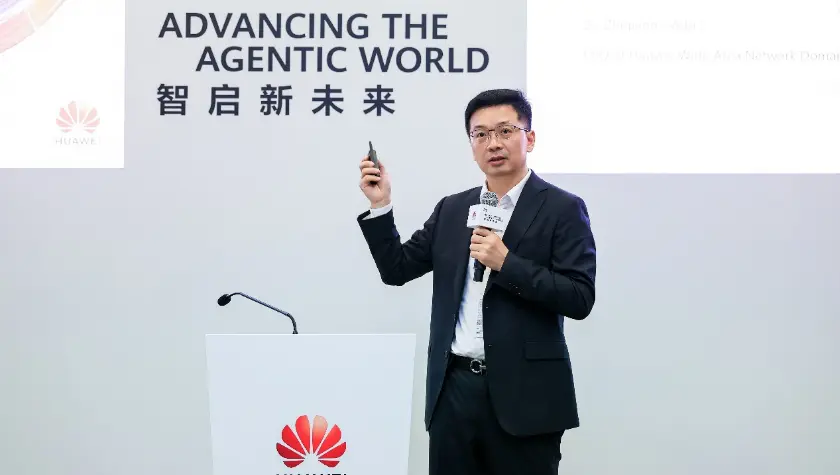
Expanding on the operational hurdles of modern AI, Ado Du, CEO of Huawei’s WAN Domain, delivered a keynote highlighting a profound structural shift in network utilization. Historically, network traffic patterns were designed around human behavior: downloading media, browsing web pages, and executing episodic enterprise queries.
Today, the rapid evolution of agentic AI—autonomous systems capable of reasoning, planning, and executing complex, multi-step tasks across distributed networks—has fundamentally altered this equation. Network connections are shifting rapidly from human-to-machine to machine-to-machine.
Du explained that agentic AI triggers massive uplink traffic as autonomous agents continuously generate, ingest, and exchange vast quantities of real-time data. Consequently, legacy network architectures, which prioritize predictable downlink consumption, are buckling under the weight of continuous, bidirectional data flows. Du stressed that network experience assurance can no longer be evaluated merely at the edge or endpoint; it must span and support entire end-to-end AI workflows.
Supporting Context & Metrics: The GlobalData Perspective
Providing an objective market assessment, Dustin Kehoe, Head of AMEA Tech Research at GlobalData, presented industry data illustrating how the explosive growth of generative and agentic AI is forcing a wholesale modernization of global WAN architecture.
The Anatomy of AI Traffic Volatility
According to GlobalData’s research, AI workloads do not behave like traditional cloud computing or enterprise database traffic. While traditional applications generate relatively stable, predictable data streams, AI training and inference models rely heavily on massively parallel, distributed computing clusters spread across disparate geographic regions.
This layout creates unique operational bottlenecks:

- Unpredictable Micro-Spikes: AI models frequently synchronize parameters across thousands of accelerators simultaneously, resulting in sudden, massive traffic bursts that can easily overwhelm legacy buffers.
- Low Latency Tolerance: Distributed machine learning is acutely sensitive to jitter and packet loss. Even minor microsecond delays can stall GPU clusters, dramatically degrading training efficiency and inflating operational expenditures.
- Massive Bandwidth Demands: The sheer scale of data movement required to feed modern large language models (LLMs) and agentic frameworks demands backbone capacities previously reserved only for core telecommunications inter-exchange carriers.
Kehoe noted that legacy networks lacking intelligent traffic awareness and dynamic routing capabilities suffer from severe congestion, leading to high packet loss rates and inefficient utilization of expensive multi-billion-dollar GPU clusters.
Official Statements and Technological Solutions
To directly counter the architectural limitations outlined by GlobalData and Huawei executives, the conference served as a launchpad for advanced product portfolios and infrastructure blueprints designed to reshape the intelligent WAN landscape.
Huawei’s Stellar AI Integrated Data WAN Solution
Ethan Liu, Vice President of Huawei’s Data Communication Product Line and Head of the Router Team, took to the stage to unveil the company’s flagship response to the crisis: the Stellar AI Integrated Data WAN Solution.
Engineered specifically to underpin enterprise and carrier intelligent transformation, the solution introduces four core technological pillars:
- Intelligent Traffic Awareness: Granular, real-time identification of specific AI application flows, allowing networks to dynamically distinguish between standard web traffic and high-priority AI model synchronization data.
- Predictive Analytics: Utilizing machine learning algorithms embedded within network operating systems to forecast traffic congestions before they occur, automatically rerouting packets to maintain zero-packet-loss environments.
- Flow-Level Scheduling: Advanced queue management and deterministic scheduling capabilities that ensure critical AI workloads maintain consistent, guaranteed latency benchmarks even during peak network utilization.
- Automated Closed-Loop Assurance: Self-healing network loops that detect performance degradation, isolate bottlenecks, and autonomously adjust routing policies without human intervention.
The National Fibre Target Network
Complementing the router and WAN layer innovations, Nick Liu, Vice President of the Enterprise Optical Team, presented a visionary keynote outlining the necessity of a National Fibre Target Network.
Liu argued that software intelligence alone cannot solve physical capacity constraints. He proposed an aggressive acceleration in the adoption of ultra-high-speed optical transmission technologies—specifically 400G and 800G optical lines, combined with advanced All-Optical Cross-Connect (OXC) architectures.
By integrating AI-enabled operations into optical transport layers, nations can build high-capacity "information highways." These optical backbones not only provide the raw bandwidth required for industrial AI deployment, but also lower the per-bit energy consumption of network operations, addressing critical enterprise sustainability goals.
The Blueprint: Intelligent WAN White Paper
The centerpiece of the event’s announcements was the official release of the Intelligent WAN White Paper in AI Era, co-authored by Huawei and GlobalData.
Serving as an authoritative industry guide, the white paper explores macro market trends, operational hurdles, target network architectures, and step-by-step evolution strategies for telecommunications operators worldwide. The document emphasizes that migrating to an intelligent WAN is no longer an optional future upgrade for competitive advantage; it is an urgent structural prerequisite for any organization seeking to capture the economic value of the ongoing AI boom.
Future Outlook: The Road Ahead for Global Connectivity
As HUAWEI CONNECT 2026 concluded, the overarching takeaway for the telecommunications and enterprise tech sectors was unambiguous: the speed of AI innovation is entirely bottlenecked by the capability of underlying network infrastructure.
The transition from human-centric internet usage to autonomous agentic AI ecosystems represents the most significant shift in network traffic dynamics since the birth of commercial broadband. Over the next 24 to 36 months, global network operators and enterprise infrastructure managers will be forced to accelerate their capital expenditure cycles toward intelligent WAN modernization.
Key milestones to watch in the immediate future include:
- Widespread Commercial Adoption of 400G/800G Backbones: Telecom operators globally are expected to fast-track optical infrastructure upgrades to handle the exponential surge in multi-site data center interconnect (DCI) traffic.
- Mainstream Integration of AI-Driven Self-Healing Networks: Reactive network management systems will rapidly phase out, replaced by autonomous, closed-loop systems capable of predicting and neutralizing latency spikes in real-time.
- Regulatory and Industry Standardization: Collaborative frameworks between standards bodies, vendors like Huawei, and market analysts like GlobalData will need to establish unified protocols for quantum-resistant security and cross-domain deterministic quality of service (QoS).
Ultimately, the success of the global intelligent transformation depends on the structural resilience of the WAN. As highlighted in Shanghai, building an intelligent connectivity foundation is the critical bridge turning the theoretical promise of artificial intelligence into reliable, real-world productivity.