Executive Overview
As artificial intelligence platforms become universally accessible, the marginal cost of content creation has plummeted to near zero. Today, any professional, marketer, or enterprise can spin up dozens of short-form content ideas, dense reports, or functional deliverables in mere seconds. Yet, this democratization of output has triggered an unprecedented paradox: while the volume of available information has exploded, its average value has sharply declined.
Because out-of-the-box generative AI relies on generalized training data, its default output tends toward the generic. Audiences, consumers, and corporate decision-makers are increasingly adept at spotting the telltale signs of unrefined AI generation—a realization that rapidly erodes institutional trust and perceived value. In this hyper-saturated digital landscape, standard AI output is no longer a competitive advantage; it is background noise.
To break free from this sea of uniformity, creators and enterprises must fundamentally shift their objective. The goal of leveraging artificial intelligence is no longer merely to do more, but to do better.
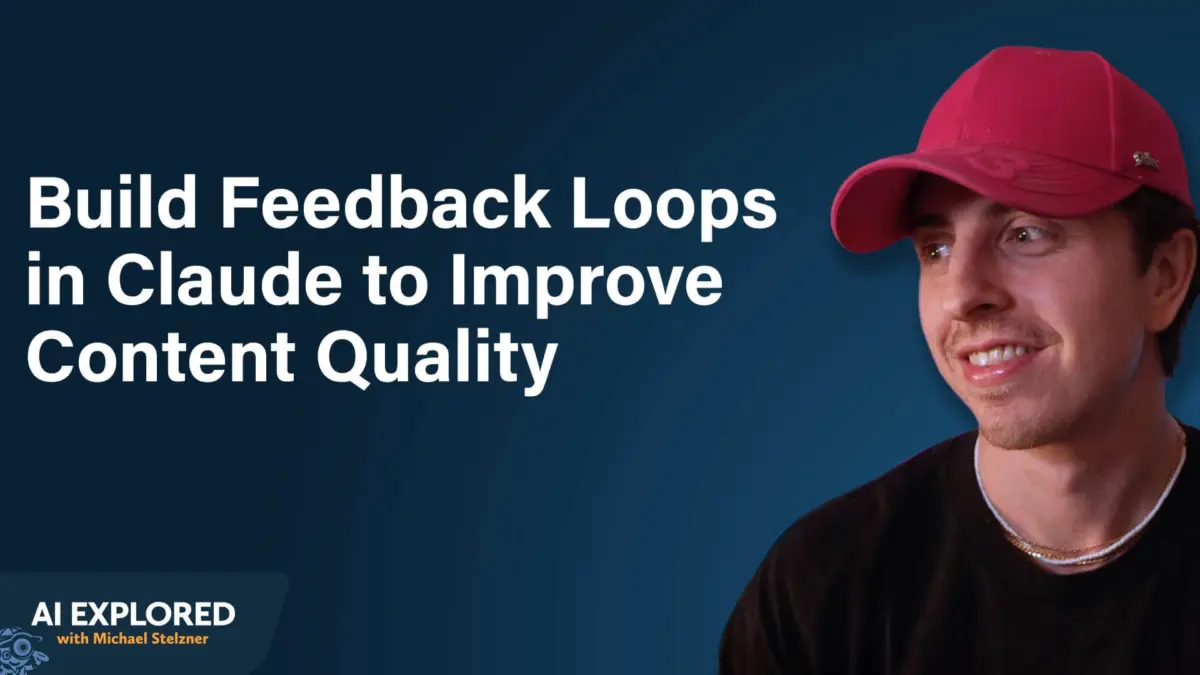
According to insights co-created by digital strategist Austin Marchese and media entrepreneur Michael Stelzner, the solution lies in a structural pivot: replacing slow, traditional human-to-human review cycles with rapid, highly calibrated human-to-AI-clone feedback loops. By establishing custom AI environments, organizing deep contextual knowledge bases, and deploying synthetic internal focus groups built from real-world data, professionals can catch 90% to 100% of critical quality gaps before any external audience ever sees their work. This comprehensive guide explores the multi-layered system required to transform raw generative output into elite, market-differentiating deliverables.
Detailed Chronology: Building the AI Quality Control System
Transitioning an AI workflow from basic prompt engineering to a sophisticated quality control engine requires a disciplined, step-by-step implementation. Industry experts recommend a five-stage architecture that shifts the user from "renting intelligence" to truly owning their intellectual property.
Phase 1: Establishing the Infrastructure—Projects, Knowledge Bases, and Skills
The technical implementation rests upon three distinct, interlocking layers that scale in complexity and capability.
- The Entry Point (Claude Projects): For most professionals, the most accessible entry point is a dedicated project workspace within platforms like Claude. By uploading audience demographics, historical feedback, and communication samples directly into the project’s context window, users create a localized sandbox. Conversations within this space automatically reference the ingested data, serving as a highly effective baseline for customized output.
- The Knowledge Base Architecture: Advanced users operating within local environments or specialized coding interfaces can link their systems directly to local file structures. Drawing from methodologies popularized by AI researcher Andrej Karpathy, this structure is typically divided into two distinct layers:
- Raw Folders: Repositories containing unprocessed, highly granular data such as unedited call transcripts, direct message exports, and raw notes.
- Wiki Folders: Curated repositories holding AI-processed summaries and distilled behavioral preferences.
When a system skill runs, it queries the wiki folder for speed, falling back to the raw data whenever specific quotes, nuances, or granular details are required.
- Data Sovereignty: This local file approach fundamentally alters the user’s relationship with technology. Rather than leasing intelligence from a cloud platform, all context, prompts, and system instructions reside on the user’s local machine. If a user decides to migrate from Claude to an open-source model or an alternative LLM, their entire intellectual property and contextual history travels with them.
- Repeatable Workflows via Skills: In modern AI tooling, a "skill" is a saved, reusable set of instructions that executes a specific task identically every time it is invoked. Instead of manually retyping complex prompts, users package entire workflows into single commands. Crucially, experts advise against writing these skill prompts by hand. By engaging the AI in an interactive interview—or dictating thoughts via voice-to-text tools like Wispr Flow to capture natural nuance—users can command the AI to build its own governing instructions, resulting in dramatically superior operational logic.
Phase 2: Identifying Where Quality Matters (The 80/20 Rule)
Attempting to optimize every single output with a rigorous quality control system is inefficient. High-performance workflows require the application of the Pareto principle: identifying the vital 20% of tasks where elevating an output from "good" to "great" yields 80% of the strategic impact.
For a YouTube creator, this critical friction point might be video packaging—specifically titles and thumbnails. For a corporate middle manager, it could be the weekly executive briefing sent up the leadership chain. For a management consultant, it represents high-stakes client deliverables. Pinpointing this high-leverage vector allows professionals to concentrate their systemic quality efforts where they truly move the needle.
Phase 3: Constructing AI Personas from Empirical Data
The core engine of this quality framework is the synthetic persona. Traditional workflows involve a costly linear sequence: drafting a document, submitting it to a manager or peer, waiting days for feedback, revising, and resubmitting. Each revision cycle quietly signals to stakeholders that the initial effort was subpar.
By building an AI clone of the intended recipient, creators can simulate this feedback loop internally. The output is run past the persona, iterated upon repeatedly, and refined before a real human ever lays eyes on it. However, an AI persona is only as good as its training data. Selecting a subject requires access to a robust historical data set:
- For Audience Personas: Real text-message exchanges, direct critiques of past content, and transcripts of in-person discussions.
- For Management Personas: Email threads, Slack communication logs, historical review notes, and direct performance feedback.
- For Marketers: Social media engagement patterns, comment sections, and direct message histories.
Phase 4: Deploying an Internal AI Focus Group
Rather than relying on a single perspective, advanced practitioners configure an internal AI focus group—a constellation of distinct audience personas that evaluate work concurrently.
For instance, a single content concept might be passed simultaneously through four distinct archetypes: a visionary founder, a technical practitioner, a price-sensitive buyer, and a risk-averse corporate decision-maker. To standardize this process, the focus group can be programmed to output a structured scorecard, rating the deliverable on a scale from 0 to 10 across multiple criteria. This establishes a rigorous, repeatable benchmark that tracks improvement across successive iterations.
Phase 5: Calibration and Iteration
An AI persona is not plug-and-play; it requires calibration through empirical reality testing. When Austin Marchese tested his system for YouTube packaging, he would generate a title, run it through his AI "Darren" persona, and then text the real Darren to compare notes.
If the AI’s critique matched the real human’s reaction, the system was validated. If it diverged, Marchese would screenshot the real-world conversation, feed it back into the project, and prompt the AI: "Based on this conversation, update the Darren skill so you don’t make this mistake again." After five to six iterative cycles, the synthetic clone matched reality so closely that the human feedback loop became obsolete. By structuring each persona as an independent skill within the project, users can modify one archetype without disrupting the rest of the ecosystem.

Supporting Context & Metrics
The quantitative implications of implementing a structured AI quality control system are profound. As the volume of generic AI content accelerates across digital channels, audiences are experiencing widespread fatigue, leading to a measurable decline in engagement for unrefined automated output.
- The Scarcity Premium: Market dynamics dictate that as the cost of generation approaches zero, the economic value shifts entirely to curation, editorial judgment, and systemic refinement. Content that undergoes rigorous multi-layer synthetic critique commands higher attention spans and retention rates.
- Empirical Growth Validation: Practitioners who have adopted the internal focus group methodology report dramatic shifts in performance metrics. For example, implementers utilizing multi-persona feedback loops for content packaging have documented exponential audience growth—scaling subscriber bases up to 10x within months of system deployment—attributing the inflection point directly to the precision of their pre-publication AI review protocols.
- Time-to-Delivery Efficiency: While adding an internal AI review step introduces an iterative phase, it drastically compresses total project lifecycles by eliminating prolonged back-and-forth negotiations with human stakeholders. Catching 90% of structural and tonal errors internally means final human approvals are streamlined into rubber-stamp validations rather than wholesale rewrites.
Official Insights & Expert Perspectives
The methodology detailed above synthesizes advanced workflow automation with media strategy, drawing heavily on the collaborative insights of digital pioneer Michael Stelzner and AI systems architect Austin Marchese.
According to Marchese, the fundamental error most professionals make is treating artificial intelligence as a magic wand rather than an interactive partner. "Everyone using these tools the same way produces the same average result," Marchese notes. The differentiator is not the sophistication of the initial prompt, but the rigor of the subsequent feedback architecture.
Furthermore, industry thought leaders emphasize the psychological shift required to trust synthetic personas. Rather than replacing human critical thinking, AI-driven quality control forces professionals to codify their own standards of excellence. By externalizing the critique process into distinct, data-driven archetypes, creators learn to interrogate their own assumptions, resulting in sharper strategic alignment long before an asset goes live.
Future Outlook
As large language models and multimodal AI architectures continue to evolve, the distinction between human-generated and AI-assisted work will cease to be a binary question of origin; instead, it will be evaluated strictly on the basis of editorial sophistication.
In the near future, we can expect the democratization of these systems to accelerate. Local knowledge base architectures and automated skill generation will likely integrate directly into standard enterprise software suites, moving advanced workflow calibration out of specialized developer circles and into mainstream corporate operations.
However, the core competitive advantage will remain human. The tools can store the data, simulate the personas, and score the deliverables, but the responsibility of defining where quality matters rests entirely with human strategic vision. Those who master the art of building, calibrating, and owning their internal AI feedback loops will dictate the standards of their respective industries, while those who rely on default, out-of-the-box generation will continue to fade into the background noise of an automated world.