Executive Overview
In the high-stakes ecosystem of Software-as-a-Service (SaaS), closing deals is paramount, but how those deals are structured can make or break a company’s long-term valuation. A recurring strategic dilemma for founders, chief revenue officers (CROs), and sales leaders is determining the optimal discounting structure for multi-year contracts paid upfront across two, three, and five-year terms.
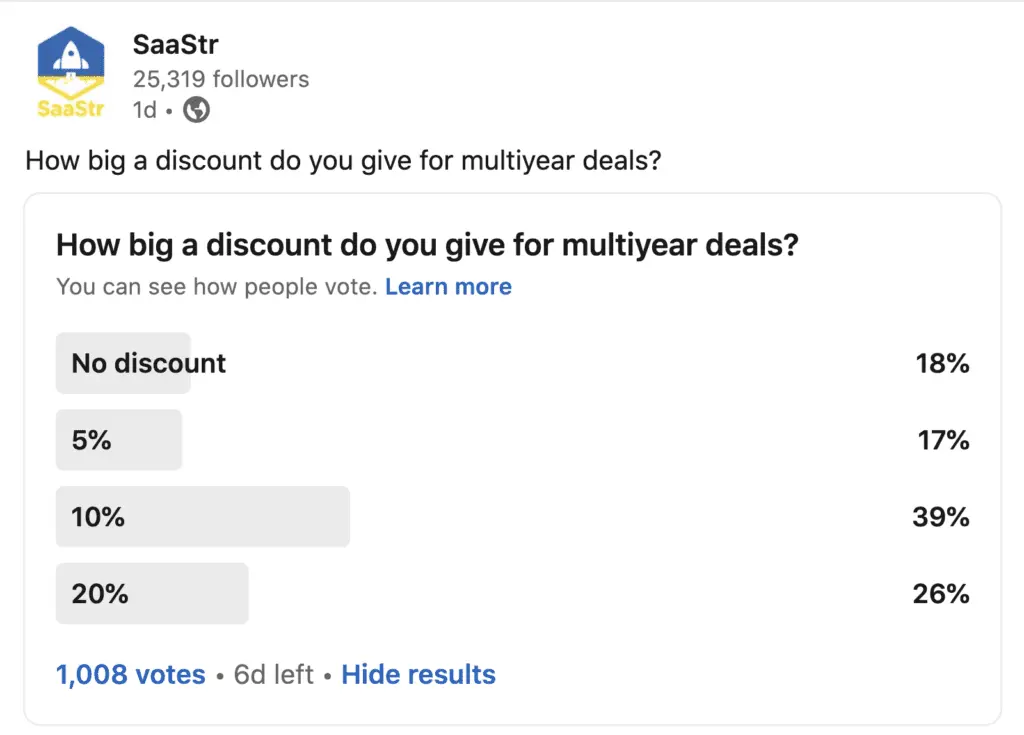
Industry benchmarks reveal that most mature and scaling SaaS organizations gravitate toward an additional 10% to 20% discount for multi-year commitments. However, this standard metric conceals a labyrinth of financial trade-offs. While securing multi-year agreements paid upfront injects vital capital reserves into the business—a significant advantage during early-stage growth or economic uncertainty—it carries hidden perils.
Offering excessive discounts beyond the 20% threshold can severely compromise downstream lifetime value (LTV). If a SaaS company maintains low churn and high net revenue retention (NRR), deep multi-year discounts prematurely lock the business into depressed pricing for future years and potentially for seat expansions added down the road. This investigative analysis explores the mechanics of multi-year SaaS discounting, evaluates the tension between immediate cash liquidity and cumulative revenue compounding, and provides an authoritative framework for balancing growth targets with long-term financial health.
Detailed Chronology: The Evolution of SaaS Contract Structuring
To understand why multi-year upfront contracts are viewed with both reverence and caution today, one must examine how SaaS sales methodologies have evolved over the past two decades.
Phase I: The Era of Land-Grab Growth (Early 2010s)
In the nascent days of the modern cloud economy, the prevailing venture capital mantra was "growth at all costs." SaaS startups were encouraged to acquire market share rapidly. During this period, sales compensation plans heavily rewarded multi-year commitments.
Founders eagerly traded future margin for present cash, often throwing in steep discounts of 25% to 40% for customers willing to pay for three to five years upfront. This influx of non-dilutive capital allowed startups to fund aggressive customer acquisition costs (CAC) and extend their runway without heading back to the venture capital market.
Phase II: The Efficiency Pivot and Retention Focus (Late 2010s to 2020)
As the SaaS market matured, institutional investors shifted their primary metric of evaluation from pure top-line growth to capital efficiency and NRR. Companies realized that discounting heavily on multi-year terms often masked underlying product-market fit issues or elevated churn.
If a product suffered from structural churn, locking a customer in for three years at a steep discount merely delayed the inevitable cancellation while capping the revenue upside. Conversely, companies with low churn realized that discounting future years was mathematically punitive.
Phase III: The Macroeconomic Re-evaluation (Post-2022 to Present)
Following the macroeconomic corrections of recent years, the cost of capital spiked, making cash king once again. SaaS leaders faced a complex balancing act: they needed the predictable cash flow of upfront multi-year deals to hedge against lengthening sales cycles, yet they could not afford to erode their future Annual Recurring Revenue (ARR) base.
Today, sales leadership must use sophisticated revenue modeling to determine when a multi-year discount is a strategic masterstroke and when it represents an expensive surrender of future enterprise value.
Supporting Context & Metrics: The Mathematics of Multi-Year Deals
When evaluating multi-year contracts for 2-year, 3-year, and 5-year terms, revenue architects must weigh several competing financial dynamics. The conversation typically centers on three core structural tiers:
1. The Two-Year Commitment
- Typical Discount Range: 5% to 10% (or flat pricing with locked-in rates against future price increases).
- Strategic Utility: A two-year contract is the lowest-friction multi-year agreement. It bridges the gap between annual budgeting cycles and long-term vendor commitment.
- Financial Impact: Low risk of margin erosion. It effectively shields the vendor from immediate churn while securing two years of predictable usage.
2. The Three-Year Commitment
- Typical Discount Range: 10% to 15%.
- Strategic Utility: The industry standard sweet spot. It provides the customer with a meaningful price break while giving the SaaS provider multi-year stability and predictable cohort data.
- Financial Impact: Requires careful evaluation of pricing power. If the company plans to introduce significant product enhancements or AI capabilities over the next 36 months, a flat 15% discount across the board can cannibalize upsell opportunities.
3. The Five-Year Commitment
- Typical Discount Range: 15% to 20% (rarely exceeding 20% unless tied to enterprise-grade minimum spend commitments).
- Strategic Utility: Typically reserved for massive Fortune 500 enterprise deployments where the logo value and sheer volume justify the margin concession.
- Financial Impact: Highly dangerous for early-stage or rapidly innovating companies. Locking in pricing for half a decade in a dynamic software market exposes the vendor to severe opportunity costs driven by inflation, R&D cost increases, and product evolution.
[Contract Length] ---> [Typical Discount] ---> [Primary Risk Factor]
  - 2-Year          --->   5% - 10%      --->   Minimal margin pressure
  - 3-Year          --->   10% - 15%     --->   Pricing power limitation
  - 5-Year          --->   15% - 20%+    --->   Severe opportunity cost & inflation exposure
The Churn and Retention Factor
The decision to discount multi-year contracts cannot be made in a vacuum; it is fundamentally dependent on a company’s Net Revenue Retention (NRR) profile:
- High Churn / Low NRR Environment: If a company experiences high annual customer churn, aggressive multi-year discounts paid upfront are financially rational. Securing the cash immediately prevents the loss of revenue that would have occurred when the customer churned out at month 12.
- Net Negative Churn / High NRR Environment: If a company enjoys net negative churn—meaning existing customers expand their spending over time faster than revenue is lost to churn—heavy multi-year discounts are counterproductive. Bet on your application and your ability to cross-sell. By locking in a discount, you restrict your capacity to naturally expand accounts through seat additions, tier upgrades, and feature module adoption.
Official Perspectives and Expert Insights
Industry luminaries and SaaS operational veterans consistently caution against the uncalculated pursuit of upfront multi-year cash.
David Skok, veteran SaaS investor and entrepreneur, has long emphasized that discounts are effectively a loan taken against future revenue—often carrying an exorbitant interest rate when factoring in compounding growth.
Similarly, Jason Lemkin, founder of SaaStr, highlights the insidious nature of downstream discounting creep:
"Once you go past 20% or so, you are giving up a material amount of downstream revenue in Years 2–10, if your churn rate is low. You’re locking yourself into a decade of discounts not just for the users you close today, but also the ones you add later."
This systemic risk—whereby the initial multi-year discount inadvertently sets a precedent or contractual obligation for future expansions and add-on seats—is a trap that catches many mid-market and enterprise sales teams off guard. Sales reps, incentivized by short-term commissions, routinely trade away multi-year pricing power without realizing that expansion seats added in Year 2 will inherit the same discounted baseline.
Furthermore, chief financial officers (CFOs) point out that deferred revenue recognition under modern accounting standards (such as ASC 606) means that receiving five years of cash upfront does not translate to immediate, recognized revenue on the income statement. It sits on the balance sheet as deferred revenue liability, meaning the cash must be carefully managed to fund operations over the entire delivery period without causing a false sense of profitability.
Future Outlook: Strategic Alternatives to Deep Disounting
As the SaaS landscape continues to evolve, forward-thinking revenue leaders are moving away from blunt-instrument percentage discounts in favor of more sophisticated contract structuring techniques. To protect long-term valuation while still providing appealing incentives for multi-year commitments, companies are adopting the following methodologies:
1. Value-Add Bundling Over Price Cuts
Instead of slashing the annual subscription price by 15%, successful SaaS vendors are maintaining list prices while bundling premium features, dedicated customer success support, or professional onboarding services into the multi-year package. This preserves the integrity of the core software’s pricing anchor while delivering tangible financial value to the buyer.
2. Escalating Pricing Models
For multi-year contracts, smart sales teams implement structured price escalators (e.g., standard pricing in Year 1, with a contractually agreed 5% to 7% price adjustment in Years 2 and 3 to account for inflation and platform enhancements). This counteracts the erosive effect of flat multi-year discounts.
3. Consumption and Minimum Commitment Hybrid Structures
Blending fixed platform fees with variable consumption metrics allows companies to secure long-term commitments without boxing themselves into rigid discount tiers. If a client expands usage dramatically over a three-year period, the vendor captures upside without being restricted by legacy seat discounts.
4. Milestone-Based Flexibility
For five-year enterprise agreements, tying pricing reviews to specific milestones—such as feature adoption benchmarks or verified corporate growth—ensures that the partnership remains mutually beneficial as both businesses scale.
Conclusion
Maximizing the value of multi-year contracts requires a delicate equilibrium between immediate liquidity and long-term enterprise valuation. While an additional 10% to 20% discount remains the industry norm for locking in multi-year upfront payments, SaaS leaders must scrutinize their underlying retention metrics before putting pen to paper.
If your organization boasts net negative churn and exceptional product-market fit, resist the temptation of deep, multi-year lock-ins. Bet on the compounding power of your software. By maintaining pricing discipline, avoiding the trap of discounting future expansion seats, and exploring non-price-cutting incentives, SaaS companies can secure healthy cash flow today without sacrificing the multi-million-dollar revenue streams of tomorrow.