Executive Overview
The landscape of software development tooling has experienced a profound shift over the past decade, yet the core mechanics of how developers interact with version control systems have remained surprisingly static. While terminal purists continue to rely on raw Command Line Interface (CLI) commands, and others utilize traditional graphical user interfaces (GUIs) like GitKraken, SmartGit, or GitHub Desktop for visual diffs and interactive rebasing, a distinct gap has persisted. Existing GUI clients largely treat artificial intelligence as an afterthought—typically manifested as a simple text-generation button designed to draft a commit message based on staged changes.
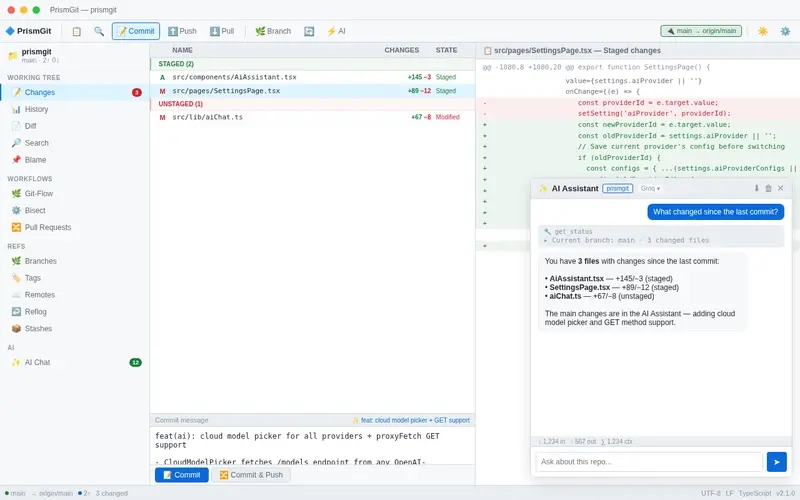
Recognizing this limitation, developer and open-source contributor mirocow set out to redefine what a desktop version control client could achieve. The result of this endeavor is PrismGit, a modern, cross-platform, open-source Git client built from the ground up to feature deep, autonomous AI integration. Rather than operating as a passive chatbot bolted onto a standard interface, PrismGit functions as an active AI pair programmer. It possesses the capability to inspect repository status, analyze code diffs, comprehend local project context, and autonomously execute complex version control operations on behalf of the developer.
Built using an elite stack of contemporary web and desktop technologies—including Electron 32, React 18, Vite 5, TypeScript 5.6, and Zustand—PrismGit bridges the divide between graphical convenience and autonomous agent workflows. Featuring support for 12 distinct Large Language Model (LLM) providers (spanning privacy-first local instances via Ollama and LM Studio to high-performance cloud APIs like Anthropic, OpenAI, Google Gemini, and Groq), the client introduces a recursive function-calling loop equipped with over 24 specialized Git tools. Distributed under the permissive MIT License and fortified by an exhaustive testing suite powered by Vitest and Playwright, PrismGit represents a bold glimpse into the future of developer tooling.
Detailed Chronology: From Concept to Cross-Platform Reality
Identifying the Pain Point in Modern Git GUIs
The journey of PrismGit began not as a grand enterprise initiative, but out of daily developer friction. While reviewing pull requests and managing multi-branch workflows, the project’s creator observed that existing GUI clients suffered from a lack of environmental awareness. A traditional Git client can show you what changed, but it cannot reason about why those changes were made, nor can it intelligently chain multiple Git operations together to resolve a multi-step user request.
The initial phase of development focused on defining the core architecture. Building a desktop application that handles heavy git workloads without locking up the user interface requires rigorous process isolation. PrismGit adopted a strict multi-process architecture:
- The Main Process (Node.js): Handles secure system-level operations, executes underlying Git CLI wrappers, and manages secure communication channels.
- The Renderer Process (React + Vite + TypeScript): Powers a lightning-fast, reactive user interface managed by Zustand for predictable state management.
- The AI Broker Layer: Intermediates between the local application context and external or internal LLM inference engines, ensuring that tool schemas and system prompts are accurately formatted and securely dispatched.
Designing the AI Agent Tool-Use Loop
The defining architectural breakthrough of PrismGit v2.1 and later is its multi-model AI assistant framework, centered around an advanced Function Calling / Tool-Use Loop.
Unlike naive wrappers that simply pipe text into an API and paste the response back into a text box, PrismGit provides the connected LLM with a comprehensive schema of 24+ specialized Git-specific tools. These tools grant the agent granular programmatic capabilities—ranging from checking status and reading diffs to stashing changes, creating branches, executing git blame, and staging files selectively.

When a developer issues a natural language prompt—such as "Examine my recent styling modifications, figure out which files are impacted, run a quick sanity check on the diff, and commit them using our standard semantic commit format"—the system initiates a recursive execution cycle:
- Context Gathering: The AI agent receives the user prompt alongside structured metadata about the current repository state.
- Tool Selection: The LLM evaluates which Git tool is required first (e.g., calling a tool to inspect the working tree or retrieve a diff).
- Execution & Feedback: The application executes the requested tool locally, captures the output (e.g., standard output, error logs, or file diff strings), and feeds that data back into the LLM context window.
- Recursive Refinement: The agent analyzes the tool output, determines if further actions are necessary (such as staging specific files based on the diff analysis), and executes subsequent tools until the task is successfully completed or requires human intervention.
This closed-loop feedback mechanism transforms the AI from a static text generator into an active, autonomous participant in the software development lifecycle.
Solving the Build and Distribution Challenge
Deploying cross-platform Electron applications is notoriously difficult due to the complexities of native Node.js module compilation (node-gyp). Native dependencies compiled on a macOS development machine will invariably fail when executed on Windows or Linux targets if not built within tightly controlled environments.
To achieve deterministic, reproducible builds without polluting host development machines, PrismGit implemented a containerized build pipeline. The project coordinates decoupled Docker containers via a unified Makefile. For seamless Windows binary generation on non-Windows host machines, the pipeline leverages advanced Wine configurations within the containerized environment. This ensures that every release—whether targeting Windows, macOS, or Linux—is compiled under identical, pristine conditions.
Supporting Context & Metrics
To understand the engineering rigor behind PrismGit, it is helpful to examine the quantitative and architectural specifications that govern the project:
| Metric / Specification | Detail |
|---|---|
| Core Framework | Electron 32 (Cross-platform desktop runtime) |
| Frontend Ecosystem | React 18, Vite 5, TypeScript 5.6, Zustand (State Management) |
| Supported LLM Providers | 12+ Providers (Local: Ollama, LM Studio; Cloud: Groq, Gemini, Anthropic, OpenAI) |
| AI Toolset Capacity | 24+ specialized Git-interaction functions (Diff parsing, staging, branching, merging) |
| Localization | 100% localization parity across 4 initial languages |
| Testing Pipeline | Fully integrated Vitest (unit/integration) and Playwright (end-to-end GUI) suites |
| Licensing | Open-source under the permissive MIT License |
| Build Infrastructure | Containerized Docker workflows managed via unified Makefiles |
Privacy and Local-First Capabilities
A critical concern for enterprise developers and open-source contributors alike is code privacy. Sending proprietary source code or sensitive internal diffs to third-party cloud endpoints is often strictly prohibited by corporate compliance policies.
PrismGit addresses this head-on by supporting fully local LLM execution environments. By integrating seamlessly with tools like Ollama and LM Studio, developers can run powerful open-weights models (such as Llama 3, Mistral, or Qwen) locally on their own hardware. This guarantees that repository data, commit histories, and code diffs never leave the developer’s local machine, satisfying the most stringent security and privacy requirements while still delivering cutting-edge AI agent capabilities.

Official Statements and Developer Insights
In technical discussions surrounding the release of PrismGit, the project’s creator, mirocow, emphasized the philosophical motivation driving the project:
"As developers, we interact with Git every single day. While terminal wizards swear by CLI, many of us prefer visual clients for complex operations like interactive rebasing or 3-pane conflict resolution. But I felt something was missing in modern Git clients: deep, autonomous AI integration. I didn’t just want another ‘AI commit message generator button’. I wanted an actual AI pair programmer that could look at my repository status, run diffs, understand the local context, and execute actions on my behalf when asked."
The emphasis on moving beyond superficial AI implementations reflects a broader industry maturation. The initial wave of generative AI tools focused heavily on text completion and basic chat interfaces. The second wave—exemplified by PrismGit’s tool-use loop—focuses on agency, execution, and contextual reasoning.
Furthermore, community feedback on platforms like GitHub and developer forums has highlighted acute interest in how PrismGit handles heavy diff parsing. Parsing multi-megabyte diff files in a JavaScript/TypeScript environment without dropping UI frames requires careful optimization. The project utilizes streaming parsers and Web Worker offloading (where applicable) to ensure that even massive repositories with thousands of changed lines render smoothly within the React-powered interface.
Future Outlook
As PrismGit continues to mature under its open-source MIT license, the roadmap ahead points toward even deeper integration between local development environments and autonomous AI agents.
Upcoming Milestones and Community Contributions
- Expanded Toolsets: Future updates aim to expand the AI tool schema beyond 24 functions, introducing capabilities for automated conflict resolution, intelligent merge-conflict navigation, and predictive branch cleanup.
- Enhanced Local Model Support: As lightweight coding models continue to improve in performance and efficiency, the client will introduce optimized prompt templates specifically tailored for smaller local models running on consumer hardware.
- Plugin Architecture: Plans are underway to establish a modular plugin system, enabling the community to contribute custom Git tools and domain-specific agent behaviors.
- Community Collaboration: The project actively invites developers, UX designers, and AI engineers to contribute via its GitHub repository (
https://github.com/Mirocow/prismgit). Discussions regarding diff optimization strategies, state management patterns in Zustand, and cross-platform native compilation remain open to the public.
Conclusion
PrismGit represents a significant evolution in desktop version control clients. By successfully marrying the high-performance UI standards of modern web technology (Electron, React, Vite, TypeScript) with the advanced capabilities of autonomous LLM agent loops, it proves that developer tools can be both visually intuitive and intellectually empowered. For developers seeking to elevate their version control workflow while maintaining absolute control over their data privacy, PrismGit offers a compelling, open-source path forward.