Executive Overview
The web platform is undergoing a profound structural evolution. As browser engines converge on advanced layout capabilities, performance optimizations, and developer ergonomics, the boundary between JavaScript-driven abstractions and native HTML/CSS implementations continues to blur.
In this edition of our deep-dive analysis into the modern web ecosystem, we examine a sweeping wave of new primitives, proposed specifications, and API enhancements that are reshaping frontend development.
From native progressive enhancement patterns for tooltips to the experimental introduction of the <geolocation> HTML element, the frontend landscape is prioritizing developer-centric primitives over heavy client-side scripting.
Key developments include:
- Interest Invokers: Pioneering modern tooltip and hover interactions via explicit CSS timing controls (
interest-delay-startandinterest-delay-end). - The
<geolocation>Element: Bridging the gap between complex hardware-level permissions and declarative markup. - MicroLighter and the Custom Highlight API: Eliminating traditional DOM-heavy syntax highlighters in favor of paint-time text styling.
- Grid Coordinate Extraction: Unlocking sophisticated reactive layouts by mapping CSS Grid metrics directly to CSS custom properties.
- Next-Generation Selectors and Functions: Evaluating the proposed Class Prefix Selector (
.something-*) and the precision feature-detection capabilities of@supports (named-feature()).
This report provides a comprehensive breakdown of these advancements, analyzing their architectural implications, current browser compatibility matrices, and strategic value for enterprise web applications.
Detailed Chronology: Breakthroughs in Layout, Interactivity, and APIs
1. Advanced Interaction Design: Instant Tooltips via Interest Invokers
For decades, developers building custom tooltips faced a frustrating architectural dilemma: if a tooltip appeared instantaneously upon mouseover, the user interface felt erratic and visually cluttered. However, adding an arbitrary JavaScript-based delay often resulted in sluggish, disconnected experiences. Furthermore, moving the mouse away from the trigger element could leave orphaned tooltips active if the hoverable hit-test region was improperly calibrated.
Abhishek Jakhar tackled this UX friction point by establishing a golden rule for interaction design: tooltips should feature an initial entry delay, followed by an instantaneous exit once dismissed.
Responding directly to these findings, Chris Coyier demonstrated a modern, standards-track implementation leveraging interest invokers. Powered by two newly introduced CSS properties—interest-delay-start and interest-delay-end—this native paradigm shifts the burden of state management from custom JavaScript event listeners to the browser engine itself.
While browser support is currently limited to Chromium-based environments, the architecture embraces progressive enhancement, ensuring graceful degradation for legacy user agents.
2. Streamlining Native APIs: The <geolocation> HTML Element
Managing geographical location data within web applications has historically been fraught with friction. The traditional JavaScript Geolocation API requires orchestrating asynchronous hardware calls across GPS satellites, Wi-Fi triangulation, and cellular network towers. Worse still, altering user permission states after an initial rejection often required navigating convoluted browser settings menus.
To alleviate this, the web platform has introduced the experimental <geolocation> HTML element. By moving permission handling and data retrieval into a declarative HTML context, developers can streamline geolocation workflows.
However, this transition introduces specific constraints, notably strict styling restrictions governing how the element interacts with the surrounding DOM.
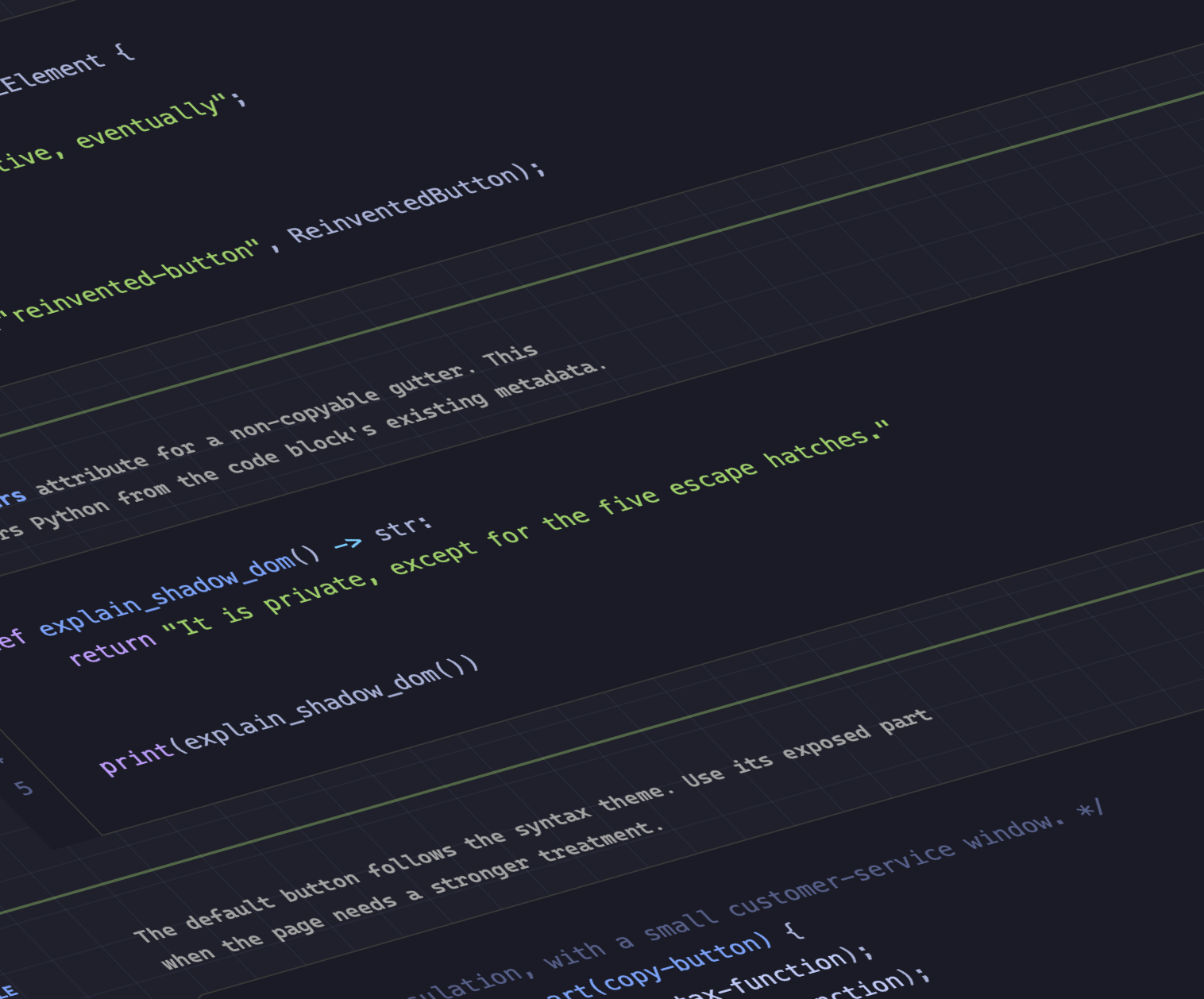
Because adoption is currently constrained to Chrome, developers must implement hybrid strategies—pairing the <geolocation> element with legacy JavaScript Geolocation API fallbacks to ensure robust, production-ready progressive enhancement today.
<!-- Conceptual hybrid implementation for progressive geolocation enhancement -->
<geolocation id="user-location">
  <template>
    <button type="button">Access Location Services</button>
  </template>
</geolocation>
3. High-Performance Text Styling: MicroLighter and the Custom Highlight API
Syntax highlighting has traditionally relied on heavy DOM manipulation, where parsers split code blocks into hundreds of individual <span> elements injected with color-specific classes. This approach bloomed memory footprints and degraded rendering performance on large documents.
Dave Rupert upended this paradigm with MicroLighter, a lightweight syntax highlighter built upon the native CSS Custom Highlight API.
Rather than mutating the underlying DOM tree, the Custom Highlight API allows developers to programmatically define ranges in text nodes and style them directly via CSS pseudo-elements like ::highlight().
Supported by Geoff and the broader CSS-Tricks community, MicroLighter demonstrates how modern CSS can completely replace heavy runtime libraries, delivering lightning-fast syntax styling with zero structural DOM overhead.
4. Bridging Layout and Variables: Extracting CSS Grid Metrics
One of the most persistent limitations of CSS custom properties (variables) has been their inability to introspect runtime layout geometries. Developers frequently needed JavaScript frameworks (such as ResizeObserver implementations) simply to read the number of active columns or rows in a dynamic CSS Grid container.
Temani Afif shattered this barrier by demonstrating a methodology for piping CSS Grid structural information directly into CSS custom properties. By evaluating grid tracks and cell positions natively, developers can determine precise $X$ and $Y$ indices for individual grid cells.
While currently restricted to grids featuring equal column widths, this technique unlocks remarkable downstream possibilities—such as calculating hover proximity entirely via CSS. By knowing a cell’s coordinates relative to the pointer, interfaces can dynamically scale, fade, or animate adjacent elements without a single line of JavaScript calculation.
5. Ergonomics and Selector Architecture: The Class Prefix Selector
CSS selectors have long lacked a native, performant mechanism for targeting families of classes sharing a common namespace without resorting to clumsy attribute selectors.
Bramus recently introduced the proposal for the class prefix selector, a syntax designed to drastically simplify scoped and utility-driven CSS architectures:
/* Proposed Class Prefix Selector syntax */
.something-*
  /* Applies styles to any class beginning with 'something-' */
This syntax offers massive performance and readability improvements over traditional attribute matching:
/* Legacy Attribute Selector Approach (Performance Heavy) */
[class^="something-"]
  /* Matches class="something-xxx" */


[class*=" something-"]
  /* Matches class="xxx something-xxx" */


[class*="something-"]
  /* Matches class="my-something-xxx" */
Although unsupported in production environments at the time of writing, the community response—highlighted extensively by Geoff—suggests high developer demand, pointing toward a rapid standardization path.
6. Precise Feature Detection: The @supports (named-feature()) Function
Feature detection in CSS has traditionally been limited to property-value pairs (e.g., @supports (display: flex)). However, browser vendors frequently ship partial implementations, bug fixes, or behavioral adjustments that cannot be detected via basic property validation.
Expanding on his architectural contributions, Bramus introduced the @supports named-feature() function. Currently supported in Chrome, this capability permits granular queries against specific browser engine behaviors—such as verifying whether an implementation respects CSS transforms when executing anchor positioning. This elevates the @supports rule from a crude property checker to a surgical diagnostic tool.
7. Balancing Multi-Row Layouts: flex-wrap: balance
Building upon the success of text-wrap: balance in typography, the web platform is introducing flex-wrap: balance to layout engineering.
Ahmad Shadeed analyzed this new Chromium feature, which automatically distributes flex items evenly across multiple rows or columns.
Instead of leaving an awkward final row with a single orphaned item, flex-wrap: balance calculates the optimal distribution of flex containers, ensuring visually harmonious layouts across responsive viewports.
Supporting Context & Metrics
To contextualize these updates within the broader frontend ecosystem, we must examine how browser vendors and developer communities are shifting priorities.
| Feature / API | Primary Engine Support | Performance Impact | Architectural Paradigm Shift |
|---|---|---|---|
Interest Invokers (interest-delay) |
Chromium (Experimental) | High (Native State Management) | Replaces custom JS timer loops with declarative hover delays. |
<geolocation> Element |
Chromium (Experimental) | Medium (Declarative DOM) | Moves permission boundaries from async JS to native markup. |
| MicroLighter / Highlight API | Modern Evergreen Browsers | Maximum (Zero DOM Mutex) | Eliminates DOM node inflation for syntax coloring. |
| Grid Metric Custom Properties | Modern Evergreen Browsers | High (Layout-Driven Variables) | Bypasses ResizeObserver loops for coordinate tracking. |
Class Prefix Selector (.something-*) |
Proposed / None | High (Selector Engine Optimization) | Replaces brittle attribute selectors with native syntax matching. |
@supports (named-feature()) |
Chromium | High (Diagnostic Precision) | Enables runtime queries of specific browser behaviors. |
flex-wrap: balance |
Chromium (Experimental) | Medium (Layout Flow) | Automatically normalizes row/column item distribution. |
The metrics indicate a decisive industry trend: native browser engines are absorbing features that previously required third-party packages. By shifting computational logic from JavaScript runtimes directly into the rendering engine, modern web applications are achieving superior execution speeds, lower memory footprints, and vastly simplified codebases.
Official Statements & Community Perspectives
The discourse surrounding these web platform updates highlights a healthy tension between rapid innovation and standardization consensus.
- On State Management & Dark Mode: The community remains divided on interface toggles. While Lea Verou advocates for traditional two-state dark mode toggles, Bramus makes a compelling case for tri-state controls (Light, Dark, and System). Meanwhile, Vale.Rocks champions an "auto-until-overridden" two-state approach, balancing user autonomy with seamless OS synchronization.
- On Native HTML Enhancements: Commenting on the integration of hardware-backed elements like
<geolocation>, standards bodies emphasize that declarative HTML must remain resilient against progressive enhancement failures. As Piccalilli notes, wrapping native elements in robust fallback layers ensures that non-supporting browsers remain fully functional. - On Layout Intelligence: Discussing features like
flex-wrap: balanceand Grid variable extraction, design systems engineers have noted that the era of manual flexbox balancing and complex JavaScript grid calculators is coming to an end. The browser is rapidly learning how to design with the developer.
Future Outlook
As we transition into the autumn development cycle, the trajectory of CSS and HTML standards is clearer than ever.
We are moving away from monolithic UI frameworks acting as the sole arbiters of application state and layout, and returning to a robust, standards-first platform capable of sophisticated computation natively.
Developers should prepare for the widespread rollout of Interest Invokers, Custom Highlight utilities, and advanced support queries by auditing existing third-party dependencies.
By leaning into progressive enhancement patterns—utilizing modern features where available while maintaining bulletproof fallbacks—engineering teams can build resilient, high-performance web applications that stand at the absolute cutting edge of platform capability.