Executive Overview
In the high-stakes, hyper-fast ecosystem of decentralized prediction markets, the pursuit of algorithmic perfection is a siren song. Developers and quantitative traders frequently fall into the trap of architectural bloat, assuming that more indicators, deeper confirmation layers, and more intricate risk engines automatically translate to a sustainable trading edge.
However, a recent engineering case study shared by developer Benjam1nCup upends this conventional wisdom. After spending weeks architecting a sophisticated Polymarket TWAP (Time-Weighted Average Price) End-Cycle Sniper bot designed for short-duration crypto markets, the creator made a counterintuitive discovery: stripping away complexity yielded significantly clearer trading signals and more reliable execution.
By pivoting away from frantic position management and continuous mid-trade micro-adjustments, the revised trading system anchors its philosophy on a singular maxim: Complexity is not the same as edge.
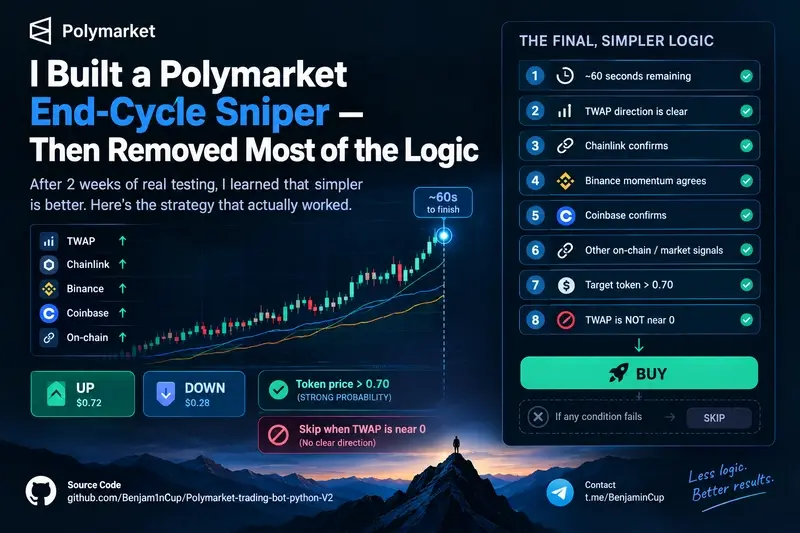
Rather than attempting to forecast volatile asset movements far in advance, the bot operates with sniper-like precision precisely 60 seconds before market expiration. By evaluating directional agreement across multiple independent data feeds—including Chainlink, Binance, Coinbase, and on-chain metrics—alongside strict token pricing and TWAP filters, the system embraces the radical notion that "no signal is also a signal."
While real-market testing over a two-week sample revealed a staggering 95% observed hit rate, the project serves as a compelling masterclass in algorithmic restraint, risk relocation, and the empirical validation necessary to survive in automated prediction market trading.
Detailed Chronology: The Evolution of a Trading Bot
The development of the Polymarket TWAP End-Cycle Sniper followed a trajectory familiar to many algorithmic builders. It began with an ambitious scope and evolved through rigorous, real-world friction.
Phase 1: Over-Engineering and Architectural Bloat
When the project commenced, the prevailing assumption was that sophistication equated to profitability. The initial iteration of the bot featured:
- Multiple overlapping entry strategies designed to catch early momentum shifts.
- Complex, multi-tiered confirmation layers relying on fragmented short-term metrics.
- An overly sensitive risk engine programmed to react to every micro-fluctuation during the lifecycle of a short-duration (e.g., 5-minute or 15-minute) market.
On paper, the system looked like an institutional-grade piece of financial engineering. In practice, it was an opaque black box. Every added rule compounded the diagnostic burden, forcing the developer to constantly question whether a specific condition was genuinely contributing to market alpha or merely increasing code complexity and vulnerability to latency.
Phase 2: The Two-Week Real-Market Stress Test
Deploying code to a live, adversarial market environment has a way of cutting through theoretical assumptions. After approximately two weeks of live-market testing against Polymarket’s fast-paced crypto settlement cycles, patterns began to emerge. The intricate risk management rules—designed to "rescue" struggling positions—were frequently generating unnecessary anxiety and counterproductive exits.
The developer recognized a fundamental flaw in the approach: constantly trying to manage risk during a trade often masked a poorly defined entry thesis. The core question needed to shift from "How can I rescue this position mid-stream?" to "Is this position exceptionally robust before it is even opened?"

Phase 3: The Purge and the Birth of the Simple Sniper
Driven by empirical observations, the developer initiated a systematic purge. Code modules, speculative entry layers, and reactive risk triggers were stripped away one by one.
What remained was not a sprawling, multi-strategy monolith, but a lean, deterministic decision engine focused on a single, high-conviction moment: the final minute before contract settlement. By shifting the heavy lifting entirely to the entry layer, the bot’s architecture transformed from a reactive hazard-management tool into a selective, late-cycle sniper rifle.
Supporting Context & Metrics: Anatomy of the Core Signal
To understand why the simplified bot achieved such stark improvements in signal clarity, one must examine the mechanics of short-duration Polymarket contracts and how the revised strategy processes external data.
The 60-Second Window
Short-duration crypto markets on prediction platforms are notoriously noisy. Trying to predict directional outcomes minutes ahead of expiration exposes a trader to sudden spot-price whipsaws and liquidity gaps.
The sniper strategy bypasses this noise by idling until roughly 60 seconds before market expiration. By this juncture, market momentum has matured, and the statistical path toward settlement has largely crystallized. The objective is no longer crystal-ball forecasting; it is structural confirmation.
Multi-Source Signal Convergence
The strategy relies on absolute consensus. When evaluating an "UP" position, the bot looks for unanimous agreement across a matrix of independent data pipelines:
- TWAP Direction: Confirms that the time-weighted average price supports an upward trajectory, mitigating the risk of reacting to a fleeting spot-price spike.
- Chainlink Oracles: Validates institutional-grade price feeds utilized heavily in decentralized finance settlements.
- CEX Momentum (Binance & Coinbase): Assesses broader centralized exchange order book pressure and volume trends.
- On-Chain Data: Incorporates broader blockchain analytics and activity indicators.
When all these disparate sources point in the exact same direction, the probability of a false signal drops precipitously.
The TWAP Zero-Filter
One of the most vital architectural safeguards implemented during testing was the TWAP Zero-Filter. If the time-weighted average price movement is hovering too close to zero, the market lacks definitive directional bias.
In such scenarios, even if external exchange momentum appears slightly bullish or bearish, the bot is hardcoded to skip the market. This operationalizes a core philosophical tenet of the system: No signal is also a signal. A true sniper does not force shots in low-visibility conditions.
The $0.70 Token Price Threshold
To ensure the bot is riding established momentum rather than engaging in speculative lottery tickets, the system incorporates a strict pricing filter on the outcome tokens.

For an "UP" entry, the target outcome token must generally be trading above $0.70 (e.g., UP at $0.72, DOWN at $0.28). This condition confirms that the broader market is already pricing the outcome as highly probable. The strategy explicitly avoids buying cheap, distressed tokens in hopes of a miracle reversal; instead, it pays a premium for high-probability, late-cycle confirmation.
Official Insights & Developer Philosophy
In technical post-mortems and documentation accompanying the open-source release of Polymarket Trading Bot Python V2, Benjam1nCup emphasized that the journey offered profound lessons extending far beyond prediction markets.
"When building trading systems, it is easy to confuse more conditions with a better strategy. They’re not the same thing. A complicated strategy can look impressive while being extremely difficult to validate. A simple strategy with a clear hypothesis is much easier to reason about, test, and refine."
By shifting risk management upstream—baking the risk assessment directly into the multi-signal entry criteria—the developer eliminated the psychological and computational drag of mid-trade intervention.
Furthermore, the public GitHub repository (Benjam1nCup/Polymarket-trading-bot-python-V2) was released not as a turnkey, get-rich-quick production script, but as an educational and research-oriented framework. It provides developers with modular building blocks for high-performance automated trading on 5-minute and 15-minute crypto markets, complete with architecture diagrams, data-ingestion pipelines, and dashboard interfaces.
Future Outlook: Statistical Rigor and Scalability
While the observed hit rate of 95% during the initial two-week testing window is undeniably eye-catching, both the developer and prudent quantitative analysts treat the metric with extreme caution.
Two weeks of live execution represents a micro-sample in the grand scheme of market microstructure. Market regimes shift; volatility spikes, liquidity profiles evolve, and macroeconomic events can instantly invalidate short-term statistical anomalies.
The Road Ahead: Comprehensive Stress-Testing
To transition the strategy from an intriguing experimental build to a battle-tested production system, the next phase of development requires processing thousands of market cycles. The developer has outlined a rigorous statistical tracking matrix designed to measure long-term viability across several critical dimensions:
- Execution Metrics: Total opportunities scanned vs. actual entries executed vs. opportunities intentionally skipped.
- Financial Performance: Average entry prices, average payouts, expected value per trade, and maximum consecutive losing streaks.
- Environmental Variables: Performance sliced across different underlying crypto assets, varying volatility regimes, precise remaining-time brackets, and specific token-price thresholds.
The ultimate question guiding the project is no longer "Did this work for a fortnight?" but rather: "Does a genuine statistical edge survive across tens of thousands of market iterations?"
Conclusion
The Polymarket TWAP End-Cycle Sniper project serves as a timely reminder to the algorithmic trading community. In an industry enamored with machine learning black boxes, complex indicator combinations, and endless micro-optimizations, ultimate clarity is often found through subtraction. By respecting the power of data convergence, honoring the validity of sitting on the sidelines, and ruthlessly trimming code bloat, developers can build systems that are not only easier to maintain—but fundamentally more honest about where their edge truly lies.