Executive Overview
Search engine optimization (SEO) has evolved far beyond simple keyword placement and backlink building. Today, technical infrastructure dictates how search engine crawlers interpret, index, and serve web content. Among the most critical components of this technical architecture are the rel="canonical" tag and hreflang attributes. These directives act as the foundational roadmap for search engine bots, preventing duplicate content penalties and ensuring that international users are directed to the correct regional variants of a website.
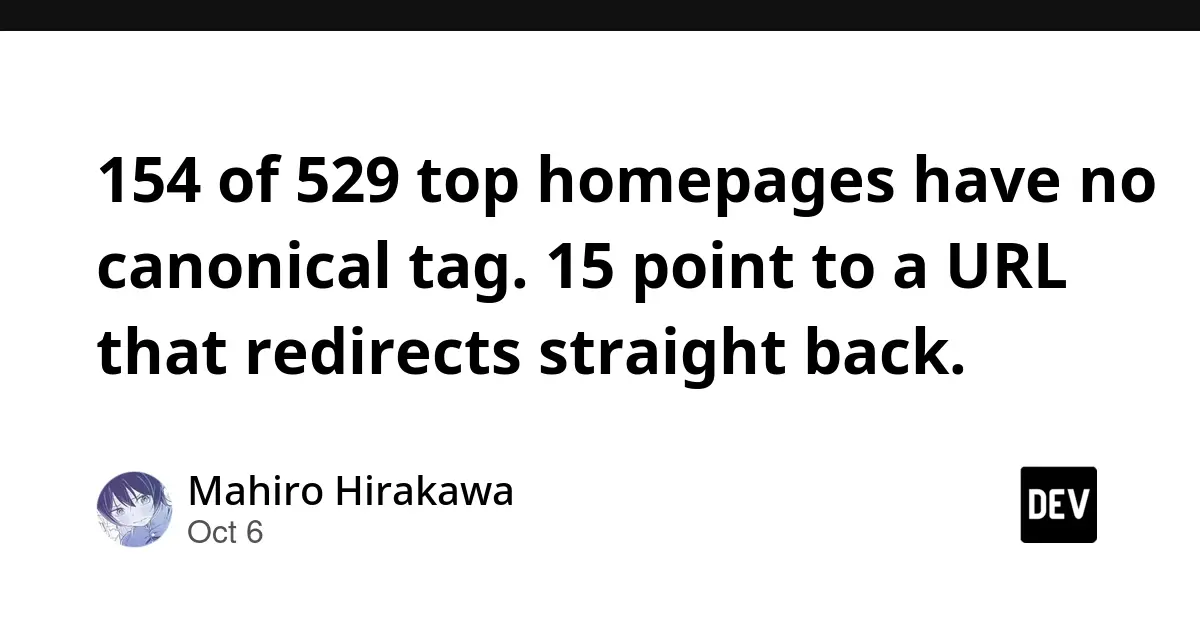
However, a recent comprehensive technical audit of the Tranco top 1,000 homepages reveals a startling reality: even the most prominent, high-traffic domains on the internet frequently misconfigure these fundamental technical elements. Out of 529 homepages that successfully returned responses during the study, nearly 30% lacked a canonical tag entirely. Furthermore, a significant number of sites that did implement canonical tags pointed them toward URLs that triggered redirect loops, 404 errors, or unintended regional divergences.
While hreflang implementations faired slightly better than their historical reputation suggests, widespread syntax errors, missing return links, and invalid language codes continue to plague major global brands. This investigative report breaks down the metrics, examines the recurring mistakes made by top-tier webmasters, explores the divergence between canonical tags and Open Graph (og:url) data, and provides an actionable blueprint for maintaining robust technical SEO hygiene.
Detailed Chronology & Methodology of the Audit
The data underpinning this analysis was meticulously gathered across two days in October 2026. The methodology was designed to simulate the behavior of advanced search engine crawlers navigating the upper echelon of the global web.
Phase One: Fetching the Tranco Top 1,000
The investigative process began by fetching the homepages of the Tranco top 1,000 list once each. The primary objective was to extract and analyze two critical tags that inform crawlers about a page’s true identity: the <link rel="canonical"> tag (along with its HTTP header equivalent) and the hreflang alternate links.
Out of the initial 1,000 targets, exactly 529 homepages returned valid, real-page statuses (HTTP 200 OK). The remaining URLs either failed to resolve, blocked the crawler, or returned server errors, narrowing the active dataset to 529 high-authority domains.
Phase Two: Canonical Evaluation and Target Probing
Of the 529 valid homepages, 154 possessed no canonical tag whatsoever. This omission leaves these major domains vulnerable to duplicate content indexing issues, especially if parameter variations or HTTP/HTTPS protocols create multiple entry points.
For the 375 homepages that did feature a canonical tag:
- 317 pointed directly at the URL they were served from, representing a healthy, self-referential configuration.
- 58 pointed to an entirely different URL.
To understand the reliability of these directives, the audit script subsequently fetched all 58 target URLs declared by the canonical tags. The results revealed a web of misdirection:
- 20 targets resulted in redirects.
- 15 of those redirected straight back to the original page that named them, creating immediate redirect loops.
- 1 target resulted in a 404 Not Found error (notably found on Stanford University’s homepage).
- 1 target resulted in a 403 Forbidden error (discovered on Synology’s homepage).
Phase Three: Hreflang and Alternate Link Verification
The hreflang side of the audit yielded a more encouraging, though still flawed, landscape. Out of the 529 homepages, 197 declared language versions (representing 37% of the active dataset). The study fetched up to three language alternates for each declaring homepage, totaling 522 individual alternate URLs, to verify whether reciprocal return links were in place.
Of the 522 alternates fetched:
- 479 successfully linked back to the original source.
- 15 of the remainder failed to return a 200 OK status (answering instead with 404s, 403s, or connection failures).
- The remaining failures stemmed from structural omissions, such as homepages failing to include themselves within their own
hreflangsets.
Supporting Context & Metrics
To fully grasp the scale of these technical misconfigurations, it is essential to examine the granular data collected during the audit. The numbers highlight not just isolated oversights, but systemic patterns of poor technical governance among global web properties.
The Canonical Breakdown
| Canonical Configuration Status | Number of Homepages | Percentage of Dataset (n=529) |
|---|---|---|
| No canonical (head or Link header) | 154 | 29.1% |
| Canonical = the URL served | 317 | 59.9% |
| Canonical points elsewhere | 58 | 11.0% |
| More than one canonical tag | 4 | 0.8% |
| Two canonicals that disagree | 1 | 0.2% |
Relative canonical (/, /us/) |
2 | 0.4% |
og:url present |
291 | 55.0% |
og:url disagrees with canonical |
19 | 3.6% |
Among the 58 homepages whose canonical tags pointed away from their served URL, the nature of the differences varied widely:
- Only the query string differed: 18 sites (often used correctly by platforms like Bing, Yandex, and YouTube to strip tracking parameters).
- A different host: 15 sites.
- A different path: 14 sites.
- Only a trailing slash: 8 sites.
- Only
www.inclusion: 3 sites.
The Problem with Canonical Targets
When probing the 58 external canonical targets, search engine bots encounter significant friction. While search engines like Google treat rel="canonical" and redirects as advisory signals, contradictory directives force crawlers to guess the site owner’s intent.
| Canonical Target Response Type | Number of Sites |
|---|---|
| 200 OK, and declares itself canonical | 32 |
| Redirects to another URL | 20 |
| No answer / Timeout | 2 |
| 404 Not Found | 1 |
| 403 Forbidden | 1 |
| 200 OK, no canonical of its own | 1 |
| 200 OK, canonical points on again | 1 |
The most alarming subset here is the 20 redirecting canonicals. Of these, 15 redirected precisely back to the URL that declared them, creating an infinite loop of authoritative indecision. Furthermore, hard failures such as Stanford University’s homepage pointing to https://www.stanford.edu/home (which yields a 404 error) and Synology’s homepage pointing to https://www.synology.com// with a double slash (yielding a 403 error) demonstrate that even elite educational institutions and tech giants suffer from broken internal link hygiene.
Geographic and Geolocation Discrepancies
A subtle yet dangerous finding from the audit involves location-based content delivery. Six of the "different host" and "different path" canonical cases—originating from four distinct multinational companies—pointed toward a regional subdirectory or country-code top-level domain (ccTLD) only when the crawler originated from a Japanese IP address.
While localized redirection can be intentional for user experience, it creates a hidden trap for global SEO. If a crawler based in the United States and a crawler based in Japan receive conflicting signals about the exact same URL, the global homepage can quietly be de-indexed or demoted in favor of a regional variant. Webmasters who utilize geo-IP serving must verify their canonical implementations from multiple international vantage points.
Open Graph (og:url) Versus Canonical Tags
Modern web development relies heavily on social sharing protocols, chief among them being Open Graph meta tags. Out of 291 homepages featuring an og:url tag, 19 disagreed with their corresponding canonical tags.
While minor discrepancies are common—such as Instagram utilizing a canonical tag with www.instagram.com while its og:url dropped the subdomain—others represent genuine architectural conflicts. For instance, Roblox’s homepage utilized an og:url pointing to /CreateAccount, while Gandi.net set its canonical tag to /en-US but declared its og:url as /en. Because link-preview scrapers and certain alternative search crawlers heavily rely on og:url, failing to synchronize these tags with the canonical declaration can lead to fractured metadata representation across social and search channels.
The Hreflang Landscape
Analyzing the 197 homepages that deployed hreflang tags (featuring a median of 13 language alternates and a maximum of 270) revealed pervasive formatting errors.
| Hreflang Implementation Flaw | Number of Homepages |
|---|---|
Includes x-default |
137 |
| Lists itself among alternates | 183 |
| Doesn’t list itself | 14 |
| Hreflang on page with external canonical | 19 |
| Invalid language/region code | 7 |
3-letter language code (fil, ceb, skr) |
5 |
Withdrawn code (iw, in) |
4 |
| Same code mapped to two different URLs | 4 |
| Relative or non-HTTP URL | 2 |
The 7 instances of invalid language and region codes highlight a widespread misunderstanding of ISO standards. Platforms like Weebly and Amp.dev utilized underscores instead of hyphens (en_GB, pt_BR), Viber used country codes like ua and gr instead of language codes, Aliyun used tc, and Shein implemented proprietary strings like hr-eur and zh-tw-sg. According to official international SEO documentation, webmasters must strictly adhere to ISO 639-1 language codes combined with optional ISO 3166-1 region codes.
Official Statements and Industry Implications
Technical SEO experts have long warned that automated publishing platforms and complex enterprise content management systems (CMS) abstract away too much control from developers. When frameworks automatically inject canonical tags, headers, and localized alternates without human verification, errors propagate across thousands of pages instantly.
Search engine representatives have repeatedly emphasized that while algorithms are increasingly forgiving of minor syntactical inconsistencies, structural contradiction—such as a canonical tag pointing to a 404 page or a redirect loop—forces automated systems to abandon algorithmic trust. When a crawler cannot definitively determine which URL represents the master copy, it defaults to heuristic guessing, often resulting in suppressed rankings or fragmented keyword distribution.
Furthermore, the prevalence of missing return links in international setups—where major brands like Atlassian, Cisco, EA, and Name.com list localized subdirectories from their root domain but fail to list the root domain within those localized pages—breaks the reciprocal validation loop that hreflang relies upon. Without mutual acknowledgment, search engines simply ignore the hreflang cluster entirely, defeating the purpose of international targeting.
Future Outlook
As the web continues to fragment into hyper-localized markets and AI-driven search crawlers increase their polling frequency, technical hygiene will separate market leaders from invisible competitors. The days of "publishing and praying" are over; automated retrieval bots demand absolute precision in server-side responses and document metadata.
Webmasters and enterprise SEO teams must move away from static, set-it-and-forget-it technical configurations. Moving forward, continuous automated auditing must become standard operating procedure. By regularly testing canonical targets, validating international alternate loops, and synchronizing Open Graph data with traditional SEO tags, organizations can safeguard their digital assets against algorithmic misinterpretation.
Actionable Checklist for Technical SEO Hygiene
To catch and rectify every vulnerability identified in this audit, webmasters should implement the following five-step inspection checklist for homepages and critical landing pages:
- Verify Canonical Presence: Ensure every indexable page features exactly one explicit, absolute canonical tag in the HTML head or delivered via HTTP headers. Avoid relative URLs (
/,/us/) within canonical declarations. - Trace Canonical Targets: Fetch the URL declared in your canonical tag. Verify that it returns an HTTP
200 OKstatus, possesses no redirect chains, and does not loop back to the originating page. - Synchronize Metadata: Check that Open Graph tags (
og:url) match the canonical URL precisely to prevent split signals between social scrapers and search crawlers. - Audit International Hreflang Clusters: Ensure that every localized page lists all language alternates—including itself—and that every referenced alternate contains a valid, reciprocal return link pointing back to the master set. Validate that all language and region codes strictly comply with ISO standards.
- Test Geolocation Responses: If your server dynamically serves different content or canonical directives based on the user or crawler’s geographic location, run audits from multiple international IP proxies to ensure uniform crawler comprehension.
For developers seeking a rapid command-line solution to verify canonical destinations, the following shell command can be utilized to evaluate a homepage’s canonical target status in real-time:
curl -s -o /dev/null -w '%http_code %redirect_urln' "$(curl -s https://example.com/ | grep -o '<link[^>]*rel="canonical"[^>]*>' | grep -o 'href="[^"]*"' | cut -d'"' -f2)"A clean response yielding an HTTP 200 status with no active redirects confirms a healthy, self-validating technical foundation. Maintaining this level of rigor ensures that search engines can effortlessly index, understand, and rank your web properties across all global markets.