Executive Overview
For business leaders and customer experience (CX) executives navigating the rapidly expanding universe of generative artificial intelligence, a central question looms large: Exactly how many support and related issues can AI agents really, truly resolve today?
Marketing literature from enterprise software providers frequently paints a utopian picture of autonomous customer service—one where human agents are entirely liberated from repetitive toil, and AI handles incoming customer queries with frictionless perfection. However, separating vendor hyperbole from operational reality has historically required expensive, custom-built testing frameworks.
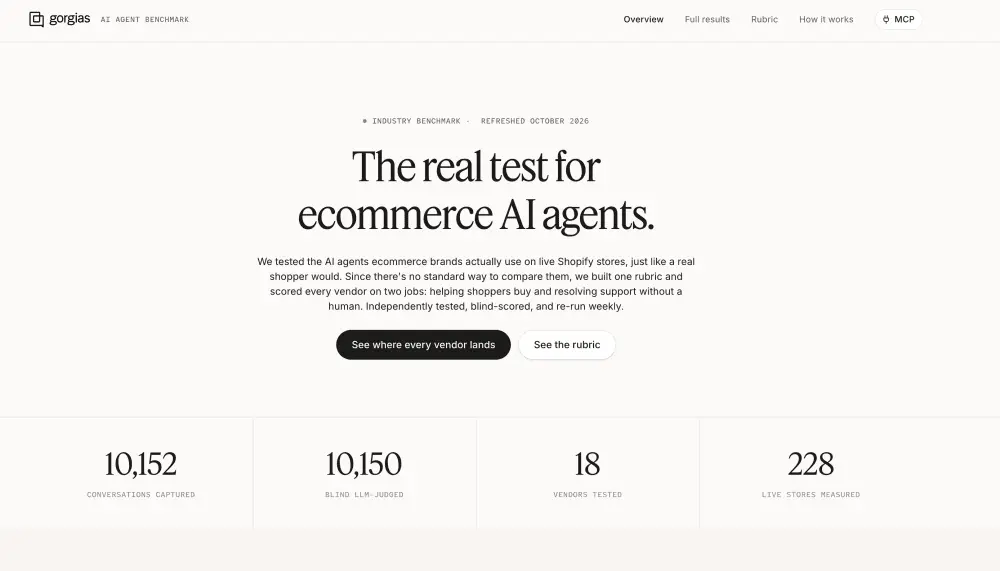
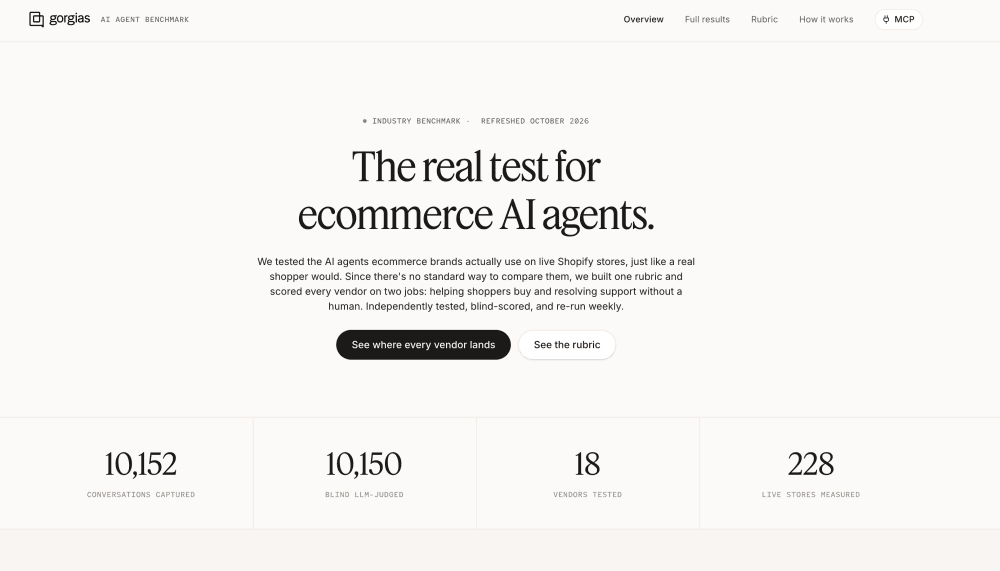
To pierce through this opacity, Gorgias—a $100M ARR e-commerce customer experience leader backed by the SaaStr Fund—has published a groundbreaking, public benchmark. Rather than relying on controlled sandboxes, synthetic product catalogs, or tightly choreographed vendor demos, this evaluation tested 13 leading AI CX vendors across 212 live, mid-market e-commerce stores carrying real, active inventory.
Every participating agent was fed identical customer messages, and responses were blindly graded by an independent judge against a rigorous set of 26 binary checks. Crucially, factual claims regarding pricing, store policies, and stock-keeping units (SKUs) were verified programmatically against the live merchant storefronts.
The findings are both sobering and revelatory. The TL;DR for the industry is clear: the absolute best AI agents on the market today fully resolve roughly 70% of customer conversations without human intervention. Yet, the typical vendor resolves under half. Furthermore, legacy helpdesk platforms that bundle native AI tools—such as Zendesk, Intercom, and Klaviyo—lag significantly behind specialized offerings, rarely clearing a 42% resolution rate.
As enterprises increasingly anchor their operational efficiency and margin targets to automated support, this benchmark serves as a vital wake-up call, redefining what leadership teams should expect from their AI investments.
Detailed Chronology & Investigative Methodology
The journey toward transparent, production-grade AI evaluations has been fraught with methodological challenges. Historically, software vendors published internal metrics derived from highly sanitized customer pilots or idealized test environments. Recognizing this trust deficit, Gorgias engineered an evaluation pipeline designed to simulate the unpredictable chaos of real-world retail support.
Phase 1: Establishing the Live-Store Testing Framework
The benchmark discarded synthetic data entirely. Instead, the evaluation framework targeted 212 live mid-market e-commerce operations. By connecting directly to active merchant infrastructure, the testing suite ensured that agents had to navigate authentic inventory constraints, fluctuating shipping timelines, and nuanced return policies.
When customer queries entered the system, they were distributed uniformly across all 13 participating vendors. This guaranteed that every AI agent received the exact same prompt corpus, eliminating selection bias and allowing for an apples-to-apples comparison of reasoning, system integration, and policy retrieval capabilities.
Phase 2: The Blind-Judge Rubric and Binary Verification
To evaluate response quality without introducing human subjectivity bias, Gorgias implemented a blind-judging protocol. The human or algorithmic judge reviewed generated answers without knowing which vendor produced them.
Each response was subjected to 26 binary checks. Factual assertions—such as whether a specific item was eligible for return, how much a product cost, or the status of a live SKU—were verified programmatically against the merchant’s live database. If an agent hallucinated a policy or provided an incorrect shipping window, it failed the check instantly.
Phase 3: The Four-Week Longitudinal Trend
Beyond a static snapshot, the benchmark tracked performance trajectories over a four-week window. This temporal analysis revealed an unexpected industry-wide trend: 9 out of 10 evaluated vendors experienced a decline in automation rates over the observed four weeks.
Whether driven by underlying foundational model updates, store configuration drift, or an increasingly complex distribution of test inquiries, this downward drift exposed a critical operational truth: The automation rate observed during a vendor’s sales pilot is rarely the rate sustained in production.
Supporting Context & Metrics: The Anatomy of AI Performance
The benchmark report yields deep insights when broken down by automation efficiency, response quality, topic complexity, and speed.
Automation Rates: The Top Tier vs. The Median
When looking strictly at the share of engaged conversations fully resolved by AI with zero human touch, the disparity across vendors is stark:
- The Top 5 Vendors: Average an impressive 70% automation rate (ranging individually from 64% to 75%).
- The Median Vendor: Resolves just 48% of conversations.
- Volume-Weighted Field Average: Sits at 46%.
Notably, the big-name platforms that brands are already paying for—Zendesk, Intercom, and Klaviyo—all underperformed, failing to break the 42% threshold in the benchmark. On the basis of this data, relying on the native AI bundled into an existing generalist helpdesk is mathematically one of the weakest strategic choices an e-commerce brand can make.
Balancing Automation and Quality
Evaluating automation rate in isolation can easily lead an organization to select the wrong vendor. An agent that rapidly closes tickets by giving incorrect information or deflecting customers creates downstream operational damage.
The benchmark evaluated vendors across both automation and a blind quality score (graded on a scale of 0 to 100):
- Strong on Both: Vendors like Yuma, Decagon, and Gorgias successfully cleared the bar for both high automation (>64%) and high quality (>65).
- High Automation, Weak Answers: Platforms like Ada closed high volumes of conversations but scored significantly lower on answer accuracy (scoring 27 points lower than Gorgias on quality). A ticket marked "resolved" that provides an incorrect return window merely generates a secondary contact from an irate customer, driving up operational costs.
- Strong Answers, Low Automation: Sierra tied with Yuma for the highest quality score on the board, yet resolved under half of its incoming conversations.
Topic Complexity: Order Tracking vs. Policy Pages
Support quality varies wildly depending on the nature of the customer inquiry. The benchmark categorized performance across common e-commerce support topics:
- Policy Questions (Highest Success): Inquiries answered directly from a static policy page (e.g., "What is your holiday return window?") scored highest across the field.
- Transactional & System Lookups (Lowest Success): Questions requiring real-time database lookups, dynamic status updates, or situational judgment calls scored near the bottom.
Order tracking—routinely the single largest ticket category for any e-commerce brand—sits stubbornly low on the performance list. Across the industry, only about a third of post-sale tracking inquiries reach a successful automated conclusion. Brands whose ticket volume is dominated by "Where is my order?" (WISMO) queries will find that benchmark averages overstate the automation they will actually experience.
The Speed vs. Resolution Trade-off
Mean time to a complete reply ranged dramatically from 5.4 seconds (Envive) to 16.5 seconds (Yuma). Envive positioned itself as the fastest responder on the board, yet achieved a modest 22% resolution rate. Conversely, Yuma proved to be the slowest responder while capturing a 71% resolution rate and top-tier quality scores.
For post-purchase support, the data confirms that speed matters far less than accuracy. Consequently, the benchmark weighted its support composite heavily: 50% automation, 40% quality, and just 10% speed.
Official Statements & Industry Perspectives
The release of the Gorgias benchmark has ignited fierce debate across the SaaS and e-commerce ecosystems, prompting commentary from founders, investors, and operations leaders.
Industry analysts have praised the methodology for refusing to grade vendors on simulated curves. By forcing AI agents to interface with live, messy, unstructured e-commerce environments, the evaluation sets a new standard for software procurement.
SaaStr Fund, which led the seed round in Gorgias, has continually emphasized the necessity of rigorous, production-grade testing. In internal deployments across more than 20 production AI agents, SaaStr practices continuous auditing, noting that seemingly stable implementations require relentless monitoring.
Furthermore, industry veterans have highlighted the crucial distinction in how "resolution" is defined. In standard vendor marketing materials, an interaction is frequently counted as automated if the AI issues a response and 72 hours pass without a human stepping in—effectively counting a frustrated customer who quietly abandons the brand as a successful "resolution."
In stark contrast, the Gorgias benchmark enforces a zero-tolerance policy: A conversation is only resolved if the AI handles it completely with zero human touch, no handovers, and no deflection out of the channel. If an agent pushes a customer to a contact form, an email address, or a phone call, it is marked as unresolved.
This definitional gap has direct financial implications. With enterprise AI agents frequently priced on a per-resolution basis (such as Gorgias AI Agent’s model of $0.90 per resolved conversation), procurement teams are being urged to secure explicit, legally binding definitions of what constitutes a "billable resolution" before signing enterprise contracts.
Future Outlook: Strategic Takeaways for E-Commerce Leaders
As artificial intelligence matures from an experimental novelty into a core operational utility, enterprise leaders must approach vendor selection with clinical precision. Based on the exhaustive data yielded by the Gorgias benchmark, CX executives should adopt a modernized playbook:
- Build Realistic Financial Models: Business cases for AI support should be built around a conservative 65% to 70% resolution ceiling, and only when partnering with a proven, top-tier vendor. Organizations utilizing bundled helpdesk AI should budget for a 20% to 42% automation ceiling.
- Evaluate Dual Metrics Simultaneously: Never shortlist an AI vendor based on automation volume alone. Quality and accuracy must be weighed equally to prevent the automation of customer dissatisfaction.
- Audit Against Your Unique Ticket Mix: Map historical customer service tickets against the benchmark’s topic breakdown. If your brand suffers from high volumes of complex order tracking or damaged-item claims, expect lower baseline automation rates than general industry averages suggest.
- Conduct Cold Reference Testing: Do not rely on vendor sales demos. Take 30 real customer support tickets from the previous month, open fresh incognito browser sessions on the vendor’s live reference merchant sites, and manually grade their resolution capabilities.
- Implement Continuous Monitoring: Because historical data indicates that 9 out of 10 vendors experience performance drift over time, automated agents must be re-evaluated on a strict monthly schedule to ensure guardrails, identity checks, and escalation workflows remain airtight.
The era of unchecked AI hype is drawing to a close. Transparency benchmarks like the one established by Gorgias prove that while artificial intelligence is reshaping commerce, true operational excellence requires rigorous engineering, continuous oversight, and an uncompromising commitment to customer satisfaction.