Executive Overview
For years, the avant-garde and mainstream fashion worlds alike have shared a peculiar linguistic and aesthetic obsession. Affectionately and irreverently, fashion lovers have referred to Maison Margiela’s iconic tabi flats and boots as "hooves"—their distinctive, cleft-toe split bearing an uncanny resemblance to the anatomy of a deer, goat, or cow. What began as a subversive Japanese-inspired design statement by Martin Margiela in the late 1980s has mutated into a permanent fixture of our collective sartorial imagination.
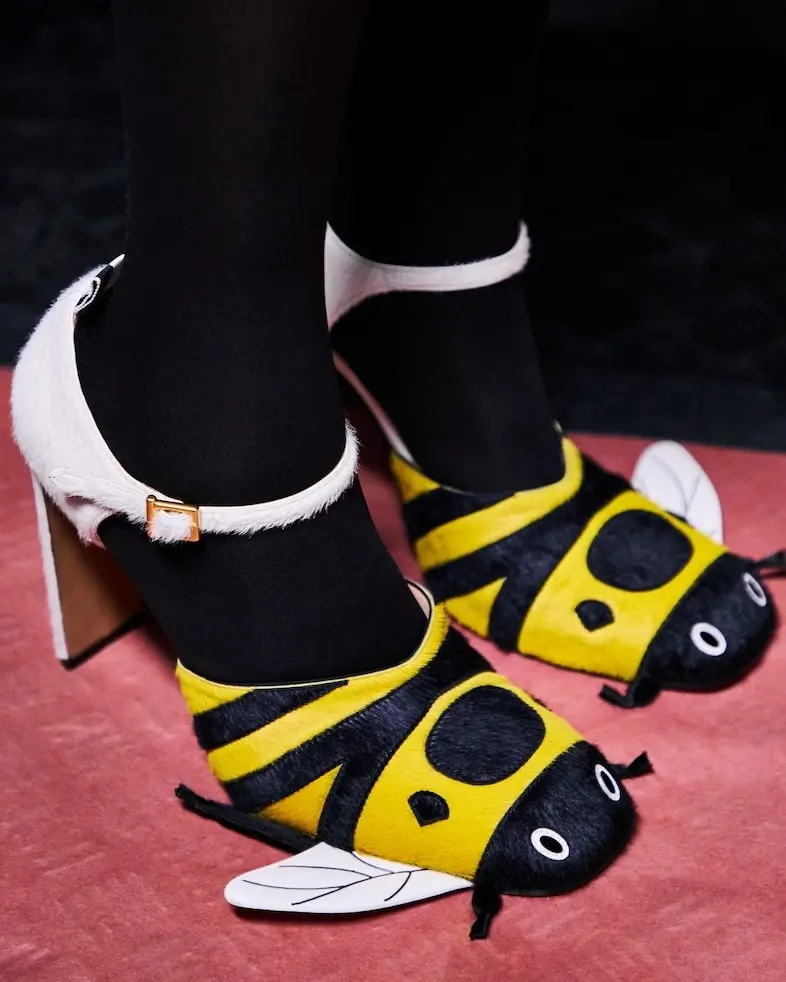
Yet, as recent runway seasons have amply demonstrated, the tabi was merely the tip of the iceberg. Today, we are living through an accidental, real-life Animorphs moment. Walk down any major fashion week corridor, and you will find an menagerie of fauna taking over the footwear category. There are Thom Browne’s whimsical butterfly and bee platform pumps, Sandy Liang’s viral bunny wedge heels, Schiaparelli’s hyper-realistic cat-head kitten heels, and Chanel’s mixed animal-print statements.
This burgeoning "creaturewear" trend is far more than a passing novelty; it represents a fascinating intersection of sculpture, psychology, subversion, and existential dread. As footwear designers increasingly push the boundaries of anatomy, transforming feet into paws, hooves, and wings, we are forced to ask a deeper question: Why do we desperately want our feet to look like animals right now?
To understand this phenomenon, we must look beyond the immediate shock value of the runway. This trend sits at the confluence of a multi-decade fascination with "freaky footwear," a post-pandemic shift toward bodily vulnerability, and a profound cultural yearning to reconnect with the natural world at a time when that world—and our own humanity—feels increasingly under threat.
Detailed Chronology: From 2002 Mouse Flats to the 2026 Menagerie
While the current zoological wave feels startlingly modern, it is anchored in a rich, century-old history of footwear as a canvas for sculptural experimentation.
The Early Roots and the 2002 Turning Point
Footwear has long served as an expressive outlet for humanity’s fascination with flora and fauna. According to historical archives, natural motifs have decorated shoes for centuries, with Western shoemakers frequently manipulating traditional silhouettes to mimic natural forms. However, the modern lineage of literal animal representation on footwear can be traced back in earnest to the early 2000s.
In 2002, Marc Jacobs introduced his iconic mouse flats—slippers complete with stitched silk noses, rounded ears, and whiskers that launched a thousand indie-sleaze iterations. Across contemporary vintage resale platforms, these millennial relics are currently experiencing a massive cultural revival, proving that our appetite for animalistic footwear is cyclical.
Around the same era, designer Andrea Pfister pushed sculptural boundaries further by creating surrealist footwear featuring heels shaped like exotic fruits and vegetables. Decades prior, in the 1980s, visionary designer Tokio Kumagai pioneered footwear decorated with distinct cat faces, merging art, humor, and utility.
The Rise of "Freaky Footwear" in the 2020s
The last five years, however, have accelerated this evolutionary timeline into overdrive. The fashion industry has settled into a yearly ritual of introducing a new, hyper-divisive "weird" shoe trend. From the mainstream adoption of bulky dad sneakers to the polarizing rise of Vibram FiveFingers street style, consumers have proven remarkably willing to sacrifice conventional elegance for conversational novelty.
By 2025 and 2026, this trajectory splintered into two distinct schools of thought within the freaky footwear ecosystem:
- The Barefoot & Toe Movement: Designed to showcase the raw, unadulterated human foot. Think of Margaret Qualley turning heads in August at the premiere of The Dog Stars, wearing Chanel’s minimalist barefoot heel-cap shoes, or the ubiquity of separated-toe footwear.
- The Creaturewear Trend: The diametric opposite, designed to completely erase and disguise the human foot beneath layers of sculptural fauna.
From Schiaparelli’s FW26 feline kitten heels to Sandy Liang’s bunny wedges, the past year has marked a tipping point. The shoe is no longer just an accessory; it is a taxidermic sculpture, a wearable terrarium, and a surrealist statement piece all at once.
Supporting Context & Metrics: The Psychology of "Subversive" Animal Wear
To unpack why consumers are lining up to strap stuffed cats, rabbits, and insects to their heels, one must examine the unique psychological load carried by human feet.
Feet as a Loaded Bodily Canvas
Unlike a graphic tee or a handbag, shoes anchor us to the earth. They are simultaneously utilitarian and deeply intimate.
"There’s definitely something in the air about animals, and feet are such a loaded part of a person’s body," notes Liana Satenstein, writer and host of the fashion series Never Worns. Satenstein points out the distinct semiotics of placement: "If I wore a big kitty cat on my shirt, it’s like, ‘I’m going to a Taylor Swift concert.’ Whereas if I’m wearing it on my feet, it’s a bit more subversive and naughty."
Placing an animal on your foot introduces a layer of ironic detachment. It is unexpected, slightly absurd, and inherently playful. While toe shoes and barefoot designs are about embracing raw, exposed human vulnerability, animal shoes lean into deliberate transformation. They render the wearer un-human, tapping into ancient mythologies of shape-shifting, satyrs, and chimeric beasts.
The Irony of the Anthropocene
Yet, the timing of this zoological footwear craze carries a poignant, almost tragic irony. The explosion of animal-themed fashion is occurring against a grim ecological backdrop.
As major political shifts—such as ongoing attempts by conservative administrations to dismantle and gut the protections of the Endangered Species Act—threaten global biodiversity, and as the insatiable energy demands of artificial intelligence strain the planet’s finite resources, humanity finds itself acutely alienated from the natural world.
We are losing our wildlife at an unprecedented rate, and in response, we are plastering them onto our accessories. The creaturewear trend can thus be read as a symptom of eco-anxiety: an obsessive, fetishized attempt to bring nature back into our daily lives, strapping it directly to our soles because we no longer encounter it in our concrete-dominated environments.
Official Statements & Industry Expert Perspectives
To gauge the longevity and cultural weight of this movement, industry historians and commentators offer contrasting views on whether the animal shoe trend is a permanent evolution or merely a dying gasp of shock-value fashion.
Elizabeth Semmelhack on the Deep History of Footwear Experimentation
Elizabeth Semmelhack, Director and Senior Curator of the renowned Bata Shoe Museum, views the current craze through a wide-angle historical lens.
"While the current trend feels very contemporary, it actually belongs to a much longer history of designers exploiting the sculptural and decorative potential of shoes," explains Semmelhack. "Depictions of flora and fauna have decorated footwear for centuries, and Western shoemakers have long played with the shape of footwear."
Semmelhack notes that innovation in footwear has historically faced fierce resistance before finding acceptance. When high heels were first introduced or when radical avant-garde shapes debuted decades ago, they were widely dismissed as "strange" or unwearable. Over time, however, the eye adjusts.
"Footwear has been the site for experimentation, and some ‘weird’ things have become normalised over time," Semmelhack observes. "Perhaps some of the ‘weird’ shoes today will endure."
Liana Satenstein on the "Ice Age" of Shock Value
Conversely, writer Liana Satenstein sounds a note of caution regarding the sustainability of fashion’s current obsession with shock-value accessories. She posits that the animal-as-shoes trend may signal that designers are reaching the absolute outer limits of novelty.
"We all know that feet are a conversation starter and will always be erotic, but you can only click on so much weird shoe stuff, and once you go barefoot and animal, there’s nothing left," Satenstein argues bluntly.
In her view, the market is approaching saturation point. The endless parade of viral, meme-ready footwear—from cartoonish big red boots to feline heels—is running on borrowed time.
"I think we will swing back to beautiful footwear," Satenstein predicts. "This is just the ice age of it all; the extinction of freaky footwear."
Future Outlook: Will Creaturewear Survive the Coming Cycles?
As the fashion calendar rolls forward, the central tension in the footwear market remains unresolved: Is creaturewear a fleeting flash in the pan destined for the clearance racks of fashion history, or is it a permanent mutation in how we conceptualize dressing from the ground up?
Several indicators suggest a nuanced middle ground:
- The Normalization of the Bizarre: Just as Margiela’s cloven "hoof" boot transitioned from an underground conceptual statement into a coveted red-carpet and boardroom staple over three decades, today’s rabbit wedges and cat heels are gradually softening the public eye. What shocks the runway in 2026 often populates high-street windows by 2028.
- The Enduring Need for Escapism: As long as geopolitical instability, environmental degradation, and digital fatigue weigh heavily on the cultural psyche, consumers will seek out tactile, imaginative forms of escapism. Whimsical fashion serves as psychological armor. Dressing up as creatures—becoming playful, feral, or mythic—offers a much-needed reprieve from sterile corporate monotony.
- The Pendulum Swing: Satenstein’s prediction of an eventual return to classicism is historically sound. Fashion operates on dialectics; maximalism invariably breeds minimalism, and grotesque surrealism eventually invites a cleansing wave of understated elegance. Yet, even when the pendulum swings back toward traditional silhouettes, the boundary of what is considered "normal" footwear will have permanently expanded.
Ultimately, whether you view Schiaparelli’s kitten heels and Sandy Liang’s bunny wedges as brilliant artistic triumphs or exhausting algorithm bait, one truth remains self-evident: humanity’s romance with the animal kingdom is deeper than skin-deep—it goes all the way down to our toes. As long as we continue to walk through an uncertain world, we will likely keep looking for ways to leave paw prints behind.