Executive Overview
In a significant development bridging the gap between professional creative software and enterprise communication platforms, Adobe has officially announced a sweeping integration with Slack. This new partnership introduces more than 70 core tools from Adobe’s industry-standard suites—spanning Photoshop, Illustrator, Premiere, Acrobat, InDesign, Lightroom, Adobe Stock, Adobe Express, and the generative AI capabilities of Adobe Firefly—directly into the Slack ecosystem.
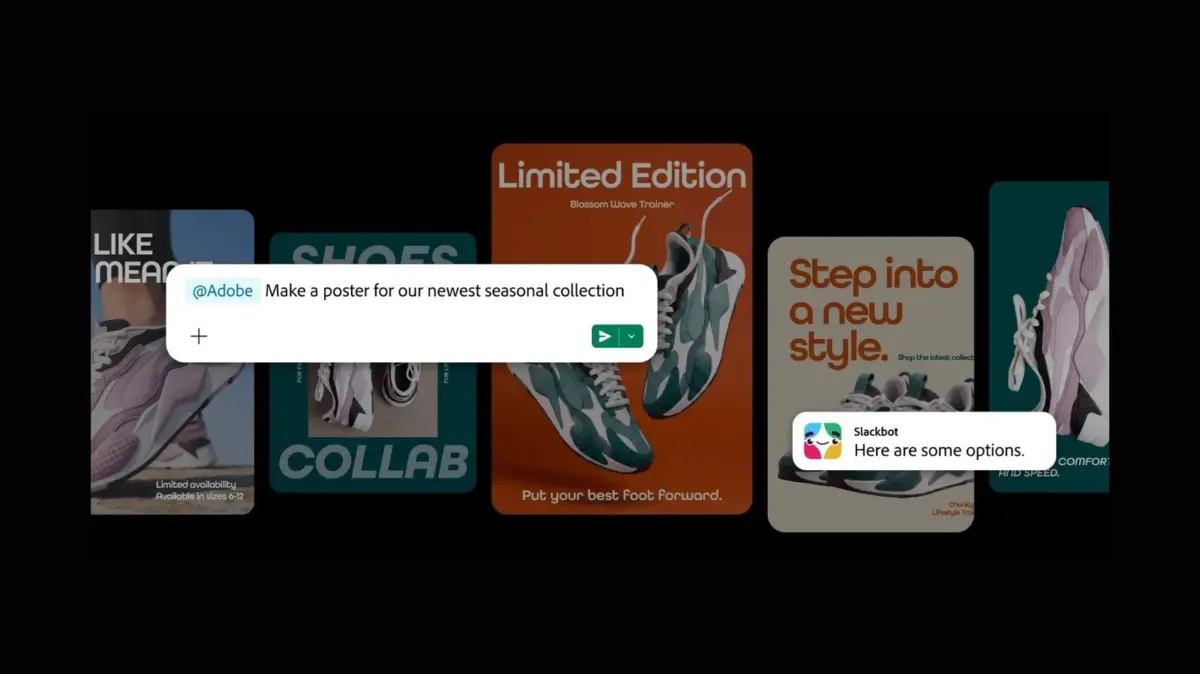
Rather than serving as a superficial link between disparate applications, the integration leverages Slackbot as an intelligent, conversational agent capable of executing complex creative and document-management tasks entirely within the chat interface. Users can now generate visual assets, edit images in bulk, manipulate PDFs, and pull marketing materials from templates without ever leaving their active communication channels.
Available immediately for Slack Business+ and Enterprise+ customers across web, mobile, and desktop platforms, this move represents a profound shift in how creative workflows intersect with everyday enterprise collaboration. Intriguingly, while heavy users will benefit from a direct link to their Adobe Creative Cloud accounts, the integration is structured to allow foundational access even for those without a paid Adobe subscription—lowering the barrier to entry for cross-functional teams.
This strategic rollout closely mirrors Adobe’s recent deployment of a nearly identical 70-tool plugin for OpenAI’s ChatGPT, signaling a broader industry trend toward conversational, agentic software integrations where generative AI serves as the universal glue between productivity suites.
Detailed Chronology
To understand the magnitude of Adobe’s integration into Slack, it is essential to trace the technical and strategic milestones that laid the groundwork for this release.
The Foundation: Model Context Protocol (MCP) and Early Competitor Integrations
The genesis of this capability dates back to June of this year, when Slack fundamentally updated its platform architecture by introducing support for the Model Context Protocol (MCP) within Slackbot. Designed to allow AI chatbots to securely interact with external data sources and developer tools, MCP opened the door for third-party software vendors to weave their native functionalities directly into Slack’s conversational fabric.
During the initial rollout of MCP support, Slack introduced early integrations with prominent design and productivity platforms, including Canva and Figma. These integrations proved that users craved a unified workspace where design assets could be discussed, previewed, and modified without the friction of context-switching between specialized applications and messaging threads. However, these early arrivals were largely limited to design-sharing and basic markup. Adobe’s entrance into the ecosystem dramatically scales up the technical ambition, moving Slackbot from a passive file viewer into an active creative and document-processing engine.
The Parallel AI Strategy: The ChatGPT Plugin Precedent
The architecture of the new Slack integration does not emerge in a vacuum. Eagle-eyed industry observers immediately noted structural similarities between the Adobe-Slack partnership and an earlier Adobe initiative: the launch of an Adobe ChatGPT plugin.
In that deployment, Adobe similarly packaged "more than 70 tools across Adobe’s creative and productivity suites" for OpenAI’s platform. By mirroring this approach for Slack, Adobe has established a repeatable blueprint for platform-agnostic distribution. Whether an enterprise team communicates via OpenAI’s custom GPTs or Slack’s native Slackbot, Adobe’s vast ecosystem of tools is positioned to act as an omnipresent utility layer.
The Official Launch and Immediate Availability
Announced via official corporate channels, Adobe for Slack went live immediately for organizations utilizing Slack’s high-tier enterprise offerings (Business+ and Enterprise+). The timing coincides with a period of intense corporate focus on workflow automation and AI-driven efficiency. By rolling out the integration simultaneously across web, mobile, and desktop operating systems, Adobe and Slack ensured that hybrid and remote teams could immediately incorporate these capabilities into their daily operations regardless of their hardware setup.
Supporting Context & Metrics
The integration of 70-plus Adobe tools into Slack touches upon several critical shifts in modern enterprise software design, data interoperability, and workflow efficiency.
Deconstructing the 70+ Tools: What’s Under the Hood?
While Adobe’s announcement broadly points to its powerhouse software suites, the functional breakdown of these 70-plus tools reveals a deliberate focus on tasks that traditionally require tedious context-switching. The toolset draws from several key pillars:
- Adobe Firefly & Adobe Express: Powering generative AI tasks, such as creating social media graphics from text prompts, generating variations of marketing posters, and swapping out image backgrounds instantly within a Slack thread.
- Photoshop & Lightroom: Enabling image manipulation tasks, ranging from basic cropping and resizing to executing bulk edits across large batches of visual assets.
- Premiere & InDesign: Assisting video and layout workflows, allowing teams to check project statuses, pull asset metadata, or format preliminary layouts.
- Acrobat & Adobe Stock: Streamlining document intelligence and asset sourcing. Users can query stock libraries for high-resolution photography or manipulate and sign PDFs without opening a standalone desktop reader.
The Mechanics of Slackbot’s New Creative Superpowers
Once the Adobe application is authorized and installed within a Slack workspace, the interaction model relies entirely on natural language processing via Slackbot.
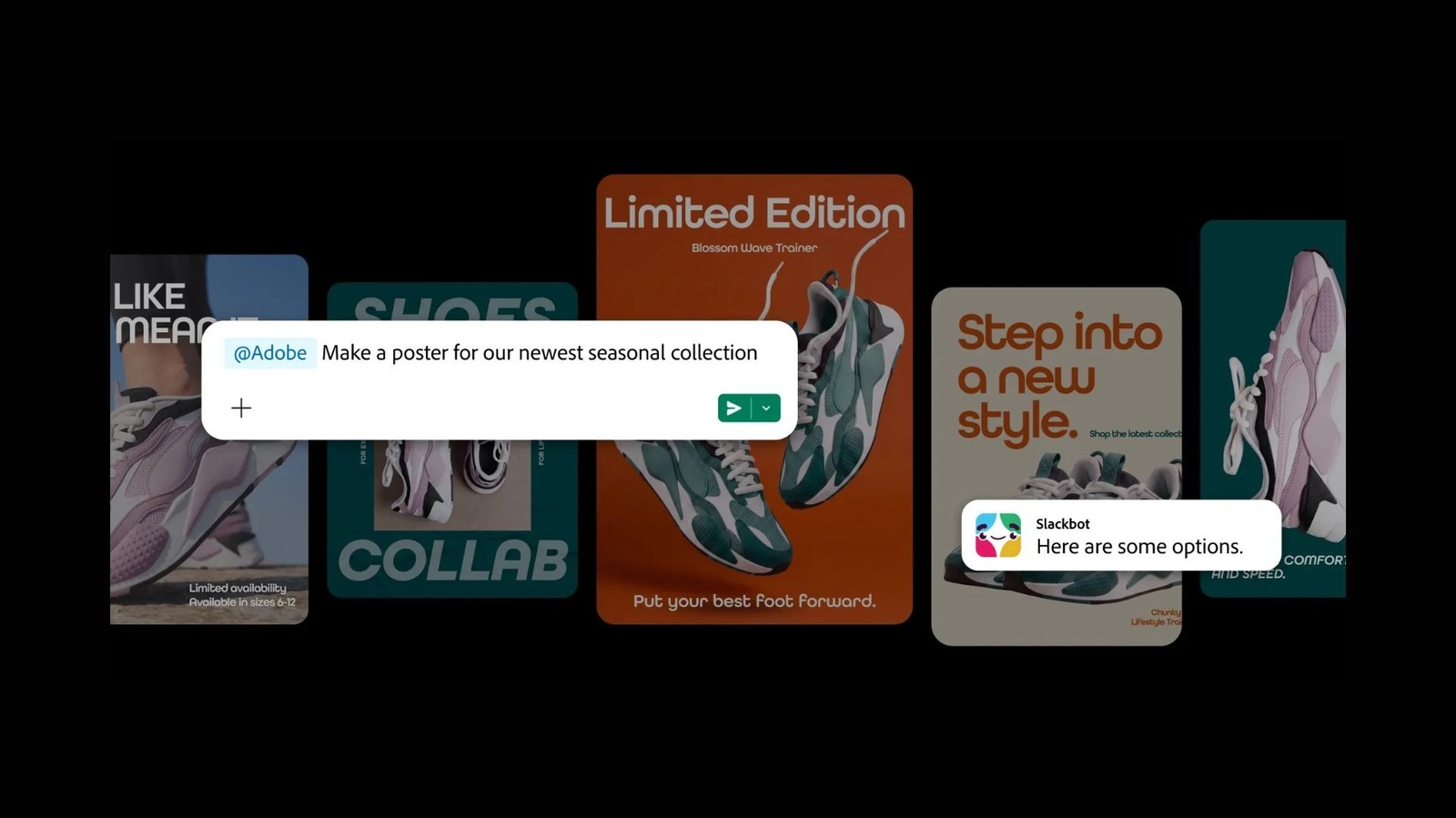
[User in #marketing-channel]: "@Slackbot, take the quarterly spreadsheet data
in this channel, convert it into an infographic using our brand template,
and generate three social media banner variations."

[Slackbot]: "Processing request using Adobe Express and Creative Cloud assets...
Here are your three draft banners. Click to review or request revisions."
Beyond direct conversational prompts, Slackbot possesses the unique ability to harvest context from multiple sources simultaneously. It can draw structural data and conversational history from Slack channels and Slack Canvases, cross-reference those requirements with stored Adobe Creative Cloud assets, and execute complex workflows.
Accessibility and the Freemium Paradigm
One of the most surprising disclosures in the rollout is that an Adobe account is not strictly required to utilize the foundational aspects of the Adobe app within Slack. By decoupling basic utility from a mandatory subscription login, Adobe is lowering the friction for casual users—such as project managers or sales professionals—who need to quickly generate a mock-up or edit a document without requesting a full Creative Cloud seat from their IT department. However, heavy-duty production work and deep asset synchronization naturally require a linked Adobe account to unlock the full depth of the creative suites.
Official Statements
Corporate leadership from both Adobe and Slack emphasized the transformative nature of this integration, framing it as a major milestone in the evolution of digital workplaces.
In the official joint launch announcement, Adobe representatives underscored the company’s commitment to meeting creative professionals and business teams wherever they work:
"By bringing the power of Adobe’s creative and productivity tools—including Photoshop, Illustrator, and Firefly generative AI—directly into Slack, we are eliminating the friction of context-switching. Teams can now ideate, create, and iterate collaboratively in real time, turning conversation into polished creative assets without ever leaving their communication hub."
Slack executives similarly highlighted how the integration aligns with the platform’s broader vision of a centralized, AI-driven command center for modern enterprises:
"When we introduced Model Context Protocol support to Slackbot, our goal was to transform Slack from a messaging app into an intelligent operating system for work. The addition of Adobe’s comprehensive toolset represents a massive leap forward. Slackbot is no longer just a notification bot or an information retriever; it is now a fully capable creative director and production assistant."
Future Outlook
As the dust settles on the initial launch of Adobe for Slack, industry analysts are already looking ahead to how this integration—and others like it—will reshape the software landscape over the coming years.
The Rise of Agentic Workflows in the Enterprise
The convergence of tools like Adobe Creative Cloud with enterprise communication hubs like Slack signals the obsolescence of isolated software silos. In the near future, workers will increasingly interact with software not by opening monolithic desktop applications, but by orchestrating autonomous or semi-autonomous AI agents across chat interfaces. We can expect future iterations of Adobe for Slack to introduce proactive assistance—where Slackbot might autonomously flag design inconsistencies in a shared campaign canvas or suggest AI-generated imagery based on ongoing chat sentiment.
Security, Governance, and Enterprise Adoption
As tools like Adobe Firefly and Slackbot gain deeper access to proprietary enterprise data, corporate IT and security departments will face new governance challenges. Ensuring that sensitive corporate assets shared in Slack channels are handled securely by external AI models will be paramount. Enterprises utilizing Business+ and Enterprise+ tiers will likely demand granular administrative controls over which channels and assets the Adobe integration can access.
Market Implications for Competitors
Adobe’s aggressive multi-platform strategy—deploying identical tool suites to both OpenAI’s ChatGPT and Salesforce-owned Slack—cements its dominance as the indispensable utility layer for digital content creation. Competitors in the design and productivity space will be forced to accelerate their own conversational AI integrations or risk being marginalized in environments where communication platforms act as the primary user interface for all digital work.
Ultimately, the Adobe-Slack integration marks a definitive turning point. The keyboard-and-chat interface has officially become the canvas, and the boundary between talking about work and actually doing work has never been thinner.