Executive Overview
Following the explosive, high-stakes trajectory of its mid-season milestones, DC’s prestige television endeavor Lanterns hit a formidable narrative speed bump with its sixth installment. Coming off the fiery devastation of Rushville in Episode 5—an event that laid bare the corruption of a hidden Manhunter and drove a permanent wedge between John Stewart (Aaron Pierre) and Hal Jordan (Kyle Chandler)—the series executed a drastic structural pivot. Returning fully to the flash-forward 2026 timeline first teased in the series premiere, Episode 6 steps away from grand cosmic spectacles and sprawling interplanetary warfare. Instead, it slows its pace dramatically to lean into a somber, ground-level murder mystery: the apparent assassination of Hal Jordan.
While structural risks are inherent to prestige television storytelling, this particular narrative gear-shift resulted in a jarring tonal whiplash. Earning a modest 6 out of 10 rating from critics, the episode struggles to maintain the breathless momentum established by its predecessor, affectionately dubbed "Lights Out." By stranding John Stewart in the present-day legal and interpersonal wreckage of his past, the series briefly sacrifices its strongest asset—the magnetic, Training Day-esque dynamic between Pierre and Chandler. Yet, even amidst uneven pacing and extraneous subplots involving local blackmail and architectural preservation, Episode 6 succeeds in planting crucial seeds for the larger DC Universe (DCU), reintroducing Nathan Fillion’s fan-favorite Guy Gardner and framing a bleakly humorous, poignant send-off for one of space’s greatest peacekeepers.
Detailed Chronology: Unpacking the 2026 Paradigm Shift
To understand the friction present in Lanterns Episode 6, one must examine the peculiar structural anatomy of the first season as a whole. Episode 5 functioned as an undeniable apex, destroying half of Rushville and bringing a decade-spanning tension to a blistering boil. Originally reported to have been developed as the seventh episode before structural reorganizations took place in the writers’ room, its placement halfway through the season inadvertently created a narrative mountain peak from which the subsequent episode had nowhere to go but down.
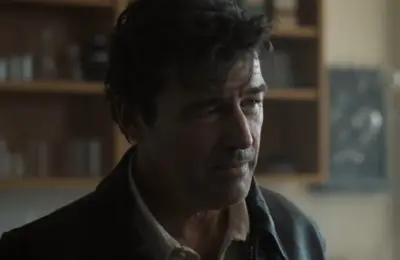
When the narrative snaps forward to the year 2026, the series immediately shifts from cosmic opera to neo-noir procedural. The core catalyst of the episode is the murder of Hal Jordan, a tragedy that hangs heavy over every frame and strips the series of its foundational partnership. However, the writers—helmed by Justin Britt-Gibson and Damon Lindelof—do manage to sneak in one breathtaking reunion: an emotionally potent diner scene taking place hours before Hal’s untimely demise.
Kyle Chandler delivers some of his most compelling work of the series in this sequence, expertly portraying the physical and emotional erosion Hal has endured over ten years of estrangement from John. His palpable anxiety at the prospect of John exposing their shared history injects the scene with an electric sense of dread, raising vital questions regarding what secrets the veterans were forced to bury.
Unfortunately, once that scene concludes, the episode is forced to navigate the hollow space left by Hal’s absence. John Stewart’s return to Rushville forms the backbone of the contemporary A-plot. We witness a man frantically trying to prevent his carefully manicured, post-superhero civilian life from disintegrating entirely. His relationships with extended family members have grown frostily distant, and the episode handles this exposition gracefully, relying on understated dialogue and weary body language rather than heavy-handed info-dumps.
Yet, the execution stumbles when introducing auxiliary dramatic beats. The subplot featuring the local waitress, Maggie (played by Hannah Christine Shetler), attempting to blackmail John feels increasingly peripheral. In a season racing toward answers concerning the elusive Sinestro (Ulrich Thomsen) and John’s ultimate destiny as a fully realized Green Lantern, spending valuable screen time on John’s legal exposure and the survival of his architecture firm risks feeling like narrative wheel-spinning.
Supporting Context & Metrics: Structural Experimentation and Universe-Building
The creative decisions driving Lanterns Season 1 highlight the immense logistical and narrative tightrope walk required when orchestrating a serialized mystery within a broader, interconnected superhero universe like James Gunn’s nascent DCU.

The Cost of Chronological Fragmentation
- Pacing Discrepancy: Teasing a flash-forward timeline in the pilot, only to bench it for a month while exploring the 2016 origin conflicts, created a fractured viewing experience.
- The Mid-Season Peak Phenomenon: Pushing the Rushville destruction to Episode 5 upended traditional television formatting. It forced audiences to transition from blockbuster-tier action choreography to a localized murder investigation in a single week.
- The "Hal-Sized" Void: With Kyle Chandler’s Hal Jordan sidelined via murder, the show temporarily loses the cross-generational friction that gave the early episodes their emotional anchor.
Despite these growing pains, the episode finds solid footing whenever it leans directly into its comic-book mythology. Most notably, Episode 6 delivers a long-promised, highly anticipated cameo from Nathan Fillion as Guy Gardner. Fillion’s brief appearance bridges critical lore gaps, offering context regarding the Green Lantern successorship matrix and explaining why Guy—rather than Hal or John—served as Earth’s active, designated Lantern during the events of 2025’s Superman. The chemistry between Fillion and Pierre is instant and sharp, teasing a dynamic that will hopefully receive a larger canvas in upcoming DCU projects like Man of Tomorrow.
Furthermore, Hal Jordan’s funeral sequence stands out as a darkly comedic, brilliantly cynical subversion of traditional superhero tropes. Hal had long envisioned his final farewell attended by interstellar dignitaries, alien emperors, and planetary celebrities. Instead, the bleak reality features a paltry gathering consisting solely of two aging ex-girlfriends and a former colleague who openly despised him. The brief appearance of Carol Ferris (Amie MacKenzie) provides a welcome nod to Hal’s tumultuous romantic history, though like many legacy characters in this series, her screen time vanishes all too quickly, leaving fans craving a deeper exploration of her perspective.
Official Statements & Creative Intentions
While network executives and showrunners have kept tight-lipped regarding the exact mechanics of the upcoming season finale twists, industry reports surrounding the production of Lanterns emphasize a deliberate effort to subvert traditional "monster-of-the-week" expectations in favor of a moody, grounded human drama.
Behind-the-scenes leaks and commentary regarding the writers’ room point to a concerted gamble by executive producers Damon Lindelof and Tom King: to treat the Green Lantern mythos not as a pure sci-fi power fantasy, but as a neo-noir character study about trauma, aging, and accountability. The structural shuffling—specifically the moving of Episode 5’s massive confrontation forward—was reportedly executed to maximize dramatic stakes, even if it risked throwing off the pacing equilibrium of the mid-season transition.
Series architects have consistently maintained that John Stewart’s journey in Lanterns is fundamentally about sacrifice. By forcing John to confront the fallout of his past choices in Rushville while hunting his friend’s killer, the creative team aims to strip away the glossy sheen of heroism to examine the dented, scarred humanity underneath the ring.
Future Outlook: Course Correction in Sight
As Lanterns looks toward its final two episodes of the inaugural season, the path forward requires a sharp recalibration of priorities. Episode 6 demonstrated that while the series can effectively construct atmospheric world-building and character melancholy, it cannot afford to lose sight of its central driving engine.
Fortunately, the narrative table is already set for a thrilling recovery. The return of the "Halogram"—the residual holographic construct of Hal Jordan—guarantees that viewers have not seen the last of the sparkling creative chemistry between Aaron Pierre and Kyle Chandler. If the series can successfully streamline its focus away from extraneous local distractions and zero in on the core murder mystery, the geopolitical machinations of Sinestro, and John’s inevitable complete ascent to the Green Lantern mantle, the back half of the season has every tool necessary to stick the landing.
Ultimately, Episode 6 may go down in franchise history as a necessary narrative valley—a sobering, quiet breath before the storm. If the creative team heeds the structural lessons learned from this stumble, the remaining episodes of Lanterns could yet transform this temporary narrative turbulence into one of the most compelling chapters in modern superhero television.