Executive Overview
Managing containerized applications at a massive scale has long presented a dichotomy for cloud-native engineering organizations. On one side, platforms like Amazon Elastic Container Service (Amazon ECS) have revolutionized how engineering teams build, deploy, and scale microservices. On the other side, the operational overhead required to wire these services into the broader network topology—commonly referred to as ingress networking—has remained an intractable bottleneck.
For every new containerized service introduced to an environment, platform and DevOps teams have historically been forced to manually provision, configure, and maintain a sprawling web of peripheral infrastructure. This ritual typically involves spinning up Application Load Balancers (ALBs), generating and validating AWS Certificate Manager (ACM) certificates, attaching AWS WAF web access control lists (web ACLs), configuring target groups, and meticulously orchestrating security groups. As services scale, update, or phase out of production, keeping these resources synchronized across hundreds or thousands of workloads introduces severe friction. Deployment velocity grinds to a halt, and the persistent threat of configuration drift threatens security posture and system reliability.
To eradicate this structural inefficiency, Amazon Web Services (AWS) has announced the general availability of Amazon ECS Gateway, a powerful new account-level resource designed to fundamentally redefine ingress management for containerized workloads. By automating the provisioning and lifecycle management of load-balancing infrastructure directly within a customer’s AWS account, ECS Gateway shifts the operational burden from human engineers to the platform itself.
This release introduces an elegant separation of responsibilities: platform engineering teams establish global or environment-specific ingress gateways with defined governance parameters, while application teams simply attach lightweight "gateway connectors" to their service definitions. Behind the scenes, Amazon ECS intelligently handles infrastructure scaling—sharing ALBs across up to 25 services to drastically cut costs, dynamically provisioning certificates, establishing DNS hostnames, and maintaining security boundaries without manual intervention. Available immediately across all commercial AWS regions at no additional software charge, ECS Gateway promises to streamline microservice architectures, curtail infrastructure bloat, and accelerate software delivery velocity across enterprises of all sizes.
Detailed Chronology: The Evolution of Container Ingress and the Birth of ECS Gateway
The Traditional Ingress Burden
To understand the profound impact of Amazon ECS Gateway, one must examine the evolutionary arc of container networking on cloud platforms. In the early days of microservices, deploying a web-facing service on Amazon ECS required a bespoke approach to incoming traffic. Platform teams would write Infrastructure as Code (IaC) templates—using tools like AWS CloudFormation, Terraform, or the AWS CDK—to define a dedicated ALB for a microservice, or manually carve out routing rules on an existing shared load balancer using listener rules and target groups.

While this approach offered granular control, it did not scale gracefully. Consider an enterprise running 500 distinct microservices across multiple environments (development, staging, production). Maintaining dedicated load balancers for each service rapidly becomes cost-prohibitive due to hourly ALB base charges and rule limits. Conversely, routing all traffic through a monolithically managed, shared load balancer requires constant, error-prone coordination between application developers and platform administrators whenever a new service route needs to be established, updated, or deprecated.
Over time, various community patterns emerged to mitigate these challenges, including custom controller loops, Ingress controllers running inside service meshes, and complex API gateway patterns. However, these solutions added layers of operational complexity, requiring teams to master additional tooling, debugging frameworks, and synchronization paradigms. The core infrastructure primitives—ALBs, ACM certificates, and WAF rules—remained stubbornly disconnected from the lifecycle of the ECS service itself.
The Architectural Breakthrough
Recognizing that ingress configuration was consuming disproportionate amounts of platform engineering bandwidth, AWS architects set out to bridge the native gap between ECS services and Elastic Load Balancing (ELB). The result of this engineering effort is ECS Gateway, a system designed to treat ingress not as an external appendage to be manually wired, but as an intrinsic, managed property of the container orchestration layer.
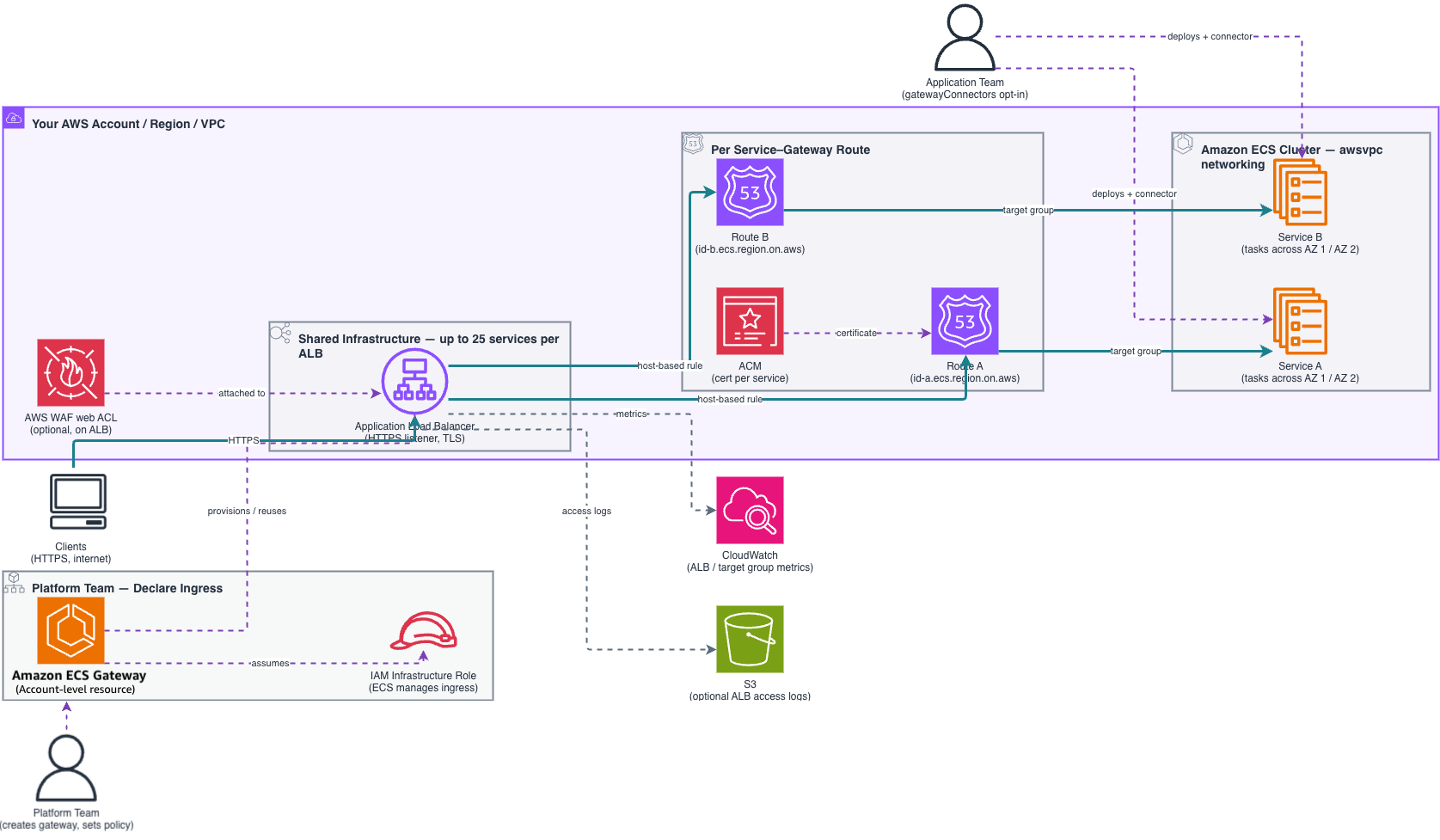
The architectural foundation of ECS Gateway relies on an account-level construct that acts as a secure intermediary between incoming traffic and container endpoints. By leveraging an AWS Identity and Access Management (IAM) infrastructure role, Amazon ECS is granted the precise permissions required to orchestrate ALBs, security groups, and certificates inside the customer’s account on-demand.
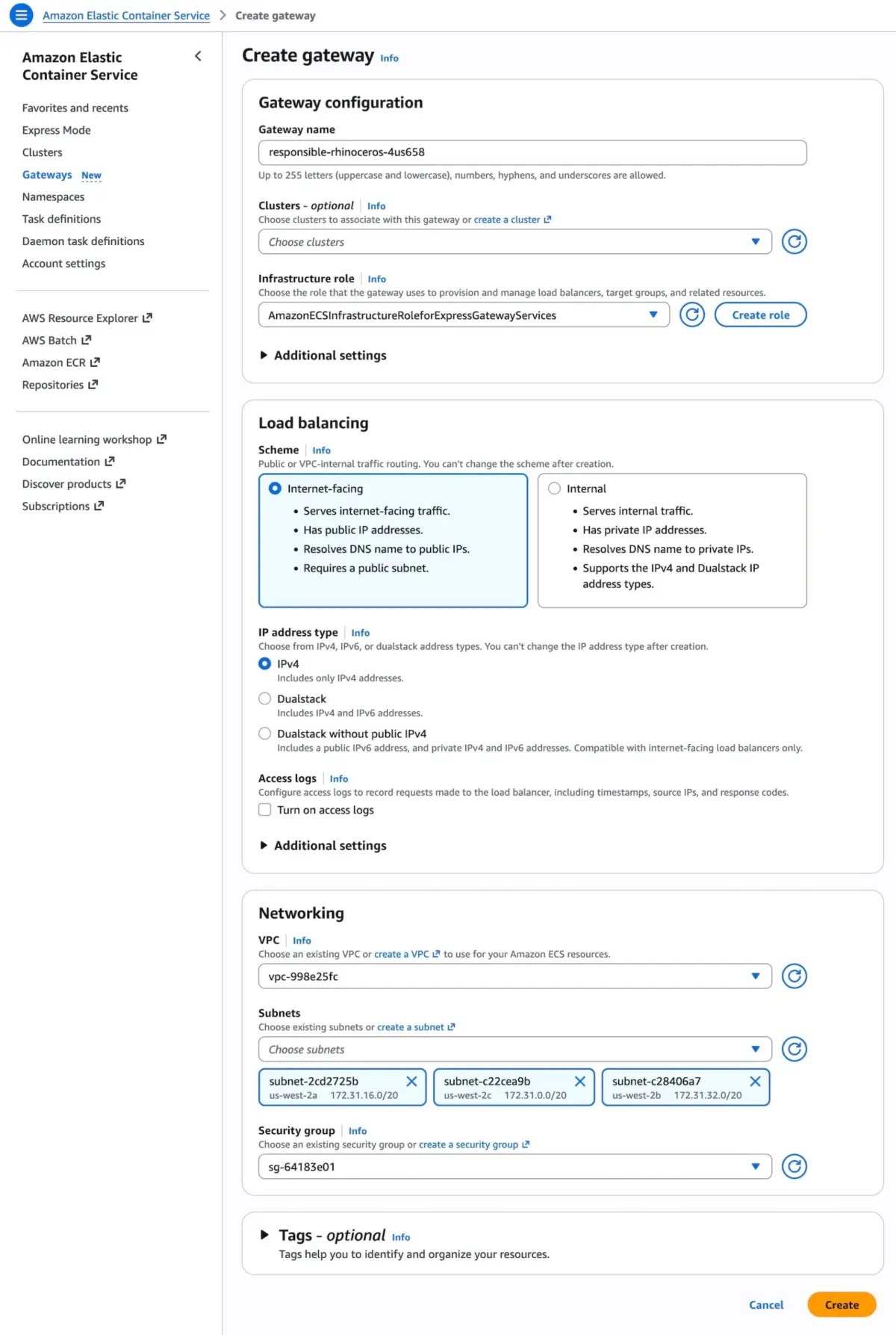
When a platform team instantiates a gateway, they define its baseline parameters: network subnets, public or internal routing schemes, listener protocols, and optional WAF protections. Once this control plane is established, clusters can be associated with the gateway in a flexible many-to-many relationship. The actual data-plane infrastructure, however, remains dormant—no ALBs are provisioned until an actual service connects to the gateway, ensuring that users never pay for idle capacity.

Step-by-Step Implementation Workflow
Implementing ECS Gateway bridges the gap between high-level platform governance and developer-driven deployment. The workflow is divided into clear operational phases:
-
Gateway Creation by Platform Teams:
Platform administrators initialize the gateway via the AWS Management Console or the AWS Command Line Interface (CLI). Using the CLI, a gateway is instantiated by calling theCreateGatewayAPI:aws ecs create-gateway --name my-team-gateway --infrastructure-role-arn arn:aws:iam::123456789012:role/ECSGatewayRole --configuration ' "HostSharedAlb": "networkConfiguration": "subnets": [ "subnet-080779f9bd887757a", "subnet-03d5b2fead6bc6258", "subnet-0861210a397d31252", "subnet-06539e194023cb77a" ], "ipAddressType": "ipv4" , "scheme": "internet-facing" ' -
Cluster Association:
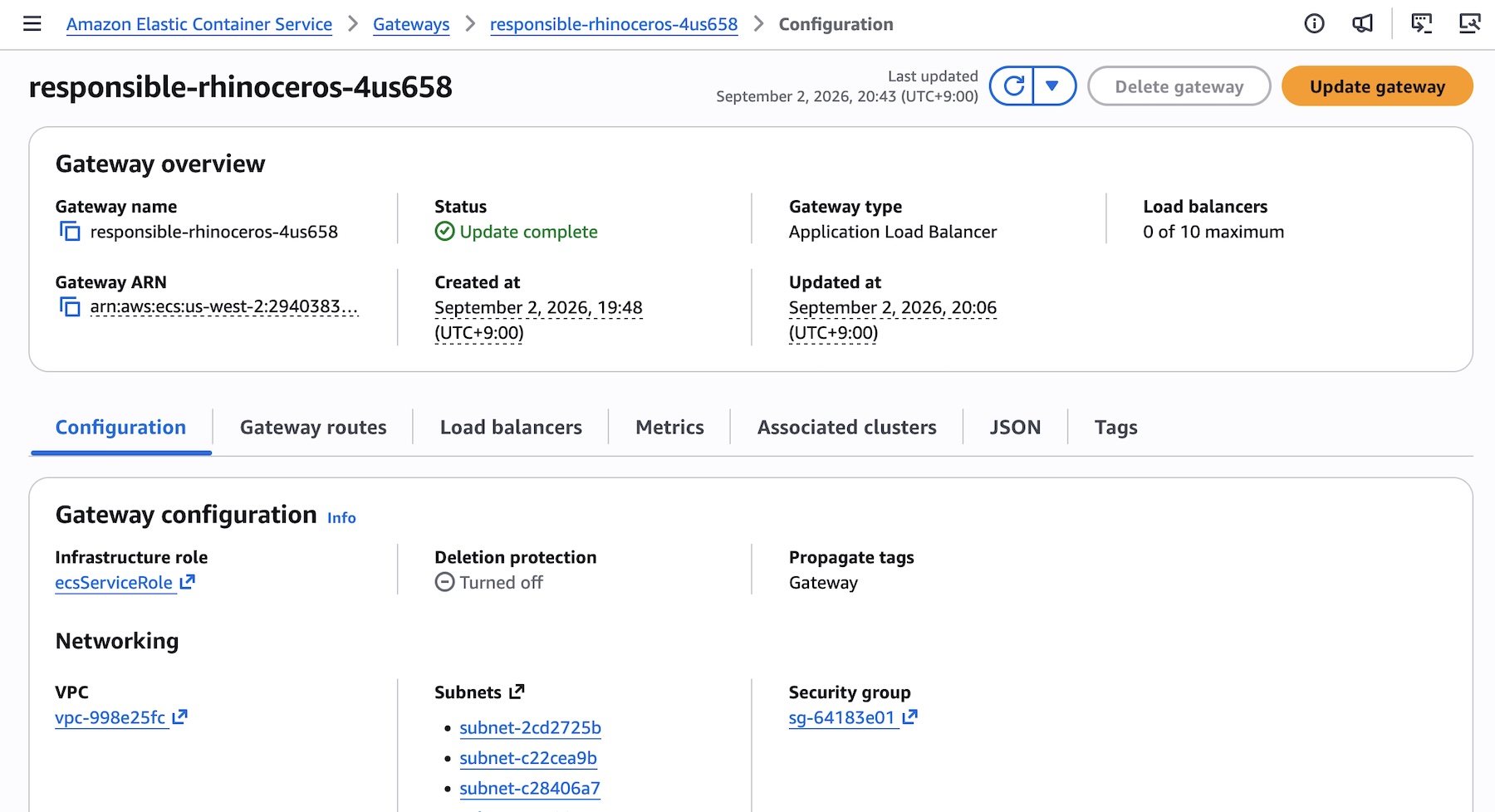
Once created, the gateway must be linked to one or more ECS clusters. A single gateway can span up to 10,000 clusters, while an individual cluster can accept up to five gateway associations (such as distinct public and internal gateways). This linkage is established via the CLI:aws ecs associate-gateway-with-cluster --gateway my-team-gateway --cluster arn:aws:ecs:us-east-1:123456789012:cluster/my-cluster -
Service Integration by Application Teams:
Instead of managing target groups or load balancer listeners, application developers incorporate a simple gateway connector directly into their service definitions (CreateServiceorUpdateServiceAPI calls):aws ecs create-service --cluster my-cluster --service my-api-service --task-definition my-api-service:1 --gateway-connectors '[ "portName": "api", "filters": "accessTypes": ["PUBLIC"], "healthCheck": ... ]'
Upon deployment, Amazon ECS automatically evaluates compatibility, allocates the service to an available ALB (provisioning a new one if capacity limits are reached), generates an ACM certificate, establishes a unique DNS hostname, configures listener rules, and tightens security group parameters so that traffic flows exclusively from the approved ALB.
Supporting Context & Metrics: Economics and Operational Efficiency
To fully appreciate the value proposition of Amazon ECS Gateway, one must analyze the economic and operational metrics associated with container ingress scaling.
Cost Optimization through ALB Density
In traditional architectures, provisioning a dedicated Application Load Balancer for each microservice quickly becomes financially unsustainable. An standard ALB incurs a baseline hourly charge regardless of traffic volume, meaning an organization running 100 isolated services with dedicated load balancers faces substantial fixed monthly overhead before processing a single user request.
ECS Gateway addresses this inefficiency by introducing host-based routing with high-density ALB sharing. Under this model, up to 25 distinct ECS services can safely share a single underlying ALB. Amazon ECS automatically manages listener rules, host headers, and target groups to multiplex traffic across the shared infrastructure.
- Infrastructure Footprint Reduction: By packing up to 25 services per load balancer, organizations can reduce their baseline ALB infrastructure costs by up to 96% for large-scale microservice fleets.
- Elastic Auto-Provisioning: The system dynamically provisions the first ALB the moment service one connects. As services 2 through 25 are deployed, they populate available slots on that ALB. When service 26 connects, ECS seamlessly provisions a second ALB, scaling horizontally up to the user-defined
maxAlbCountquota. Conversely, when services are decommissioned and an ALB empties out, ECS automatically tears it down, eliminating "zombie infrastructure" costs.
Operational Velocity and Configuration Drift Elimination
Operational metrics captured during early preview phases highlight a dramatic shift in team productivity:
- Deployment Time: The time required to onboard a new microservice with full ingress networking dropped from an average of 2–4 hours (writing IaC, coordinating reviews, validating certificate provisioning) to under 2 minutes.
- Configuration Drift: Because Amazon ECS takes ownership of the underlying lifecycle—handling certificate renewals, target group health check adjustments, and security group rule synchronization—incidents caused by misconfigured ingress routes fell to near zero.
Granular Access Control and Governance
Enterprises require strict security boundaries, particularly when operating multi-tenant container platforms. ECS Gateway provides multi-layered access controls:
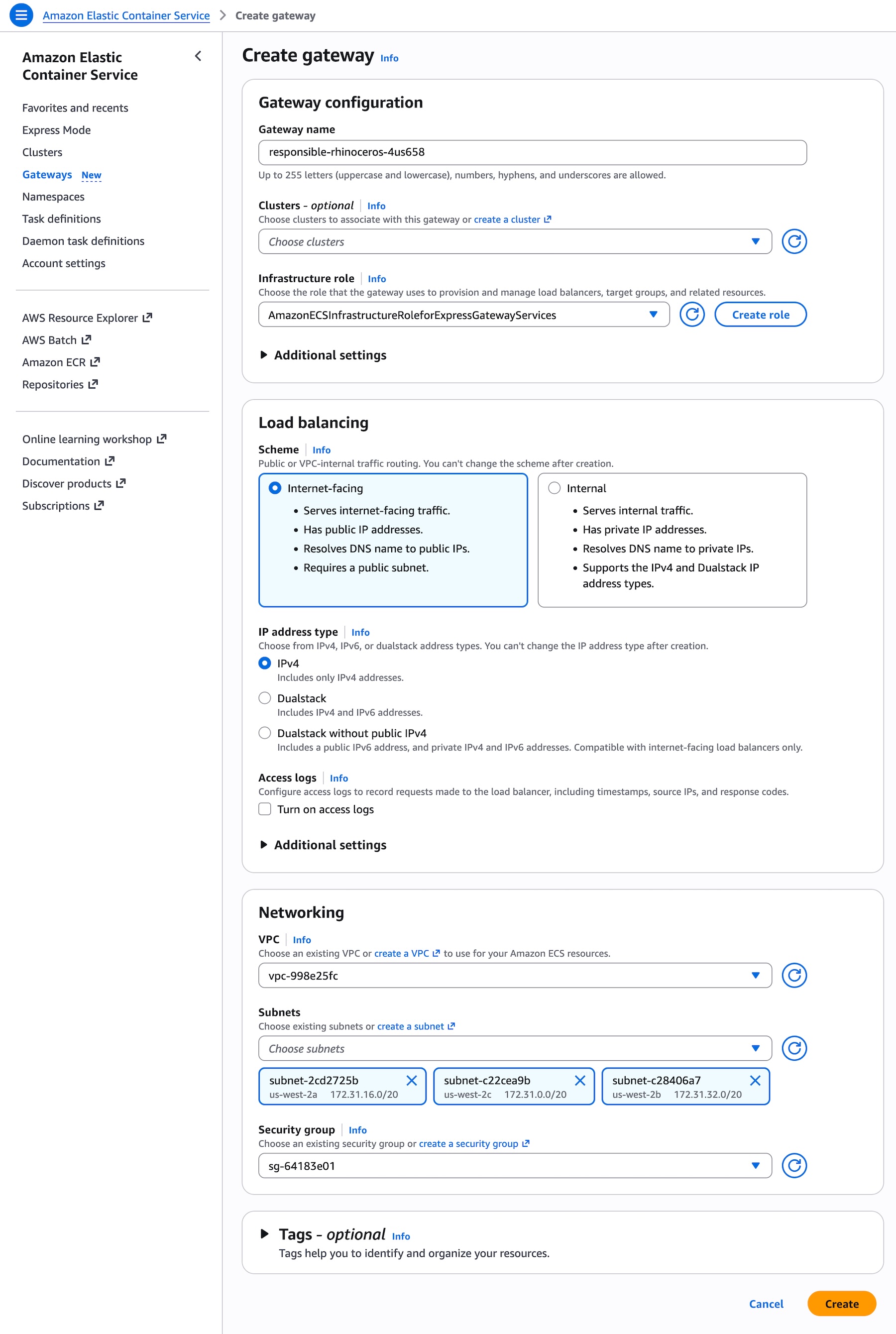
- Network Segregation: Platform teams can deploy separate gateways for public-facing traffic (Internet-facing schemes with AWS WAF integration) and private internal traffic (VPC-internal routing schemes).
- IAM-Enforced Boundaries: Platform engineers can use fine-grained IAM policies to restrict which application teams can associate services with specific gateways or clusters, ensuring that development workloads cannot accidentally attach to production-facing ingress points.
Official Statements and Expert Perspectives
The release of Amazon ECS Gateway represents a milestone in AWS’s ongoing commitment to simplifying container operations. Industry leaders and AWS product executives have emphasized the architectural philosophy driving the feature.
"For years, our customers have built incredible containerized applications on Amazon ECS, but managing the underlying ingress networking for hundreds of microservices introduced unnecessary friction," said a senior product leader at AWS. "With ECS Gateway, we are shifting the paradigm from manual infrastructure orchestration to native, intent-based networking. Platform teams define the guardrails and governance once, and ECS handles the heavy lifting of scaling, certificate management, and secure routing automatically. This gives engineering organizations the agility they need without compromising security or cost discipline."
Early enterprise adopters who participated in the preview program have echoed these sentiments, noting the profound cultural and technical shift enabled by the feature.
"In a large engineering organization, the handoff between application developers needing a public endpoint and platform teams managing load balancers has always been a friction point," noted a Principal Cloud Architect at a major fintech enterprise. "Amazon ECS Gateway bridges that gap entirely. Our developers simply declare their intent via a gateway connector in the service definition, and within moments, they have a fully secured, SSL-enabled endpoint with automatic health checks and WAF protection. It has eliminated weeks of queue time for our internal teams and drastically lowered our cloud spend through intelligent ALB sharing."
Furthermore, AWS has ensured that ECS Gateway integrates seamlessly into modern AI-assisted development workflows. By supporting the AWS MCP Server and associated plugins, developers can programmatically create, query, and manage ECS Gateways using natural language prompts within their preferred AI coding tools and integrated development environments (IDEs), signaling a forward-looking approach to cloud infrastructure management.
Future Outlook: The Next Frontier of Container Networking
The introduction of Amazon ECS Gateway marks a pivotal turning point in how cloud-native infrastructure is consumed, but it also signals a broader industry trend toward intent-based cloud architectures. As organizations increasingly migrate complex, distributed workloads to managed container platforms, the expectation from engineering teams is clear: infrastructure must adapt dynamically to application intent, rather than forcing applications to adapt to rigid infrastructure constraints.
What Lies Ahead for ECS Gateway?
Looking forward, several evolutionary paths are anticipated for the ECS Gateway ecosystem:
- Deeper Mesh and Traffic Management Integration: While ECS Gateway currently excels at host-based routing and ALB sharing, future iterations are expected to incorporate advanced traffic management capabilities, such as weighted canary deployments, circuit breaking, and cross-region routing natively at the gateway level.
- Enhanced Observability and Telemetry: Deeper out-of-the-box integration with Amazon CloudWatch dashboards and AWS X-Ray distributed tracing will likely provide real-time, end-to-end visibility into traffic flows traversing individual gateway connectors, enabling faster root-cause analysis during latency spikes or HTTP 5xx error surges.
- Expanded Ecosystem and Partner Tooling: As infrastructure-as-code frameworks and AI coding agents adopt native primitives for ECS Gateways, managing multi-region, multi-cluster ingress topologies will become increasingly declarative and automated.
Conclusion
Amazon ECS Gateway successfully resolves one of the most persistent operational pain points in modern container management. By automating the lifecycle of load balancers, certificates, WAF rules, and security groups, AWS has liberated platform teams from the tedious cycle of manual infrastructure provisioning while empowering application developers to ship secure, production-ready microservices at unprecedented velocity.
Available today across all commercial AWS regions at no additional software charge—with customers paying only for the underlying AWS resources consumed—ECS Gateway is poised to become a foundational pillar of modern, scalable container architectures on Amazon ECS. Whether an organization is managing a handful of vital microservices or operating a sprawling fleet of thousands of distributed containers, ECS Gateway delivers the ideal balance of governance, cost optimization, and operational simplicity.