Executive Overview
In the wake of its blockbuster autumn hardware announcements—highlighted by the debut of the iPhone 18 Pro and the innovative iPhone Duo—Apple has updated its official trade-in catalog, offering customers immediate pathways to offset the cost of new upgrades. However, this year’s rollout has triggered widespread debate across the tech community, specifically concerning the residual valuation assigned to the iPhone Air.
Traditionally, Apple waits until a direct successor generation arrives on the market before officially incorporating a device into its trade-in architecture. Breaking with this long-standing convention, Apple has made both the iPhone 17 and the iPhone Air immediately eligible for trade-in credit, even though no "iPhone Air 2" or base iPhone 18 has been released or even formally announced.
While the inclusion of these models allows early adopters to pivot toward the newly launched iPhone 18 Pro or iPhone Duo, the financial mechanics of the trade-in program reveal a striking anomaly. Following a sweeping series of price hikes across Apple’s entire hardware lineup this week, the iPhone Air’s trade-in value has flatlined at parity with its less expensive stablemate, the base iPhone 17. For consumers who paid a significant premium for the ultra-slim form factor, the mismatch between purchase price and trade-in return has transformed what should be a seamless upgrade cycle into a frustrating exercise in diminishing returns.
Detailed Chronology of the 2026 Autumn Product Cycle
To fully understand the current friction surrounding Apple’s trade-in valuations, it is necessary to examine the sequence of events that unfolded during the company’s recent hardware event and its immediate aftermath.
The Surprise-and-Shine Event and Hardware Debuts
Earlier this week, Apple hosted its highly anticipated autumn product showcase, colloquially dubbed by insiders as the "Surprise-and-Shine" event. The spotlight immediately fell on the introduction of the iPhone 18 Pro, which boasts next-generation silicon and advanced computational photography enhancements, alongside the iPhone Duo, a completely reimagined dual-form-factor device designed to capture the middle tier of the smartphone market.
As per standard operating procedure, the introduction of these flagship devices triggered a comprehensive restructuring of the broader iPhone portfolio. Consumers scanning Apple’s updated storefront were greeted not only by shiny new hardware options but also by a series of quiet, retroactive adjustments to existing models that remained on sale—most notably the iPhone 17 and the premium iPhone Air.

The Unprecedented Price Hikes
The foundational grievance among consumers stems from sudden, widespread price adjustments implemented across the ecosystem. Without prior warning, Apple increased the baseline pricing for several key devices:
- The iPhone 17 received a $100 price increase, pushing its starting retail price to $899.
- The iPhone Air also absorbed a $100 price increase, elevating its entry-level cost to a hefty $1,099.
This $200 price delta between the base iPhone 17 and the flagship iPhone Air has always been justified by Apple through hardware engineering marvels—specifically, the Air’s exceptionally thin chassis, premium materials, and specialized internal architecture. However, the true shock came mere hours after the event concluded, when Apple published its updated trade-in tables, revealing that both devices command the exact same maximum trade-in payout.
Breaking Tradition: Early Eligibility
Ordinarily, Apple preserves a strict temporal boundary for its trade-in ecosystem. A device typically depreciates naturally over a full 12-month cycle, with maximum trade-in values dropping only after a direct sequel (such as an iPhone $X+1$) hits store shelves.
Because neither an iPhone Air 2 nor an iPhone 18 has been announced—with analysts projecting a release window no earlier than early next year—industry watchers initially assumed that current-generation devices would be insulated from aggressive trade-in restructuring. Instead, Apple has actively incentivized recent buyers to abandon their hardware prematurely, creating a unique window of vulnerability for consumers who purchased the iPhone Air expecting robust long-term residual value.
Supporting Context, Financial Metrics, and Discrepancies
A granular look at the numbers highlights the mathematical paradox that has left analysts and consumers bewildered.
The Numbers Game: iPhone 17 vs. iPhone Air
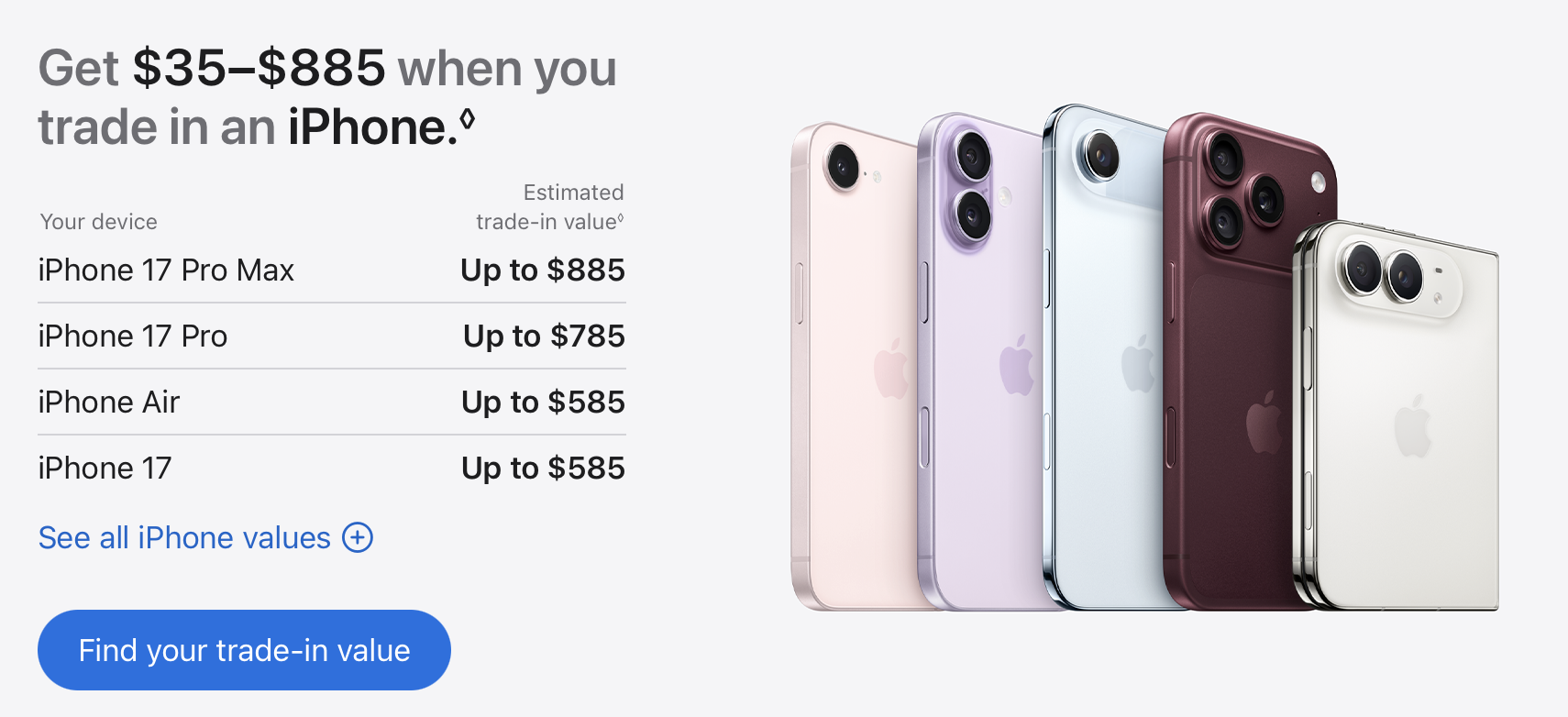
When breaking down the economics of Apple’s current trade-in structure, the disparity becomes glaringly apparent:
-
iPhone 17 Profile:
- New Retail Price: $899 (post-increase)
- Maximum Trade-In Payout: Up to $585
- Net Cost Depreciation (Theoretical Max): ~$314
-
iPhone Air Profile:
- New Retail Price: $1,099 (post-increase)
- Maximum Trade-In Payout: Up to $585
- Net Cost Depreciation (Theoretical Max): ~$514
+------------------+-------------------+-----------------------+---------------------+
| Device Model     | New Retail Price  | Max Trade-In Payout   | Value Retention %   |
+------------------+-------------------+-----------------------+---------------------+
| iPhone 17        | $899              | $585                  | ~65.0%              |
| iPhone Air       | $1,099            | $585                  | ~53.2%              |
+------------------+-------------------+-----------------------+---------------------+
As the data illustrates, a consumer who invests an extra $200 to purchase the iPhone Air over the standard iPhone 17 realizes zero financial dividend when returning that device to Apple for credit toward an iPhone 18 Pro or iPhone Duo. Both devices cap out at a maximum trade-in value of $585.
Hardware Realities vs. Corporate Valuations
What makes this valuation strategy particularly confounding is the underlying component engineering of the iPhone Air. Unlike the base iPhone 17, which utilizes standard-tier processing silicon, the iPhone Air shares close architectural parity with the high-end iPhone Pro lineup, frequently leveraging advanced system-on-chip (SoC) designs and cutting-edge display technologies.
From a purely hardware and parts-salvage perspective, the internal components of an iPhone Air hold considerably more intrinsic market value than those of a standard iPhone 17. Yet, Apple’s proprietary valuation algorithms appear blind to these technical nuances, treating both handsets as equivalent commodities in its refurbishment pipeline.
Market analysts suggest that this flat-rate approach stems from aggregate demand forecasting and consumer adoption patterns rather than a literal accounting error. Apple’s internal metrics likely dictate a standardized recovery ceiling for its current-generation mid-to-high-tier chassis, inadvertently penalizing early adopters who opted for the company’s experimental thin-form-factor flagship.

Official Industry Reactions and Consumer Sentiment
The tech journalism community and consumer advocacy forums have reacted swiftly to Apple’s policy update. Across major platforms, the consensus is one of disbelief, with critics pointing out the stark misalignment between Apple’s marketing messaging and its financial execution.
Industry commentators have noted that while Apple frequently markets its upper-tier devices as long-term investments in premium engineering, short-term trade-in policies of this nature actively undermine consumer confidence in experimental form factors.
- "When you pay a $200 premium for a device marketed as the pinnacle of modern industrial design, you expect that premium to be reflected across its lifecycle—including its residual value," noted one prominent tech analyst. "To have it valued identically to a lower-tier device mere months into its run feels like a penalty for early adoption."
Furthermore, third-party trade-in competitors—such as Gazelle, Decluttr, and carrier-specific buyback programs—are already capitalizing on the gap. Early reports indicate that secondary market providers are offering more granular valuations that account for the iPhone Air’s superior processor and display components, potentially drawing frustrated Apple users away from the official Apple Trade In program entirely.
Future Outlook and Strategic Implications
As the consumer electronics market adjusts to the realities of broader macroeconomic price increases and component supply stabilization, Apple’s handling of the iPhone Air trade-in dilemma offers a fascinating lens into the company’s long-term hardware strategy.
What This Means for Future Form Factors
Apple has historically used iterative design experiments—such as the iPhone mini and the original iPhone SE lines—to test market appetite for non-traditional sizes. The iPhone Air represents the spiritual successor to these exploratory engineering exercises, proving that consumers are willing to pay top dollar for ultra-thin profiles.
However, if residual value tracking continues to conflate experimental chassis designs with standard models, future adoption rates for novel form factors could face resistance. Buyers are increasingly sophisticated, calculating not just the upfront retail cost of a smartphone, but its total cost of ownership over a two-to-three-year upgrade cycle.

Anticipating the iPhone Air 2
Looking ahead, industry insiders are already turning their attention toward the eventual release of an iPhone Air 2 or equivalent successor, projected for early next year.
- Market Correction: Once a direct successor enters the market, historical precedent suggests that the original iPhone Air’s trade-in value will experience a more standardized, graduated depreciation curve.
- Consumer Advice: For current iPhone Air owners weighing an immediate upgrade to the iPhone 18 Pro or iPhone Duo, financial advisors strongly recommend checking third-party buyback channels before committing to Apple’s official trade-in program. Given the $585 ceiling imposed by Apple, independent platforms may yield significantly better returns for consumers looking to recoup their initial $1,099 investment.
Ultimately, while Apple’s latest trade-in policy successfully lowers the barrier to entry for users migrating to the iPhone 18 Pro ecosystem, it serves as a cautionary tale for early adopters: in Cupertino’s eyes, cutting-edge design does not always translate to a higher payout at the trade-in counter.