Executive Overview
For nearly a decade, the open-source Kubernetes ecosystem has operated under a strict architectural mandate: upgrading a control plane is a proverbial "one-way door." Historically, once cluster administrators initiated a Kubernetes version upgrade, there was no officially supported native mechanism to reverse it. While the broader community has made commendable strides—such as the introduction of KEP-4330 and its work on emulated versions—the fundamental friction of an irreversible upgrade has long plagued enterprise engineering organizations.
To mitigate this inherent risk, platform engineering teams have historically been forced to construct elaborate, expensive, and time-consuming safety nets. These include multi-tiered bake periods, complex stagger groups, mandatory automated sign-offs, and drawn-out upgrade cycles spanning several months. Because the Kubernetes project releases three minor versions annually, organizations managing hundreds—or even thousands—of clusters, particularly those operating within heavily regulated industries like finance, healthcare, and government, often choose to delay upgrades entirely. The fear of an unrecoverable failure under pressure routinely outweighs the desire for new features, leaving critical infrastructure stuck on aging software versions, missing essential security patches, and hurtling dangerously close toward extended support deadlines.
Today, Amazon Web Services (AWS) is fundamentally altering that calculus. In a major announcement for cloud-native infrastructure management, AWS has introduced native Kubernetes version rollbacks for Amazon Elastic Kubernetes Service (Amazon EKS). This powerful new feature provides cluster administrators with a reliable safety net, effectively acting as an "undo button" for version migrations.
By allowing teams to reverse a Kubernetes version upgrade within a seven-day window if unforeseen compatibility issues arise, AWS is removing one of the most stubborn adoption barriers in modern enterprise IT. This capability is available immediately at no additional cost across all commercial AWS regions where EKS is offered, supporting clusters running on both standard and extended support tiers.
Detailed Chronology & Mechanics: How EKS Version Rollbacks Work
To fully appreciate the significance of this release, one must examine the limitations of previous transitional holding states and understand how Amazon EKS executes a true production-grade rollback.
The Problem with Transitional States
Alternative approaches in the broader Kubernetes ecosystem—such as emulated versions—often keep a cluster in a temporary, transitional holding state. While helpful for testing, these mechanisms do not always reflect the true operational reality of running a specific version in production.
In contrast, Amazon EKS version rollbacks restore a cluster to a fully validated previous version that has already successfully run in production. For example, if an organization upgrades a production cluster from Kubernetes 1.34 to 1.35 and subsequently discovers a subtle application compatibility issue or a broken controller integration, administrators can safely initiate a rollback to version 1.34 at any point within a seven-day window. There is no need to manually rebuild the cluster from scratch, restore complex etcd snapshots under extreme operational stress, or scramble to troubleshoot live regressions in a broken environment.
Incremental Versioning and Cluster Insights
To maintain architectural stability and align with upstream Kubernetes patterns, EKS version rollbacks support stepping backward one minor version at a time, mirroring the incremental path used during upgrades.
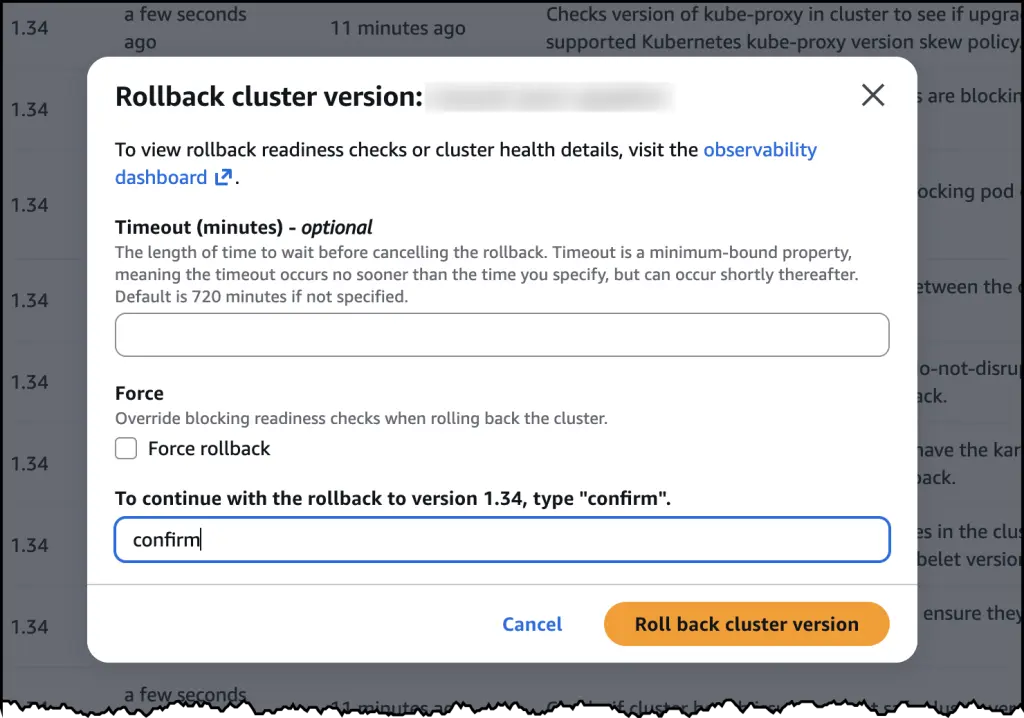
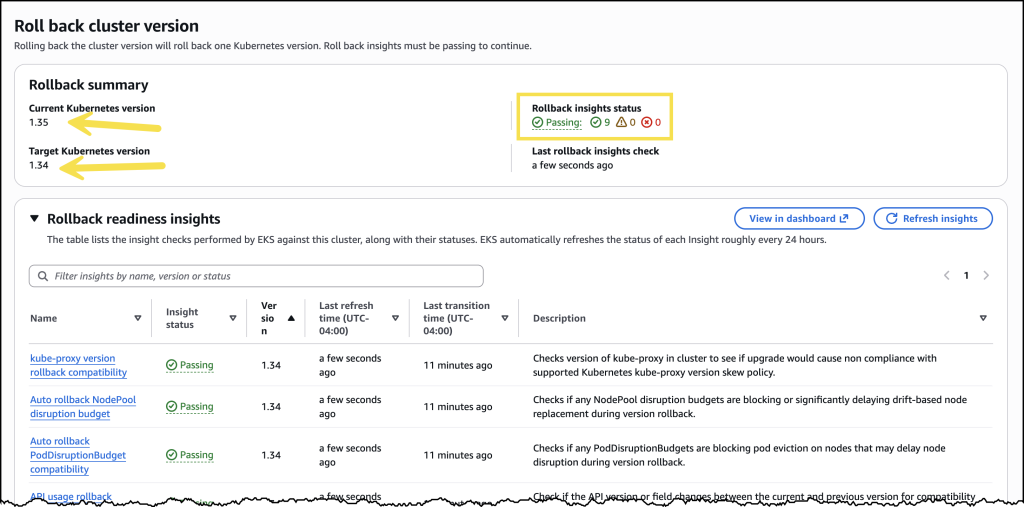
Before a rollback is executed, AWS ensures safety through deep diagnostic integration with cluster insights. Before proceeding, the system automatically evaluates the cluster’s rollback readiness, flagging critical configuration items such as:
- Node version compatibility mismatches
- Third-party add-on dependency conflicts
- Deprecated API usage that might break workloads on the older version
For teams that have already performed rigorous pre-flight checks and need to execute emergency remediations rapidly, AWS provides a --force flag that bypasses these automated warnings. This applies universally across all EKS clusters, regardless of whether administrators manage their own worker nodes or rely on AWS-managed infrastructure. However, for organizations that have embraced fully managed infrastructure via EKS Auto Mode, the architecture introduces an even higher level of orchestration sophistication.

Rollback Mechanics for EKS Auto Mode
EKS Auto Mode was engineered to streamline cloud-native operations by providing one-click deployment of production-ready Kubernetes clusters. It automates compute, networking, and storage management, allowing developers to focus entirely on application logic rather than underlying infrastructure orchestration.
However, rolling back an EKS Auto Mode cluster introduces unique complexity: both the control plane and the managed worker nodes must be rolled back simultaneously and harmoniously. Because node rollbacks must strictly respect configured Pod Disruption Budgets (PDBs) to prevent application downtime, the overall execution time can vary depending on cluster size and workload density.
To ensure administrators retain absolute control during this automated sequence, AWS has introduced a dedicated cancel API. If an administrator decides that a rolling node reversion is taking longer than anticipated, or if they wish to pivot their remediation strategy, they can invoke the cancel API to halt the node rollback mid-stream. From there, they can dynamically adjust their PDBs to accelerate the process or pursue an alternative operational path.
By default, EKS preserves strict workload stability, refusing to bypass PDBs during a rollback unless explicitly commanded to do so by the operator.
Supporting Context & Metrics: The Enterprise Upgrade Dilemma
To understand the profound industry impact of the EKS rollback feature, one must look at the economic and operational friction inherent in enterprise Kubernetes management.
Industry benchmarks consistently show that human error and configuration drift during major infrastructure upgrades account for a significant percentage of preventable production outages. When a Kubernetes minor version deprecates key APIs—such as the transition away from extensions/v1beta1 or networking.k8s.io/v1beta1 APIs in past cycles—enterprises often spend weeks writing static code analyzers and custom scripts just to audit their Helm charts and YAML manifests.
Prior to native EKS rollbacks, the lifecycle of a cluster upgrade in a regulated enterprise typically looked like this:
- Planning & Code Auditing (Weeks 1–4): Reviewing upstream release notes, checking deprecated APIs, and updating CI/CD pipelines.
- Staging & Validation (Weeks 5–8): Deploying the upgrade to non-production staging environments and running end-to-end integration tests.
- Staggered Production Rollouts (Weeks 9–16): Implementing complex canary deployments across regional clusters with mandatory bake periods.
- The "Point of No Return" Risk: If an edge-case bug slipped past staging and manifested under heavy production load on day 17, the team faced an agonizing choice: frantically patch forward in production or rebuild the cluster from backups.
By introducing a guaranteed seven-day safety net, AWS is effectively compressing the perceived risk window. Organizations can now rely on live production traffic to validate minor version upgrades, confident in the knowledge that a swift, native reversion mechanism is only a few clicks or API calls away. This is expected to drastically reduce the number of enterprise clusters languishing on end-of-life Kubernetes versions due to upgrade phobia.
Step-by-Step Walkthrough: Testing EKS Version Rollbacks
To evaluate the user experience and verify the operational workflow of this new feature, AWS engineers documented a typical rollback procedure within the Amazon EKS management console:
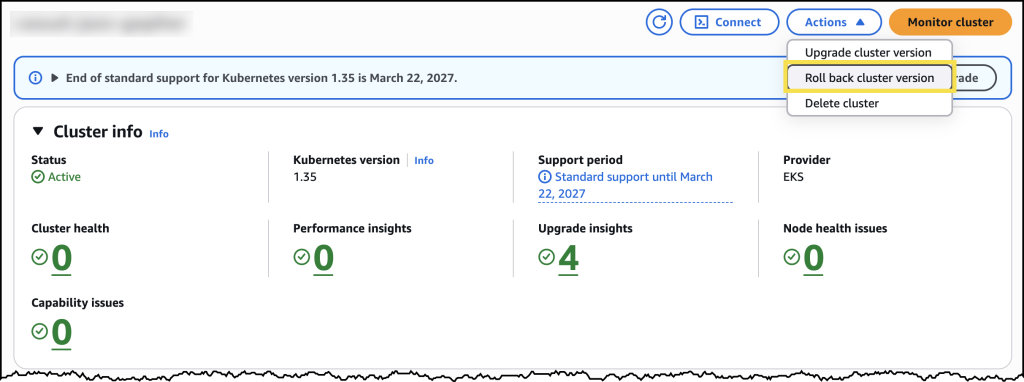
- Accessing the Console: Navigating to the Amazon EKS console and selecting a target cluster that had recently undergone a minor version upgrade.
- Reviewing Configuration: From the cluster’s primary configuration dashboard, administrators can instantly view the clear option to initiate a version rollback, alongside transparent telemetry indicating the remaining duration of the active seven-day rollback window.
- Evaluating Insights: Before pressing confirmation, reviewing the dedicated rollback insights tab. The console surfaces real-time node status and highlights potential compatibility roadblocks or add-on dependencies that require attention.
- Executing the Rollback: Upon confirmation, the control plane rollback initiates immediately while the cluster remains fully operational for end-users. Control plane reversion typically completes within approximately 20 minutes—comparable to the duration of a standard forward upgrade.
- Node Coordination: For clusters running EKS Auto Mode, worker nodes gracefully downgrade in alignment with pre-configured Pod Disruption Budgets, ensuring zero unexpected application downtime.
- Verification: Once the asynchronous orchestration workflow concludes, the cluster successfully re-establishes its operational state on the prior Kubernetes minor version, fully responsive and stable.
Official Statements & Industry Implications
While AWS has integrated this capability seamlessly into the EKS control plane, the broader cloud-native community views native rollbacks as a watershed moment for infrastructure reliability.
Infrastructure architects and reliability engineers have long argued that declarative infrastructure platforms must support bidirectional state transitions to achieve true enterprise maturity. Critics of early cloud-native tooling often pointed to the fragile nature of stateful cluster management as a primary vector for catastrophic downtime incidents.
By taking the lead with native version rollbacks, AWS is setting a new benchmark for managed Kubernetes services industry-wide. Competitors in the managed container space will likely face immediate enterprise pressure to match this level of control plane resilience. Furthermore, the feature reinforces AWS’s broader narrative around EKS Auto Mode: abstracting away the undifferentiated heavy lifting of infrastructure management while simultaneously providing escape hatches and deep control APIs for enterprise operators when edge cases arise.
Future Outlook: What This Means for the Cloud-Native Ecosystem
The release of Amazon EKS version rollbacks opens the door to several exciting possibilities for the future of enterprise cluster automation:
- Accelerated Enterprise Adoption: Freed from the paralyzing fear of unrecoverable upgrade failures, risk-averse organizations in regulated sectors will likely accelerate their upgrade cadences, ensuring better alignment with upstream security patches and feature releases.
- Intelligent CI/CD Integration: As continuous delivery tools (such as ArgoCD, Flux, and AWS-native deployment pipelines) evolve to integrate with the EKS rollback and cluster insights APIs, automated self-healing clusters could theoretically initiate rollback routines autonomously if health metrics cross predefined thresholds post-upgrade.
- Upstream Influence: As AWS proves the operational viability and enterprise demand for control plane rollbacks, these patterns may heavily influence future Kubernetes Enhancement Proposals (KEPs) within the Cloud Native Computing Foundation (CNCF), potentially paving the way for standardized rollback primitives in vanilla upstream Kubernetes over the coming years.
Kubernetes version rollbacks for Amazon EKS are available today at no additional cost in all commercial AWS regions where EKS is deployed. Customers incur only standard EKS control plane fees and underlying compute charges, with zero hidden surcharges for utilizing the rollback capability. Control plane rollbacks are accessible across all EKS clusters, node rollbacks are fully supported for EKS Auto Mode, and the feature covers all Kubernetes versions currently maintained under EKS standard and extended support policies.
To begin exploring this capability, administrators can review the official technical documentation via the Amazon EKS User Guide or navigate directly to the Amazon EKS Console to inspect eligible clusters today.