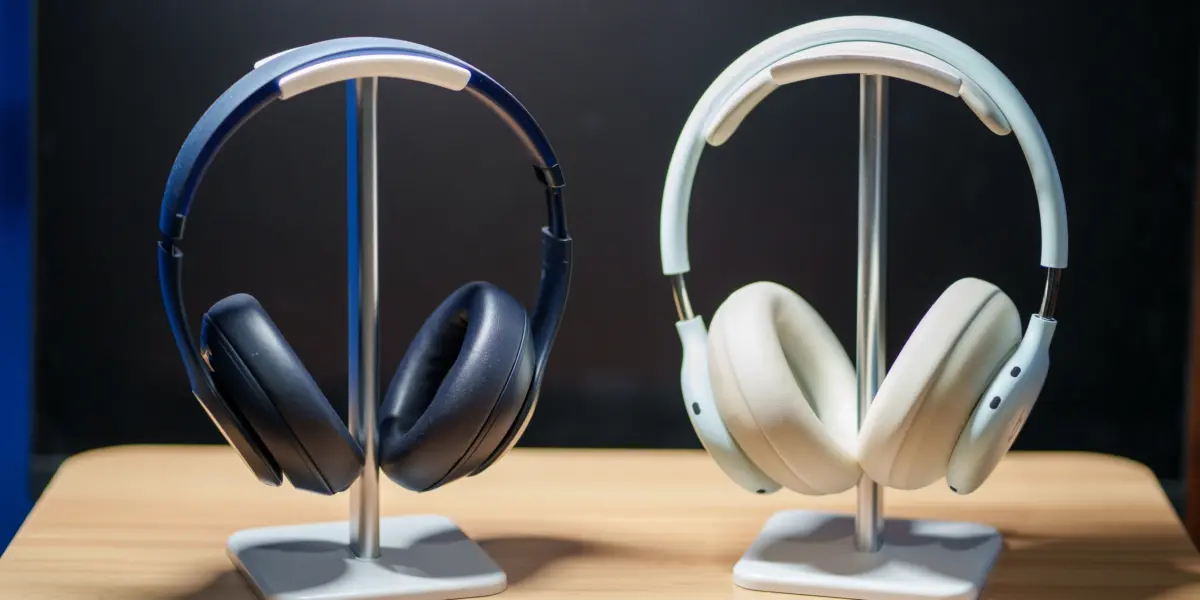
Executive Overview
The landscape of consumer audio has shifted dramatically over the last few cycles, with Apple’s subsidiary, Beats by Dre, attempting to balance high-end technological integration with mainstream accessibility. Following the September rollout of the flagship Beats 360—the brand’s first true premium over-ear release since the debut of the Beats Studio Pro in 2023—consumers face a compelling dilemma.
On one hand, the Beats 360 represents the cutting edge of acoustic engineering, offering refined Active Noise Cancellation (ANC), seamless Apple ecosystem integration, and modular, swappable ear cushions. On the other hand, the older Beats Studio Pro has aged gracefully, carving out a niche for budget-conscious buyers through aggressive retail discounting, a more travel-friendly foldable chassis, and the inclusion of both legacy 3.5mm and lossless USB-C wired audio connectivity.
This comprehensive guide analyzes the functional, financial, and ecosystem-based trade-offs between these two heavyweights. Whether you are navigating daily commutes, prioritizing spatial audio fidelity, or seeking out maximum value per dollar, this analysis will help you determine which pair of over-ear headphones deserves a spot in your tech arsenal.
Detailed Chronology & Evolution of Beats Over-Ear Design
To understand the current product matrix, one must look at how Beats has evolved its industrial design philosophy over the past half-decade.

The 2023 Pivot: Beats Studio Pro
When the Beats Studio Pro launched in 2023, it was positioned as a bridge between the ecosystem-heavy AirPods Max and the cross-platform, bass-forward legacy of the traditional Beats lineup. Powered by a custom Beats proprietary acoustic platform, the Studio Pro aimed to satisfy audiophiles and casual listeners alike.
However, its release was accompanied by certain compromises. While it featured advanced spatial audio, dynamic head tracking, and lossless audio support via USB-C, it retained the classic folding hinge design that fans of the Studio series had come to expect. This design allowed the earcups to pivot inward, collapsing neatly into a compact, included hardshell carrying case. Furthermore, Beats kept the traditional 3.5mm analog headphone jack—a vanishingly rare inclusion in modern wireless flagships—allowing users to plug directly into legacy gear, in-flight entertainment systems, and analog mixing setups without consuming battery power.
The 2026 Shift: The Arrival of the Beats 360
Fast forward to September, when Apple introduced the Beats 360. Signaling a stark departure from the Studio Pro’s utilitarian approach, the Beats 360 was built from the ground up to compete more directly with ultra-premium offerings like the Sony WH-1000XM5 and Bose QuietComfort Ultra.
The Beats 360 prioritized structural sleekness and customizability over packability. Abandoning the traditional folding hinge—a mechanical weak point in many over-ear designs—the Beats 360 features a rigid, streamlined headband and static, rotating earcups. This trade-off allowed engineers to optimize the internal acoustic chambers and integrate upgraded microphone arrays for drastically improved ANC and Transparency modes. Moreover, the introduction of a modular design philosophy, highlighted by customizable exterior plates and easily swappable UltraPlush magnetic ear cushions, marked a new era of repairability and aesthetic personalization for the brand.

Supporting Context & Metrics: Feature-by-Feature Comparison
Choosing between the Beats 360 ($349) and the Beats Studio Pro ($199–$249 retail, frequently discounted) ultimately boils down to a calculation of features, lifestyle utility, and price.
Pricing and Value Proposition
- Beats Studio Pro: Retailing initially at $349, the Studio Pro has matured into a discount champion. Savvy shoppers can routinely find these headphones on major e-commerce platforms like Amazon for between $199 and $249. This makes them significantly more affordable—often saving buyers $100 to $150 compared to the newer flagship.
- Beats 360: Command a strict, undiscounted price of $349. Because they are the newest addition to the lineup, third-party retailers have yet to introduce meaningful price cuts, placing them firmly in the premium pricing tier.
Ergonomics, Form Factor, and Portability
- The Case for the Studio Pro: Portability is where the Studio Pro punches well above its weight class. Thanks to its classic folding mechanism, the headphones collapse into a tight footprint that easily slips into cramped backpacks, briefcases, or small tote bags. Additionally, the default leather-like UltraPlush cushions offer plush comfort right out of the box without requiring additional purchases.
- The Case for the Beats 360: The lack of a folding mechanism means the Beats 360 must be carried in a slightly larger, flatter hardshell case. However, what they lack in foldability, they make up for in long-term durability and ergonomic weight distribution. The clamping force is finely tuned for prolonged listening sessions, and while the stock cushions are comfortable, the real triumph lies in the modularity: swapping out worn-out earcups takes seconds, dramatically extending the lifespan of the hardware.
Connectivity and Wired Audio
- Beats Studio Pro: A massive selling point for traveling professionals and gamers is the Studio Pro’s inclusion of dual connectivity options. It features both a 3.5mm analog jack and lossless audio over USB-C. This ensures zero latency when plugged into a Nintendo Switch, a commercial airplane’s entertainment screen, or a professional audio interface.
- Beats 360: In a controversial move that mirrors broader industry trends, the Beats 360 strip away all physical wired audio ports. There is no 3.5mm jack, nor is there support for USB-C audio transmission. They are strictly wireless Bluetooth devices. For users heavily embedded in wireless ecosystems, this is a non-issue; however, for frequent flyers and retro-hardware enthusiasts, it is a glaring omission.
Acoustic Performance, ANC, and Ecosystem Integration
- Noise Cancellation & Transparency: The Beats 360 run circles around the older Studio Pro in this category. The upgraded processor and microphone arrays deliver significantly stronger Active Noise Cancellation, successfully dampening high-frequency chatter and deep low-end rumbles alike. More importantly, the Transparency mode on the Beats 360 sounds remarkably natural. On the Studio Pro, the transparency mode can sound muffled, often forcing users to physically lift an earcup to engage in a conversation—a friction point entirely resolved on the 360.
- Device Switching and Apple Ecosystem: While both pairs feature Apple-centric pairing comforts, the Beats 360 introduce true, instantaneous automatic device switching across iCloud-linked devices (iPhone, iPad, Mac, and Apple Watch). If you are listening to music on your Mac and an incoming call rings on your iPhone, the transition is seamless. The Studio Pro supports ecosystem pairing, but lacks the fluid, modern background-hand-off reliability found in the newer 360 model.
Official Statements and Industry Insights
In recent product briefs and developer roundtables, Apple’s audio division has emphasized that the Beats brand is evolving to serve two distinctly different user profiles.
According to product positioning insights, the Beats Studio Pro was designed as an "all-terrain workhorse"—a device engineered to offer maximum connection versatility (via legacy wires) and physical adaptability (via folding hinges) for users on a tighter budget. It remains a staple for studio engineers, budget-conscious students, and traditionalists who refuse to surrender physical ports.
Conversely, industry analysts note that the Beats 360 represents Apple’s vision for the future of lifestyle audio: premium, modular, and deeply integrated into software-defined ecosystems. By removing mechanical hinge points and legacy ports, engineers were able to dedicate internal volume entirely to acoustic dampening chambers and advanced silicon.

A senior Beats hardware spokesperson noted during the 360 launch cycle:
"We wanted to build an over-ear experience that focuses intensely on the purity of the active acoustic environment. By refining our spatial audio pipelines and introducing modular, user-replaceable wear-components, we are creating a product that not only sounds superior day one, but maintains its integrity over years of heavy daily use."
Future Outlook: Which Pair Should You Buy?
As the audio market moves deeper into an era dominated by wireless stability, spatial processing, and software-driven enhancements, the choice between these two headphones highlights a classic consumer crossroads: cutting-edge performance versus practical utility.
Buy the Beats Studio Pro if:
- You are on a strict budget: Saving $100 to $150 via retail discounts makes the Studio Pro an exceptional value proposition.
- You rely on wired connections: If you frequently plug into analog airplane audio systems, mixing boards, or legacy gaming consoles via a 3.5mm jack or USB-C audio, the Studio Pro is mandatory.
- Packability is your priority: If you despise bulky hard cases and demand headphones that fold down into a compact travel footprint, the Studio Pro wins hands-down.
Buy the Beats 360 if:
- You demand top-tier ANC and Transparency: The acoustic performance, environmental noise suppression, and natural passthrough mode on the Beats 360 are generations ahead.
- You live inside the Apple Ecosystem: True automatic device switching and frictionless iCloud pairing make the Beats 360 feel like a true first-party Apple accessory.
- You care about long-term sustainability: The modular design—featuring easily swappable ear cushions and customizable exterior plates—ensures that when normal wear-and-tear sets in years down the road, you can refresh your hardware rather than throw it away.
Ultimately, while the Beats Studio Pro remains a competent, feature-rich device for its discounted price, the Beats 360 stands as the superior overall headphone. It delivers the refinement, comfort, and technological prowess expected of a modern flagship, making it the definitive choice for anyone seeking the ultimate Beats over-ear experience.