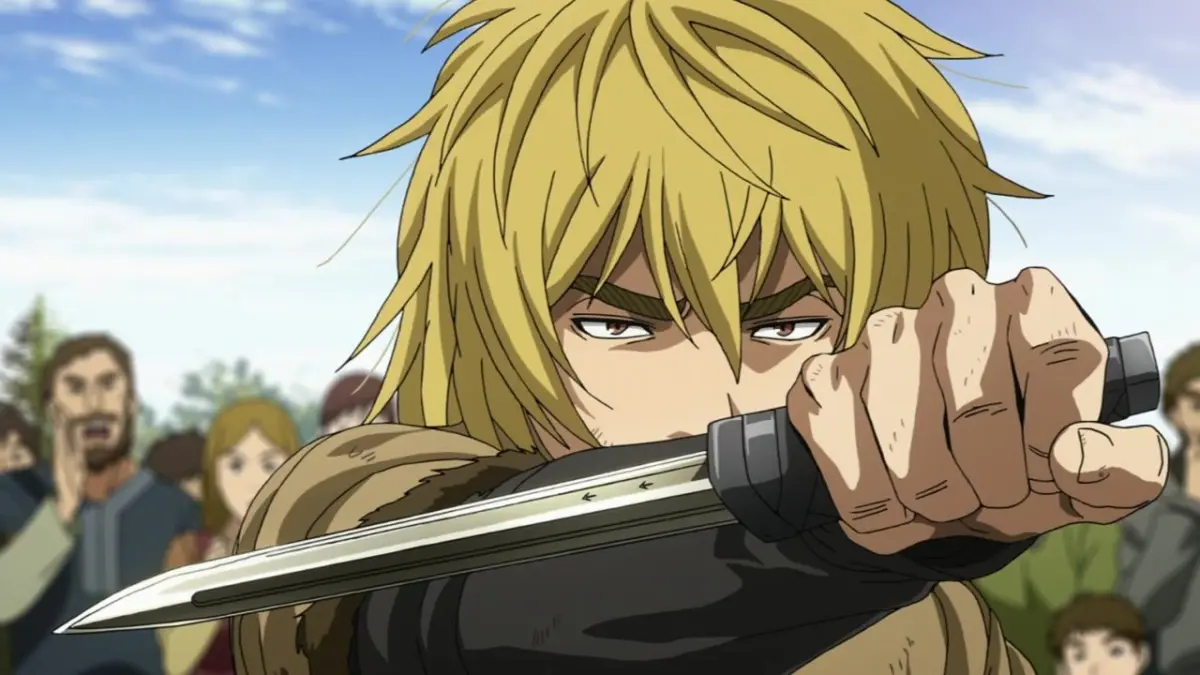
In the vast and frequently formulaic landscape of modern shonen and seinen anime, few protagonists face a trial as psychologically taxing or existentially harrowing as Thorfinn of Vinland Saga. Initially introduced as a bloodthirsty, vengeance-driven child soldier navigating the brutal theater of 11th-century Viking expansionism, Thorfinn’s narrative trajectory stands as a staggering subversion of traditional tropes.
Created by Makoto Yukimura, Vinland Saga sets out wearing the aesthetic skin of a historical action epic—complete with visceral raids, tactical military campaigns, and unrelenting violence—only to systematically dismantle those very foundations. Rather than celebrating physical dominance, the series champions an agonizing, counter-cultural thesis: true strength lies not in the capacity to destroy an adversary, but in the radical, unyielding rejection of the concept of an enemy altogether.
By analyzing the journey from Thorfinn’s formative trauma to his harrowing redemption in the "Slave Arc" (Season 2), this article explores how Vinland Saga challenges the core power-scaling fantasies of the anime medium. It redefines heroism through the lens of labor-intensive pacifism, psychological reckoning, and the painful unlearning of systemic violence.
Detailed Chronology: From Vengeance to Void
1. The Crucible of Blood and the Seed of Wisdom
The foundational inciting incident of Vinland Saga occurs in the shadow of betrayal. Thors, a legendary Jomsviking warrior who faked his death to live a quiet life as a pacifist farmer, is forced back onto the bloody waters of war to protect his settlement. Despite his peerless combat prowess, Thors chooses to disable his attackers rather than slaughter them. When he is ultimately outmaneuvered and ambushed by the cunning mercenary leader Askeladd, Thors sacrifices his life to guarantee the safe escape of his crew and his young son, Thorfinn.
As Thors lies dying, he imparts a final, paradigm-shifting lesson to the young boy who would soon dedicate his life to murderous retribution:
"Listen to me, Thorfinn. You have no enemies. No one has any enemies. There is no one in this world that you should hurt."
For a child raised on the hyper-masculine, honor-bound ethos of the Viking age, these words are not immediately understood as wisdom; they are experienced as an impossible paradox. Thorfinn’s response to this trauma is absolute immersion into the cycle of violence. He joins Askeladd’s band, biding his time for a legal duel to avenge his father, spending over a decade turning himself into a hollow, remorseless killer whose humanity is eaten away by single-minded hatred.
2. The Collapse and the "Slave Arc" (Season 2)
The psychological architecture of Vinland Saga reaches its structural turning point with the death of Askeladd at the hands of Prince Canute. Deprived of his singular purpose, his target, and his reason for breathing, Thorfinn’s worldview shatters. He is sold into slavery, working the muddy fields of Ketil’s farm in Southern Denmark.
This phase of the narrative, widely praised as the "Slave Arc," marks a profound departure from traditional battle anime. Stripped of his daggers, his social status, and his physical agency, Thorfinn is forced to confront the literal ghosts of his past. He suffers from chronic, debilitating Post-Traumatic Stress Disorder (PTSD), plagued by night terrors where the countless men he murdered drag him down into a literal abyss of blood and ash.
It is here that Thorfinn finally begins to decode his father’s dying words. He realizes that by reducing others to "enemies" to justify his own violence, he became a monster. His transformation in this arc is not characterized by leveling up or mastering a new martial art; rather, it is a grueling, daily confrontation with guilt, remorse, and the physical labor required to rebuild what he once helped destroy.
To fully appreciate the narrative subversion performed by Vinland Saga, one must examine the broader cultural context of the anime industry. The medium is overwhelmingly dominated by the power-fantasy framework.
The Power-Scaling Paradigm: From pioneering titles like Akira Toriyama’s Dragon Ball (Goku) and Eiichiro Oda’s One Piece (Luffy) to contemporary juggernauts like Gege Akutami’s Jujutsu Kaisen (Yuji Itadori) and Chu-Gong’s Solo Leveling (Sung Jin-Woo), the structural heartbeat of action anime is progression through combat. Protagonists train rigorously, unlock esoteric power-ups, defeat escalating tiers of antagonists, and measure their personal worth through physical supremacy.
The Rejection of the Duel:Vinland Saga operates as a direct counter-narrative to this formula. While Wit Studio (Season 1) and MAPPA (Season 2) animate breathtaking, fluid battle sequences that satisfy the appetite of action enthusiasts, the narrative consistently pulls the rug out from under the audience. Fights do not resolve systemic conflicts; they perpetuate generational trauma.
Audience Reception and Critical Acclaim: Upon the release of Season 2, initial fan reactions were mixed due to the dramatic shift in pacing and the near-total absence of sword fights in the early episodes. However, retrospective critical analysis has cemented the "Farmland Saga" as a masterpiece of character development, proving that mainstream anime audiences are willing to embrace complex moral interrogations over superficial adrenaline spikes.
Official Statements and Creator Insights
The philosophical weight of Vinland Saga stems directly from the creative vision of manga author Makoto Yukimura. In various interviews discussing the evolution of Thorfinn, Yukimura has frequently reflected on the dangers of romanticizing historical and fictional violence.
Deconstructing the Warrior Myth: Yukimura has noted that when he began writing the series, he was heavily inspired by the raw, kinetic energy of historical Viking chronicles. However, as the narrative progressed, he felt an ethical responsibility to question the glorification of battle. "If you depict war as cool," Yukimura has suggested in conceptual discussions about the series, "you are inevitably encouraging young people to accept it as a solution."
The Weight of Pacifism: The author has frequently addressed the criticism that Thorfinn’s pacifism is unrealistic or weak. Yukimura deliberately constructed Thorfinn’s path to be as painful, humiliating, and physically punishing as possible precisely to illustrate that choosing peace is exponentially more difficult than drawing a sword. In Vinland Saga, pacifism is not framed as a moral high ground achieved overnight, but as an ongoing, exhausting practice that requires infinite patience and resilience.
Future Outlook: The Road to Vinland
As Vinland Saga looks toward future adaptations covering the remaining arcs of the manga, the thematic stakes continue to expand. Thorfinn’s overarching mission is no longer merely personal survival or local atonement; it is the establishment of a peaceful, multi-ethnic settlement free of slavery and war in Vinland (North America).
This upcoming phase of the story promises to test whether Thorfinn’s philosophy of radical non-violence can survive first contact with systemic geopolitical realities and the inevitable friction of cross-cultural expansion. By refusing to let its protagonist default to the easy comfort of a blade, Vinland Saga has carved out a permanent, irreplaceable legacy in anime history. It serves as an enduring reminder that the most radical thing an action hero can do is put down their weapon and choose to build, rather than destroy.