Executive Overview
Few subgenres in cinema capture existential dread quite like cosmic horror. Rather than relying on traditional, grounded tropes like serial killers, masked slashers, or conventional paranormal spirits, cosmic horror taps into a far more profound and destabilizing fear: human insignificance in the face of an infinite, largely indifferent universe. This genre posits that the cosmos is not merely empty space, but a dark expanse populated by forces, entities, and concepts utterly beyond human comprehension.
Cinematic milestones such as Alex Garland’s Annihilation (2018), John Carpenter’s The Thing (1982), and Richard Stanley’s Color Out of Space (2019) lean heavily into this unsettling existential baseline. Similarly, films like The Void (2016) and In the Mouth of Madness (1994) wade deep into Lovecraftian waters, while reality-bending indies like The Endless (2017) and Coherence (2013) force characters—and audiences—to question the very fabric of human identity and perception.
Yet, sitting comfortably alongside these masterpieces is Paul W.S. Anderson’s 1997 sci-fi horror hybrid, Event Horizon. Initially dismissed by critics and largely abandoned by audiences at the box office, the film has since undergone a profound critical reassessment. It is now celebrated as a cult classic that maps a literal and psychological descent into hell. Operating at the intersection of technological hubris and eldritch terror, Event Horizon excels through its uncompromising commitment to the grotesque. For those looking to revisit its chilling corridors—or experience them for the first time amidst whispers of an unexpected franchise expansion—the film is currently available to stream for free on Pluto TV.
Detailed Chronology: The Voyage into the Unknown
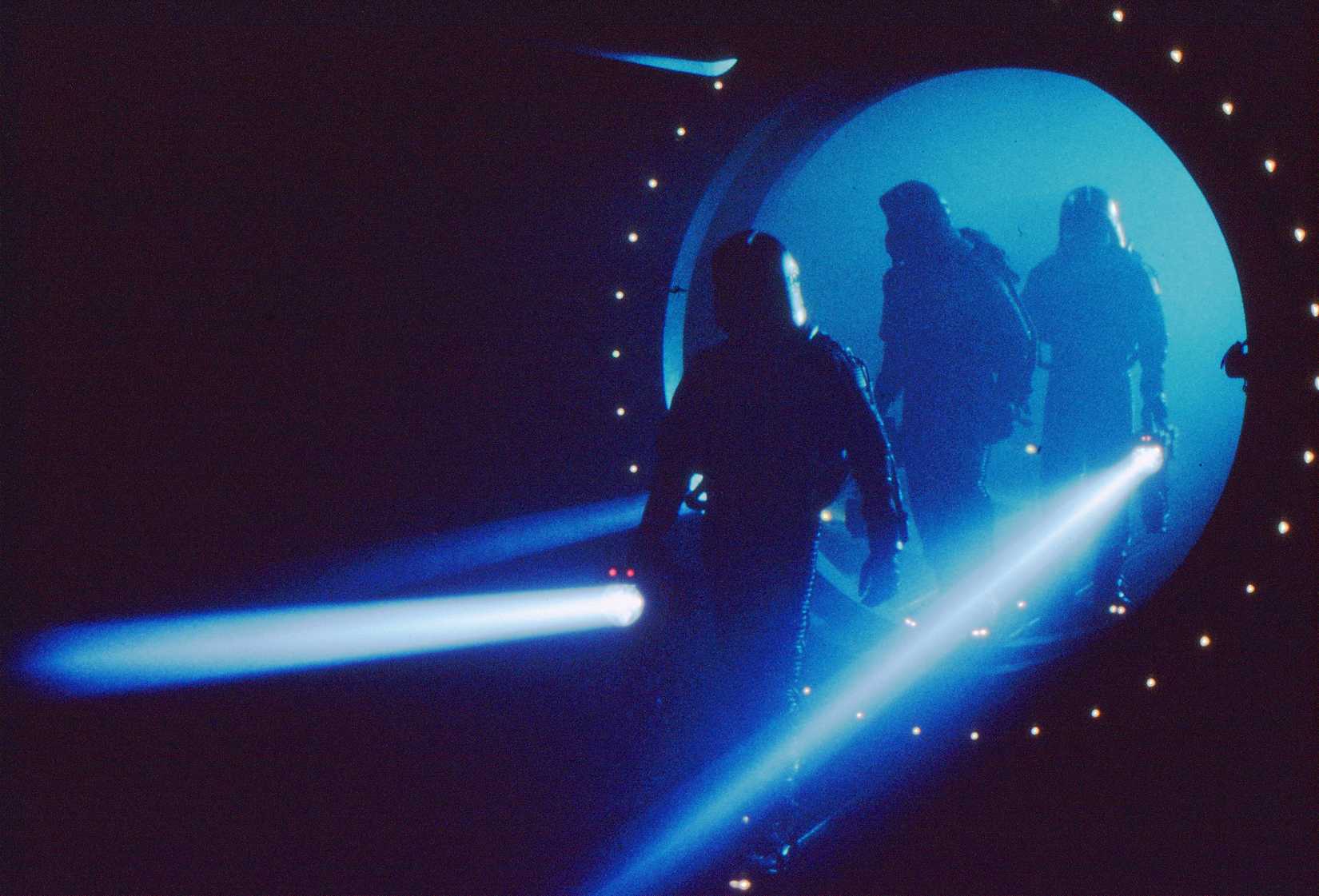
Set in the grim, near-future year of 2047, Event Horizon begins with a distress signal intercepted by space authorities. The origin of the signal is the Event Horizon, an ultra-advanced experimental spacecraft that mysteriously vanished during its maiden voyage seven years prior. To investigate the derelict vessel, a hardened rescue crew is dispatched aboard the spacecraft Lewis and Clark, led by the steady and pragmatic Captain Miller (Laurence Fishburne). Accompanying them is Dr. William Weir (Sam Neill), the brilliant yet emotionally compromised astrophysicist who designed the Event Horizon’s revolutionary propulsion system.
As the rescue team approaches the silent ship, Dr. Weir attempts to brief them on the physics behind the vessel’s experimental gravity drive. Designed to fold space-time, the drive was meant to allow instantaneous travel across interstellar distances by creating an artificial black hole. However, upon boarding the target vessel, the crew is immediately greeted by a chilling, oppressive atmosphere. The ship is eerily frigid, its metallic corridors echoing with silence and decay.
The investigation quickly takes a macabre turn when the crew uncovers a recovered video log left behind by the original crew. The footage reveals a horrifying descent into madness, self-mutilation, and sadistic slaughter, executed with gleeful depravity. It becomes shockingly clear that the Event Horizon did not simply travel through space; it punched a hole straight into a dimension of pure, sentient evil.
As the rescue team attempts to escape back to the Lewis and Clark, the Event Horizon actively sabotages their efforts, destroying their primary escape vehicle. Trapped aboard a ship that appears to have developed a malevolent consciousness, the crew members are systematically targeted not just by physical threats, but by vivid, personalized hallucinations that exploit their deepest psychological traumas and guilt. One by one, the ship turns the crew against their own minds, transforming the vessel into a floating slaughterhouse of psychological and physical terror.
Supporting Context & Metrics: Architecture of a Nightmare
To understand why Event Horizon works on such a visceral level, one must examine its distinct architectural and thematic design. While films like Ridley Scott’s Alien (1979) and Andrei Tarkovsky’s Solaris (1972) established the template for atmospheric, isolated space horror, Paul W.S. Anderson consciously sought to break away from sterile, futuristic spaceship tropes.

In a 2020 retrospective interview with The Ringer, Anderson detailed his visual philosophy:
"I wanted to do something different that hadn’t been done in spaceships before, and because we were telling a gothic horror story, I reached back in time."
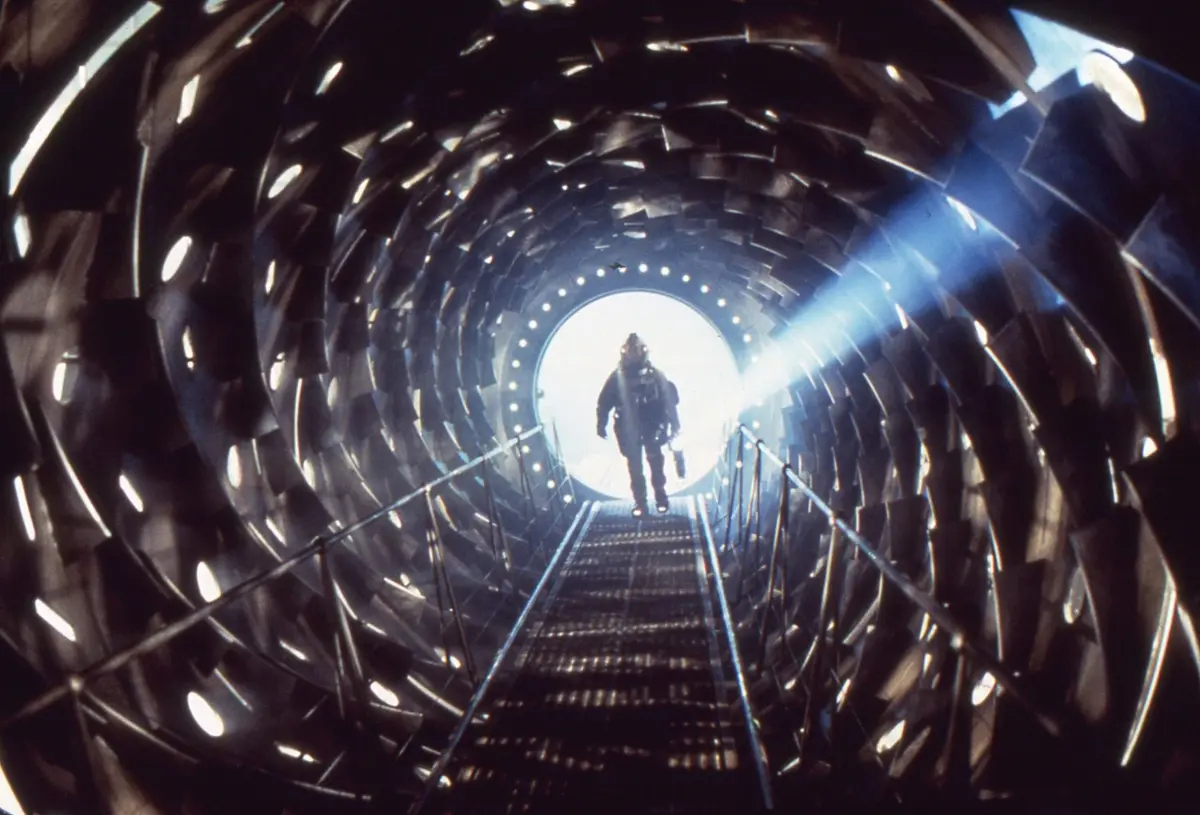
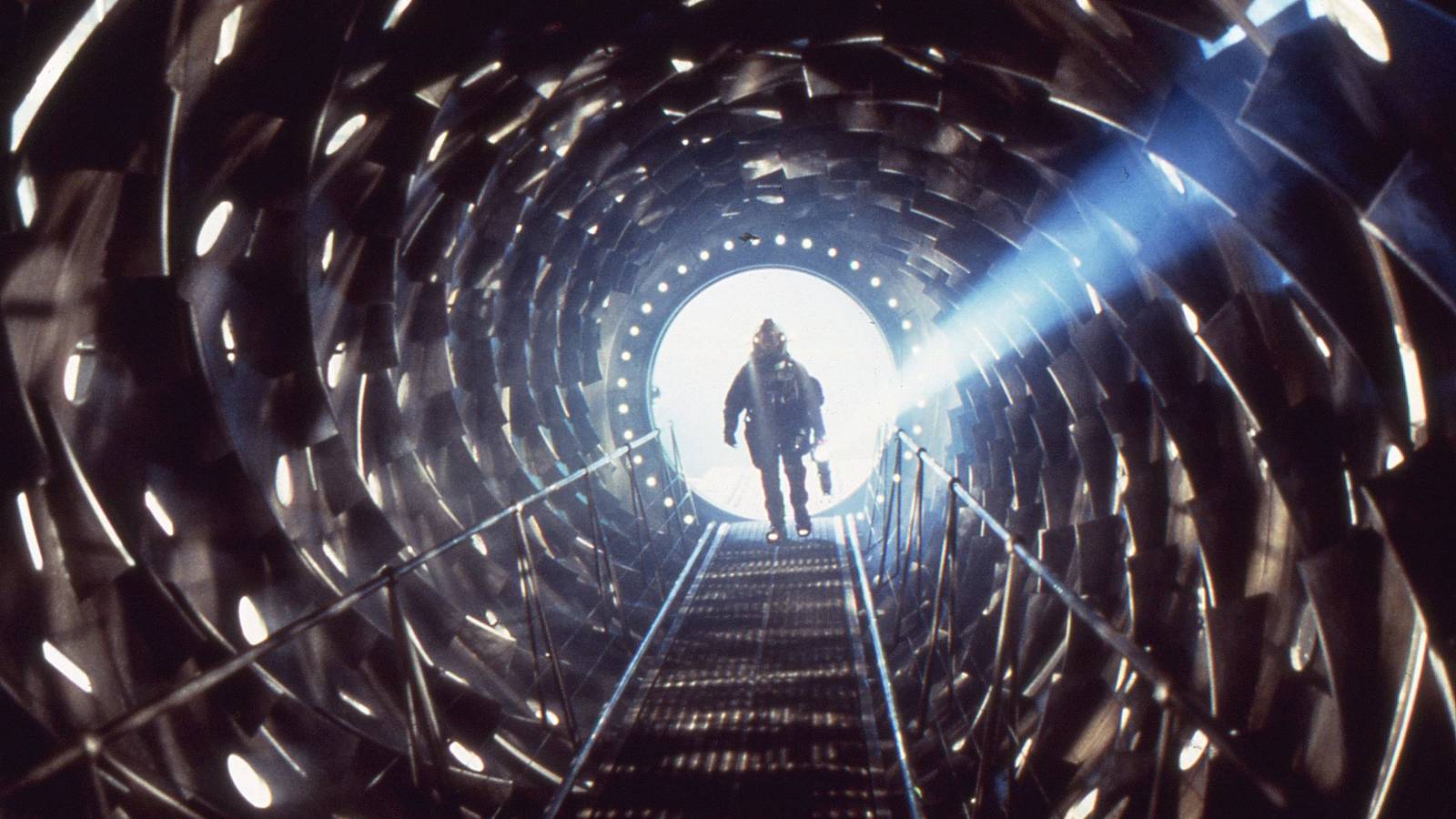
Anderson and his design team looked to historic architecture—specifically drawing inspiration from the Notre Dame Cathedral—to construct the interiors of the Event Horizon. When the ship first looms into view against the backdrop of deep space, its silhouette deliberately mimics a giant crucifix. Inside, the vessel rejects the clean, utilitarian lines of traditional sci-fi ships in favor of sprawling, gothic chambers, claustrophobic spiral staircases, and shadowy halls that evoke a haunted medieval castle rather than a high-tech vessel.
This design choice serves a thematic purpose. The experimental gravity drive—the embodiment of human hubris and the desire to conquer the stars—functions as a literal gateway to hell. Its central core rotates like medieval torture machinery, casting spinning, cross-like shadows across the rooms. This seamless fusion of high-end science fiction and dark, ecclesiastical gothic horror allows the film’s eldritch elements to feel organic rather than out of place.
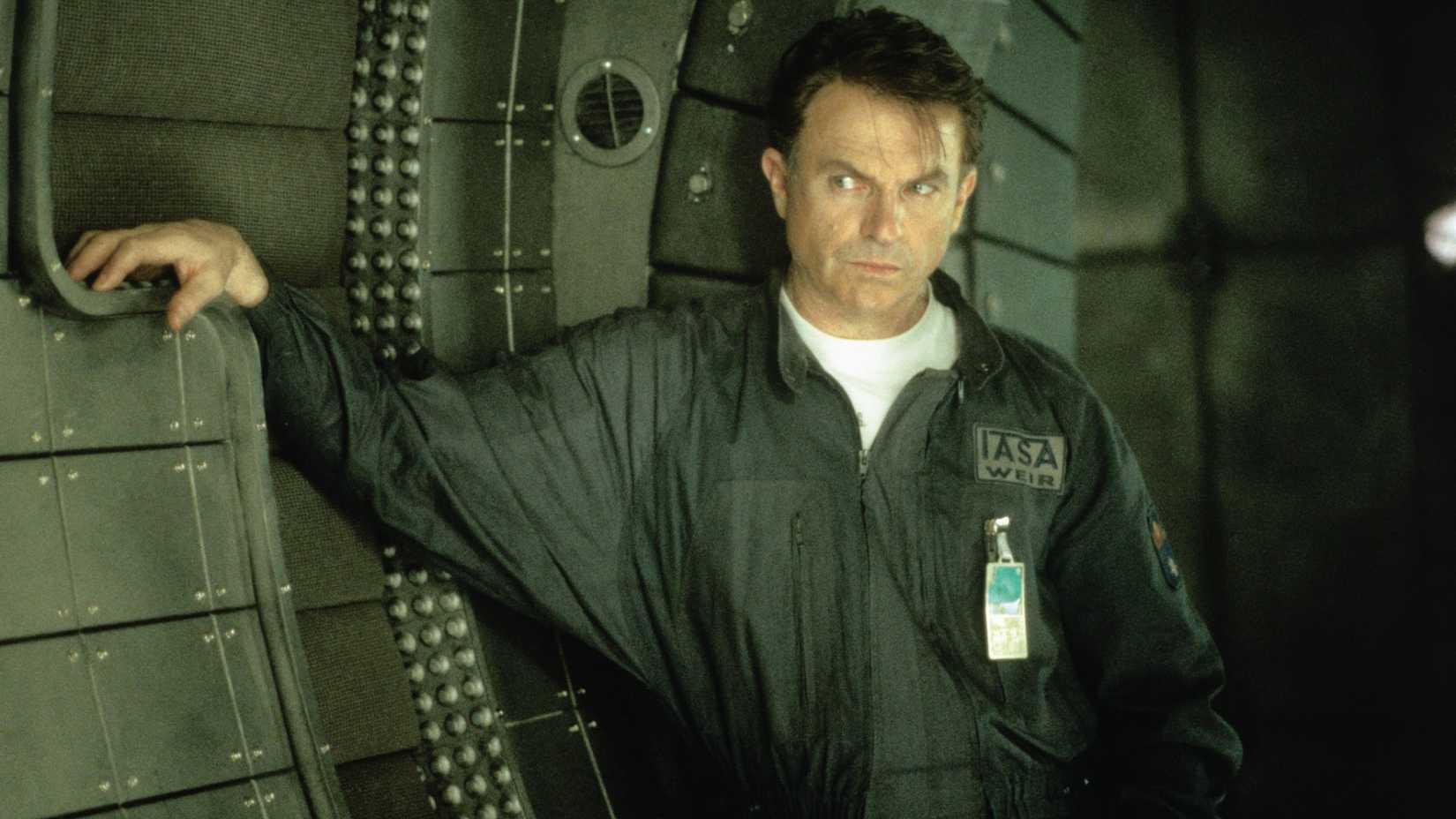
Furthermore, Event Horizon shares deep thematic DNA with Clive Barker’s Hellraiser (1987). In both narratives, exposure to a dimension beyond human comprehension strips individuals of their sanity and humanity, reducing them to playthings of sadomasochistic torment. The film posits that humanity is fundamentally unequipped to process absolute, primordial knowledge. As characters are exposed to the ship’s dark dimension, they are literally and metaphorically robbed of their sight, echoing the iconic line uttered by a possessed Dr. Weir: "Where we’re going, we won’t need eyes to see."
Official Statements & Production Insights
The journey of Event Horizon from a troubled 1997 box office disappointment to a revered cult classic is one of Hollywood’s most fascinating trajectories. Plagued by studio interference, aggressive editing to secure an R-rating, and a rushed post-production schedule, the original theatrical cut left behind a massive trove of footage that fans have hunted for decades.
Director Paul W.S. Anderson has frequently spoken about the legendary "lost cut" of the film, which contained far more graphic depictions of the original crew’s horrific orgies of self-destruction and torture. In past interviews, Anderson noted the immense pressure from Paramount Pictures to truncate the runtime and soften the most visceral sequences following dismal test screenings.
Despite these early executive hurdles, the film’s cast members have consistently defended its bold artistic vision. Laurence Fishburne’s grounded, authoritative portrayal of Captain Miller anchors the movie’s descent into madness, while Sam Neill’s transformative performance as the tragic, corrupted Dr. Weir remains one of the 1990s’ most memorable villainous turns.
In recent years, Paramount has embraced the film’s enduring legacy, fueling renewed interest through anniversary releases, merchandise, and ongoing discussions regarding expanded universe projects, including comic book tie-ins and potential television or sequel developments. The cultural staying power of Event Horizon proves that genuine artistic daring often takes decades to be fully appreciated by mainstream audiences.
Future Outlook: The Resurgence of Event Horizon
As modern audiences continue to re-examine 1990s genre cinema through a more appreciative lens, Event Horizon stands out as a high-water mark for studio-backed science fiction horror. Its willingness to embrace unrelenting bleakness, bodily mutilation, and metaphysical terror sets it apart from safer, more sanitized modern franchise entries.
With recent developments pointing toward potential expanded media—such as comic book explorations of the ship’s dark origins and persistent industry rumors regarding a follow-up project—the intellectual property is hotter now than it was during its initial theatrical run nearly thirty years ago.
For newcomers and die-hard fans alike, the timing could not be better. As streaming platforms continually rotate their libraries, the recent addition of Event Horizon to Pluto TV provides an accessible, zero-cost gateway back into the dark corridors of the most terrifying ship in cinematic history. Whether viewed as a cautionary tale against technological overreach or a pure, adrenaline-fueled descent into cosmic damnation, Paul W.S. Anderson’s gothic nightmare remains an essential, spine-chilling watch for anyone brave enough to step across the threshold.