By Investigative Staff
Published: May 2018
Executive Overview
In the wake of a cultural reckoning that has successfully upended powerful figures in Hollywood, media, and politics, the explosive national dialogue surrounding workplace misconduct has largely focused on high-profile, white-collar environments. However, a parallel battle is quietly unfolding on the front lines of corporate America—within blue-collar spaces, customer service hubs, and call centers where marginalized workers often bear the brunt of institutional apathy.
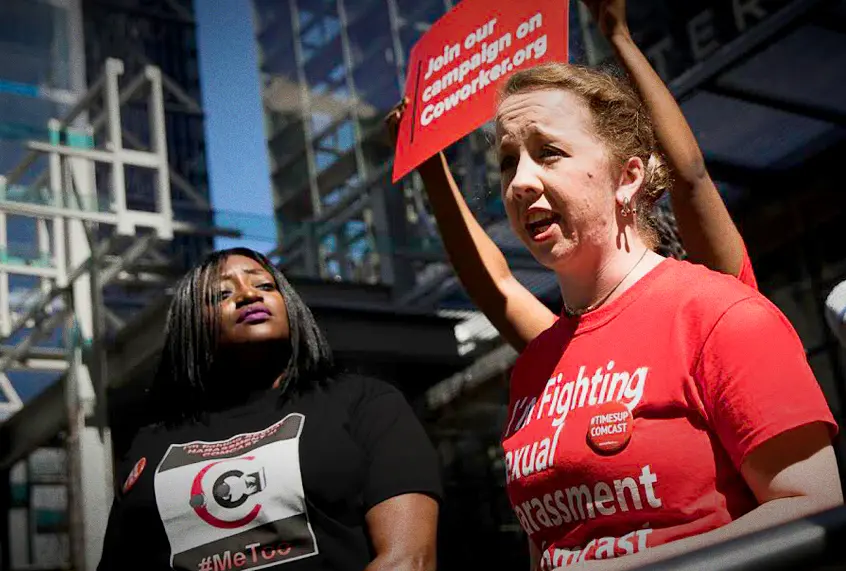
At telecommunications giant Comcast, former employees are stepping forward to expose what they describe as a deeply entrenched culture of sexual harassment, systemic indifference, and aggressive retaliation. Led by former representatives Laterrica Perry and Rylinda Rhodes, a growing coalition of current and former workers, alongside thousands of sympathetic consumers, delivered a petition exceeding 4,000 signatures to Comcast’s corporate headquarters in Philadelphia.
The petition demands that Comcast Chief Executive Officer Brian Roberts take decisive action to overhaul the company’s handling of sexual misconduct and protect employees who report abuses. Despite facing severe professional, financial, and personal repercussions—ranging from diagnosed Post-Traumatic Stress Disorder (PTSD) to sudden termination—these women are refusing to remain silent. Their crusade sheds light on the darker, less-visible side of the corporate #MeToo movement, proving that the fight for workplace dignity extends far beyond the executive suites.
Detailed Chronology: Anatomy of Misconduct and Retaliation
Laterrica Perry’s Battle in Memphis
The ordeal faced by Laterrica Perry, a 30-year-old former sales representative at a Comcast facility in Memphis, Tennessee, illustrates the severe obstacles victims face when navigating internal corporate grievance procedures.
In July 2017, Perry took the courageous step of filing an anonymous report with the Comcast Human Resources department. She backed her complaint with undeniable evidence—including text messages and call records—detailing months of persistent sexual harassment by her direct supervisor. The inappropriate behavior included unwanted sexual advances and explicit commentary that poisoned her work environment.
According to Perry, her refusal to acquiesce to her supervisor’s advances triggered an immediate campaign of retaliation. Her boss allegedly weaponized his managerial authority against her, denying her authorized sick leave and withholding critical letters of recommendation essential for career mobility.
Compounding the trauma, Perry claims that Human Resources moved at a glacial pace, failing to terminate the offending supervisor until October 2017. During those intervening months, she asserts that the supervisor actively worked to tarnish her professional reputation within the company.
The psychological toll was devastating. Perry was diagnosed with PTSD stemming from the sustained harassment and hostile work environment. Consequently, she was forced onto medical disability leave through March 2018, triggering a catastrophic drop in income that compelled her to execute a financial hardship withdrawal from her 401(k) retirement account to cover basic living expenses.
Adding insult to injury, Perry discovered on April 30, 2018, that she had been officially terminated by Comcast while she was awaiting a formal separation package.
"The only information I got was via e-mail saying that they had proceeded with the actual separation, but I didn’t get the actual package that showed why I was separated," Perry recounted in an interview. "I received everything, as far as my COBRA coverage, my 401(k) information. The only thing that I had not received is the explanation for my termination. I kind of felt like that was something suspicious."
Rylinda Rhodes and the 2012 Precedent
Perry’s experiences mirror those of Rylinda Rhodes, a former dispatch representative whose ordeal at Comcast spans the years 2007 to 2012. Rhodes, who worked across four different Comcast call centers and reported experiencing sexual harassment in all but one, became a central figure in organizing the workplace resistance.
Rhodes’s breaking point occurred when a male co-worker allegedly entered her office and physically groped her breasts. When she formally reported the incident, the internal response was hostile and dismissive. On August 1, 2012, Rhodes was terminated by Comcast—officially under the guise of health reasons—following a period of short-term medical leave taken to undergo talk therapy for the trauma she endured.
Rather than letting the experience break her, Rhodes launched an internal and public campaign in November 2017, coinciding with the peak of the national #MeToo movement. Her primary goal was to provide an institutional lifeline to workers who felt entirely isolated by corporate grievance structures.
Supporting Context & Metrics: The Blue-Collar #MeToo Blindspot
While public attention has justifiably fixated on high-profile entertainment moguls, news anchors, and politicians, statistics indicate that sexual harassment is profoundly pervasive in industries characterized by hourly wages, remote management, and corporate hierarchies.
According to data compiled by the Center for American Progress, approximately 1,200 formal charges of sexual harassment were filed with the Equal Employment Opportunity Commission (EEOC) within the information industry—which encompasses telecommunications giants like Comcast—between 2005 and 2015.
Experts note that blue-collar and customer-service environments create unique vulnerabilities for workers:
- Power Asymmetry: Call center and sales representatives often possess little job security and depend heavily on immediate supervisors for shift scheduling, metrics approvals, and advancement.
- Isolation: Remote offices and decentralized call centers often operate outside the watchful eye of main corporate headquarters, allowing toxic local management cultures to flourish unchecked.
- Demographics: A significant portion of frontline customer service and call center workers are women of color, who frequently face compounded vulnerabilities related to race, class, and economic stability when reporting misconduct.
For women like Perry and Rhodes, coming forward meant risking their primary sources of livelihood. The systemic failure of human resources departments to swiftly neutralize harassers—while simultaneously penalizing the victims—underscores a structural flaw in how major corporations police themselves.
Official Statements and Corporate Stance
Faced with mounting public pressure, petition deliveries, and media inquiries, Comcast has consistently defended its institutional record while maintaining that it enforces zero-tolerance policies regarding misconduct.
When Jezebel first broke the stories of Perry and Rhodes in February 2018, Jenni Moyer, Comcast’s Senior Director of Corporate Communications, issued a formal corporate response:
"Sexual harassment, or harassment of any kind, is not tolerated at Comcast. The company was founded on a foundation of respect, integrity and trust. We have strong policies against sexual and other forms of harassment and encourage employees to report any harassing behavior. Any allegation of harassment is taken very seriously."
Despite these assurances of stringent oversight, actions taken during the recent petition delivery painted a starkly different picture. When Rhodes, Perry, and a third former employee traveled to Philadelphia on May 2, 2018, to hand-deliver their petition directly to executive leadership, Comcast executives refused to meet with them.
Rather than viewing the refusal as a defeat, Rhodes framed the demonstration as an important symbolic milestone:
"It’s still a win. It lets them know people are watching and coming forth," Rhodes said. "It’s also for the ones that are still suffering. To know they are not alone. We are just getting started. All women should have the freedom to be their authentic self and not a scared version because of sexual harassment."
Future Outlook: Legacy of the Movement and the Road Ahead
The courage displayed by the former Comcast employees highlights a broader truth about the modern labor and civil rights movements: true accountability rarely trickles down voluntarily; it must be demanded from the bottom up.
Though NBCUniversal—a subsidiary of Comcast—has faced severe external scrutiny following high-profile scandals involving figures like Matt Lauer and veteran anchor Tom Brokaw, the internal experiences of hourly and salaried support workers demonstrate that corporate cultural reform remains incomplete.
Reflecting on the uphill battle ahead, Perry remains realistic about whether Comcast will voluntarily reform its practices:
"I have doubts that Comcast will be open to meeting with us and be open to resolving the issue that they have with sexual harassment," she noted.
Nevertheless, Perry harbors zero regrets about stepping into the public eye. By lifting the veil on corporate retaliation, she views her efforts as a vital public service designed to pave the way for future victims:
"What I’m doing is giving a voice to the voiceless. I’m empowering people to step forward and say if something happens to them, whether it be at Comcast or any other corporation… That’s my silver lining."
Both women plan to dedicate their futures to advocacy, resource distribution, and peer support networks. By transforming their personal traumas into communal armor, Perry and Rhodes are ensuring that the women who come after them will not have to navigate the dark, isolating corridors of corporate retaliation alone. The message delivered to Comcast’s Philadelphia headquarters resonates far beyond a single telecommunications firm: the era of institutional silence is over, and the reckoning has arrived for corporate America at every level.