Executive Overview
In the wake of a cultural reckoning that has exposed rampant sexual misconduct across Hollywood, media, and politics, the spotlight is increasingly turning toward corporate America’s blue-collar and customer-service sectors. For telecommunications giant Comcast, the pressure reached a boiling point when former call center and dispatch employees delivered a petition with over 4,000 signatures to the company’s Philadelphia corporate headquarters.
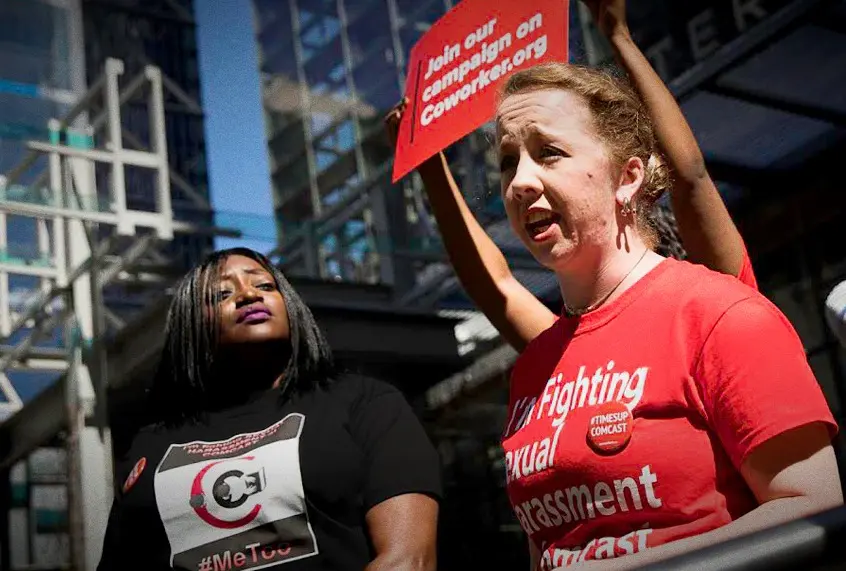
The demonstration, led by former sales representative Laterrica Perry and former dispatch representative Rylinda Rhodes, lays bare persistent allegations of sexual harassment, systemic managerial retaliation, and institutional indifference. Despite Comcast’s public assertions of zero tolerance, these women—joined by a growing chorus of advocates and former employees—contend that reporting misconduct within the corporation’s sprawling operational infrastructure frequently results in professional isolation, punitive demotions, or outright termination.
This unfolding controversy underscores a stark disparity in the #MeToo movement: while high-profile white-collar executives face swift public disgrace, workers in telecommunications and other hourly environments—disproportionately women of color—often labor in isolated, high-pressure environments where reporting abuse jeopardizes their financial security, mental health, and livelihoods.
Detailed Chronology of Events and Escalation
The grievances vocalized at Comcast’s headquarters are rooted in years of alleged systemic suppression and administrative failure. The timeline of events highlights a troubling pattern of internal reporting met with administrative stonewalling and subsequent retaliation.
The Case of Laterrica Perry: Memphis, Tennessee
In July 2017, Laterrica Perry, then a 30-year-old sales representative at a Comcast call center in Memphis, took a courageous step: she filed an anonymous report with the company’s Human Resources department. Armed with contemporaneous digital evidence—including text messages and call logs—Perry detailed a harrowing pattern of unwanted sexual advances, inappropriate comments, and harassment perpetrated by her direct supervisor.
Rather than offering immediate protection or administrative suspension, HR’s investigation dragged on for months. Perry asserts that during this protracted window, her supervisor actively retaliated against her for rebuffing his advances. She was repeatedly denied essential sick leave and refused a critical letter of recommendation necessary for career advancement within the company.
The toll on Perry’s well-being was severe. Diagnosed with post-traumatic stress disorder (PTSD) stemming from the harassment and subsequent retaliation, she was placed on disability leave through March 2018. This forced medical leave created a cascading financial crisis; to stay afloat, Perry was compelled to execute a hardship withdrawal from her 401(k) retirement account. Though she engaged in regular therapy sessions and psychiatric care, the professional fallout continued unabated.
On April 30, 2018, while awaiting a formal separation package to clarify her employment status, Perry received an unexpected email notification from Comcast. The message confirmed that her employment had been terminated, yet it omitted the standard separation documentation outlining the rationale for her dismissal. While she eventually received administrative paperwork concerning COBRA health continuation and her retirement assets, the explicit reason for her termination remained conspicuously absent—a move Perry and her supporters view as the culmination of sustained corporate retaliation.
The Case of Rylinda Rhodes: A Broader Pattern
Perry’s ordeal mirrors the experiences of Rylinda Rhodes, whose tenure at Comcast between 2007 and 2012 spans four different call centers, in three of which she alleges she faced sexual harassment.
Rhodes’s breaking point occurred when a co-worker allegedly entered her office and physically groped her breasts. When she formally reported the incident, the internal resolution process proved agonizing. While Comcast investigated her claims, Rhodes was instructed to apply for alternate positions within the company. Deeply traumatized, she went on short-term medical leave to seek talk therapy.
On August 1, 2012, Rhodes was officially terminated. While company records attributed her dismissal to health reasons, Rhodes maintains that her firing was direct retaliation for refusing to sweep her physical assault under the rug. Inspired by the momentum of the #MeToo movement in late 2017, Rhodes chose to break years of silence, launching an online petition via Coworker.org to demand sweeping accountability from Comcast CEO Brian Roberts.
The Corporate Confrontation in Philadelphia
On Wednesday, May 2, 2018, Perry, Rhodes, and a contingent of fellow former Comcast workers traveled to the company’s headquarters in Philadelphia to deliver their petition. Boasting over 4,000 signatures—including more than 100 individuals identifying as current or former Comcast employees and customers—the petition called upon executive leadership to fundamentally overhaul how workplace misconduct is investigated and punished.
Despite traveling to the corporate offices, the delegation was met with a closed door; Comcast executives refused to meet with them. Nevertheless, the activists framed the action as a pivotal victory in visibility. The demonstration served notice that corporate accountability cannot be evaded simply by ignoring survivors on the doorstep.
Supporting Context, Statistics, and Industry Metrics
While the initial waves of the #MeToo movement focused heavily on high-profile industries like entertainment, media, and politics, the structural vulnerabilities facing hourly and customer-service workers are immense.
Data from the U.S. Equal Employment Opportunity Commission (EEOC) highlights the scale of the issue within the broader information and telecommunications sector. Between 2005 and 2015, approximately 1,200 formal charges of sexual harassment were filed with the EEOC within the information industry alone. Advocacy groups note that these figures represent only a fraction of actual incidents, as fear of blacklisting, financial ruin, and lengthy litigation frequently deter hourly workers from coming forward.
In blue-collar and corporate call-center environments, power dynamics are heavily skewed. Call center employees are often subjected to rigid performance metrics, constant electronic monitoring, and direct oversight by micro-managers who wield significant discretionary power over schedules, bonuses, and job security. When a supervisor engages in harassment, the victim frequently realizes that challenging the authority figure can jeopardize their entire livelihood, creating a fertile ground for unchecked predatory behavior.
Furthermore, Comcast’s corporate ecosystem carries added layers of scrutiny. As the parent company of media powerhouse NBCUniversal, Comcast has faced intense public pressure regarding workplace culture. The conglomerate has weathered a series of high-profile #MeToo scandals within its news division, including the firing of Today show host Matt Lauer following multiple allegations of sexual misconduct, alongside subsequent accusations leveled against veteran news anchor Tom Brokaw. Against this corporate backdrop, the failure to adequately protect frontline service workers risks exposing a profound hypocrisy in how executive-level infractions versus call-center grievances are handled.
Official Statements and Corporate Response
Comcast has consistently denied tolerating harassment of any kind. In response to initial investigative reporting by Jezebel and subsequent inquiries by other media outlets in February 2018, Jenni Moyer, Senior Director of Corporate Communications at Comcast, issued a definitive statement:
"Sexual harassment, or harassment of any kind, is not tolerated at Comcast. The company was founded on a foundation of respect, integrity and trust. We have strong policies against sexual and other forms of harassment and encourage employees to report any harassing behavior. Any allegation of harassment is taken very seriously."
However, employee advocates argue that a chasm exists between corporate policy on paper and enforcement in practice. While HR departments emphasize reporting mechanisms, survivors like Perry and Rhodes contend that the internal machinery is engineered to protect the institution and insulate management rather than safeguard vulnerable employees from retaliation. The refusal of Comcast executives to meet with the petition delegation in May 2018 further fueled perceptions among workers that corporate assurances ring hollow.
Future Outlook and the Legacy of the Campaign
As the dust settles on the petition delivery in Philadelphia, the long-term implications for Comcast and corporate labor standards remain uncertain.
For her part, Laterrica Perry remains pessimistic about whether Comcast will voluntarily reform its internal grievance procedures. Yet, she views her public crusade not as a localized dispute, but as part of a broader mission to empower marginalized workers across all corporate structures. By sharing her struggles with PTSD and financial displacement, Perry aims to demystify the reporting process and equip future victims with the knowledge and resources necessary to navigate post-reporting retaliation.
Rylinda Rhodes shares a similar sentiment, emphasizing that the primary goal of the campaign is solidarity. Knowing how isolating and shameful the experience of workplace harassment can be, Rhodes hopes her advocacy reaches workers who feel trapped in toxic environments. Even if her story rescues just one person from despair, she considers the effort a success.
Ultimately, the courage of the women of Comcast serves as a critical reminder that the movement against workplace harassment extends far beyond red carpets and newsrooms. True corporate accountability requires dismantling the systemic barriers that silence hourly workers, ensuring that reporting abuse does not carry a devastating professional and personal penalty. As public scrutiny intensifies, companies like Comcast face a definitive choice: maintain a posture of defensive denial, or embrace structural transparency to ensure dignity and safety for every employee on the payroll.