Executive Overview
In the wake of a cultural reckoning that has fundamentally transformed how society addresses sexual misconduct in elite white-collar industries, the lived experiences of blue-collar and corporate support workers frequently remain overlooked. While the #MeToo movement has successfully toppled powerful executives, prominent politicians, and high-profile media figures in Hollywood and New York, a systemic undercurrent of harassment continues to affect frontline workers in structured corporate environments.
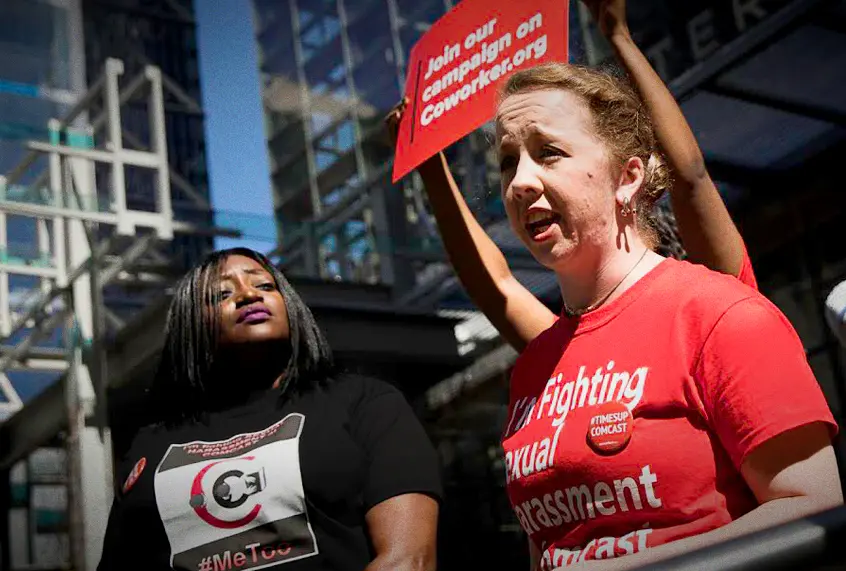
Nowhere has this stark contrast become more apparent than at telecommunications giant Comcast. In May 2018, former call center and dispatch employees stepped forward to challenge what they describe as a pervasive, deeply entrenched culture of sexual harassment and subsequent corporate retaliation. Spearheaded by former sales representative Laterrica Perry and former dispatch representative Rylinda Rhodes, a growing coalition of current and former workers delivered a petition boasting over 4,000 signatures to Comcast’s corporate headquarters in Philadelphia.
The petition, hosted on Coworker.org, directly challenges Comcast CEO Brian Roberts to overhaul the company’s internal reporting mechanisms, address rampant misconduct, and halt retaliatory practices against those who dare to speak out. Despite facing severe professional fallout, medical hardships, and corporate stonewalling, these women have united to amplify the voices of the marginalized, proving that the demand for workplace dignity and accountability belongs to every worker, regardless of their position on the corporate ladder.
Detailed Chronology: The Ordeals of Laterrica Perry and Rylinda Rhodes
The struggle for accountability at Comcast is rooted in harrowing personal accounts of abuse, institutional gaslighting, and systemic retaliation. The timelines provided by Perry and Rhodes expose critical vulnerabilities in how corporate human resources departments handle reports of sexual misconduct.
Laterrica Perry: The Memphis Sales Center
In July 2017, Laterrica Perry, then a 30-year-old sales representative at a Comcast facility in Memphis, Tennessee, reached her breaking point. For months, she had endured persistent and unwanted sexual advances, inappropriate commentary, and explicit propositions from her direct supervisor. Recognizing the toxicity of her environment, Perry chose to take formal action, filing an anonymous report with Comcast Human Resources accompanied by concrete evidence, including call logs and text messages.
What followed, according to Perry, was a campaign of targeted retaliation designed to force her out. She alleges that her supervisor systematically blocked her professional advancement, denied her legitimate requests for sick leave, and withheld essential letters of recommendation. Despite the clear digital evidence she provided, Comcast’s HR department moved at a sluggish pace, ultimately failing to terminate the supervisor until October 2017—months after the initial complaint was lodged. By then, the damage to Perry’s professional reputation within the company was already done.
The psychological toll of the harassment and subsequent retaliation was severe. Perry was medically diagnosed with Post-Traumatic Stress Disorder (PTSD) and placed on disability leave through March 2018. The extended absence precipitated a devastating drop in her income, forcing her to execute a premature hardship withdrawal from her 401(k) retirement account just to cover basic living expenses.
"I’ve been having regular therapy sessions, my psychiatrist helps, and being medically regulated has helped me for the most part," Perry shared.
However, the ordeal did not end with her medical leave. On April 30, 2018, while awaiting a formal separation package from the company, Perry discovered via a routine email that Comcast had quietly proceeded with her termination. While she received standard administrative documentation regarding her COBRA health insurance continuation and 401(k) assets, the company conspicuously failed to provide a formal explanation for her firing.
"The only information I got was via e-mail saying that they had proceeded with the actual separation, but I didn’t get the actual package that showed why I was separated," Perry noted. "I received everything, as far as my COBRA coverage, my 401(k) information. The only thing that I had not received is the explanation for my termination. I kind of felt like that was something suspicious."
Rylinda Rhodes: The Multi-Center Struggle
Rylinda Rhodes’s encounter with workplace misconduct spans a longer timeline, exposing systemic failures across multiple Comcast facilities. Having worked as a dispatch representative across four different Comcast call centers between 2007 and 2012, Rhodes reported experiencing verbal and physical sexual harassment in all but one of them.
The crisis culminated on August 1, 2012, when Rhodes was terminated following a formal complaint that a male coworker had entered her office and physically groped her breasts. Rather than protecting the victim, Comcast’s internal apparatus placed the burden on Rhodes. While she was on short-term medical leave—seeking talk therapy to cope with the profound trauma inflicted by the workplace—Comcast instructed her to apply for other jobs internally while ostensibly investigating her claims. Ultimately, Rhodes was fired on August 1, 2012, with her formal termination letter citing health reasons rather than the underlying misconduct.
Reflecting on the psychological barriers that kept her silent for years, Rhodes articulated the deep shame and self-doubt experienced by survivors of workplace harassment.
"The shame and embarrassment came from feeling powerless that this happened," she recalled. "I listened to what my supervisors and managers said, like, ‘hey, you’re sensitive,’ and I started believing that I was the problem. That was one of the hardest things to go through. Then I realized, ‘No, you are not too sensitive,’ ‘No, you’re not a prude.’ … There are rules set in place to prevent this and they did not follow the rules."
Supporting Context & Metrics: Blue-Collar Harassment and the Information Industry
While public discourse surrounding sexual harassment has justifiably focused on high-profile industries like entertainment, media, and politics, statistical data reveals that misconduct is equally prevalent—if not more deeply entrenched—in blue-collar and corporate support sectors where workers possess significantly less institutional leverage.
According to data compiled by the Center for American Progress, approximately 1,200 formal charges of sexual harassment were filed with the Equal Employment Opportunity Commission (EEOC) within the information industry—a broad sector encompassing telecommunications giants like Comcast—between 2005 and 2015. Despite these thousands of filings, workers in call centers, dispatch hubs, and customer service departments rarely command the public sympathy or legal firepower afforded to elite corporate employees.
For women of color, who make up a substantial portion of the frontline workforce in telecommunications call centers, the barriers to reporting are compounded by intersectional vulnerabilities. Power dynamics in a structured corporate environment often leave customer service representatives feeling entirely expendable. When HR departments prioritize institutional self-preservation over employee safety, vulnerable workers are forced to choose between enduring chronic abuse or facing financial ruin through termination and retaliatory blacklisting.
The grassroots campaign organized by Rhodes and Perry serves as a vital bridge, connecting isolated workers across regional hubs and proving that corporate malfeasance cannot easily be concealed when survivors band together. By utilizing digital organizing platforms like Coworker.org, these women successfully mobilized over 4,000 signatories—including more than 100 current and former Comcast employees and customers—to demand systemic reform.
Official Statements and Corporate Response
The corporate response from Comcast has been characterized by a sharp disconnect between public relations messaging and the day-to-day realities experienced by its workforce.
When details of Perry and Rhodes’s allegations first surfaced in the media, Jenni Moyer, Senior Director of Corporate Communications at Comcast, issued a definitive statement defending the company’s culture and policies:
"Sexual harassment, or harassment of any kind, is not tolerated at Comcast. The company was founded on a foundation of respect, integrity and trust. We have strong policies against sexual and other forms of harassment and encourage employees to report any harassing behavior. Any allegation of harassment is taken very seriously."
However, the actions of Comcast executives during the delivery of the petition sharply contradicted these assurances. On Wednesday, May 2, 2018, Perry, Rhodes, and a third former employee traveled to Philadelphia to personally deliver their petition to Comcast’s corporate headquarters. Company executives categorically refused to meet with the delegation.
Despite being turned away at the doors, Rhodes viewed the action as an undeniable victory.
"It’s still a win. It lets them know people are watching and coming forth," Rhodes stated. "It’s also for the ones that are still suffering. To know they are not alone. We are just getting started. All women should have the freedom to be their authentic self and not a scared version because of sexual harassment."
The refusal of Comcast leadership to engage with the petitioners unfolds against a broader backdrop of scrutiny for NBCUniversal, Comcast’s media subsidiary. NBC faced intense public backlash following multiple allegations of sexual misconduct against former Today show host Matt Lauer, followed closely by accusations leveled against veteran news anchor Tom Brokaw. As the parent company of a media empire grappling publicly with its own reckoning on sexual misconduct, Comcast’s resistance to internal accountability at its telecommunications subsidiary highlights a glaring institutional hypocrisy.
Future Outlook: A Movement Beyond the Boardroom
As Laterrica Perry and Rylinda Rhodes look toward the future, their perspectives on corporate reform diverge, yet their commitment to empowering other survivors remains absolute.
Rhodes remains cautiously optimistic that sustained public pressure can force Comcast to reevaluate and modify its internal disciplinary and HR procedures. Drawing on fond memories of her very first, highly professional assignment at the company, she believes that structural excellence is achievable if leadership commits to genuine cultural reform.
Perry, conversely, harbors deep skepticism regarding Comcast’s willingness to voluntarily alter its practices. "I have doubts that Comcast will be open to meeting with us and be open to resolving the issue that they have with sexual harassment," she noted.
Nevertheless, neither woman expresses regret for stepping forward. By breaking their silence, they have catalyzed a movement that extends far beyond the confines of Comcast’s call centers. Perry views her advocacy as a profound responsibility to give voice to the voiceless, creating a blueprint for workers across the corporate landscape who find themselves isolated after reporting abuse.
"What I’m doing is giving a voice to the voiceless. I’m empowering people to step forward and say if something happens to them, whether it be at Comcast or any other corporation. . . That’s my silver lining," Perry reflected. She plans to dedicate her future endeavors to establishing resource networks that guide survivors through the complex aftermath of reporting workplace misconduct—navigating everything from legal aid and psychological support to institutional accountability.
Similarly, Rhodes emphasizes that the primary objective of her campaign is to dismantle the pervasive stigma and isolation that keeps survivors trapped in silence. Even if her story reaches just one struggling worker, she considers the effort a success.
"The most important thing about this is sharing this to give hope to whoever is out there that feels lost, that feels like it was their fault, that feels shame and blame," Rhodes concluded. "I want them to know it is not their fault and that there are things that they could do to feel better and to be better. This does not have to define the rest of their lives."
The courage demonstrated by the former employees of Comcast serves as a stark reminder that the #MeToo movement’s true legacy will not be measured solely by the fall of high-profile executives, but by its capacity to protect and empower the most vulnerable workers on the front lines of American industry.