Executive Overview
On a fateful Wednesday, the rugged, mountainous borderlands of Nepal and Tibet became the theater of a staggering natural disaster. A catastrophic flash flood, born from the heights of the Himalayas, tore through the valley with terrifying speed and destructive force.
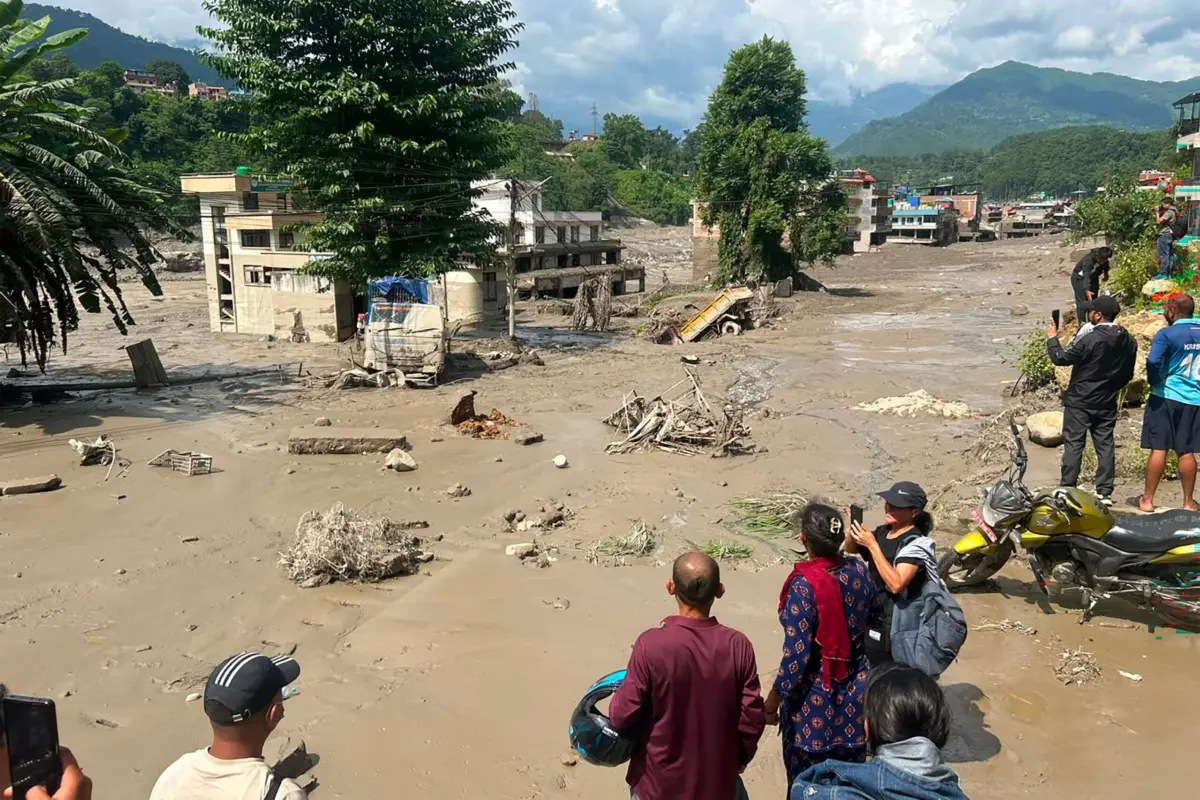
Roughly 160 people have been confirmed dead, while hundreds more—including dozens of international tourists drawn to the region’s breathtaking trekking routes—remain unaccounted for. Harrowing footage shared across social media platforms captured the grim reality of the disaster: walls of muddy water violently surging through river gorges, sweeping away multi-story buildings, infrastructure, and vehicles as terrified residents and travelers fled for higher ground.
Initial analyses of satellite imagery, seismic readings, and preliminary governmental reports indicate that the flash flood was likely triggered by a massive structural failure of the upper cryosphere. A gargantuan section of a high-altitude glacier fractured, plummeting thousands of feet into the valley below. The resulting impact pulverized the ice, combining with unseasonable snowmelt and debris to create an unstoppable hyper-concentrated torrent.
Geoscientists and climate researchers emphasize that this catastrophe is not an isolated anomaly. Rather, it represents the terrifying convergence of rapid global warming, destabilized alpine permafrost, and structural vulnerabilities long documented across the Himalayan range. As global temperatures continue to climb, the "Third Pole"—the region containing the largest reserve of ice outside the polar caps—is experiencing unprecedented rates of melt and destabilization. Wednesday’s tragedy has once again thrust the existential risks of glacial retreat into the international spotlight, highlighting the profound peril faced by millions living downstream.
Detailed Chronology: Anatomy of a Himalayan Disaster
The Collapse at the Summit
While search-and-rescue teams continue to battle treacherous terrain to reach isolated hamlets, geologists have begun piecing together the timeline of the disaster. According to data evaluated by experts, the sequence of events began high above the valley floor where atmospheric warming had been persistently stressing the local ice sheets.
Daniel Shugar, a geomorphologist at the University of Calgary, examined high-resolution satellite imagery captured immediately before and after the event. His preliminary assessment suggests that a massive slab of ice—measuring an astounding 2,000 feet wide—sheared off a high-altitude slope. The ice block plummeted nearly 4,000 feet down the near-vertical rock face.
The physics of the fall were catastrophic. Upon impact with the valley floor, the immense kinetic energy of the multi-ton ice mass utterly pulverized the frozen structure, instantaneously transforming solid ice and accumulated snow into a fluid, high-velocity slurry.
The Seismic Signature
The sheer violence of the collapse and subsequent debris flow was so immense that it registered on global monitoring equipment. According to the United States Geological Survey (USGS), the impact and subsequent torrent generated seismic waves equivalent to a magnitude 5.2 earthquake.
This seismic footprint underscores a vital, often-overlooked aspect of high-altitude hazards: modern climate change is now generating forces so powerful they mimic tectonic shifts. The vibrations alerted monitoring stations miles away, but for the communities situated directly below the path of the falling ice, there was virtually no advance warning.
The Deluge Descends
Within minutes of the collapse, a colossal wall of water, mud, boulders, and shattered ice rushed down the river valley. The torrent behaved as a debris flow, swelling in volume as it scoured the riverbanks, ripping up old-growth trees, and demolishing bridges.
Villages situated along the trans-boundary river corridors were caught completely off guard. Survivors described a sudden, deafening roar akin to a low-flying jet engine, followed instantly by the arrival of the floodwaters. Buildings constructed over decades to withstand seasonal monsoon rains were obliterated in seconds. Vehicles were tossed about like toys, and roads connecting remote mountain communities were carved away, leaving rescue helicopters as the only means of access for emergency personnel.
Supporting Context & Metrics: The Crisis on the Third Pole
To understand the mechanics of Wednesday’s disaster, experts look to the broader context of Himalayan climate degradation. The mountain ranges of Nepal, Tibet, India, and Pakistan are warming at a rate significantly higher than the global average, triggering a cascading series of environmental failures.
The Accelerating Retreat of Glaciers
Glaciers are dynamic systems that rely on a delicate balance between winter snowfall accumulation and summer melt. In recent decades, that balance has been catastrophically upended.
- Global Scale: Since the year 2000, the world’s glaciers have shed an estimated 5 percent of their total ice mass, with the rate of loss accelerating sharply over the past ten years.
- The Nepalese Impact: Research indicates that Nepal’s glaciers lost nearly a quarter of their total surface area between 1970 and 2010. More than 160 smaller glaciers within the country have vanished entirely, leaving behind barren rock faces and unstable moraine deposits.
- The 1.5°C Threshold: A landmark study published by researchers at Columbia University’s Lamont-Doherty Earth Observatory warns that up to 40 percent of the world’s glacial ice could disappear if global greenhouse gas emissions are not curbed sufficiently to keep warming under the critical threshold of 1.5 degrees Celsius.
Interconnected Hazards: Permafrost Thaw and Glacial Lakes
Joseph Shea, an associate professor of geography at the University of Northern British Columbia, notes that the dangers facing the Himalayas extend far beyond simple ice retreat. The crisis is characterized by compounding vulnerabilities.
"The glaciers over there are definitely in retreat," Shea explains. "There’s a lot of glacier mass up there, but we’re seeing thinning, we’re seeing retreating."
As glaciers shrink, they lose their structural integrity. Furthermore, alpine permafrost—the permanently frozen ground that acts as cement holding steep mountain slopes together—is thawing due to rising ambient temperatures.
- Permafrost Degradation: "It’s summertime," Shea notes, highlighting the seasonal vulnerabilities. "There’s lots of warming, lots of melt happening, lots of water around. There’s also things like alpine permafrost thaws: The ground temperatures warm up, and big blocks and chunks that would have been frozen in place are now suddenly becoming mobile."
- Glacial Lake Outburst Floods (GLOFs): As glaciers retreat, they frequently leave behind massive, high-elevation lakes held back only by unstable walls of rock and debris known as terminal moraines. When landslides or collapsing ice blocks crash into these lakes, they trigger massive overtopping events that can cause the natural dams to fail catastrophically. While Wednesday’s disaster appears to be a direct ice avalanche rather than a GLOF, the mechanism of sudden, catastrophic water release remains a constant, pervasive threat across the region. Last year alone, Nepal experienced two major GLOF events, and scientific assessments confirm that millions of people worldwide live in the direct path of these hidden high-altitude time bombs.
Official Statements and Global Reactions
Governments, international bodies, and scientific communities have responded to the tragedy with a mixture of grief for the victims and urgent calls for enhanced monitoring systems.
Governmental and Emergency Response
Nepalese authorities, operating alongside regional disaster management agencies, mobilized immediate search-and-rescue operations. However, the sheer scale of the destruction has severely hampered relief efforts. Landslides triggered by the initial flood have blocked major thoroughfares, and unstable ground continues to threaten rescue personnel on the ground.
In a joint statement, Nepalese officials expressed deep condolences to the families of the deceased and missing locals and foreign nationals alike. The Ministry of Tourism has scrambled to set up information centers to assist embassies in tracing missing international tourists who were trekking in the region.
The Scientific Community Speaks Out
The international scientific community has utilized the disaster to amplify warnings that have long gone unheeded by policymakers.
"What we are witnessing in the Himalayas is the visible, undeniable unraveling of Earth’s cryosphere," said a prominent glaciologist during an emergency climate briefing. Researchers emphasize that while individual extreme weather events cannot always be definitively pinned to a single cause, the frequency and ferocity of these disasters directly correlate with anthropogenic climate change.
Comparisons are already being drawn to other recent cryospheric disasters around the globe. In 2022, the catastrophic collapse of the Marmolada glacier in the Italian Alps claimed the life of 11 mountaineers, an event researchers directly linked to unseasonal heatwaves and rising alpine temperatures. Similarly, a massive glacier collapse in Switzerland last year buried parts of a mountain town in debris.
Experts stress that mountain communities—from the European Alps to the high peaks of Asia—are on the front lines of a changing climate, forced to adapt to environmental conditions that have no historical precedent.
Future Outlook: Mitigating the Next Crisis
As the search for survivors transitions into a grim recovery operation, attention must inevitably turn toward the future. The disaster on the Nepal-Tibet border serves as a brutal wake-up call regarding the inadequacy of current early-warning infrastructure in high-altitude zones.
The Urgent Need for Monitoring Systems
Implementing comprehensive monitoring networks across the vast, inaccessible stretches of the Himalayas is an extraordinary logistical challenge. However, advances in satellite technology, remote sensing, and automated sensor deployment offer a glimmer of hope.
- Early Warning Networks: Scientists are advocating for the installation of real-time acoustic sensors, radar monitoring systems, and automated water-level gauges downstream from high-risk glacial lakes and unstable slopes. These systems can provide critical minutes or hours of warning, allowing downstream communities to evacuate before a wall of water strikes.
- Vulnerability Mapping: Governments must accelerate comprehensive risk assessments to identify populations living within high-hazard zones. Relocating vulnerable infrastructure away from immediate river floodplains will be essential as the cryosphere continues to destabilize.
The Broader Climate Imperative
Ultimately, scientists emphasize that local engineering solutions can only act as a temporary bandage. The root cause of the Himalayan crisis is global greenhouse gas emissions that continue to trap heat in the atmosphere.
Without aggressive, coordinated global action to curtail emissions and limit warming to the 1.5°C target, the cascading disasters seen this week will become increasingly common. The "Roof of the World," long revered as an eternal, immutable sanctuary of ice and snow, is rapidly transforming into one of the most volatile landscapes on Earth. Wednesday’s tragedy is a stark reminder that what happens on the high peaks of the Himalayas does not stay in the mountains—its impacts echo devastatingly down to the valleys below.