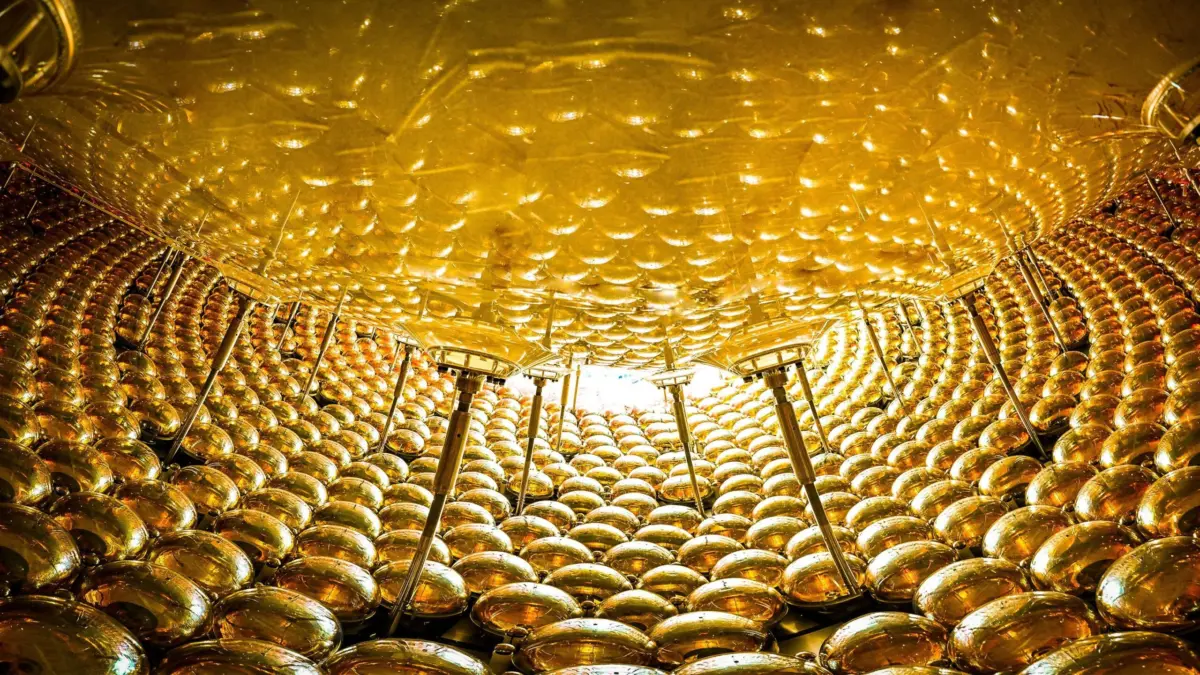
Deep beneath the Canadian Shield, two kilometers underground in the pitch-black labyrinth of the Creighton Mine in Sudbury, detector technologist Matt Depatie floats on an inflatable raft inside a vast, white-walled cavern. Around him, 7,000 tons of ultrapure water glow with an ethereal blue luminescence, shielding a house-sized acrylic sphere from the relentless bombardment of cosmic radiation. This is SNOLAB, home to the SNO+ neutrino experiment—a monumental feat of engineering designed to capture some of the most elusive, ghostly particles in the universe.
For decades, neutrino detectors like SNO+ have gazed outward, studying the fiery furnaces of our sun and tracking cosmic messengers from the deepest reaches of space. But recently, a vanguard of particle physicists and geochemists has pivoted downward. By hunting for a rare subset of these subatomic particles known as geoneutrinos—subatomic fallout generated by the radioactive decay of elements deep inside the Earth—scientists are opening a revolutionary window into our planet’s inaccessible interior.
The stakes for this research are planetary. The heat produced by the radioactive decay of uranium, thorium, and potassium within the mantle and crust drives plate tectonics, fuels volcanic eruptions, and sustains the protective magnetic field that shields Earth from solar winds. Without this internal nuclear furnace, our world would have long since cooled into a geologically dead, barren rock.
Yet, translating fleeting subatomic flickers into a comprehensive chemical map of the Earth’s interior is fraught with immense technical and geological hurdles. With the SNO+ collaboration releasing its historic first geoneutrino detection in November 2025—marking the first such measurement in the Western Hemisphere—and massive new detectors like China’s JUNO coming online, the field of neutrino geoscience is entering a golden age. This report examines the mechanics of these subterranean laboratories, the startling implications of recent data pointing toward an uneven mantle, and the ambitious future technologies required to finally map Earth’s deepest subterranean realms.
Detailed Chronology: The Evolution of Geoneutrino Detection
The journey to using subatomic particles as geological probes is a testament to decades of iterative technological refinement. Because neutrinos interact so rarely with normal matter, conceptualizing a detector capable of isolating terrestrial signals from cosmic background noise was once thought nearly impossible.
1999–2006 (The SNO Era): The Sudbury Neutrino Observatory (SNO) operates in the same Canadian cavity, famously solving the "solar neutrino problem" by proving that solar neutrinos oscillate between different "flavors" on their journey to Earth. This foundational work wins a Nobel Prize and sets the stage for repurposing the infrastructure.
2005 (The KamLAND Breakthrough): Located in a mine in the Japanese Alps, the KamLAND (Kamioka Liquid Scintillator Antineutrino Detector) collaboration stuns the scientific community by reporting the world’s first experimental detection of geoneutrinos, proving that subatomic particle physics can be harnessed to study geodynamics.
2009 (Borexino’s Italian Contribution): Nestled beneath the Apennine Mountains at the Gran Sasso National Laboratory in Italy, the Borexino detector reports catching several dozen geoneutrinos, providing the first European baseline for Earth’s radioactive interior and hinting at regional variations in mantle heat production.
August 2025 (JUNO’s Commencement): The massive 20-kiloton Jiangmen Underground Neutrino Observatory (JUNO) begins operations in a mountain-encased cavern outside Guangzhou, China, positioning itself to harvest unprecedented volumes of particle data.
November 2025 (SNO+ Milestone): SNO+ officially announces its first detection of geoneutrinos, capturing approximately 50 events. This milestone represents a monumental achievement: the first geoneutrinos ever measured in the Western Hemisphere, offering a crucial comparative data point against European and Asian findings.
Late 2026 and Beyond: JUNO prepares to release its inaugural geoneutrino flux calculations, while theoretical physicists and geochemists debate the viability of constructing the ultimate neutrino telescope: an ocean-bottom detector anchored far away from the radioactive interference of continental crust.
Supporting Context & Metrics: The Physics and Geology of the Subterranean Hunt
To understand why capturing geoneutrinos is such a monumental challenge, one must first comprehend the nature of the particles themselves. Neutrinos are the most abundant particles in the universe that possess mass, yet that mass is unimaginably minuscule—roughly a millionth of the mass of an electron. Carrying a neutral electromagnetic charge, they glide through ordinary matter as if it were absolute nothingness. Trillions of solar neutrinos pass through every square centimeter of the human body every second without leaving a trace.
Geoneutrinos are a specific, exceptionally rare breed of antineutrinos produced during the beta decay of long-lived radioactive isotopes—specifically uranium-238, thorium-232, and potassium-40—embedded within the Earth’s mantle and crust.
The Subterranean Architecture: SNO+ and Its Peers
Detecting these ghost particles requires absolute, radical isolation. At SNO+, the experimental apparatus consists of:
Depth: Buried 2 kilometers beneath the surface in the Creighton Mine, where the overlying rock overburden blocks the blinding downpour of cosmic rays.
Shielding: An outer cavity filled with 7,000 tons of ultrapure water that absorbs ambient radiation from the surrounding mine walls.
The Scintillator: An acrylic sphere housing 780 tons of an oily liquid scintillator, flanked by nearly 10,000 highly sensitive photomultiplier tubes (PMTs). When a rare geoneutrino collides with a proton in the scintillator, it triggers a microscopic flash of light—a faint flicker that the PMTs convert into digital data.
Cleanliness is an absolute prerequisite. During the descent down the mine shaft, human bodies and clothing accumulate microscopic traces of radioactive radon dust. Before entering the cleanrooms, technicians must shed their mining gear, scrub down, and don electric-blue jumpsuits and hairnets. As technologist Matt Depatie notes, "The showers aren’t for you; they’re for the science."
The Great Mantle Debate: Uniform or Lumpy?
For generations, conventional geodynamic and geochemical models assumed that Earth’s mantle—the sluggishly churning layer of rock situated between the crust and the outer core—was thoroughly mixed by billions of years of convective currents. Consequently, textbooks taught that heat-producing radioactive elements were distributed relatively homogeneously throughout the mantle.
However, data emerging from global neutrino detectors is beginning to fracture this consensus. When comparing the flux measurements across different sites, discrepancies appear:
Borexino (Italy): Suggests a relatively high geoneutrino flux from the mantle underneath Europe.
KamLAND (Japan): Measures a lower mantle flux beneath its region.
SNO+ (Canada): Initial analyses point toward a "middle-of-the-road" mantle profile beneath North America.
These variations hint at a radical possibility: the Earth’s mantle may not be uniform at all. Instead, radioactive elements could be concentrated in massive, mysterious structures known as Large Low-Shear-Velocity Provinces (LLSVPs)—continent-sized blobs of anomalously hot, dense material anchored deep in the lower mantle near the core-mantle boundary, located beneath Africa and the Pacific Ocean. If these ancient structures act as chemical reservoirs, they could be concentrating heat-producing elements in specific geological zones, rewriting our understanding of deep Earth dynamics.
Official Statements and Expert Perspectives
The ambiguity in current data has ignited intense debate among the world’s leading particle astrophysicists and geochemists, who grapple with the profound uncertainties inherent in filtering out background noise.
"It’s the one thing we do that focuses on the Earth. Everything else we do is more focused on what we receive from other places in the universe."
— Ryan Bayes, Particle Astrophysicist, Queen’s University
Isolating a geoneutrino signal is not as simple as watching a counter tick upward. Physicists must meticulously subtract a staggering array of background signals, including high-energy cosmic interactions, particles with incorrect helicity properties, and artificial antineutrinos streaming out of commercial nuclear power reactors. Furthermore, they must filter out the substantial contribution of geoneutrinos originating from the local continental crust—particularly within a few hundred kilometers of each detector.
"They don’t just show up and say, ‘Hi, I’m a geoneutrino.’"
— Ryan Bayes, describing the complex data-sorting process
Mark Chen, director of the SNO+ collaboration at Queen’s University, emphasizes that while the geographical diversity of detections is opening new conceptual doors, caution remains paramount.
"It could be that that’s the first hint that the mantle is not uniform… There may be deep Earth structures in the mantle that are not understood. It could be that they concentrate some kinds of elements."
— Mark Chen, Director of the SNO+ Collaboration
William McDonough, a pioneering geochemist at the Chinese Academy of Sciences who has spent decades championing geoneutrino research, points out the stark analytical divisions plaguing the current generation of detectors:
"If we take it at face value, we could say maybe the western hemisphere has a lot more radioactive material in it than the eastern hemisphere… Are the Italians right? Are the Japanese right? Are they both right? Or is something wrong?"
— William McDonough, Geochemist, Chinese Academy of Sciences
These uncertainties are compounded by the complex local geology surrounding specific labs. For instance, SNO+ researchers must account for the unique radiogenic signature of the Sudbury Basin—itself the scar of a massive meteorite impact that struck the region 1.8 billion years ago. Virginia Strati, a researcher at the University of Ferrara in Italy who helped formulate local radioactivity models for SNOLAB, notes that local geological unknowns make isolating the pure mantle signal exceptionally difficult.
"There are lots of unknowns in this geological area… The difference in the geoneutrino flux expected from various distributions of radioactive elements is very small, and is hidden in these uncertainties."
— Virginia Strati, University of Ferrara
Future Outlook: The Horizon of Subterranean and Oceanic Physics
As the global network of detectors matures, the field of neutrino geoscience stands on the precipice of major breakthroughs. The immediate future belongs to massive-scale infrastructure projects designed to swallow unprecedented volumes of particle data.
The JUNO Factor
Operating outside Guangzhou, China, the Jiangmen Underground Neutrino Observatory (JUNO) represents a quantum leap in scale. Featuring a gargantuan 20-kiloton liquid scintillator detector housed beneath a mountain, JUNO is expected to capture more geoneutrinos in its first operational year than the cumulative output recorded by KamLAND, Borexino, and SNO+ combined over decades of painstaking work. Its incoming data, anticipated later this year, will provide a vital fourth vantage point, testing whether regional mantle anomalies hold up under a vastly larger statistical lens.
The Ultimate Frontier: Ocean-Bottom Detectors
Despite the triumphs of land-based mines and mountain tunnels, researchers acknowledge that continental crust remains a noisy, radioactive nuisance that muddies mantle-level calculations. Continents are thick, irregular, and rich in radioactive minerals, introducing continuous uncertainty into every terrestrial flux measurement.
To solve this, William McDonough and a cadre of visionary geophysicists have long championed a radical, high-stakes proposal: building a neutrino detector anchored at the bottom of the deep ocean.
Oceanic crust is significantly thinner, chemically simpler, and far more uniform than continental crust. By placing a detector miles offshore on the abyssal plain, researchers could bypass continental background noise entirely.
The Advantage: Crust-related uncertainties plummet, dropping the experiment directly into "mantle-only territory."
The Obstacle: Cost and logistics. Estimated at hundreds of millions of dollars, an ocean-bottom neutrino detector presents staggering engineering challenges involving deep-sea deployment, high-pressure containment, and remote maintenance.
While Western funding agencies have been slow to embrace the ocean-bottom concept, McDonough remains optimistic, pointing to China’s recent green-lighting of massive, billion-dollar national geoscience initiatives as a potential pathway forward.
Conclusion
Until the day an ocean-floor neutrino telescope becomes reality, the quest to map the hidden chemistry of our world will continue in the damp, subterranean corridors of deep-rock laboratories. From the glowing blue waters of SNOLAB to the colossal caverns of JUNO, physicists will keep paddling inflatable rafts across pools of ultrapure water, listening for the faint, microscopic whispers of ghost particles—transforming elusive subatomic flicker into our most profound map of the Earth’s fiery heart.