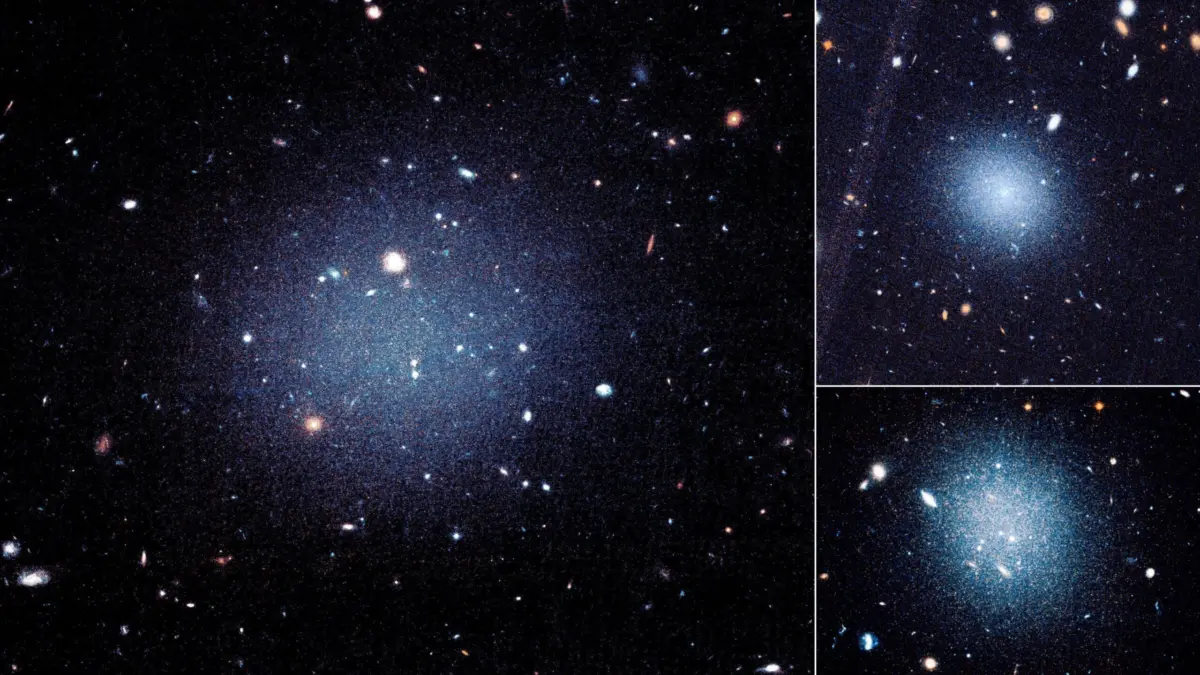
About 65 million light-years from Earth, suspended in the silent expanse of space, three celestial objects defy the established rules of the cosmos. Known officially as DF2, DF4, and DF9, these peculiar formations are not the vibrant, pinwheeling whirlpools of light typical of normal spiral galaxies. Instead, they present a pallid, translucent appearance—dimly illuminated by a sparse scattering of aging stars, floating like cosmic ghosts against the black void.
Yet, their ghostly aesthetic is merely a prelude to a far deeper astrophysical riddle. For decades, standard cosmological models have relied on dark matter—the invisible, elusive gravitational glue that accounts for roughly 27 percent of the universe and 85 percent of all matter—to explain how galaxies form and hold together. Without dark matter pulling ordinary, visible matter inward, stars would struggle to coalesce, and rapidly spinning galactic limbs would fling themselves apart into empty space.
Almost all known galaxies are heavily dominated by this invisible scaffolding. However, when astronomers used a suite of ground- and space-based telescopes to estimate the masses of DF2, DF4, and DF9 by tracking the velocities of their internal stars, they were stunned. These three galaxies possess virtually no dark matter at all. They are composed almost entirely of a paltry selection of ordinary matter, operating without the massive invisible halos that dictate galactic structure everywhere else we look.
A breakthrough study published in The Astrophysical Journal offers a compelling origin story for this bizarre trio. According to the research, an ancient cosmic collision between two regular galaxies caused their gas and dust (ordinary matter) to tangle, clump, and stall, while their massive reservoirs of dark matter passed straight through one another like phantoms moving through a wall. This celestial demolition derby left behind newly spawned, dark-matter-free fragments that have struggled ever since to form normal generations of stars.
Crucially, this discovery serves a dual purpose in modern astrophysics. Not only does it explain how these anomalous galaxies came to be, but it also delivers a heavy blow to alternative gravitational theories—such as Modified Newtonian Dynamics (MOND)—that attempt to argue dark matter does not exist at all. By isolating ordinary matter from dark matter and witnessing the structural and evolutionary consequences, scientists are finding ironic confirmation: the absolute absence of dark matter in these three galaxies may finally prove that dark matter is a very real, physical substance.
Detailed Chronology of Discovery
The unraveling of this cosmic mystery spans nearly a decade of high-precision observation, beginning with the initial shock of discovery in the late 2010s and culminating in the 2026 findings that cemented the triplet’s significance.
2018: The Shock of DF2
The saga began when astronomers identified NGC 1052-DF2 (or simply DF2), an oddball galaxy that immediately confounded conventional theories. While roughly the same physical size as our majestic Milky Way, DF2 possessed an astonishing 200 times fewer stars, rendering it remarkably faint and ghostly.
Intrigued and suspicious of these preliminary readings, an international team of researchers pointed the powerful Keck Observatory in Hawaii at DF2. By tracking the orbital motions of the galaxy’s globular star clusters—using them as proxies to measure the system’s total mass—the team calculated an astonishing result. DF2 was remarkably lightweight, containing at most 400 times less dark matter than standard cosmological models predicted for a galaxy of its size. It was the first time a dark-matter-deficient galaxy had ever been definitively observed, sparking fierce debates across the astrophysical community regarding measurement errors or observational quirks.
2019: DF4 Joins the Ranks
Skepticism surrounding DF2 began to evaporate when a second outlier was discovered. In 2019, astronomers utilizing observations from the Hubble Space Telescope and ground-based facilities identified a companion galaxy, dubbed DF4.
Much like its predecessor, DF4 exhibited a profound dearth of dark matter. The discovery of a second anomaly deeply undermined the hypothesis that DF2 was merely a rare, freak occurrence or a measurement artifact. Instead, it suggested that an entire population of these ghost galaxies might be lurking in the cosmos, born from a specific, radical evolutionary pathway.
2026: The Triplet Complete with DF9
The puzzle snapped into sharper focus when researchers announced the discovery and mass estimation of a third member: DF9. Containing the mass of roughly 100 million suns—consistent with a universe containing only ordinary matter—DF9 aligned spatially with DF2 and DF4.
The realization that these three gossamer galaxies existed not in isolation, but as a linear family of neighbors, galvanized astrophysicists. It became clear that their shared proximity was not a coincidence, but a glaring fingerprint pointing directly to a violent, shared past.
Supporting Context & Metrics: The Physics of the Phantom Triplet
To comprehend why DF2, DF4, and DF9 have shaken the foundations of cosmology, one must understand the fundamental divide between ordinary matter and dark matter, and how they interact—or fail to interact—during extreme cosmic events.
The Standard Model vs. The Invisible Scaffolding
In modern astrophysics, ordinary matter (baryons)—the atoms that make up stars, planets, gas clouds, and human beings—accounts for a mere 5 percent of the universe’s total mass-energy inventory. Dark matter makes up roughly 27 percent, with dark energy comprising the remaining 68 percent.
Dark matter interacts almost exclusively via gravity. Unlike ordinary matter, it does not absorb, reflect, or emit light, making it electromagnetically invisible. Furthermore, it shows no compelling evidence of interacting with the other fundamental forces of nature, such as the strong and weak nuclear forces or electromagnetism.
This distinct behavioral profile dictates what happens when galaxies collide. If two typical galaxies experience a head-on smash-up:
Ordinary Matter: Gas, dust, and plasma interact via all four fundamental forces, creating immense electromagnetic drag, friction, and turbulence. The clouds slam together, slow down, and become entangled in a chaotic stellar nursery.
Dark Matter: Because it experiences virtually no drag, the massive halos of dark matter surrounding each galaxy pass right through one another, continuing onward at full velocity like an unbothered ghost.
Astronomers often compare this to a medieval jousting match: the knights and their splintering lances (ordinary matter) collide and are thrown violently to the ground in a tangled heap, while their unbridled horses (dark matter) keep on galloping at full speed.
Parallels with the Bullet Cluster
This cosmic segregation is not entirely unprecedented, though it has never been captured with such clean separation at the individual galaxy scale. The phenomenon is famously observed in the Bullet Cluster, a massive collection of colliding galaxy clusters located 3.8 billion light-years away.
Recently scrutinized with unprecedented clarity by the James Webb Space Telescope (JWST), the Bullet Cluster displays a messy, disrupted distribution of mass where intracluster gas has clearly been ripped away and left behind, while the gravitational signatures of dark matter have decoupled and surged ahead. DF2, DF4, and DF9 represent the miniature, localized equivalents of this grand cosmic destruction derby.
Official Statements and Expert Perspectives
The publication of the 2026 study in The Astrophysical Journal has sparked intense dialogue among leading theorists, particle physicists, and astronomers, highlighting a profound shift in how scientists view the interplay between galactic evolution and fundamental physics.
The Case for Physical Dark Matter
Michael Keim, an astrophysicist at Yale University and a lead author of the new study, emphasizes that the behavior of the triplet directly targets alternative gravitational models:
"What this is showing is that dark matter is… not just a modification of gravity. If you segregate ordinary matter from dark matter, you’d expect that the dark-matter-lacking galaxies would struggle to form stars—and that’s what DF2, DF4, and DF9 show."
Shyam Balaji, a theoretical physicist at King’s College London, highlights the inherent irony of the discovery:
"The absence of dark matter is, in a way, some evidence of dark matter, which is ironic. It’s easier to remove matter, cold dark matter, through something like a collision, than it is to turn off a law of nature."
Daniel Whiteson, a particle physicist at the University of California, Irvine, echoes this sentiment regarding the overwhelming body of independent evidence supporting particulate dark matter:
"We don’t know which dark matter candidate is the right one… Whatever it is, it has yet to be detected. But there’s a lot of independent lines of evidence that dark matter is matter." Whiteson adds bluntly regarding alternative theories: "I think it’s fine and healthy to have alternative theories and open debate. But let’s also be frank about whether the theory fits the data. MOND does not."
Alternative Interpretations and Skepticism
Not all researchers are entirely convinced that a high-speed collision is the sole culprit behind the triplet’s missing mass.
Kinwah Wu, a theoretical astrophysicist at University College London, has pointed out that DF2, DF4, and DF9 do not exhibit some of the fluid, wispy tidal tails typically expected in the immediate aftermath of a galactic crash. Instead, Wu suggests an alternative scenario: the trio may have passed through the immense gravitational environment of a larger group of massive galaxies, which literally stripped the triplet of their dark matter halos during an ill-fated orbital voyage.
Stacy McGaugh, an astronomer at Case Western Reserve University and a prominent champion of modified-gravity theories, remains cautious:
"It’s not clear to me what the formation mechanism is. An ancient collision is a plausible origin story, albeit an exceptional one. If that’s what’s happened, then the rest follows… But the question is: Is that what happened? And I’m not convinced that that’s the only way that can happen."
Without absolute certainty regarding their precise genesis, McGaugh argues it remains premature to use the galaxies as definitive proof of dark matter’s microphysical nature. However, mainstream consensus leans heavily toward the collision model, with Chamkaur Ghag, a physicist at University College London, noting:
"It’s hard to explain how you’d get something like this evolving by itself without something like dark matter."
Future Outlook: Implications for MOND and the Search for Identity
The implications of DF2, DF4, and DF9 extend far beyond galactic archaeology; they strike at the heart of a decades-long ideological war in cosmology regarding the true nature of gravity.
A Heavy Blow to Modified Newtonian Dynamics (MOND)
Since its introduction in 1983 by physicist Mordehai Milgrom, Modified Newtonian Dynamics (MOND) has served as the primary intellectual rival to dark matter. MOND posits that dark matter does not exist; rather, our understanding of gravity is fundamentally flawed. According to MOND proponents, when objects experience extremely weak gravitational accelerations—such as stars located at the extreme peripheries of galaxies—the force of gravity does not drop off as rapidly as Newtonian or Einsteinian physics predicts. This hypothetical enhancement provides the extra holding power needed to keep spinning galaxies intact without invoking invisible matter.
However, MOND has steadily lost ground in the face of modern multi-messenger astronomy:
The 2015 LIGO Breakthrough: The Laser Interferometer Gravitational-Wave Observatory detected gravitational waves for the first time, proving that these ripples propagate through space at the exact speed of light across cosmological distances. This demonstrated that gravity behaves in a consistent, unmodified manner throughout the universe.
The Ghost Triplet Crisis: MOND struggles immensely to explain how galaxies with identical ordinary matter content can exhibit wildly different internal dynamics based on whether dark matter is present or absent. If gravity itself were universally modified for all low-mass systems, every galaxy of a certain size should experience the same enhanced gravitational effect. The fact that DF2, DF4, and DF9 lack this enhancement—acting precisely as ordinary matter would when stripped of its dark matter halo—shatters the universal predictive power of MOND.
What Lies Ahead?
While the identity of dark matter continues to elude direct detection in underground particle detectors and high-energy colliders, nature has provided an unexpected laboratory 65 million light-years away. By stripping the cosmic clockwork apart, the universe has exposed the inner workings of galactic architecture.
As upcoming generations of space telescopes and wide-field optical surveys sweep the cosmos for more phantom galaxies, astronomers are poised to map the frequency of these dark-matter-free remnants. Each ghostly system discovered adds another layer of empirical weight to the standard cosmological model, bringing humanity one step closer to unmasking the invisible substance that holds our universe together.