Executive Overview
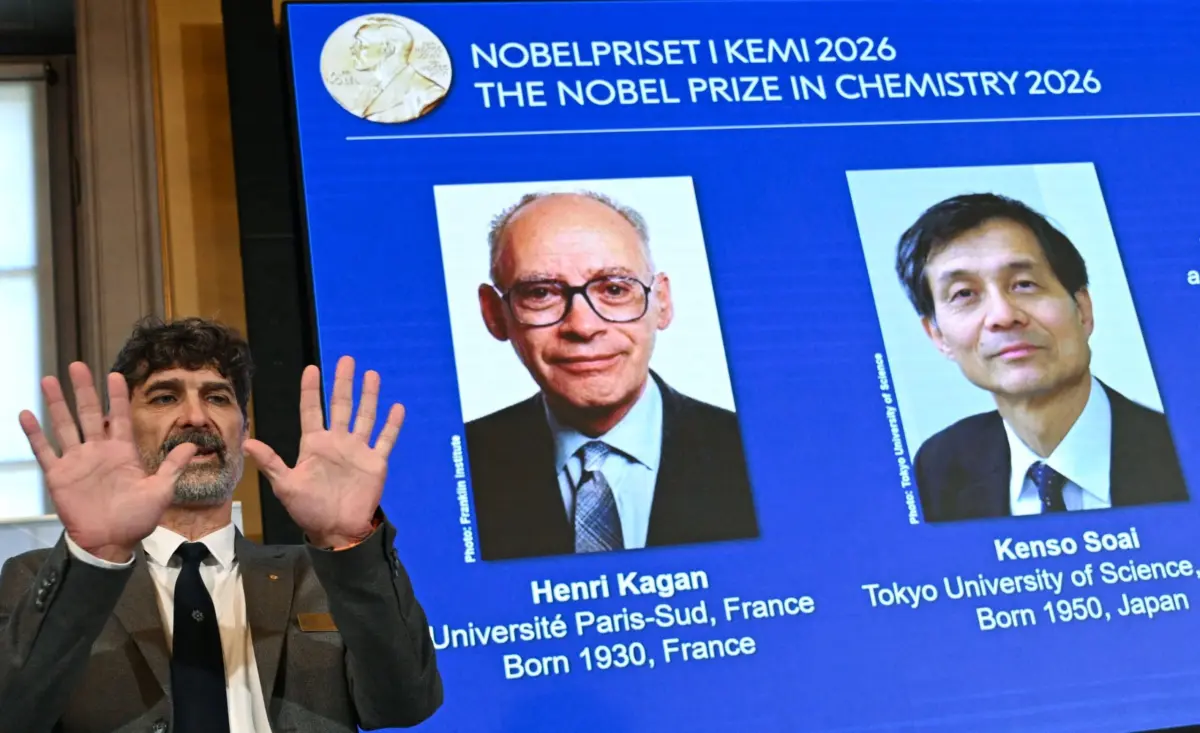
The 2026 Nobel Prize in Chemistry has been awarded to Henri Kagan and Kensō Soai for solving one of the most profound and persistent mysteries in the natural sciences: the origin of molecular asymmetry. For decades, the fundamental handedness of chemical structures—known scientifically as chirality—remained a stubborn puzzle. While the universe and its inanimate components frequently display a democratic balance of left- and right-handed forms, living organisms exhibit a striking and near-exclusive preference for just one version. This phenomenon, known as homochirality, is a cornerstone of biology, defining everything from the DNA double helix to the amino acids that build human tissue.
By unlocking the mechanisms behind chiral manipulation, Kagan and Soai have fundamentally transformed our understanding of synthetic chemistry. Their groundbreaking work has moved humanity past the limits of classical laboratory synthesis, providing the pharmaceutical, material science, and agricultural industries with unprecedented control over molecular manufacturing.
Today, the implications of their discoveries extend far beyond theoretical chemistry. In the pharmaceutical sector, where a molecule’s handedness can mean the difference between a life-saving medication and a toxic compound, Kagan and Soai’s methodologies have enabled safer, more efficient drug discovery. By bridging the gap between theoretical physics and applied organic chemistry, these laureates have answered a question first posed by Louis Pasteur more than a century and a half ago, reshaping how humanity interacts with the building blocks of life itself.
Detailed Chronology: A Century-Long Quest for Asymmetry
The Pasteur Paradigm and Early Limitations
The story of chemical asymmetry begins in the mid-19th century with Louis Pasteur. While studying tartaric acid crystals, Pasteur made a startling observation: molecules could exist in two distinct forms that were non-superimposable mirror images of one another, much like a pair of human hands. These twin molecules, known as enantiomers, share identical physical properties—such as melting points, boiling points, and solubility—yet they interact with polarized light and biological systems in drastically different ways.
Pasteur discovered that living bacteria could selectively consume only one of these enantiomers, leaving the other untouched. This revelation sparked a fundamental question that would baffle generations of scientists: Why is life homochiral? Why do proteins exclusively use left-handed amino acids, and why do nucleic acids rely on right-handed sugars?
For decades, attempts to replicate this natural selectivity in the laboratory ended in frustration. Whenever chemists synthesized chiral molecules from achiral (symmetrical) starting materials, the result was invariably a racemic mixture—a 50-50 split containing equal amounts of both left- and right-handed variants. Nature’s knack for producing pure, single-handed molecules remained an exclusive domain of biology.
Marckwald’s Catalyst and the First Incremental Steps
At the dawn of the 20th century, German chemist Willy Marckwald made the first tentative breakthrough toward breaking this symmetry. By employing a chiral catalyst—a substance that accelerates a chemical reaction without being consumed itself—Marckwald managed to produce a reaction that yielded a slightly greater proportion of one enantiomer over the other.
While groundbreaking in principle, Marckwald’s experiment suffered from a severe limitation: the ratio between the two variants shifted only marginally. The dream of achieving absolute or near-absolute enantiomeric purity in a laboratory setting remained elusive, and the physical mechanisms driving nature’s homochirality stayed hidden behind a wall of statistical probability.
Charles Frank’s Theoretical Blueprint (1953)
In 1953, theoretical physicist Charles Frank changed the trajectory of asymmetric research by publishing a mathematical model that outlined the exact requirements for replicating homochirality outside of living systems. Frank theorized that three conditions had to be met simultaneously:
- An asymmetric reaction must exist that inherently favors one enantiomer over the other.
- Amplification mechanisms must be present to magnify that initial, minute imbalance.
- Autocatalysis must occur, meaning the reaction itself must produce the very catalyst that drives it, creating a positive feedback loop.
According to Frank’s model, if these conditions were met, a tiny initial advantage would trigger a runaway effect, causing one variant to assemble at an exponentially faster rate until it completely dominated the reaction vessel. For nearly three decades, Frank’s paper remained a purely theoretical framework—until Henri Kagan and Kensō Soai independently operationalized its principles.
Henri Kagan and the Discovery of the Nonlinear Effect
Beginning in the early 1980s, French chemist Henri Kagan focused his research on refining asymmetric reactions by taking a closer look at the catalysts involved. At the time, standard chemical dogma held that catalysts operated in a linear, predictable fashion. Scientists used catalytic systems composed of a central metal atom (driving the reaction) paired with a chiral modifier (ensuring asymmetry). It was universally assumed that if a chemist used a chiral modifier composed of a 50-50 mixture of two enantiomers, the resulting product would also be a balanced, 50-50 mixture.
Kagan questioned this assumption. He hypothesized that the active metal atom did not interact with just one enantiomer of the catalyst independently, but rather engaged with both simultaneously. By mixing catalyst variants A and B, three distinct combinations could form within the reaction solution: A-A, B-B, and A-B.
While the homochiral pairs (A-A and B-B) behaved predictably as mirror images, Kagan discovered that the heterochiral combination (A-B) could interact uniquely with the reaction components, often dramatically slowing down the overall rate of product formation. This unexpected kinetic drag indirectly favored the accumulation of one specific variant in the final product.
Kagan termed this phenomenon the nonlinear effect. It shattered decades of conventional chemical wisdom and provided researchers with an entirely new mathematical and practical tool to manipulate chemical reactions, laying the groundwork for advanced catalysis studies worldwide.
Kensō Soai and the Breakthrough of Absolute Asymmetry
Inspired by Kagan’s revelation regarding reaction amplification, Japanese chemist Kensō Soai set out to build a chemical system where a product could act as its own catalyst—fulfilling Charles Frank’s theoretical requirement for autocatalysis.
In the early stages of his research, Soai experimented with a substance known as 5-pyrimidylalkanol. In initial trials, when one enantiomer held a mere 2-percent abundance advantage over its mirror image at the start of the reaction, that tiny edge skyrocketed to an 87-percent advantage by the time the reaction concluded.
Soai spent the ensuing years pushing this amplification phenomenon to its absolute limits, striving to replicate the molecular purity found inside living organisms. The culmination of his life’s work arrived in 2003, when he engineered an extraordinary chemical reaction.
Starting with substances that possessed no defined spatial orientation or initial asymmetry, Soai allowed them to react. Purely by chance, microscopic statistical fluctuations in the early moments of the reaction created a nearly imperceptible surplus of one enantiomer. Thanks to Soai’s autocatalytic feedback loop, that microscopic difference triggered a cascading amplification effect. Gradually, that specific molecular variant completely dominated the reaction vessel, ultimately accounting for 99.99 percent of the final product.
In executing this reaction, Soai achieved what no human scientist had ever done before: starting from a completely symmetrical, unskewed baseline, he synthesized a single, pure enantiomer with near-absolute perfection.
Supporting Context & Metrics: Understanding Chiral Significance
To fully grasp the magnitude of Kagan and Soai’s contributions, one must understand the sheer ubiquity and functional importance of chirality in everyday chemistry, particularly in pharmacology.
+-------------------------------------------------------------------------+
|                       THE CHIRAL LOCK & KEY MODEL                       |
+-------------------------------------------------------------------------+
|                                                                         |
|   [Left-Handed Enantiomer]  ----->  [Target Biological Lock]            |
|   (Desired Therapeutic Effect)        (Successfully Unlocked)           |
|                                                                         |
|   [Right-Handed Enantiomer] ----->  [Target Biological Lock]            |
|   (Potential Toxicity/Side Effects)   (Damaged / Unintended Reaction)   |
|                                                                         |
+-------------------------------------------------------------------------+
The Lock and Key Analogy
The Nobel Committee famously utilized a locksmith analogy to illustrate the perils of improper chiral control: a skilled locksmith can forge two mirror-image keys, but only one will fit a specific lock. Inserting the wrong key can jam, break, or damage the mechanism entirely.
In human biology, proteins, enzymes, and cell receptors act as intricate locks. When a pharmaceutical drug is introduced into the body, its molecules must fit precisely into these biological receptors.
- The Efficacious Enantiomer: One chiral variant of a drug will fit the receptor smoothly, triggering the desired healing response.
- The Toxic Enantiomer: Its mirror-image counterpart may fail to engage the receptor entirely, or worse, bind to unintended biological targets, triggering severe toxicity, birth defects, or neutral inactivity that burdens the patient’s liver and kidneys.
Historical Precedents and Modern Standards
The tragic consequences of failing to control chirality were tragically highlighted in the late 1950s and early 1960s with the distribution of thalidomide. Prescribed widely to combat morning sickness in pregnant women, thalidomide was manufactured as a racemic mixture. While one enantiomer safely alleviated nausea, the mirror-image enantiomer proved to be teratogenic, causing devastating birth defects in thousands of infants worldwide.
Modern drug manufacturing requires absolute enantiomeric purity. Before Kagan and Soai’s discoveries, separating racemic mixtures was an expensive, wasteful, and often inefficient process that discarded up to 50 percent of synthesized material. By allowing chemists to steer reactions toward the preferential production of a single, desired enantiomer from the outset, asymmetric catalysis has revolutionized green chemistry, minimized industrial chemical waste, and drastically accelerated drug development timelines.
Official Statements and Expert Perspectives
The announcement of the 2026 Nobel Prize in Chemistry drew widespread acclaim from the international scientific community, validating decades of painstaking organic and theoretical research.
In its official prize announcement, the Nobel Committee for Chemistry emphasized the profound philosophical and practical nature of the laureates’ achievements:
"Other than life itself, no one had previously achieved this feat. Kagan and Soai unlocked the mechanisms that govern nature’s chemical asymmetry, transforming a biochemical mystery into a practical toolkit for modern manufacturing."
Highlighting the specific utility of Henri Kagan’s breakthrough, José María Andrés García, a professor in the Department of Organic Chemistry at the University of Valladolid, noted in a statement distributed by SMC Spain:
"In addition to their practical interest, nonlinear effects are a very valuable tool for studying reaction mechanisms and the nature of catalytically active species. Kagan’s identification of how heterochiral catalyst combinations alter reaction kinetics opened our eyes to the hidden complexities occurring inside standard reaction vessels."
Reflecting on Kensō Soai’s milestone experiment, structural chemists have repeatedly pointed out that Soai’s 2003 asymmetric autocatalysis experiment provides the most compelling laboratory model yet for how prebiotic molecules on early Earth may have broken their symmetry, eventually leading to the homochirality of all known terrestrial life.
Future Outlook: The Next Frontier of Chiral Engineering
As the scientific community celebrates the work of Henri Kagan and Kensō Soai, attention is rapidly shifting toward the future applications of asymmetric catalysis and chiral manipulation.
AI-Powered Drug Discovery
The convergence of asymmetric chemistry with modern artificial intelligence represents the next major frontier. As detailed across contemporary chemical research platforms, machine learning models are now being trained on Kagan’s kinetic principles and Soai’s autocatalytic datasets. These AI systems can accurately predict nonlinear effects in complex multi-metallic catalytic systems before a single beaker is touched in the laboratory.
By predicting how subtle structural tweaks in chiral catalysts will influence enantiomeric excess, computational models are drastically shortening the R&D cycle for novel therapeutics, agrochemicals, and advanced nanomaterials.
Origin of Life Studies
Beyond industrial manufacturing, Soai’s reaction models continue to fuel astrobiological and prebiotic research. Scientists investigating how life began on Earth—or how it might form on distant exoplanets—frequently look to asymmetric autocatalysis as a plausible mechanism for how random chemical soup transitioned into ordered, single-handed biological systems. Understanding how physical forces, polarized light, or magnetic minerals can induce initial chiral imbalances in prebiotic environments remains an active and thrilling area of interdisciplinary study.
Sustainable and Green Manufacturing
In an era prioritizing environmental sustainability, the ability to synthesize single enantiomers cleanly and efficiently without generating vast quantities of unwanted, discarded byproducts is paramount. Industrial chemistry is increasingly adopting catalytic frameworks rooted in Kagan and Soai’s foundational principles. By maximizing atom economy and eliminating waste, these methodologies align directly with global goals for green manufacturing.
Ultimately, the 2026 Nobel Prize in Chemistry honors more than just two brilliant careers. It celebrates humanity’s growing mastery over the subtle, left-and-right-handed architecture of the universe—ensuring that the medicines we take, the materials we build, and our understanding of life’s origins remain firmly guided by precision, safety, and elegance.