Executive Overview
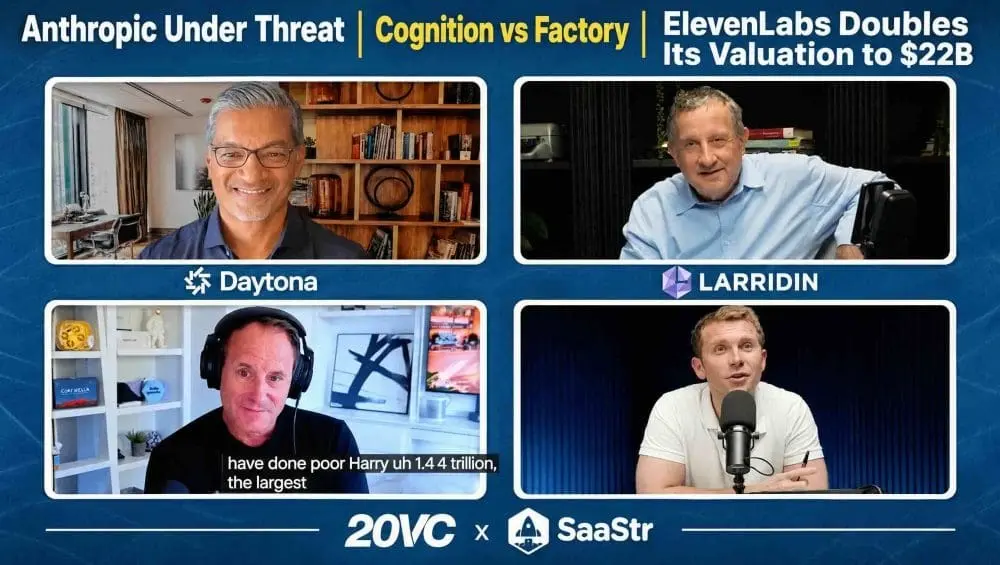
The global technology landscape is experiencing a period of hyper-acceleration, characterized by staggering valuations, blistering product cycles, and high-stakes executive realignments. In a recent high-profile panel discussion on the joint 20VC x SaaStr platform, host Harry Stebbings sat down with industry heavyweights Jason Lemkin, Rory O’Driscoll, and special guest Dev Ittycheria, who had stepped back into the CEO seat at MongoDB just one week prior.
The conversation unfolded against a backdrop of seismic industry shifts. With OpenAI hurtling toward a $70 billion annualized run rate and private valuations brushing against the $1.4 trillion mark, traditional boundaries defining software monopolies, developer loyalty, and corporate governance are breaking down. Meanwhile, high-profile corporate skirmishes—such as the explosive public feud between Factory and venture capitalist Vinod Khosla—have highlighted the cutthroat nature of the generative AI talent wars.
This deep dive captures the core takeaways from the panel, analyzing how soaring enterprise token budgets, massive mega-rounds, high-stakes M&A, and radical shifts in B2B distribution are redefining the technology sector.
Detailed Chronology & Market Shifts
1. The Executive Turnstile: Dev Ittycheria’s Return to MongoDB
The recording took place mere days after CJ Desai abruptly stepped down as CEO of MongoDB on September 28, departing to lead Meta’s new enterprise platform under Mark Zuckerberg. The MongoDB board immediately named Dev Ittycheria interim President and CEO. Having previously helmed the database titan from 2014 to 2025—scaling its annual revenue from $35 million to over $2.3 billion—Ittycheria brings a seasoned, stabilizing hand back to the enterprise software pioneer. The timing could not have been more poignant, as the panel opened with a dissection of executive loyalty, corporate boardrooms, and the rapid pace of leadership churn across the tech ecosystem.
2. OpenAI’s Meteoric Ascent and Anthropic’s Public Preparations
OpenAI’s annualized revenue is barreling toward $70 billion, marking a staggering 70% surge since the beginning of the third quarter alone. Enterprise sales have more than doubled over the same timeframe.
- The Competitive Landscape: While Anthropic dominated early agentic coding narratives earlier in the year, OpenAI has clawed back market share aggressively. Portfolio companies are actively swapping out models due to performance and cost advantages.
- The Financial Horizon: OpenAI is currently in talks to raise a minimum of $30 billion at a $1.4 trillion valuation as a bridge to an eventual IPO. Simultaneously, competitor Anthropic is prepping a blockbuster public debut for mid-November, targeting a valuation between $1.8 trillion and $2 trillion. According to Rory O’Driscoll, this will mark a historic milestone: the first private valuation to comfortably breach the trillion-dollar threshold.
3. The Factory vs. Cognition Feud and the Vinod Khosla Fallout
On September 30, Factory CEO Matan Grinberg publicly fired board advisor Chris Degnan, alleging that he leaked confidential information to direct competitor Cognition. Just two hours later, Degnan announced his appointment as Cognition’s new Chief Revenue Officer.
- The Venture Capital Fallout: Khosla Ventures, an investor in both Factory and Cognition, became embroiled in the drama when Keith Rabois (who led Factory’s Series C) defended the startup, while Vinod Khosla publicly sided with Degnan. In a blistering post, Khosla accused Grinberg of dishonesty and dismissed Factory as a "struggling second-tier competitor."
- Industry Reaction: The panel slammed Khosla’s public remarks as a catastrophic misstep. Ittycheria noted that the tweet handed competing VC firms a potent weapon to use against Khosla Ventures in future deal-making: Is this the partner you want standing by you when things go bad?
4. Hardware Megadeals and Consumer IPO Pullbacks
The frenzy extended far beyond pure software plays:
- The Nvidia-Groq Agreement: Two former Groq engineers filed a Delaware Chancery Court lawsuit regarding a reported $20 billion transaction ($17 billion for a non-exclusive license and $3 billion in RSUs for migrating engineers), raising critical questions about equity distribution and corporate structural integrity in acqui-hires.
- Oura’s Canceled IPO: Despite being four times oversubscribed and posting stellar revenues of $1.21 billion (up 74% year-over-year), wearable tech leader Oura abruptly postponed its $2.2 billion Nasdaq IPO just days before pricing, signaling lingering anxieties around public market pricing for consumer hardware.
Supporting Context & Metrics
To fully grasp the velocity of the current tech cycle, one must examine the staggering financial and operational metrics discussed by the panel:
- $70 Billion: OpenAI’s surging annualized run rate, propelled by enterprise sales doubling since July.
- $2 Trillion: Anthropic’s anticipated valuation target ahead of its mid-November initial public offering roadshow.
- $22 Billion: ElevenLabs’ latest valuation following a massive $300 million employee tender offer led by heavyweight institutional investors Wellington and T. Rowe Price—doubling its valuation in less than a year.
- $2 Billion: Salesforce’s acquisition price for Listen Labs, a three-year-old AI agent startup boasting roughly $30 million in ARR, delivering a monumental win for early-stage backers like Sequoia Capital.
- 50%+: The proportion of Vercel’s current infrastructure deployments triggered directly by AI agents rather than human developers, signaling a foundational shift in developer tools consumption.
Official Statements & Industry Perspectives
The conversation illuminated starkly contrasting viewpoints from leaders who have built, funded, and scaled category-defining enterprises.
- On Developer Loyalty & Token Budgets:
Drawing from over a decade of enterprise sales experience at MongoDB, Dev Ittycheria emphasized that enterprise buyers prioritize concrete workflows, predictable token budgets, and security over brand loyalty. "Inside MongoDB, my conversations with CIOs are entirely about token costs, token budgets, and who controls the data," Ittycheria noted. - On the Death of Traditional Corporate Loyalty:
Jason Lemkin argued that the AI boom has permanently rewritten the rules of executive and talent retention. Where a departing executive once observed a conservative "rule of two" regarding team migration, today’s frontier lab pivots routinely see eight to ten key employees depart within the first week of an executive shift. - On Autonomous Agent Discovery:
Discussing Vercel’s metric showing that software agents drive the majority of its new deployments, Rory O’Driscoll stressed that digital presence is no longer just about human search optimization. "If you are missing from an AI-generated answer, it’s like being invisible on Google. Companies must ensure their APIs and documentation cater directly to autonomous agents."
Future Outlook
As the technology sector marches toward the close of the decade, several clear trajectories are emerging from the noise:
- The Commoditization of Inference: With newer, highly efficient open-weight models like Reflection AI’s Beam promising a fraction of traditional inference compute costs, enterprises will increasingly adopt a tiered routing strategy—utilizing lightweight models for routine tasks and reserving frontier models for complex analytical problem-solving.
- The Rise of Agentic Procurement: Software consumption patterns are undergoing a structural inversion. As autonomous agents take the wheel in purchasing cloud infrastructure, developer tools, and data solutions, enterprise marketing and product-led growth (PLG) strategies must evolve to target machine evaluators rather than human buyers.
- Heightened Governance Scrutiny: The public implosion of investor-founder relationships at Factory and ongoing legal challenges surrounding modern acqui-hires (such as the Nvidia-Groq litigation) signal that venture capital and startup boards will face heightened pressure to establish rigorous ethical and contractual guardrails around competitive conflicts of interest.
Ultimately, as Dev Ittycheria remarked upon rushing back to his operational duties at MongoDB, the fundamental mechanics of building enduring enterprise value remain unchanged: shipping world-class software, relentlessly managing customer outcomes, and executing with absolute discipline.