Executive Overview
The landscape of content creation has experienced a seismic shift over the past half-decade. As high-definition video became ubiquitous—demanded by audiences scrolling through TikTok, YouTube Shorts, Instagram Reels, and high-production-value creator channels—the standards for audio fidelity evolved in parallel. Legacy wireless audio setups, traditionally favored by broadcast professionals, were notoriously bulky, expensive, and fragile to configure, often requiring complex frequency coordination and cumbersome battery management systems.
Enter DJI’s Mic Mini series. Designed from the ground up for the agile vlogger, mobile journalist, and modern digital creator, the initial iterations of the Mic Mini dominated the market by offering a straightforward value proposition: affordability, exceptional reliability, and surprisingly robust voice clarity wrapped in a featherlight form factor. However, a glaring omission kept high-end professionals and meticulous videographers at arm’s length. Prior models lacked internal audio recording capabilities. Without onboard storage to serve as a local safety net, creators working in dynamic, unpredictable environments risked losing critical audio entirely if wireless interference dropped packets or sudden acoustic spikes overloaded the signal path.
With the release of the DJI Mic Mini 2S, the company has directly addressed this Achilles’ heel. Scoring an impressive 8.7 out of 10 in field evaluations, the Mic Mini 2S introduces pristine 32-bit float internal recording to the ultra-compact form factor, alongside support for four-microphone simultaneous inputs. While it retains the signature ease-of-use and incredible battery longevity that made its predecessors household names, these upgrades position the Mic Mini 2S as a serious contender for professional-adjacent workflows. Nevertheless, as rigorous testing reveals, minor hardware limitations and the persistent debate over branding visibility mean it may not entirely displace traditional broadcast-grade gear for every seasoned sound engineer.
Detailed Chronology & Hardware Iteration
The trajectory of DJI’s audio division illustrates a masterclass in rapid prototyping and consumer listening. When the original Mic Mini units entered the marketplace, they proved instantly transformative. Creators weary of complex menu navigation and heavy beltpacks gravitated toward magnetic mounting solutions and instant auto-pairing. Yet, the audio community voiced a unified critique: reliability in wireless transmission is never absolute. RF (Radio Frequency) interference, physical obstructions, and dead zones are perpetual hazards of field production. Without local, on-device backups, a dropped connection spelled absolute ruin for a take.
Recognizing this market friction, DJI’s engineering teams initiated development on the next-generation architecture that would ultimately crystallize into the Mic Mini 2S.
The Weight of Innovation: Design and Form Factor Adjustments
At first glance, the Mic Mini 2S transmitters look nearly identical to the Mic Mini 2. They measure almost the exact same dimensions and retain the discrete, unobtrusive silhouette that allows talent to wear them comfortably on collars, lapels, and ties without dragging down fabric. However, placing the transmitters on a scale reveals a tiny, purposeful delta: a weight increase of just one single gram, bringing each unit to 12 grams.
This infinitesimal gain is entirely functional. Nestled within that miniature chassis is 14.5GB of internal solid-state memory. This onboard storage capacity is generous enough to capture approximately 28 hours of uncompressed 24-bit audio or roughly 22 hours of data-dense 32-bit float audio.
Aesthetically, subtle refinements differentiate the 2S from its predecessor:
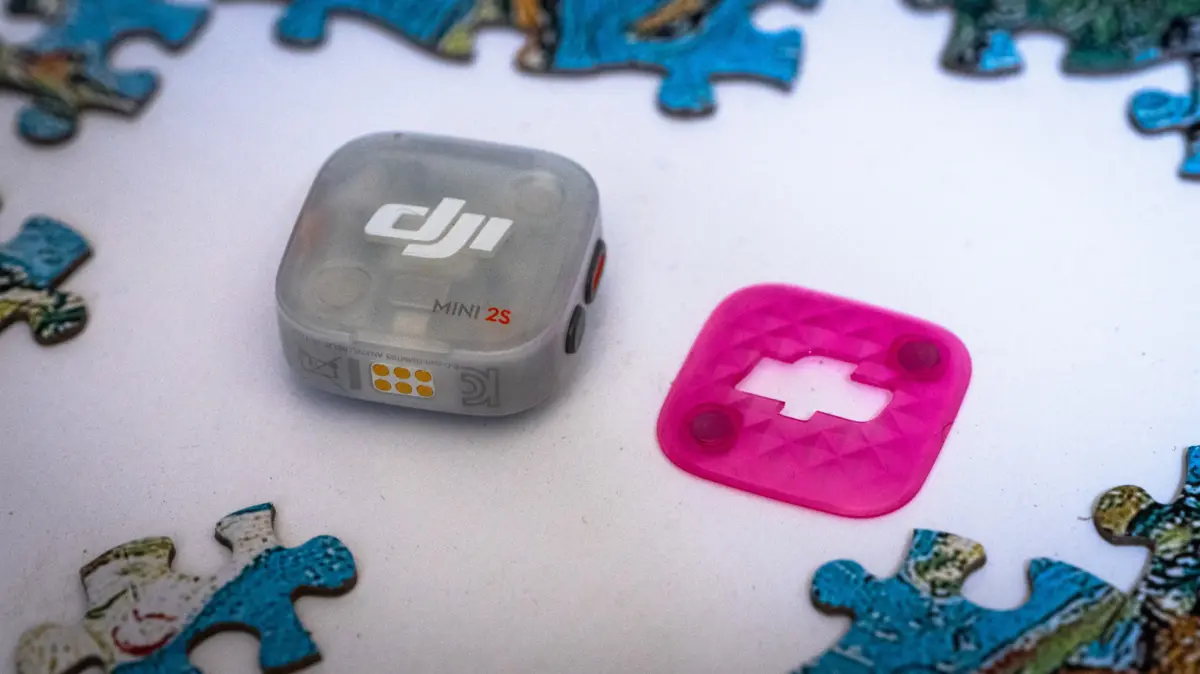
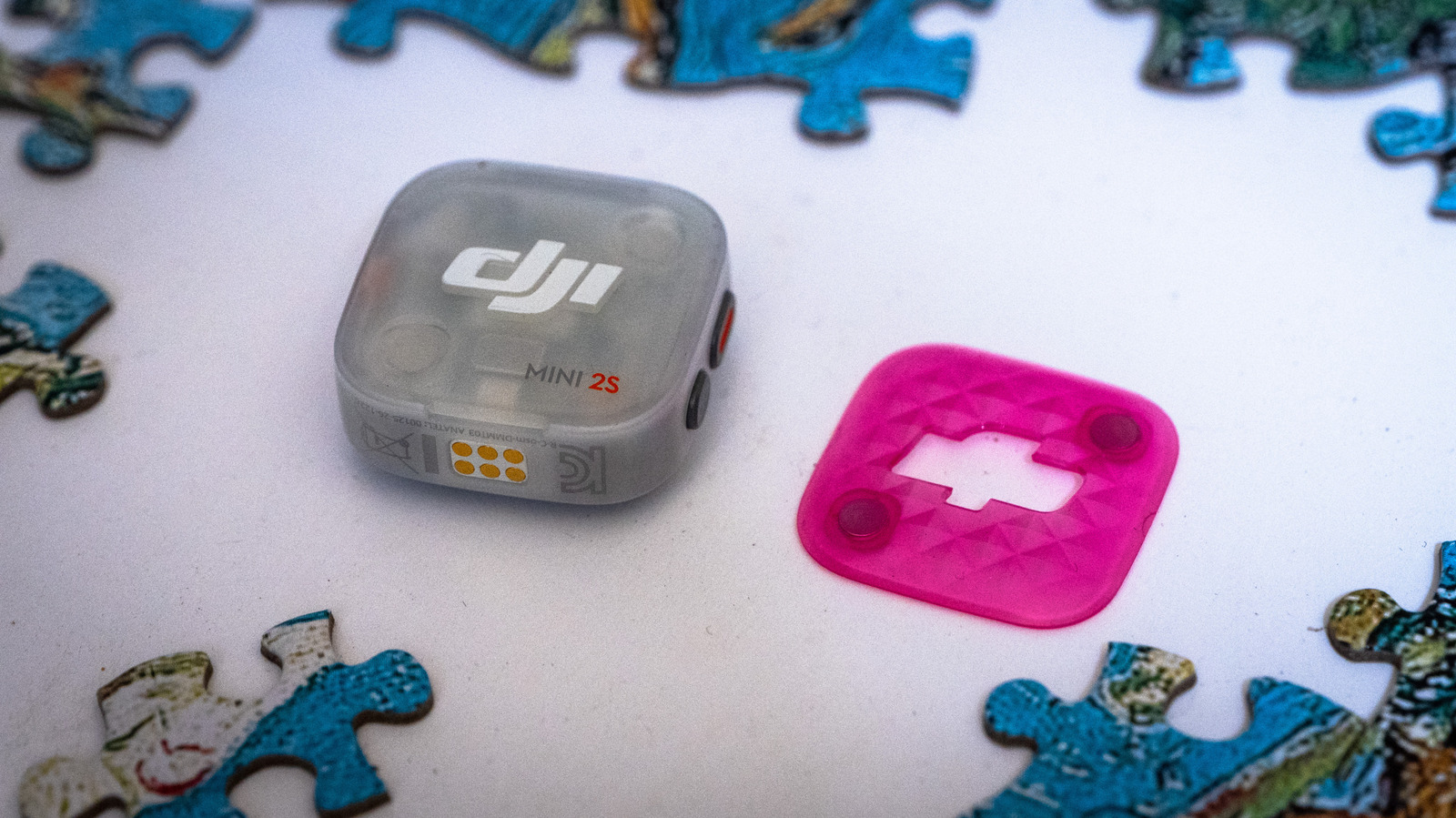
- Translucency and Branding: The protective clear cover is perceptibly more transparent, housing a microscopic "Mini 2S" logo rendered in dual-tone orange and gray.
- Tactile Power Controls: The power button shifts from clear plastic to a vibrant, high-visibility orange. Furthermore, the embossed DJI logo on the front face protrudes outward by roughly one millimeter.
- The Custom Cover Ecosystem: This deliberate protrusion is not accidental. The camera kit ships with ten colorful interchangeable mic covers designed with a precise cutout that locks securely over the elevated logo.
Despite these clever aesthetic additions, a long-standing critique remains unaddressed: professional creators frequently express a strong aversion to corporate branding prominently featured in their video assets. While DJI provides a rainbow of colorful plates, they still showcase the corporate insignia. A truly blank, stealth-focused plate—even offered as an optional premium accessory—remains a missed opportunity for high-end cinematic applications.
Kit Configurations and Receiver Versatility
The Mic Mini 2S is offered in two distinct packaging tiers:
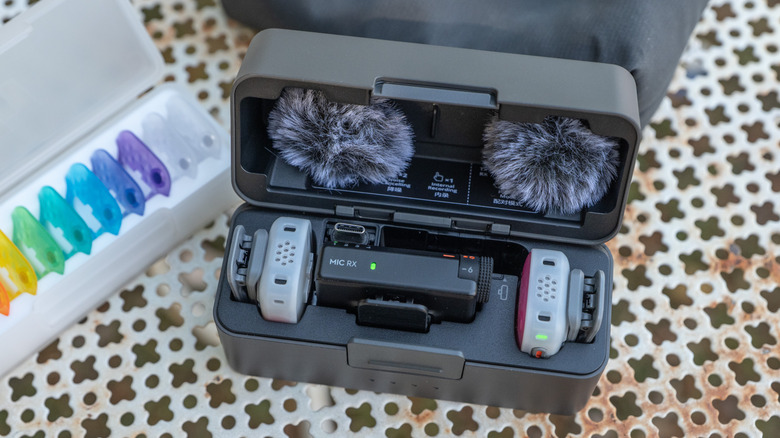
- The Camera Kit: Targeted at mirrorless and DSLR shooters, this package includes a dedicated receiver equipped with a standard 3.5mm microphone output jack, a matching TRS/TRRS connection cable, two transmitters, a hard-shell charging case, magnetic clips, wind muffs, and cover plates.
- The Smartphone Kit: Streamlined for mobile-first creators, this bundle swaps the standalone camera receiver for a compact mobile receiver featuring a male USB-C connection, a single transmitter, and a streamlined charging case.
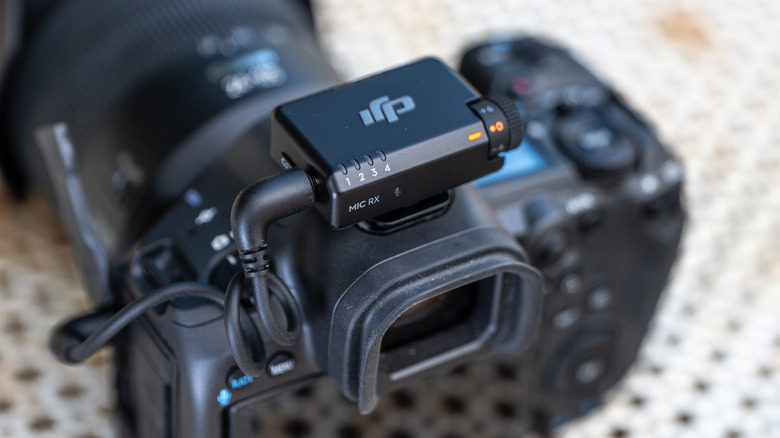
The camera-centric receiver boasts a tactile volume control dial, a 3.5mm monitoring/mic port, dedicated power and Bluetooth buttons, and a cold-shoe clip designed to slide effortlessly into a camera’s hot shoe mount. Notably, the camera receiver has been upgraded to support up to four transmitters simultaneously—doubling the multi-subject capacity of the previous generation. Four discrete, numbered LED indicators provide instant visual verification of link status.
The smartphone receiver, meanwhile, integrates a male USB-C plug alongside a female USB-C pass-through port, enabling continuous device charging during marathon recording sessions. A dedicated physical switch for quick noise reduction rounds out its onboard controls.
Supporting Context & Metrics
Evaluating a modern wireless audio system requires diving deep into quantitative performance metrics—ranging from power efficiency and memory bandwidth to signal-to-noise ratios and advanced DSP (Digital Signal Processing) capabilities.
Battery Longevity and Power Management
Battery anxiety is a silent killer on any production set. DJI’s engineering specifications rate each Mic Mini 2S transmitter for up to 11 hours of continuous operation on a single charge, with the dedicated receiver yielding approximately 10 hours—a minor reduction of 30 minutes compared to prior iterations, largely driven by the power demands of internal flash memory and expanded processing.
In real-world thermal testing conducted at standard room temperatures:
- Transmitter Endurance: Achieved just under 10 hours of continuous wireless transmission and internal recording.
- Receiver Endurance: Matched the 10-hour benchmark almost down to the minute.
- Charging Case Capacity: The camera kit’s charging case can fully replenish both mics and the receiver roughly 3.2 times, delivering a cumulative operational window exceeding 40 hours before the case itself requires a wall plug.
This endurance profile comfortably outperforms primary market rivals within the same price tier, including the Rode Wireless Go III and the Hollyland Lark M2. Furthermore, the ecosystem’s cross-compatibility allows Mic Mini 2 transmitters to pair directly via Bluetooth with smartphones or interface seamlessly with native DJI imaging hardware—such as the Osmo Action 6, Osmo 360, and Osmo Pocket 4—utilizing DJI’s proprietary OsmoAudio protocol.
Operation and Audio Workflow Integration
Field operation is engineered for frictionless deployment. Clipping the magnetic transmitter to talent, connecting the receiver via the 3.5mm cable, and powering on the units initiates automated pairing.
Managing channel routing requires minimal effort:
- Mono vs. Stereo: A quick double-press of the receiver’s link button toggles between mono summing and stereo separation. When deploying two microphones, stereo mode routes talent A to the left channel and talent B to the right channel, preventing vocal bleed in post-production.
- Multi-Mic Workflows: When scaling up to four concurrent microphones, isolated channel segregation is best managed by engaging simultaneous internal recording on each individual transmitter.
Deep-dive configurations are unlocked via the DJI Mimo app. By linking the receiver to a smartphone via the included adapter, creators gain access to advanced operational layers:
- Loop Recording: Automatically overwrites the oldest internal audio files if storage reaches maximum capacity during extended shoots.
- Adaptive Gain Control (AGC): Automatically scales input gain in real-time to maintain a normalized output volume and prevent unexpected digital clipping.
- AI-Powered Noise Reduction (NR): Features a tiered architecture split into a "Basic" mode (tailored for continuous low-frequency hums like HVAC systems) and a "Strong" mode (optimized for unpredictable outdoor environments).
- Voice Tone Presets: Offers three distinct equalization profiles—"Rich" (adds acoustic depth), "Bright" (enhances vocal presence and clarity), and "Regular" (neutral flat response).
Official Performance Analysis and Audio Fidelity
To establish an authoritative baseline, testing was executed across multiple camera bodies, including mirrorless hybrid systems and dedicated cinema rigs.
Frequency Response and Sonic Character
With input levels tuned conservatively just above the green threshold, the 48kHz, 24-bit audio captured directly via the camera receiver sounded clean, articulate, and highly intelligible. However, flat-response analysis reveals a minor attenuation in the lower-mid bass frequencies. Activating the Mimo app’s "Rich" voice preset successfully compensates for this, imparting an agreeable warmth that minimizes the need for heavy equalization during the editing phase.
Nevertheless, broadcast purists will note a distinct boundary. While consumer and prosumer vloggers will find the fidelity stellar, high-end acoustic engineers accustomed to the rich, uncolored capture of high-end Sennheiser or Lectrosonics lavalier systems may perceive a subtle upper-midrange distortion when isolating specific vocal frequencies. Manually attenuating gain in that specific frequency band noticeably smooths out the texture, but the Mic Mini 2S ultimately remains an exceptional tool for content creators rather than a drop-in replacement for pristine, high-end broadcast hardware.
The True Value of 32-Bit Float Recording
The definitive marquee feature of the Mic Mini 2S is its implementation of 32-bit float internal recording. Traditional 24-bit audio has a fixed dynamic range; if an acoustic source exceeds 0dBFS (decibels full scale), the digital waveform clips, resulting in harsh, irreparable distortion.
To test DJI’s implementation, the test environment was deliberately pushed to extremes: input gains on both the camera and the Mic Mini 2S were cranked far past the redline, intentionally inducing catastrophic clipping on the primary camera audio track.
- The Camera Track: Completely ruined—distorted, square-waved, and utterly unusable.
- The Internal 32-Bit Float Track: Pulled into DaVinci Resolve Studio and adjusted downward in post-production, the waveform revealed its true power. The clipped peaks vanished, exposing a clean, fully recoverable, distortion-free vocal track.
This technological safety net completely transforms high-stakes recording environments where sudden shouting, dynamic environmental noises, or erratic speaker delivery can ruin a take in an instant.
Evolution of AI Noise Reduction
Comparing the noise-reduction algorithms of the older Mic Mini 2 against the updated architecture of the Mic Mini 2S demonstrates clear generation-over-generation progress.
- On the legacy Mini 2, engaging the basic noise reduction filter resulted in noticeable vocal degradation, imparting an artifact-heavy "watery" texture to the speaker’s voice.
- On the Mic Mini 2S, the Basic setting suppresses persistent background rumble with negligible impact on vocal timbre. While the Strong NR setting still exhibits minor digital artifacts during chaotic acoustic spikes, it handles non-voice frequencies with significantly more grace, avoiding the aggressive, unnatural frequency cutting seen in previous iterations.
Future Outlook & Market Positioning
Despite its formidable feature set, the DJI Mic Mini 2S faces unique commercial and geopolitical realities. Due to ongoing national security reviews and regulatory scrutiny surrounding Chinese drone and hardware manufacturers, the Mic Mini 2S is notably unavailable in the United States, with no definitive timeline indicating if or when it will clear domestic regulatory hurdles.
For international markets—including Canada, the United Kingdom, and the broader European Union—pricing is aggressively competitive:
- Camera Kit (Receiver, 2 Transmitters, Charging Case): $265 CAD / £169 / €189
- Smartphone Kit (Receiver, 1 Transmitter, Charging Case): $149 CAD / £79 / €99
Competitive Landscape
At these price points, the Mic Mini 2S undercuts or aggressively challenges its primary competitors:
- Rode Wireless Pro ($259): A formidable alternative offering 32-bit float internal recording and bundled wired lavalier mics, though lacking DJI’s ecosystem-level camera integrations.
- Sennheiser Pro Audio Profile Wireless ($279): Appeals directly to broadcast traditionalists seeking the legendary Sennheiser acoustic pedigree alongside 32-bit float support.
- DJI Mic 3 ($277): DJI’s own flagship alternative, which is available in the US market, featuring integrated color touchscreens and expanded internal storage.
Final Verdict
When weighing comprehensive feature integration, class-leading battery endurance, form-factor ergonomics, and the safety net of 32-bit float recording, the DJI Mic Mini 2S carves out a commanding position at the apex of ultra-compact audio gear. For digital creators, independent filmmakers, and mobile journalists operating outside the US market, it represents an almost compulsory purchase. For just a marginal price premium over its predecessor, it eliminates the single largest reservation creators had against the original lineup.
If your production workflow demands a bulletproof backup system and your regional availability permits acquisition, the DJI Mic Mini 2S sets a punishing new standard for what a micro-wireless microphone can achieve.