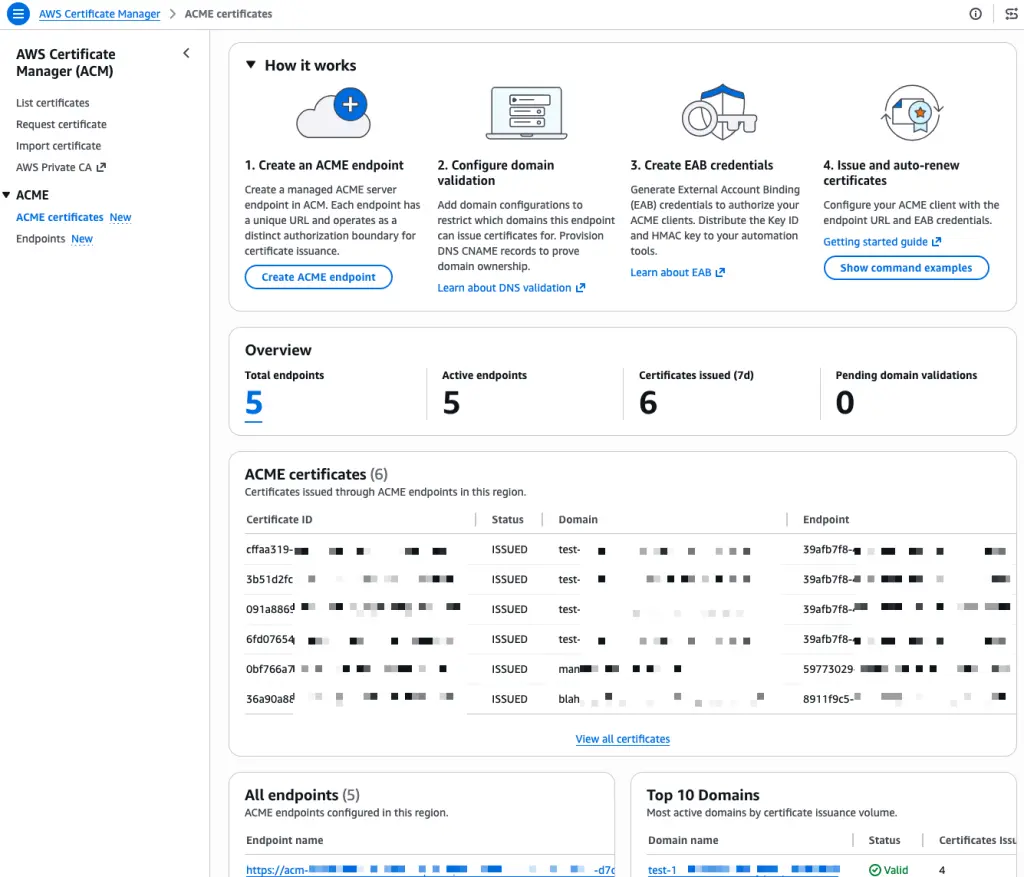
Amazon Web Services (AWS) has announced native support for the Automatic Certificate Management Environment (ACME) protocol within AWS Certificate Manager (ACM). This launch introduces a fully managed ACME server endpoint integrated directly into the AWS ecosystem, enabling organizations to automate the issuance, renewal, and revocation of public Transport Layer Security (TLS) certificates using Amazon Trust Services (ATS).
The release addresses a mounting operational challenge for enterprise Public Key Infrastructure (PKI) administrators. Driven by updated mandates from the Certification Authority/Browser (CA/Browser) Forum, maximum TLS certificate validity periods are shrinking dramatically. Under these new industry standards, maximum validity drops to 100 days by March 2027 and further contracts to 47 days by 2029. Manual certificate tracking and renewal processes are no longer tenable at scale. While external ACME-backed CAs have historically assisted with automation, relying on them alongside AWS Certificate Manager has often introduced visibility fragmentation, siloed dashboards, and complex policy enforcement gaps.
By embedding an ACME server endpoint directly into ACM, AWS allows organizations to leverage standard, open-source ACME clients—such as Certbot, cert-manager for Kubernetes, and acme.sh—while retaining centralized governance, automated DNS validation, fine-grained access control through AWS Identity and Access Management (IAM), and comprehensive audit trails via AWS CloudTrail and Amazon CloudWatch. This new capability bridges the gap between developer-centric automation and enterprise security compliance, eliminating the administrative friction traditionally associated with large-scale certificate lifecycles.

Detailed Chronology & Technical Implementation
The deployment of ACME support within AWS Certificate Manager follows a structured lifecycle designed to separate administrative governance from application-level execution. The implementation workflow is categorized into distinct procedural phases: endpoint provisioning, domain authorization, cryptographic validation, External Account Binding (EAB) generation, and client execution.
1. Endpoint Provisioning and Configuration
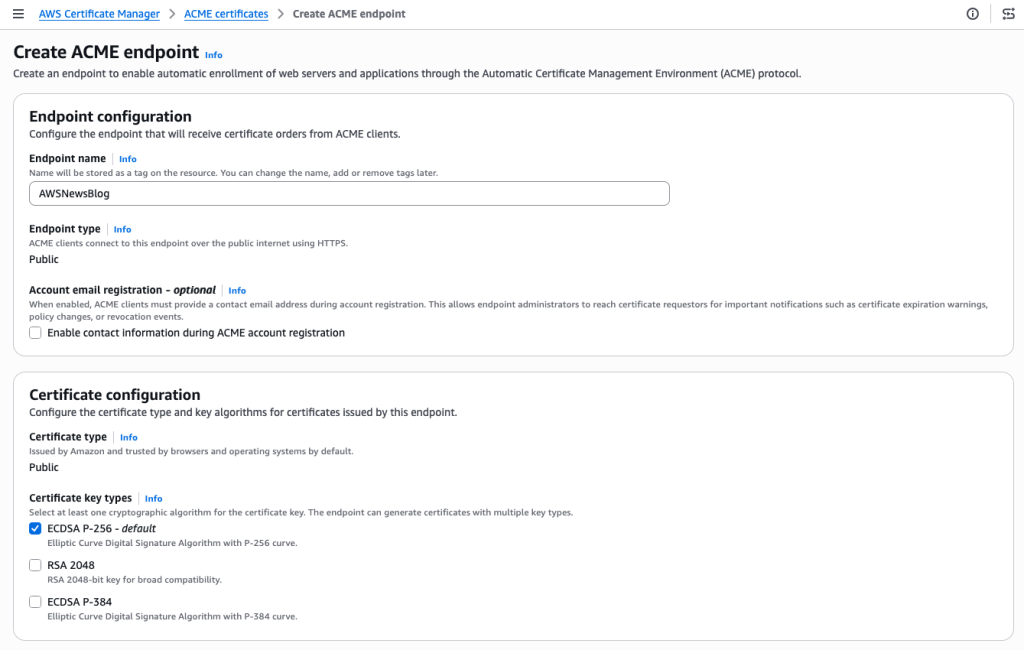
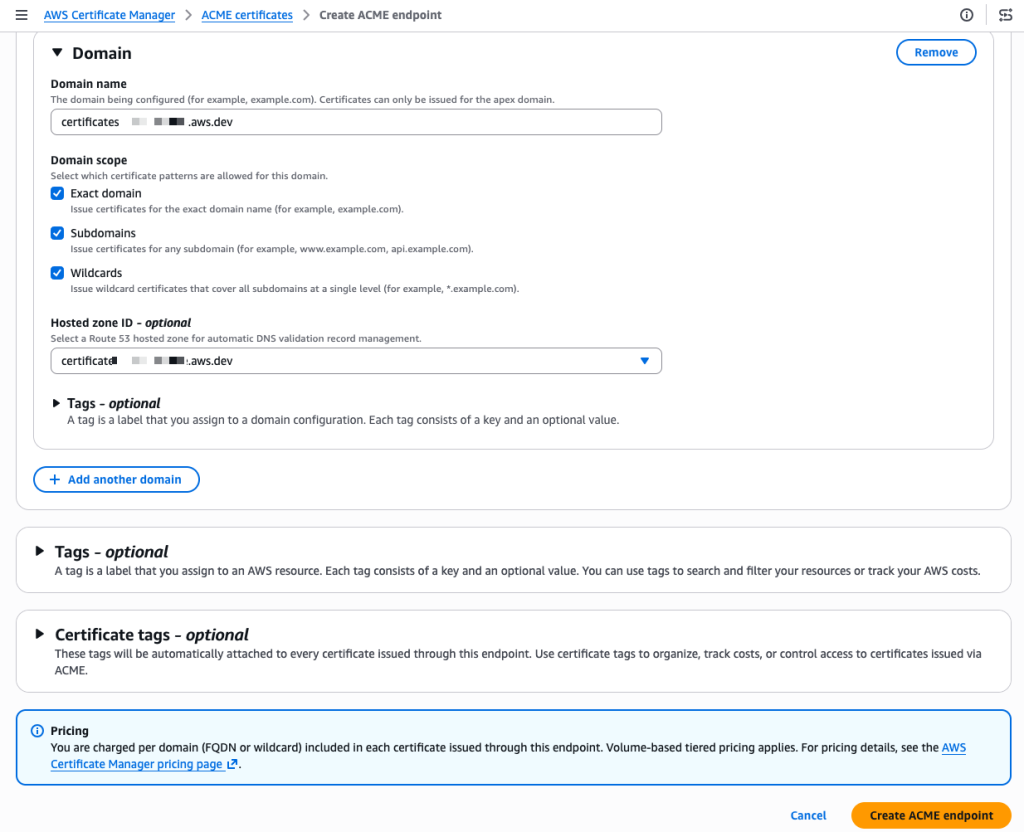
The lifecycle begins within the AWS Certificate Manager console, where administrators navigate to the newly introduced ACME certificates interface and select Create ACME endpoint.
During this initial setup, administrators define several critical parameters:

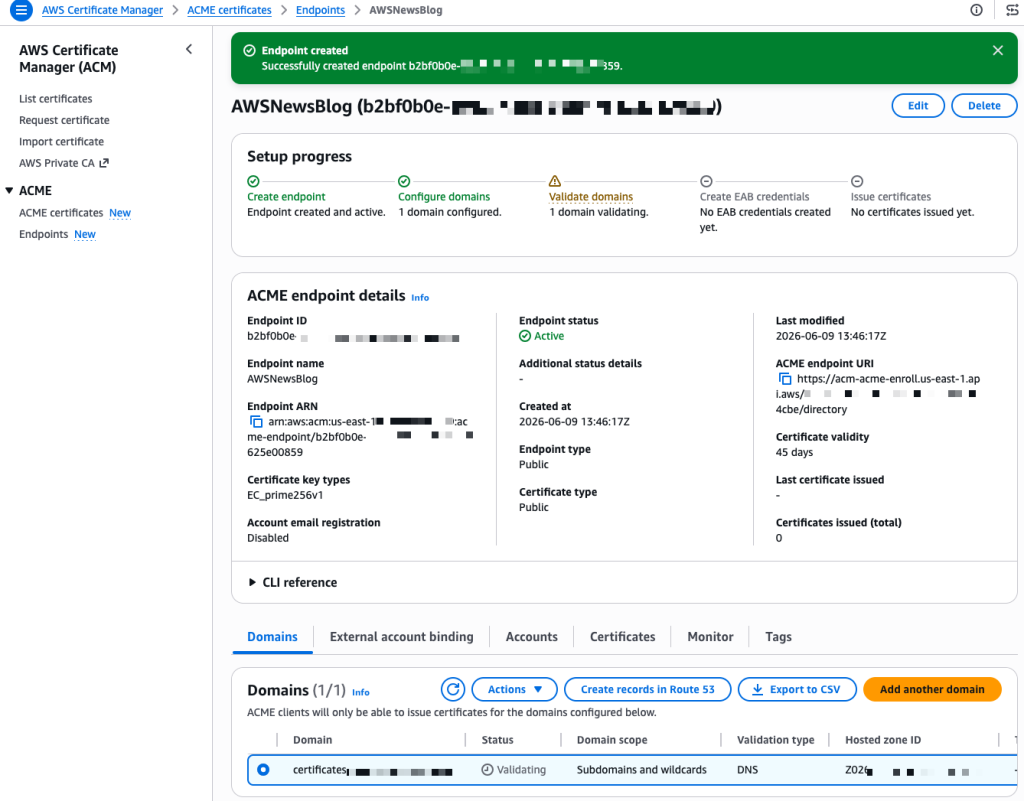
- Endpoint Type & Network Accessibility: Configured as a public endpoint, allowing ACME clients to communicate securely over the public internet.
- Certificate Authority & Trust: Certificates are issued via Amazon Trust Services, ensuring native compatibility and default trust across all major web browsers, mobile operating systems, and computing platforms.
- Cryptographic Key Types: Administrators can select among modern cryptographic standards, including default ECDSA P-256, alongside ECDSA P-384 and traditional RSA 2048 keys, depending on client compatibility requirements.
2. Domain Scoping and Security Boundaries
A defining feature of the ACM ACME implementation is its granular domain scoping mechanism. When configuring an endpoint, administrators input the target domain and assign a strict operational scope. This scope dictates what types of certificates an authorized ACME client can request:
- Exact Domain: Restricts issuance strictly to the specified domain name.
- Subdomains: Permits the generation of certificates for hierarchical subdomains (e.g.,
api.example.comordev.example.com). - Wildcards: Authorizes wildcard certificate generation (e.g.,
*.example.com).
By intentionally omitting specific scopes—such as wildcards—PKI administrators can enforce stringent organizational security baselines. If a scope is left unchecked, the ACME endpoint will reject any client request for that certificate type, preventing privilege escalation or unauthorized wildcard generation even if the client’s underlying request is structurally valid.
3. Automated Validation via Amazon Route 53
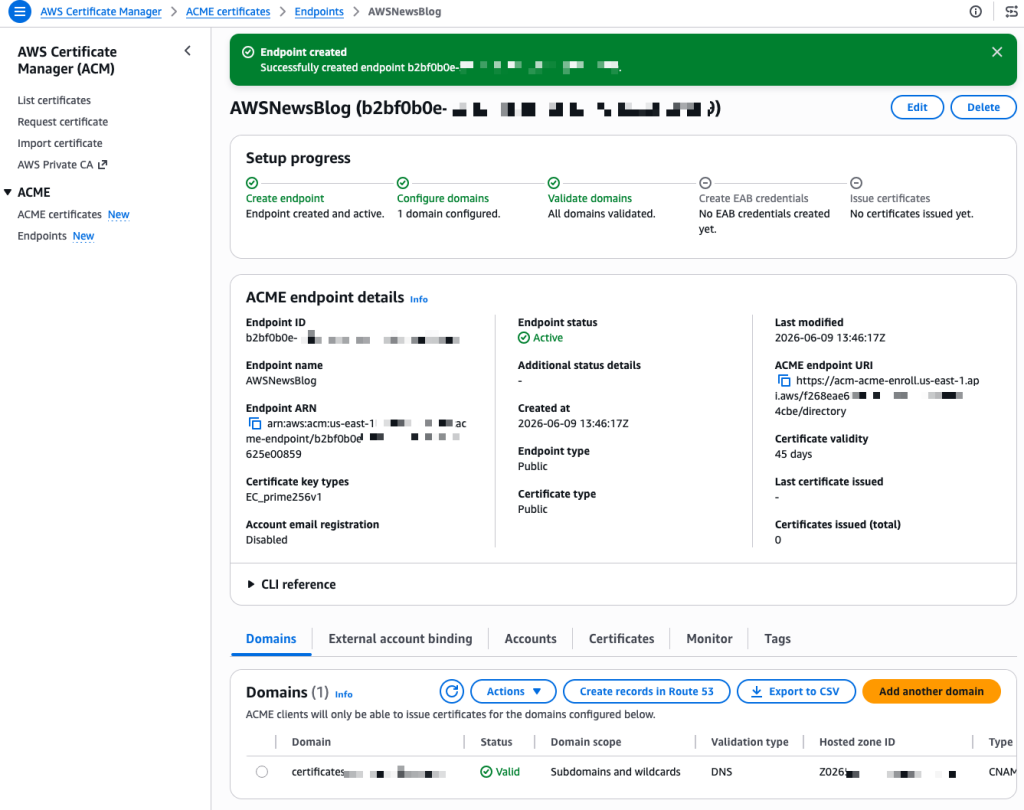
Domain validation represents a crucial security milestone in any ACME workflow, confirming that the entity requesting the certificate actually controls the target domain. Traditional ACME implementations often require individual application clients to manage their own DNS challenges, necessitating the wide distribution of DNS update credentials.
AWS Certificate Manager resolves this operational risk through integrated domain validation:
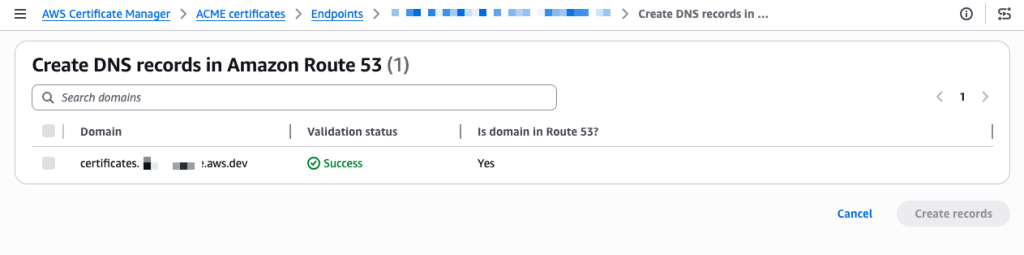
- When configuring the ACME endpoint, administrators select an existing Amazon Route 53 hosted zone associated with the domain.
- ACM automatically provisions the required DNS CNAME records for validation.
- For domains hosted outside of Route 53, administrators can manually configure the provided CNAME record at their external DNS provider once.
This architecture creates a vital operational separation: the PKI administrator validates domain ownership a single time at the endpoint level using secure DNS credentials that never leave administrative control. Application owners never touch DNS keys. Instead, they interact exclusively with the ACME endpoint via restricted credentials.
4. External Account Binding (EAB) and Client Authentication
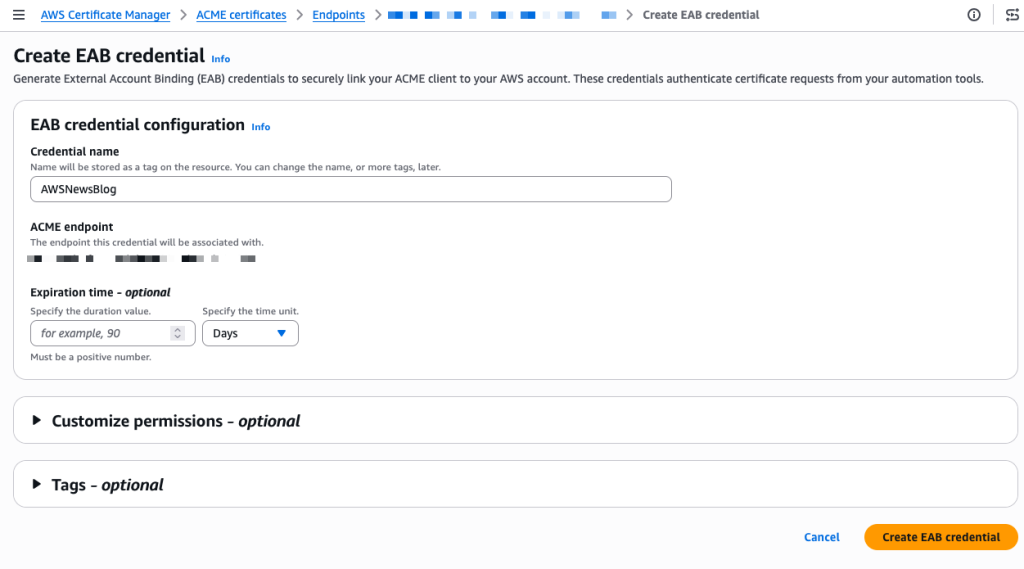
To secure the registration process between third-party ACME clients and the managed AWS endpoint, ACM utilizes External Account Binding (EAB). EAB pairs a unique Key ID (KID) with a symmetric HMAC cryptographic key.
Application owners use these EAB credentials during their initial client registration with the ACME server. Once registered, the client generates its own asymmetric key pair, which is subsequently used to sign and authenticate all future certificate requests. Administrators can assign expiration timelines to EAB credentials to limit their operational lifespan strictly to the duration needed for client onboarding.
5. Client Execution and Operational Retrieval
With the endpoint active, domain validated, and EAB credentials established, application operators can execute standard ACME client commands to request certificates. For example, utilizing Certbot within a containerized environment requires a streamlined command referencing the AWS endpoint directory, EAB credentials, and target domain:
certbot certonly --standalone --non-interactive --agree-tos
    --email [email protected]
    --server https://acm-acme-enroll.us-east-1.api.aws/<ENDPOINT_ID>/directory
    --eab-kid <EAB_KID>
    --eab-hmac-key <EAB_HMAC_KEY>
    --issuance-timeout 300
    -d api.example.com
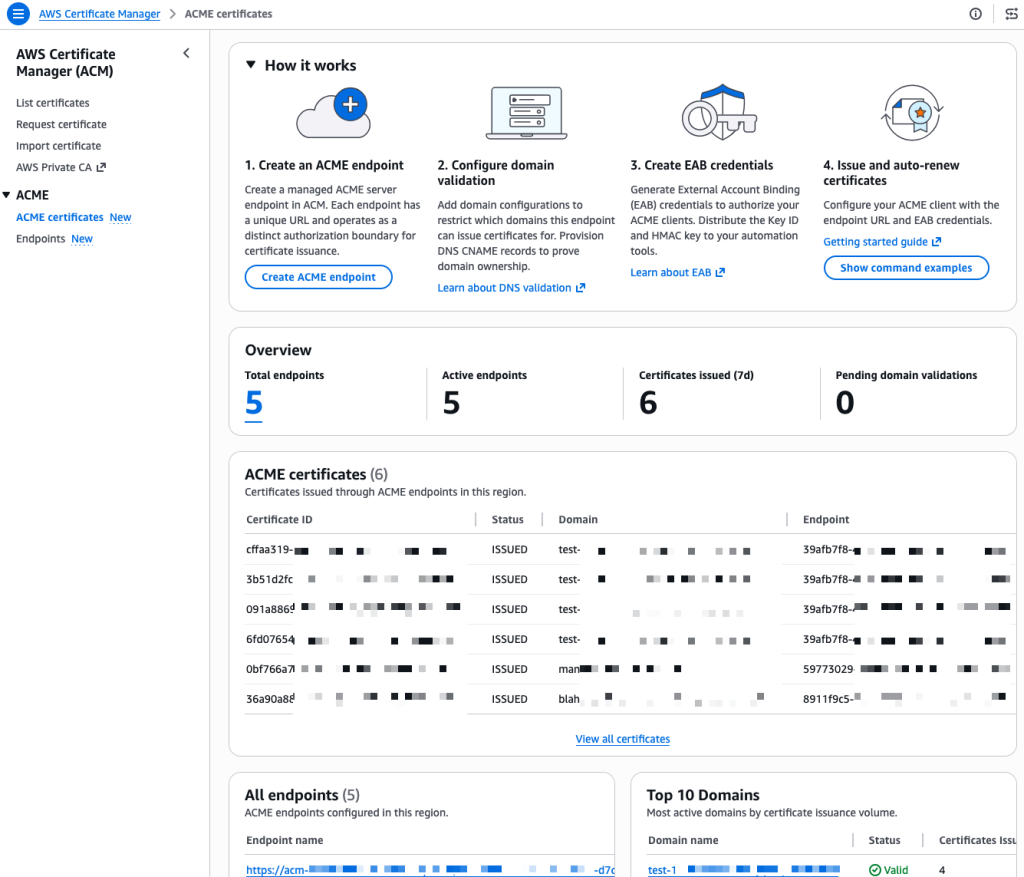
Upon execution, the ACME client communicates with the managed AWS endpoint, completes the cryptographic challenge, and retrieves a fully valid TLS certificate signed by Amazon Trust Services. The newly minted certificate immediately appears within the central ACM console under the ACME certificates tab, sitting alongside certificates provisioned via standard API calls or the AWS Management Console.
Supporting Context & Metrics
The introduction of native ACME support within AWS Certificate Manager arrives at a critical inflection point for internet security architecture. Industry-wide shifts toward reduced cryptographic lifespans are accelerating rapidly.
The Regulatory Pressure of Shorter Lifespans
For over a decade, standard TLS certificate validity periods stood at 398 days, giving organizations ample breathing room for manual tracking, spreadsheet-based inventories, and periodic calendar alerts. However, the cryptographic threat landscape and industry demands for rapid revocation agility have driven a stark reduction in certificate longevity.
The Certification Authority/Browser Forum—the voluntary consortium of certificate authorities and browser vendors that establishes baseline requirements for the issuance and management of public-key certificates—has codified aggressive timeline reductions:
- March 2027: Maximum certificate validity drops to 100 days.
- 2029: Maximum certificate validity contracts further to just 47 days.
At a 47-day validity window, manual tracking becomes entirely impossible for enterprise environments managing hundreds or thousands of internal microservices, edge proxies, and containerized workloads. A single missed renewal cycle under a 47-day regime guarantees catastrophic production outages, broken customer trust, and severe brand damage.
Resolving Architectural Fragmentation
Prior to the launch of native ACME endpoints in ACM, organizations attempting to implement automated TLS workflows faced a difficult architectural compromise. They were forced to adopt external certificate authorities that natively supported the ACME protocol, running them in parallel with AWS Certificate Manager.
This hybrid approach introduced significant friction:
- Fragmented Visibility: Certificates were scattered across disparate dashboards—some monitored in ACM, others tracked through third-party platforms with no single pane of glass.
- Policy Gaps: PKI administrators lacked centralized control over domain scopes, cryptographic key types, and client authorization boundaries.
- Operational Overhead: Organizations often found themselves forced to build custom policy layers or purchase expensive third-party Certificate Lifecycle Management (CLM) software simply to govern automated issuance.
By centralizing ACME endpoints directly inside ACM, AWS integrates automated issuance into a unified governance framework. PKI teams gain complete visibility across all certificates, regardless of whether they were requested via the AWS Console, an SDK API call, or an automated ACME client. Furthermore, native logging via AWS CloudTrail captures every individual certificate request for complete auditability, while Amazon CloudWatch tracks real-time operational metrics and ACM issues automated alerts ahead of approaching expirations.
Official Statements
While AWS engineers and product managers have highlighted the security and operational benefits of the release, the broader architectural community has embraced the update as a necessary evolution in cloud-native cryptographic management.
An AWS spokesperson familiar with the product development noted during the launch:
"As industry standards move rapidly toward shorter certificate validity periods—culminating in the 47-day maximum validity mandate by 2029—manual certificate management is no longer a viable strategy for modern enterprises. By bringing fully managed ACME support directly into AWS Certificate Manager, we are giving our customers the best of both worlds: the universal compatibility of the open-source ACME protocol combined with enterprise-grade governance, automated Route 53 DNS validation, and centralized auditing through CloudTrail. Organizations can now empower their development teams with frictionless automation while retaining absolute administrative control over their cryptographic posture."
Industry analysts and cloud architects have similarly emphasized the elimination of operational silos. By decoupling domain ownership from certificate request capabilities via External Account Binding and domain scoping, AWS has solved a persistent multi-tenant security challenge within large enterprise engineering organizations. Security teams no longer need to compromise their infrastructure security by distributing sensitive DNS management keys to individual application development squads.
Future Outlook
The launch of native ACME support in AWS Certificate Manager establishes a robust foundation for the future of cloud cryptographic governance, but it also signals broader structural shifts ahead as the industry braces for 2027 and 2029 validity thresholds.
Anticipated Regional Expansion
At launch, ACME support in ACM is immediately available across all standard commercial AWS Regions. AWS has confirmed that rollout plans are underway to bring the capability to specialized operational partitions, including AWS GovCloud (US), the isolated China Regions, and the highly secure AWS European Sovereign Cloud. These expansions will ensure that public sector organizations and heavily regulated European enterprises operating under strict data residency and sovereignty requirements can also leverage automated, compliant ACME workflows.
Evolving Pricing and Scale Dynamics
Priced on a predictable, per-domain model calculated at the time of issuance—with tiered volume discounts based on total monthly domain occurrences within an AWS account—the service aligns economic incentives with modern containerized microservice architectures. As enterprises scale their Kubernetes deployments and serverless container fleets, the automated handling of ephemeral certificates will become an invisible utility layer rather than an active engineering burden.
The Road to Automated Zero-Touch Cryptography
Looking further ahead toward the 2029 mandate for 47-day certificates, the role of the PKI administrator will continue to shift away from manual generation and towards policy definition and anomaly monitoring. Features like ACM’s ACME endpoints represent a vital maturation of cloud infrastructure—shifting security teams from reactive firefighting to proactive, automated policy enforcement. As more organizations transition their application stacks to embrace these native endpoints, the industry moves closer to a truly zero-touch cryptographic posture where certificate expirations and browser trust errors are relegated entirely to history.