Executive Overview
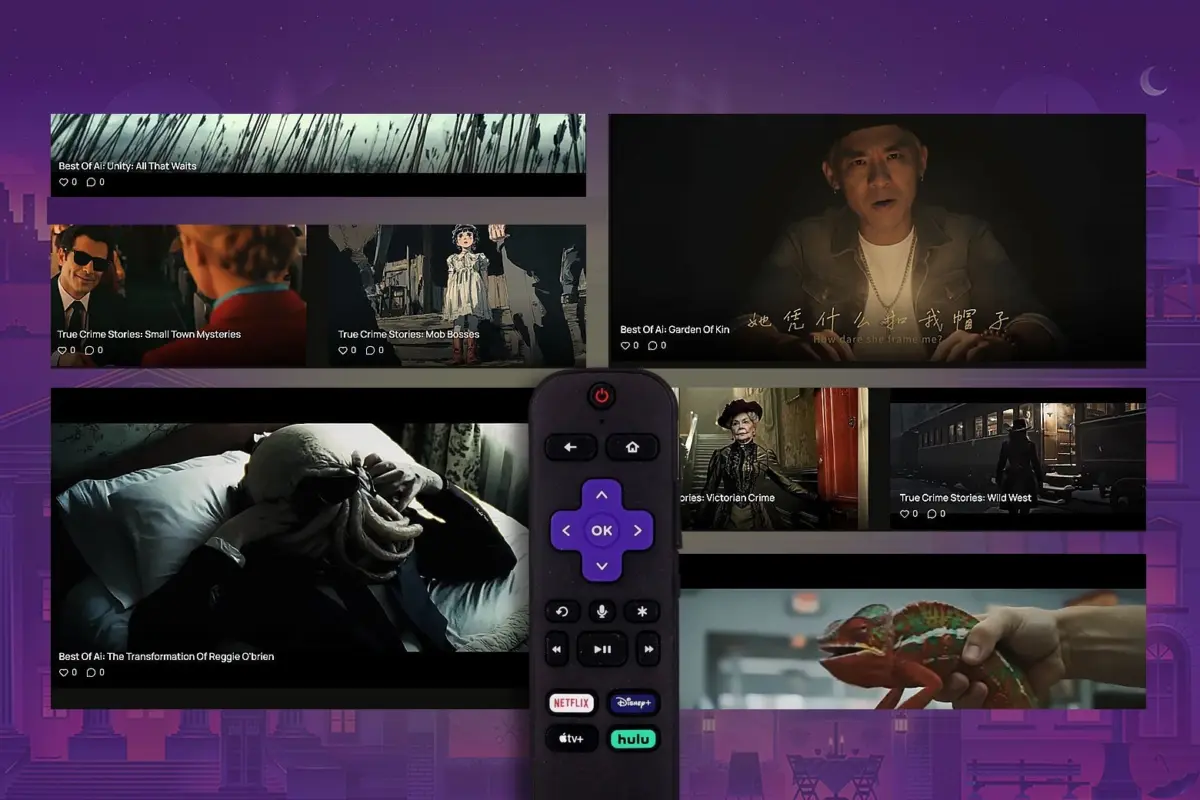
The frontier of digital entertainment has officially arrived, and it looks remarkably like a low-res fever dream. Roku, a titan in the free ad-supported streaming television (FAST) market, has rolled out a first-of-its-kind, 24-hour linear channel dedicated entirely to artificial intelligence-generated content. Located at Channel 300 on the Roku Channel’s Live TV Guide, the appropriately named “AI Creator TV” operates around the clock, churning out algorithmic films, synthetic shorts, and commercial breaks populated by digital avatars.
Billed by its corporate proponents as a democratization of media and an empowering platform for underground digital artists, the channel is supplied by Fairground—a year-old studio that acts as an aggregator for algorithmic creators. Yet, an extended viewing session reveals a stark reality: far from a burgeoning cinematic renaissance, AI Creator TV currently serves as an unrelenting barrage of the uncanny valley. It is a digital wasteland of robotic narration, jarring animation shifts, and derivative storytelling that raises pressing questions about the intersection of vast technological power and absolute artistic bankruptcy.
Detailed Chronology: A Week Inside the Algorithm
The rollout of AI Creator TV earlier this month represents a major escalation in the commercialization of generative video. To understand the cultural footprint of this experiment, one must look at the timeline of its genesis and the grueling reality of its output.
The Genesis of Fairground and the FAST Integration
Fairground was established roughly a year ago with a singular mission: to aggregate, vet, and distribute content produced by independent users leveraging generative AI tools like Runway, Suno, and Sora-adjacent applications. Recognizing the immense hunger for cheap, endless content within the FAST ecosystem—where platforms like Roku, Tubi, and Pluto TV dominate viewing hours—Fairground secured partnerships to place its content across multiple providers.
The strategy culminated in August 2026 with the formal launch of AI Creator TV. Colin Petrie-Norris, CEO of Fairground, positioned the venture as a liberation movement for creators stifled by traditional Hollywood gatekeepers. Promising "high-quality entertainment" and "gorgeous things," Petrie-Norris and his team set out to compile work from over 100 self-taught algorithmic filmmakers globally.
The Viewing Experience: A Catalog of Confusion
To test these promises, a multi-day dive into the channel’s programming schedule exposes a jarring parade of public-domain appropriation and nonsensical plots.
Among the channel’s flagship series is Reimagined, which purports to show how modern generative tools view classic literary figures. One notable broadcast, "Dracula Meets the Walkers" by YouTuber DJ Marcelll, relocates the classic vampire into a modern suburban sitcom alongside a family of zombies. Complete with dated, inorganic quips about a "warm glass of plasma" and visual gags centered on smartphone-obsessed youths, the short epitomizes the derivative nature of early AI television.
Equally baffling is "Pinok IO," a piece that reimagines Pinocchio within a Minecraft Movie-esque visual paradigm. The narrative culminates in a bizarre twist where the protagonist’s name is revealed not to be a tech-industry reference, but the literal number 10, convincing the character of his newfound "realness." The end credits of such productions rarely list human actors, cinematographers, or writers; instead, they feature neat tabulations of the software stacks utilized—displaying corporate tool names like Runway and Suno like badges of honor.
Historical Misadventures and Narrative Collapse
The channel’s ambitions extend beyond fiction into historical and documentary-style programming. "True Crime Stories: Wild West" attempts to dramatize historical events, though it is frequently kneecapped by stiff, unnatural 3D character models and synthesized acoustic tracks. Another historical vignette detailing the 1894 march of "Coxey’s Army" utilizes Suno to generate a bizarrely sterile, AI-reimagined version of the classic folk anthem "Hallelujah, I’m a Bum."
Perhaps the most dizzying narrative peak encountered during the review was "Rush," a seven-minute thriller following a mountain biker who races to the hospital for the birth of his child, only to be struck down by the very ambulance carrying his wife. The story continues from the perspective of the protagonist’s bicycle, which is subsequently claimed by a pizza deliveryman who also enters a race, finishes it, and miraculously makes it to the hospital in time for the birth.
Animation is similarly erratic. The Best of AI: Animation opens with vertical, anime-styled shorts where characters barely articulate their dialogue, culminating in abrupt title cards like "To Be Continue .. " (failing to even complete a standard ellipsis). Interspersed between these viewing hazards are corporate self-promotions, including a Roku advertisement featuring a mad scientist murdering a hardware design team simply because Roku remotes have fewer buttons.
Supporting Context & Metrics: The Economics of Slop
To contextualize AI Creator TV, one must examine the broader economic and technological landscape governing modern streaming and generative artificial intelligence.
The FAST Channel Boom
Free ad-supported streaming television has exploded over the past half-decade, driven by consumer fatigue with rising subscription video-on-demand (SVOD) costs. FAST channels mimic traditional cable television, offering continuous, linear streams of niche content—ranging from 24-hour home renovation blocks to single-show loops.
However, the fundamental economic model of FAST channels relies on maximizing volume while minimizing overhead. Because ad revenue is tied to viewership duration rather than critical acclaim, platforms are incentivized to fill airtime cheaply. Generative AI represents the ultimate economic realization of this model: zero human residuals, instantaneous production cycles, and an endless stream of content that can keep users passively engaged or trapped in a trance of scrolling background noise.
The Tool Stack and the Creator Economy
Fairground relies on a democratization narrative, asserting that it bypasses Hollywood gatekeepers to elevate underrecognized talent. However, the technical infrastructure behind these creators relies heavily on proprietary, centralized models:
- Video Synthesis: Platforms like Runway and OpenAI’s Sora equivalents provide the visual framework.
- Audio and Voice Generation: Suno and Udio supply the synthesized scores and folk anthems, while various text-to-speech engines handle robotic dialogue.
- Curation Metrics: Fairground evaluates entries based on visual consistency, prompt adherence, and output stability across scenes—metrics that prioritize technical stability over narrative coherence or emotional resonance.
Comparative Analysis: Traditional vs. AI-Generated FAST Programming
| Metric / Feature | Traditional FAST Programming | AI Creator TV (Roku / Fairground) |
|---|---|---|
| Production Cost | Moderate to High (acquired libraries, archival content) | Ultra-Low (user-generated or prompt-generated) |
| Content Origin | Licensed from studios, indie filmmakers, and networks | Independent prompt engineers and studio competitions |
| Narrative Consistency | High (scripted, edited, human-directed) | Low to Moderate (frequent logic gaps, surreal shifts) |
| Monetization | Ad-supported, shared licensing revenues | Ad-supported, minimal overhead costs for aggregators |
| Artistic Intent | Entertainment, storytelling, human expression | Technological demonstration, format experimentation |
Official Statements and Industry Perspectives
The launch of AI Creator TV has ignited a broader industry debate regarding the boundaries of artistic innovation and corporate responsibility.
Fairground’s Defense of the Medium
Colin Petrie-Norris, CEO of Fairground, has consistently defended the aesthetic and cultural value of the content his studio distributes. In various media appearances, Petrie-Norris has emphasized that the platform is designed to spotlight hidden gems that traditional studio systems routinely ignore:
"We’re looking for high-quality entertainment. We want to exhibit gorgeous things selected by our staff that otherwise haven’t found traction because of gatekeepers and things."
Proponents of the platform argue that every new medium—from early cinema to computer-generated imagery—suffered through an initial phase of derivative, awkward experimentation before finding its distinct artistic voice. They frame AI Creator TV not as the final destination of entertainment, but as the primordial soup from which a new cinematic language will eventually emerge.
The Backlash from Artists and Critics
Conversely, cultural critics and established filmmakers have raised alarms over the normalization of low-effort, synthetic media. While industry heavyweights such as Martin Scorsese and Natasha Lyonne have expressed genuine curiosity regarding the cinematic and narrative possibilities of AI tools as assistive devices, they have simultaneously cautioned against discarding human labor and artistic intent.
Critics point out a profound disconnect among technology boosters—figures across the tech and entertainment sectors who wield immense capital yet consistently display a fundamental misunderstanding of why audiences connect with art. Art, critics argue, is rooted in lived human experience, empathy, and intentional subversion—elements that algorithmic probability engines fundamentally cannot comprehend, no matter how many public-domain characters they remix.
Future Outlook
As AI Creator TV settles into its permanent home at Channel 300 on the Roku Channel, its long-term viability and cultural impact remain subjects of intense speculation.
- The Novelty Curve: Initially, channels of this nature capture viewer attention purely through morbid curiosity. Audiences tune in to witness the bizarre hallucinations of neural networks, much like early internet users browsed viral fail compilations. However, maintaining long-term engagement without narrative depth or emotional stakes will prove exceedingly difficult.
- The Professionalization Gap: As foundational models improve, the technical baseline of AI-generated video will undoubtedly rise. Characters will stop flickering, lips will synchronize more accurately, and temporal consistency will improve. Yet, better rendering does not automatically equate to better storytelling. Unless platforms like Fairground incorporate rigorous narrative curation—reintroducing the very "gatekeepers" they claim to despise—the output risks remaining an expensive, high-definition novelty.
- The Threat to Independent Labor: The most pressing concern for the broader entertainment industry is not that AI will replace master auteurs, but that platforms will use cheap, synthetic streams to devalue mid-tier human labor. If platforms can fill hundreds of hours of linear television with zero-cost algorithmic slop, the economic pressure on independent animators, voice actors, and writers will intensify significantly.
Ultimately, AI Creator TV stands as a monument to a paradoxical moment in media history: a point where technology has advanced to the edge of science fiction, yet the cultural imagination driving it has rarely felt more derivative. Whether this channel marks the infancy of a legitimate artistic revolution or merely the peak of a passing algorithmic fad remains to be seen. But for now, the uncanny valley has a 24-hour broadcast license, and viewers have the ultimate power of all: the remote control.