Executive Overview
In the fast-paced ecosystem of cloud computing, minor architectural features can unexpectedly introduce vast security blind spots. Such is the case with Amazon S3 annotations—a powerful capability introduced by Amazon Web Services in mid-2026. Designed to streamline AI agent workflows and modern analytics pipelines, S3 annotations allow engineers and automated systems to attach up to 1 gigabyte of structured context directly to object storage entities. Crucially, these annotations are fully mutable; they can be updated, rewritten, or appended to at any time without altering the underlying data bytes.
While this mechanism effectively eliminates the need for external metadata synchronization tables like DynamoDB, it introduces a subtle, profound security vulnerability: Context Drift.
Through a controlled security research simulation, this investigation demonstrates how an unprivileged entity or a compromised upload role can exploit lax Identity and Access Management (IAM) configurations to silently reclassify a highly regulated, HIPAA-compliant patient health record as "public." Because the underlying file bytes remain entirely untouched, object checksums, ETags, and conventional file-integrity monitoring tools register zero anomalies. The data remains physically secure within its bucket, yet its perceived security context is utterly compromised. This article explores the anatomy of this architectural gap, the mechanics of context drift, and the dual-pronged mitigation strategy required to defend modern cloud infrastructures against context tampering.

Detailed Chronology: The Anatomy of a Silent Exploit
To understand how S3 annotations can be weaponized, one must first examine the intended utility of the feature and how the operational mechanics of cloud storage permissions inadvertently pave the way for abuse.
The Power and Peril of Object Annotations
Historically, AWS administrators relied on traditional object tags (limited to 10 tags of 256 characters each) or user metadata (restricted to a 2KB total ceiling) to attach attributes to objects stored in S3. These legacy options required full object rewrites whenever metadata needed updating. S3 annotations revolutionized this paradigm by offering a massive warehouse of structured context—up to 1,000 annotations per object, each scaling to 1 MB—that can be updated independently of the core file.
| Feature | Legacy Object Tags | User Metadata | S3 Annotations |
|---|---|---|---|
| Size Limit | 10 tags, 256 chars each | 2 KB total | 1,000 per object, 1 MB each (up to 1 GB) |
| Mutability | No (Requires rewrite) | No (Requires rewrite) | Yes (Mutable without rewriting) |
| Queryability | Limited | None | Yes, via Athena & Apache Iceberg |
| Supported Formats | Key/Value | Key/Value | JSON, XML, YAML, Text |
While optimized for feeding intelligent AI agents contextual data without human intervention, the capability to modify an object’s descriptive layer independently of its data layer creates a dangerous divergence between what the file actually is and how the system interprets it.

Simulating a Document Classification Pipeline
To construct a realistic testing environment, security researchers built a document classification pipeline designed to parse incoming files and automatically apply a security verdict annotation across four tiers: public, internal, confidential, and regulated.
The classification logic relied on regular expressions and strict hierarchy rules (most-restrictive-wins logic):
- Regulated: Triggered by HIPAA terms, Protected Health Information (PHI), Medical Record Numbers (MRN), or Social Security Number (SSN) patterns.
- Confidential: Triggered by credit card patterns or HR restrictions.
- Internal: Triggered by internal-only runbooks or routing markers.
- Public: Triggered by press release markers.
When tested against synthetic datasets—including fake mortgage applications, payroll CSVs, and patient records—the classifier successfully categorized sensitive documents. However, a significant operational hurdle emerged during the execution phase: the AWS CLI’s streaming blob parser rejected various local path formats (file://, fileb://) on Windows platforms when executing aws s3api put-object-annotation. Bypassing the CLI in favor of the Python Boto3 SDK provided an immediate workaround, allowing developers to successfully write, verify, and read back classification annotations programmatically.

Exploiting the Wildcard IAM Gap
The core security vulnerability does not stem from a bug in S3 annotations, but rather from human habit in IAM policy authoring. Cloud administrators routinely grant ingestion roles broad permissions using wildcards, such as s3:Put*, to avoid the tedious enumeration of individual actions.
When AWS introduced S3 annotations, the s3:PutObjectAnnotation and s3:DeleteObjectAnnotation actions were quietly nested under standard storage operations. Consequently, an IAM policy intended solely to grant file-upload capabilities (s3:PutObject) inadvertently authorized the holder to overwrite security classifications across the bucket.
Using AWS IAM’s simulate_custom_policy API, researchers verified that a naive uploader role possessed unfettered ability to invoke s3:PutObjectAnnotation. The attack path was clear: an attacker or compromised service account could upload harmless files or target existing sensitive assets, leaving the underlying data intact while shifting the administrative classification label.

Supporting Context & Metrics: The Mechanics of Context Drift
The culmination of this architectural flaw is realized when an attacker manipulates the classification label of a high-risk document.
The "Same Bytes, Different Label" Phenomenon
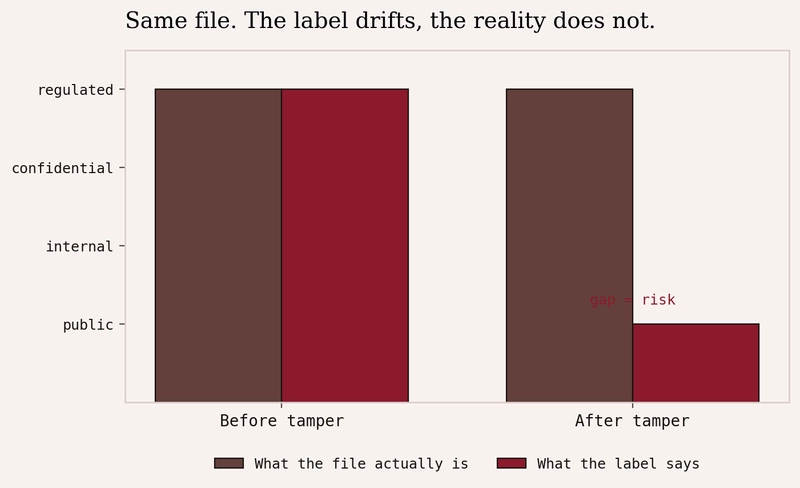
During the simulation, a synthetic HIPAA patient health record (patient-record-882.txt) was targeted. The file was initially classified correctly as regulated. Using an automated tampering script, researchers overwrote only the annotation payload, changing its classification state to public.
The results highlight the insidious nature of context drift:

- Object ETag Before Modification:
"f1f48ca4ab47402c49afa1433a50ae02" - Object ETag After Modification:
"f1f48ca4ab47402c49afa1433a50ae02" - Underlying File Bytes: Unchanged
- Security Classification: Shifted from
regulatedtopublic - Integrity Alarms / AWS CloudWatch: Completely silent
Because the underlying object byte stream remained identical, standard file integrity monitors, versioning controls, and cryptographic hash verifications registered zero modifications. Yet, any downstream AI agent, data lake query, or automated access control gate relying exclusively on the S3 annotation to dictate sharing policies would now treat confidential patient data as freely shareable material.
Official Statements and Industry Implications
The introduction of mutable metadata layers at scale marks a paradigm shift in cloud data governance. As organizations increasingly delegate data discovery and access authorization to autonomous AI agents, the boundary between data content and metadata context becomes a critical attack surface.
While AWS positions annotations as a major leap forward for data discoverability—integrating natively with Amazon Athena and Apache Iceberg tables for petabyte-scale querying—cloud security architects warn that security models must evolve in tandem. Industry experts emphasize that metadata can no longer be treated as a passive descriptive layer; it must be governed with the same rigorous access controls and verification standards applied to primary databases and source code repositories.

Future Outlook: Remediation and Defensive Engineering
Preventing context drift requires a comprehensive defense-in-depth strategy that bridges the gap between static storage permissions and dynamic content validation. Security engineers must implement two foundational layers of defense:
1. Hardening IAM Policies at the Front Door
Organizations must immediately audit their S3 access policies and eliminate broad administrative wildcards. Privileges must be explicitly segregated. Upload roles must be restricted strictly to object creation, while annotation modification rights must be isolated to automated classification engines or security administrators.
An effective hardened policy employs explicit denials to override potential permission creep:

  "Sid": "UploadsOnly",
  "Effect": "Allow",
  "Action": "s3:PutObject",
  "Resource": "arn:aws:s3:::YOUR-DEMO-BUCKET/*"
,

  "Sid": "NoContextTampering",
  "Effect": "Deny",
  "Action": ["s3:PutObjectAnnotation", "s3:DeleteObjectAnnotation"],
  "Resource": "arn:aws:s3:::YOUR-DEMO-BUCKET/*"
2. Implementing Content-Driven Drift Detection
Because preventative IAM controls only safeguard future operations against known threat vectors, organizations must implement periodic drift audits to investigate historical and accidental tampering.
By executing a continuous background audit loop that re-derives classification logic directly from object byte content and compares it against the active S3 annotation, security teams can instantly flag anomalies:
for key in keys:
    body = s3.get_object(Bucket=BUCKET, Key=key)["Body"].read().decode("utf-8", "replace")
    content_level, _ = classify(body)
    annotated_level = read_classification(s3, BUCKET, key)["level"]
    if content_level != annotated_level:
        print(f"  key  content=content_level  annotation=annotated_level  <-- DRIFT")
Limitations of Automated Detection
Security teams must remain mindful of the limitations inherent to drift detection. This methodology functions reliably only when classifications are fully derivable from deterministic rules applied directly to the object’s binary or textual content. When annotations incorporate subjective human evaluations, manual reviewer notes, or non-deterministic AI summaries, automated byte-comparison detectors fail. In such advanced environments, organizations must transition toward cryptographically signed metadata or immutable audit trails.

Conclusion
Amazon S3 annotations represent an undeniable leap forward for big data analytics and agentic AI workflows. However, convenience often walks hand-in-hand with vulnerability. By recognizing that security metadata is as critical as the data it describes—and by enforcing strict IAM boundaries alongside continuous drift auditing—organizations can safely harness the power of mutable cloud context without compromising their data governance posture.