Executive Overview
The boundary separating biology from synthetic engineering continues to blur, yielding innovations that challenge our fundamental definitions of machinery. For decades, the field of robotics has relied on an uncompromising lexicon of metals, rigid plastics, complex wiring, and heavy-duty servomotors. However, as automation penetrates increasingly delicate domains—ranging from microscopic medical surgeries to wearable health devices and the gentle handling of fragile biological tissues—engineers have increasingly turned toward soft robotics. These flexible, compliant systems mimic the mechanics of biological muscles, transforming energy into controlled, highly nuanced physical motion without the rigid constraints of traditional industrial hardware.
Now, a pioneering team of researchers at the Delft University of Technology (TU Delft) in the Netherlands has vaulted living-material research into an entirely new paradigm. As detailed in their recent publication in Nature, the research collective has successfully engineered a soft robotic arm colonized and powered by living microalgae. Rather than utilizing external batteries, complex internal circuitry, or high-pressure pneumatic pumps, this miniature bio-actuator moves in direct response to photosynthesis. When exposed to light, the resident microbes consume carbon dioxide and fix nitrogen, altering local pH levels and triggering a physical expansion in the robot’s hydrogel structure. When darkness falls, metabolic respiration reverses the chemical shift, causing the material to contract.
This breakthrough represents a profound shift toward self-sustaining, environmentally responsive machines. By harnessing the metabolic pathways of unmodified plant-like organisms, the TU Delft team has demonstrated that future robotics might operate independently of electrical grids, functioning as carbon-negative systems with minimal environmental impact. While currently in the proof-of-concept stage—and constrained by a slow operational tempo that requires hours to achieve maximum flex—these photosynthetic soft actuators point toward an extraordinary future for autonomous agricultural equipment, lab-on-a-chip fluid controls, and sustainable underwater exploration.
Detailed Chronology: The Evolution of Bio-Actuation and the TU Delft Breakthrough
The journey toward living robotics has been a gradual convergence of materials science, biotechnology, and soft engineering. To understand the significance of the TU Delft achievement, it is necessary to trace how bio-actuators have evolved from theoretical concepts into physical, functioning hardware.

Phase One: The Rise of Soft Actuators and Hydrogels
Traditional robotics thrived in environments where speed, rigidity, and repeatability were paramount. However, factory floors and heavy manufacturing represent only a fraction of potential robotic applications. As engineers conceptualized devices designed to interact intimately with the human body, delicate ecological zones, or microscopic environments, rigid metallic arms proved inadequate.
This realization catalyzed the development of soft actuators. These devices convert external energy sources—such as electricity, thermal fluctuations, or light—into mechanical motion using compliant, elastic materials. Among the most versatile materials in this domain are hydrogels: polymer networks capable of absorbing and retaining vast amounts of water. By engineering hydrogels to respond to environmental stimuli like temperature or acidity (pH), scientists created materials that could swell or shrink on demand, mimicking the contractions of biological muscle fibers.
Phase Two: Integrating Living Cells into Synthetic Matrices
While chemically responsive hydrogels offered promising flexibility, they still relied on external triggers engineered by humans, such as artificially shifting the chemical composition of a surrounding bath. Researchers began to ask a more ambitious question: What if the material could generate its own stimuli by integrating living biological components?
This gave rise to bioactuators—machines that harness the functional properties of living cells to generate mechanical work. Early iterations often relied on mammalian muscle cells, cardiac tissue, or genetically modified bacteria. While successful, these biological integrations frequently introduced complex hurdles: living tissues often demanded stringent nutritional environments, sterile conditions, and, in the case of modified microbes, strict biosafety protocols to prevent accidental environmental contamination.

Phase Three: The TU Delft Algae-Powered Breakthrough
Seeking to bypass the complications of mammalian tissue and genetically engineered microbes, Marie-Eve Aubin-Tam and her research team at TU Delft shifted their focus toward microalgae—robust, self-sustaining, plant-like organisms capable of photosynthesis.
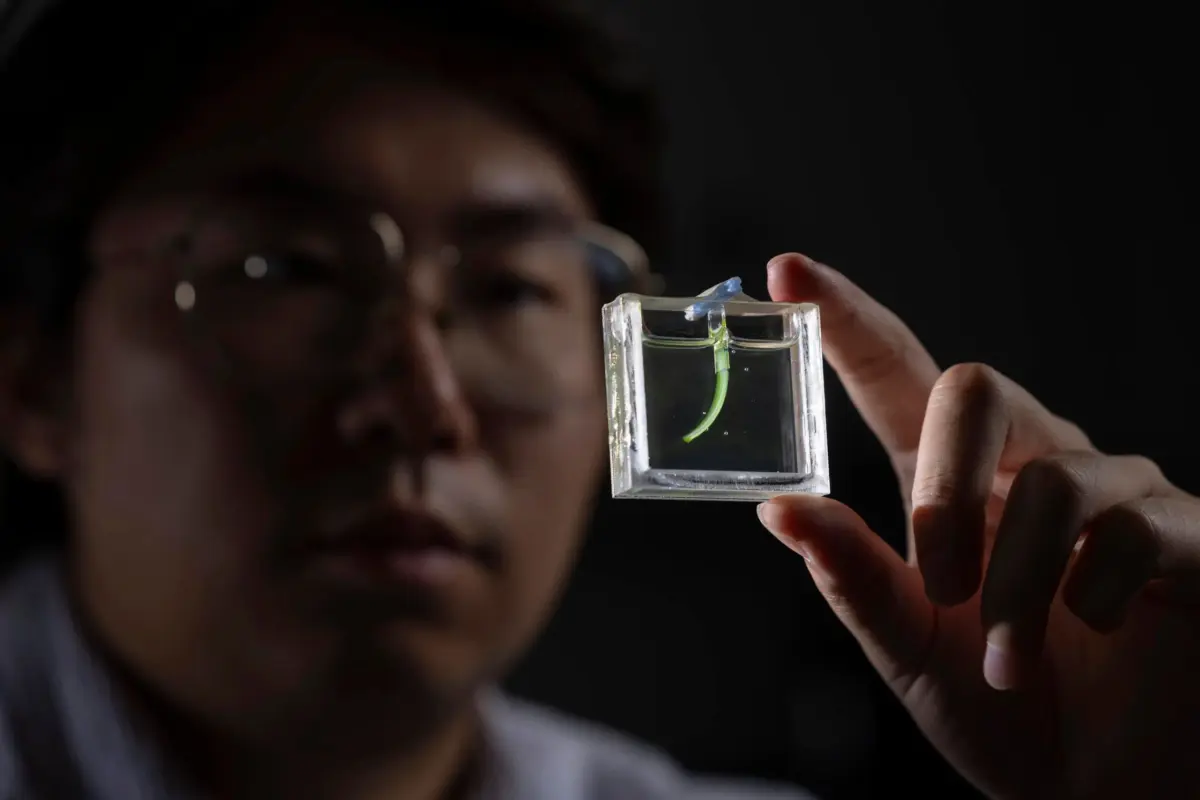
Rather than viewing the microbes merely as a biological payload, the researchers envisioned them as active metabolic engines integrated directly into the robotic architecture. The team constructed tiny robotic arms—measuring approximately three-quarters of an inch in length and roughly as thick as a standard credit card—out of a dual-layer hydrogel system. They colonized the surface of these hydrogel layers with microalgal cells.
The resulting integration created a closed-loop, stimulus-response system driven entirely by light. When light strikes the microscopic algae, photosynthesis initiates. The microbes absorb carbon dioxide and fix nitrogen, shifting the local chemical environment toward a more basic (alkaline) state. This localized pH shift interacts directly with the underlying hydrogel, causing it to swell dramatically. Conversely, when light is removed, the algae shift from photosynthesis to cellular respiration, releasing carbon dioxide, returning the local environment to an acidic state, and causing the hydrogel layer to shrink. Through differential volume changes between the hydrogel layers, the microscopic arm bends with remarkable dexterity, lifting objects without a single electronic sensor or motor.
Supporting Context & Metrics: Mechanics, Materials, and Performance
The engineering behind the TU Delft soft robotic arm relies on precise biochemical interactions and mechanical design principles. Analyzing the specific metrics of the device reveals both its remarkable efficiency and its current operational limitations.

Physical Dimensions and Composition
- Scale: The prototype robotic arms measure approximately three-quarters of an inch (around 1.9 centimeters) in length.
- Thickness: The structures are exceptionally thin, measuring approximately as thick as a standard credit card.
- Material Architecture: The devices are constructed from two distinct layers of hydrogel, with living microalgal cells densely populated across the exterior surface.
- Payload Capacity: Despite their diminutive size and reliance on light rather than motorized torque, experimental grippers have successfully lifted extremely lightweight objects, such as hollow metal spheres and rubber rings weighing far less than a small paperclip.
The Chemistry of Photosynthetic Bending
The core mechanism driving the robot’s movement is a localized pH gradient produced by algal metabolism. Most previous pH-responsive soft robots required researchers to alter the chemical composition of the entire surrounding liquid bath—an impractical approach for real-world deployments. The TU Delft algal bots, however, generate changes locally through their own biological activity.
The quantitative shift in the hydrogel is striking. According to data published by the research team:
- In acidic conditions (ranging between pH 3 and pH 7), the responsive hydrogel layer contracts to approximately 37 percent of its original weight.
- In basic conditions (reaching up to pH 11), driven by active algal photosynthesis, the hydrogel absorbs water and expands to quadruple its original baseline weight (400 percent).
This volumetric differential between the two hydrogel layers forces the arm to bend and curl.
Operational Kinetics: Speed Versus Sustainability
While the chemical signaling system is remarkably responsive, the physical mechanics exhibit a distinct temporal profile:

- Initial Chemical Response: The biochemical shift begins rapidly, triggering approximately 20 seconds after exposure to light and roughly 10 seconds after transitioning to darkness.
- Mechanical Actuation: While the chemical reaction starts almost immediately, the actual physical bending of the hydrogel takes several hours to reach its maximum displacement.
Consequently, these are not high-speed industrial pick-and-place robots. Instead, they operate on a geological or biological timescale, making them ideal for slow, deliberate, energy-efficient tasks where patience is secondary to autonomy and ecological harmony.
Official Statements & Expert Insights
The development of the algae-powered soft robotic arm has generated substantial interest within the international materials science and robotics communities. Speaking in official press releases and academic documentation, lead researcher Marie-Eve Aubin-Tam emphasized that the project was driven by fundamental scientific exploration rather than immediate commercialization pressures.
"We didn’t start with a specific application," explained Marie-Eve Aubin-Tam, who led the research team at TU Delft. "Our goal has always been to bring the research of living materials to new levels. We wanted to explore what becomes possible when living cells are integrated into functional materials."
Aubin-Tam highlighted the inherent advantages of utilizing microalgae over more delicate or heavily engineered biological substrates. Because microalgae are robust, plant-like organisms capable of autonomous survival through simple light capture, they eliminate the need for complex external power supplies or constant chemical feeding.

"Microalgae are plantlike organisms that are largely self-sustaining," Aubin-Tam noted. This biological self-sufficiency "gives the actuator potential for long-term operation with minimal external input. In theory, it wouldn’t require a lot of energy to run a system based on this technology."
Furthermore, because the microalgae utilized in the study do not require genetic modification, the research sidesteps the rigorous biosafety hurdles, containment protocols, and public anxieties frequently associated with synthetic biology and microbe-based technologies. The result is a device that operates in profound harmony with its environment, actively sequestering atmospheric carbon dioxide while harvesting light energy to perform mechanical work.
Future Outlook: Toward Autonomous Ecological and Medical Robotics
As the TU Delft research team looks beyond their initial proof-of-concept phase, the horizon for photosynthetic soft robotics is expanding rapidly. By successfully demonstrating that living microalgae can drive functional, dextrous grippers without electrical wiring or external pumps, the researchers have opened pathways to numerous advanced application domains.
1. Automated Agricultural Equipment
In agricultural settings, delicate handling is paramount. Future iterations of soft bio-actuators could be deployed to manage fragile crops, monitor soil chemistry, or assist in pollination processes. Because these robots run on sunlight and atmospheric carbon dioxide, they could operate autonomously across vast agricultural fields without requiring extensive battery-charging infrastructure or electrical grids.

2. Lab-on-a-Chip Fluid Controls
Microfluidic devices—often referred to as "lab-on-a-chip" systems—require precise, minute control over fluid flows for medical diagnostics and chemical analysis. The localized pH-shifting capabilities of algal hydrogels make them prime candidates for regulating microscopic valves and channels. By using light to control photosynthetic activity, technicians could direct fluid movement within medical testing kits with absolute precision and zero electronic interference.
3. Underwater and Marine Robotics
The natural habitat of microalgae makes underwater robotics an exceptionally promising frontier. Submersible soft robots powered by photosynthesis could operate in marine environments for extended periods, performing delicate ecological monitoring, coral reef restoration tasks, or pollution sampling without the risk of battery leaks, heavy metal contamination, or noisy motor disruptions that might frighten aquatic life.
4. Carbon-Negative Automation
Ultimately, the most profound implication of the TU Delft research lies in its environmental profile. As global industries race to decarbonize, the integration of photosynthetic organisms into synthetic machinery points toward a new class of carbon-negative technology. If future engineering can overcome the speed limitations of hydrogel expansion, humanity may soon enter an era where our machines do not merely consume energy from the Earth, but actively participate in healing it.