Executive Overview
In a decisive maneuver aimed at dismantling the financial plumbing sustaining the Kremlin’s wartime economy, the United Kingdom has levied sweeping economic sanctions against Cryptomus, a notoriously elusive cryptocurrency payment processor. Security experts, blockchain intelligence firms, and international investigators have long identified Cryptomus as a central conduit for illicit capital flows. The platform serves as a critical bridge for ransomware gangs, narcotics traffickers, darknet marketplaces, and sophisticated cybercrime syndicates—all while actively assisting Russian entities in circumventing Western financial restrictions.
Announced on October 8, the U.K. Foreign, Commonwealth & Development Office sanctions target Cryptomus directly, alongside its aliases and affiliated virtual payment platforms, including VexPay, TokenSpot, and the Tsunami Payments service. The sanctions enact an immediate freeze on any assets held by Cryptomus within British financial institutions and legally bar UK-based companies, individuals, and legal entities from engaging in any commercial or virtual business relationships with the platform.
The regulatory action represents a watershed moment in international cybersecurity enforcement. According to blockchain analysts, this is the first known instance of a "Five Eyes" intelligence-sharing nation (comprising Australia, Canada, New Zealand, the United Kingdom, and the United States) directly sanctioning a commercial cryptocurrency operation originally incorporated within another Five Eyes jurisdiction.
While previous efforts by allied nations—such as a record-breaking financial penalty levied by Canada—failed to shutter the operation due to jurisdictional and enforcement hurdles, British sanctions strike directly at the core of the enterprise. By criminalizing financial interactions and cutting off access to institutional banking networks, the U.K. action highlights a growing global consensus: that modern cybercrime, state-sponsored sanctions evasion, and illicit cryptocurrency platforms are inextricably linked threats requiring coordinated, hard-hitting countermeasures.
Detailed Chronology of an Illicit Empire
Emergence and Evolution (2022–2024)
Cryptomus burst onto the digital landscape in 2022, quickly establishing itself as a preferred payment gateway for a multitude of Russian cryptocurrency exchanges and online portals peddling cybercrime-as-a-service. Operating under a variety of corporate guises—including Certa Payments and Xeltox Enterprises—the platform utilized corporate opacity to mask its true operational footprint.
From its inception, Cryptomus positioned itself as an accommodating processor for illicit actors seeking to bypass international banking controls. Investigators later revealed that the platform shared a nominal physical address in Vancouver, British Columbia, with dozens of other foreign currency dealers and money transfer businesses—none of which maintained an actual physical presence at the location.
Despite operating in plain sight, Cryptomus processed billions of dollars in digital assets with minimal regulatory friction. Its infrastructure became indispensable to threat actors looking to launder funds derived from ransomware attacks, financial fraud, and underground marketplaces.
The Canadian Reckoning and the Birth of "Heleket"
As the scale of illicit activity moving through Cryptomus became impossible to ignore, regulatory authorities began closing in. In late 2025, Canadian financial watchdogs levied a historic CAD $176 million administrative monetary penalty against Cryptomus for severe violations of anti-money laundering (AML) and know-your-customer (KYC) regulations.
Faced with mounting regulatory pressure and the enforcement action, Cryptomus adopted a classic chameleonic strategy. The platform instituted superficial and short-lived KYC rules on its main domain—which caused a temporary dip in its overall transaction volumes—while simultaneously launching a parallel, no-KYC processing service known as Heleket.
Operating essentially as Cryptomus under a different banner, Heleket allowed cybercriminals, darknet vendors, and sanctioned Russian entities to continue transacting anonymously. Even as Telegram support agents for Heleket adamantly denied any formal affiliation with Cryptomus, blockchain investigators quickly mapped the underlying infrastructure, proving that Heleket was merely a rebranded continuation of the same illicit enterprise designed to evade Canadian fines.
The U.K. Sanctions Hammer (October 2026)
Recognizing that administrative fines against foreign-facing crypto platforms are frequently uncollectible and easily circumvented, the United Kingdom took a far more aggressive stance. On October 8, 2026, the U.K. government officially designated Cryptomus, Heleket, VexPay, TokenSpot, and Tsunami Payments under its Russia sanctions regime.

Within hours of the announcement, the impact was immediate. Telegram support bots utilized by Cryptomus and Heleket began sending automated error messages to users, indicating that the platforms were suddenly and inexplicably unable to process outgoing or incoming transactions. By cutting off access to liquidity and prohibiting British entities from engaging with the service, the U.K. sanctions effectively initiated a systemic operational collapse that traditional regulatory fines had failed to achieve.
Supporting Context & Metrics
The scale of illicit wealth managed by Cryptomus and its ecosystem is staggering. Comprehensive data compiled by leading blockchain intelligence and analytics firms paint a vivid picture of a financial engine explicitly built to service the global criminal underground and Russia’s wartime economy.
Volume and Ecosystem Impact
According to investigative findings published by TRM Labs in April 2026, Cryptomus had processed more than $7 billion in cumulative transactions since its founding in 2022. This massive volume was not limited to traditional financial arbitrage or legitimate e-commerce; TRM Labs identified significant transaction flows associated with dangerous illicit categories, including:
- Vendors trafficking in Child Sexual Abuse Material (CSAM).
- Terrorist financing networks operating across geopolitical fault lines.
- International human trafficking and smuggling syndicates.
- Ransomware operators targeting critical infrastructure in Western nations.
Chainalysis Insights on Russian Sanctions Evasion
Data released by Chainalysis following the October 8 U.K. sanctions announcement underscored the vital role Cryptomus and Heleket played in mitigating the impact of Western financial restrictions on Russia. Chainalysis noted that these platforms functioned as a primary conduit for Russian financial institutions seeking to move capital across borders outside the purview of traditional SWIFT banking channels.
Furthermore, Chainalysis revealed that Cryptomus and Heleket had emerged as massive systemic hubs for illicit cryptocurrency activity. In late 2025, at the height of their operational pivot, the number of distinct illicit counterparties interacting with the platform surged to more than 900 in a single month. According to the firm’s dataset, these combined services received higher volumes of illicit funds across tracked categories than traditional cryptocurrency mixers—historically the primary tool for laundering cybercrime proceeds.
Official Statements and Expert Analysis
The coordinated takedown of Cryptomus has elicited strong reactions from the blockchain intelligence community, highlighting the fundamental shift in how Western governments are choosing to police decentralized financial infrastructure.
The Superiority of Sanctions Over Fines
Richard Sanders, a prominent blockchain analyst and investigator who spent months mapping Cryptomus’s intricate payment infrastructure and interacting directly with its clientele, emphasized the profound legal and operational difference between monetary fines and economic sanctions.
"A fine doesn’t stop a cryptocurrency payment processor from processing payments," Sanders wrote in a public analysis shared on LinkedIn. "Sanctions kill the operation. The distinction matters."
Sanders pointed out that while Canada’s record-breaking CAD $176 million fine was a notable public relations milestone, it was ultimately unenforceable and uncollectible against an entity designed to operate in the regulatory shadows. By contrast, the U.K. sanctions introduce severe criminal liabilities for any financial institution, intermediary, or corporation that continues to touch Cryptomus-linked funds, effectively starving the network of its operational oxygen.
Intelligence-Sharing and Cross-Border Precedent
Security analysts have also noted the geopolitical significance of the U.K.’s action within the context of the Five Eyes intelligence alliance. Because Cryptomus maintained nominal corporate roots within a Five Eyes territory (Canada) while laundering funds primarily to benefit a hostile state (Russia) and servicing global criminal syndicates, its operations exposed glaring gaps in international regulatory harmonization.
By stepping in to sanction an entity born within an allied jurisdiction, the U.K. has established a vital precedent: national borders and shell corporation registrations will no longer serve as an impenetrable shield for cryptocurrency platforms operating as transnational criminal enterprises.

The Anatomy of a Phantom Regulator
One of the most persistent mysteries surrounding Cryptomus and its parent entities has been the question of their regulatory provenance. How do unregulated cryptocurrency platforms operating shell companies derive the apparent legal authority to offer international financial services?
An in-depth investigative report published by KrebsOnSecurity in December 2024 uncovered a bizarre and audacious corporate structure that answered this question, pointing directly to phantom financial institutions overseen by a phony regulatory body positioned in a territory largely unrecognized as a sovereign nation.
The Western Sahara Connection
According to corporate filings and investigative tracking, the sole shareholder of Cryptomus’s original parent company, Certa Payments, was a 25-year-old Ukrainian national. Alongside her role at Certa Payments, this individual also headed several other corporate entities, including the WS Management and Advisory Corporation.
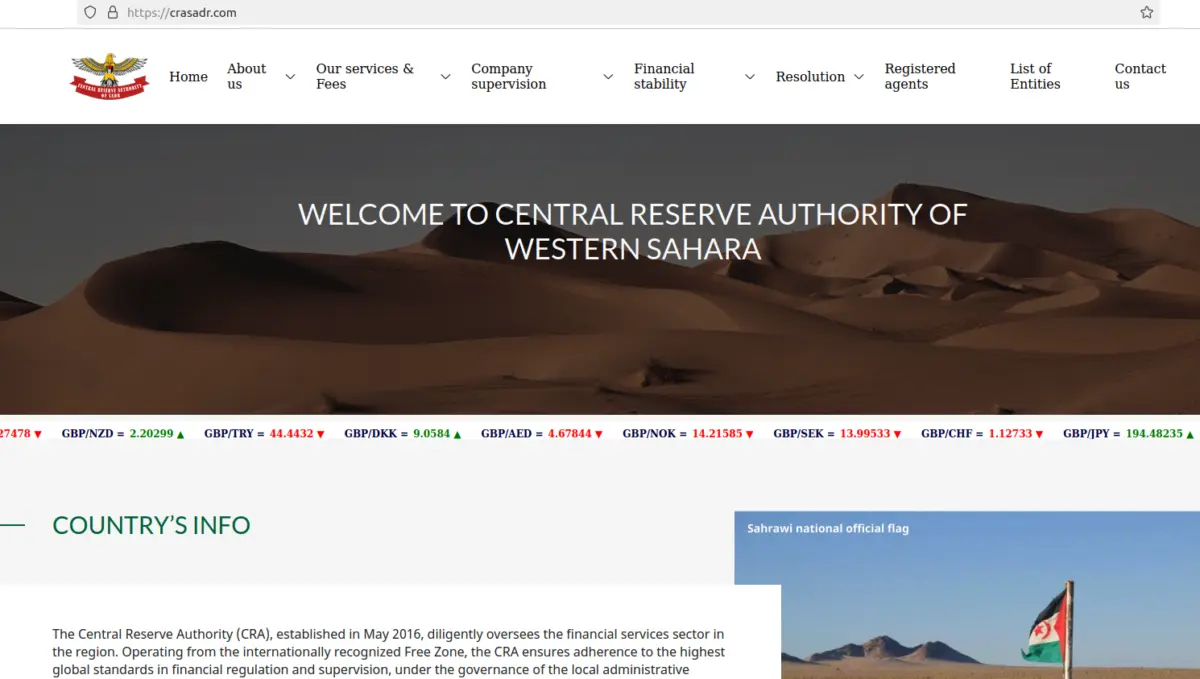
WS Management and Advisory Corporation aggressively marketed itself as an exclusive, authoritative regulatory body responsible for issuing licenses to cryptocurrency exchanges, foreign exchange brokers, and online gaming businesses incorporated within the disputed region of northwest Africa known as the Western Sahara.
Through its official portal—crasadr.com, representing the Central Reserve Authority of the Western Sahara—the fake regulatory body offered applicants assistance with corporate formation, bank setup, and the acquisition of official-looking financial licenses. Digital forensics revealed that one of Certa Payments’ former domains (certa.website) shared a server with twelve other dubious domains, including rasd-state.ws, further unmasking the interconnected web of fictitious state authorities used to legitimize illicit payment processors.
This elaborate facade allowed Cryptomus to present itself to unsuspecting merchants and high-risk clients as a fully licensed and compliant entity, masking its true function as a high-volume laundering machine for Russian sanctions evasion and global cybercrime.
Future Outlook
The implementation of U.K. economic sanctions against Cryptomus, Heleket, and their associated payment rails marks a critical turning point in the ongoing war against cryptocurrency-enabled financial crime. However, security experts warn that the battle is far from over.
The Whack-A-Mole Phenomenon
Chameleonic payment processors have repeatedly demonstrated an uncanny ability to adapt to regulatory pressure. As demonstrated by the seamless transition from Cryptomus to Heleket following the Canadian financial penalties, criminal syndicates operating in this space are adept at shedding old corporate skins, rebranding under new names, and spinning up parallel infrastructure almost overnight.
Law enforcement agencies and blockchain analytics firms will need to maintain continuous, real-time surveillance to track emerging iterations of these networks. As soon as one payment processor is sanctioned or frozen, its operators are likely attempting to establish new front companies utilizing similarly obscure jurisdictions and fake regulatory bodies.
Implications for the Broader Crypto Ecosystem
The decisive action taken by the United Kingdom sends an unmistakable warning shot to the wider cryptocurrency industry: compliance is no longer optional, and platforms that intentionally turn a blind eye to sanctions evasion and high-risk criminal transactions will face existential threats.
For legitimate cryptocurrency exchanges, custodian services, and decentralized finance (DeFi) protocols, the downfall of Cryptomus reinforces the necessity of robust chain-alysis tools, strict KYC enforcement, and thorough counterparty risk management. As international regulators increasingly align their sights on cross-border crypto laundering networks, the safe harbors available to cybercriminals and sanction-busters are rapidly shrinking.