Executive Overview
The intersection of two titans in the modern pop-culture landscape is expanding in a direction few could have anticipated. Following the initial groundswell of excitement generated by last year’s Spider-Man and Marvel Super Heroes crossovers, Wizards of the Coast (WotC) is preparing for its third major foray into the Marvel Universe. Titled Darkhold Destiny, this upcoming expansion is shedding the grounded, street-level New York aesthetics of its predecessors in favor of something far more esoteric, high-fantasy, and grim.
Instead of treating the Marvel crossover as a temporary visitation of familiar cinematic icons onto foreign cardboard, Darkhold Destiny establishes a deeper narrative integration. Wizards of the Coast has been granted the creative autonomy to craft an original, in-house story featuring mystical heavyweights like Doctor Strange, the Asgardians, and iconic cosmic entities. The result is a set that blurs the lines between Marvel lore and the sprawling, planar cosmology of Magic: The Gathering (MTG).
Scheduled for release in April 2027, with introductory comic tie-ins beginning as early as February 2027, Darkhold Destiny promises a heavy mechanical emphasis on spellcasting, the reintroduction of a long-dormant card subtype, and a product lineup designed to satisfy both competitive players and collectors alike. This report breaks down the thematic pillars, mechanical developments, artistic shifts, and product architecture of MTG’s most magical crossover yet.
Detailed Chronology: The Genesis and Evolution of the Marvel Crossover
The Foundation: Spider-Man and Marvel Super Heroes
To understand the significance of Darkhold Destiny, one must look at the trajectory of WotC’s Universes Beyond initiative, specifically its multi-year partnership with Marvel. Last year, the introduction of Spider-Man and the broader Marvel Super Heroes set proved that superhero properties could successfully transition into the complex rules engine of MTG.
However, those initial sets were constrained by traditional depictions. Characters like the Scarlet Witch, Iron Man, and Captain America wore outfits lifted straight from standard comic book pages, functioning primarily as direct translations of their well-known iterations. While commercially successful, these sets occasionally drew critiques from purists who felt the aesthetic integration into Magic’s multiversal framework felt skin-deep.
Pivoting to the Esoteric: The Conception of Darkhold Destiny
Recognizing the potential for a deeper narrative synthesis, WotC and Marvel collaborated on a concept that would allow the MTG design team to flex its creative muscles. Rather than pitting heroes against street-level thugs or localized supervillains, the narrative architects turned their gaze toward the cosmic and the occult.
At the center of this new narrative nexus is the Darkhold—the primordial book of spells and dark magic in the Marvel Universe. In Darkhold Destiny, the stakes are multiversal. The dread lord Dormammu and the Asgardian goddess of death, Hela, harness the corruptive power of the Darkhold to initiate an invasion spanning across realities. Opposing them is an alliance of mystics, gods, and supernatural antiheroes led by Doctor Strange and Thor.
By moving the setting away from mundane urban environments and into realms of pure magic, WotC was able to write an entirely original story. This narrative freedom allowed the design and art teams to reimagine classic Marvel characters through the stylized lens of Magic: The Gathering, laying the groundwork for a truly unique crossover experience.
Supporting Context & Metrics: Art, Mechanics, and Product Lineup
Artistic Redirection: Blending Marvel with MTG’s Multiverse
One of the most striking revelations surrounding Darkhold Destiny is the level of artistic liberty afforded to WotC’s stable of illustrators. In previous Marvel sets, characters maintained an explicit, traditional comic book fidelity. Darkhold Destiny, however, reimagines these icons to fit seamlessly into the rich visual tapestry of MTG.
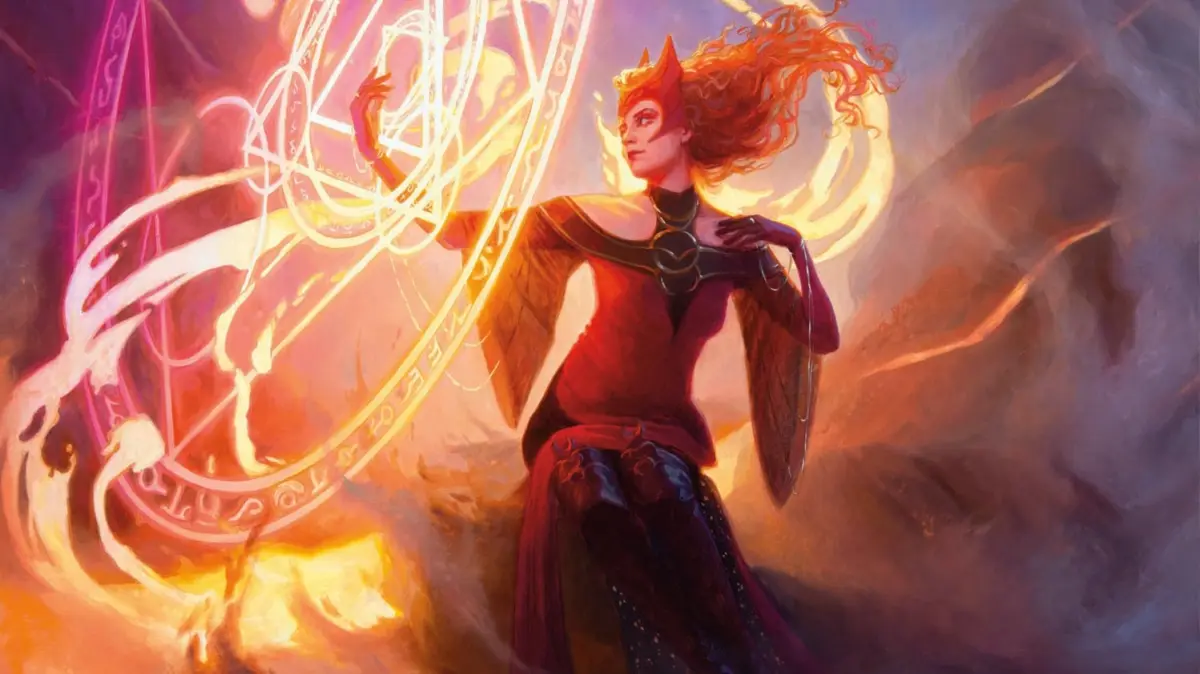
Consider the treatment of the Scarlet Witch. In the Marvel Super Heroes set, her visual design leaned heavily into her recognizable modern and classic comic iterations. In contrast, the conceptual art revealed for Darkhold Destiny showcases a character unmistakably filtered through the high-fantasy aesthetic of Magic. While signature elements—such as her iconic headpiece—remain intact, her garments, posture, and environmental aura evoke the high-fantasy spellcasters native to planes like Dominaria or Innistrad. This intentional stylistic shift transforms the characters from guest stars into denizens of a shared aesthetic universe.
The Three Schools of Magic: Arcane, Divine, and Dark
The mechanical and thematic identity of Darkhold Destiny revolves heavily around the act of spellcasting. To structure this mechanically, WotC has divided the set’s magical ecosystem into three distinct ideological and mechanical "schools":

- Arcane Magic: Centered primarily around Doctor Strange and his inner circle of sorcerers, this school deals with the manipulation of dimensional energies, tactical wizardry, and reality-bending spells.
- Divine Magic: Wielded by Thor, the Asgardians, and other celestial or mythological entities, this school leans into grandeur, thunderous invocations, and celestial authority.
- Dark Magic: Primarily the domain of the set’s antagonists—Dormammu, Hela, and their corrupted legions—this school also incorporates morally ambiguous or tormented antiheroes, such as Ghost Rider, who channel infernal and forbidden forces to fight fire with fire.
Mechanical Innovations: The Return of the Arcane Subtype
For MTG veterans, the most exciting mechanical takeaway from Darkhold Destiny is the heavy emphasis on instants, sorceries, and unique enchantments. To capture the flavor of grand wizard duels, Wizards of the Coast is officially bringing back the Arcane subtype for instants and sorceries—a mechanical tag that has remained dormant since the Saviors of Kamigawa expansion way back in 2005.
While WotC has confirmed that the notoriously complex and obscure "Splice Onto Arcane" mechanic will not be making a return, the mere reintroduction of the Arcane subtype opens up fascinating design space for modern card synergies, spell-heavy deck archetypes, and nostalgic deckbuilding.
Product Architecture and Collector Options
As has become standard for major MTG releases, Darkhold Destiny will roll out across a comprehensive suite of products designed to cater to different segments of the player base:
- Core Offerings: Traditional Booster Packs, Collector Boosters, and standard Bundles will form the baseline availability.
- Commander Decks: Four distinct Commander decks will be released alongside the main set, providing pre-constructed entry points for multiplayer formats. Each of these four decks will also feature a dedicated Collector’s Edition variant, completely decked out in premium foiling treatments.
- Scene Boxes: Two immersive scene boxes will launch with the set, each containing six mechanically unique cards that piece together larger panoramic pieces of artwork when assembled.
- Promo Cards: Both the standard Bundle and the specialized Gift Bundle will include mechanically unique promotional cards. While these promos are anticipated to generate significant demand and potential secondary market spikes on platforms like TCGPlayer, they represent highly coveted centerpieces for collectors.
Official Statements and Rollout Schedule
The rollout for Darkhold Destiny is structured to build narrative momentum well in advance of the physical card release.
Wizards of the Coast has announced a collaborative publishing partnership with Image Comics to bring the original in-house Marvel story to life. The first official comic book issue, detailing the initial incursions of Dormammu and Hela via the Darkhold, is scheduled to hit shelves in February 2027. This will serve as a narrative prologue, introducing players and comic fans alike to the stakes of the crossover.
A secondary comic issue will follow closer to the global launch of the set, bridging the gap between the written narrative and the tabletop experience.
Speaking on the creative philosophy behind the set, the design team emphasized that Darkhold Destiny is an experiment in breaking down the barriers between intellectual properties. By giving artists and writers the breathing room to construct a bespoke narrative arc rather than simply mimicking cinematic plotlines, WotC aims to deliver a product that feels essential rather than obligatory.
Future Outlook
The release of Magic: The Gathering – Darkhold Destiny in April 2027 marks a critical inflection point for the Universes Beyond product line. As crossover sets become an increasingly permanent fixture of Magic’s release calendar, the core challenge has always been maintaining the mechanical integrity and atmospheric depth that long-time players expect from the game.
By pivoting away from mundane settings and leaning into high-fantasy cosmic horror, Wizards of the Coast is attempting to prove that external intellectual properties can be successfully assimilated into Magic’s multiversal DNA. If Darkhold Destiny successfully strikes the balance between engaging limited environments, nostalgic mechanical throwbacks (such as the return of the Arcane subtype), and compelling original storytelling, it could redefine how players perceive crossover expansions for years to come.
Whether the secondary market stabilizes around its unique promo items, or whether the narrative resonates with purists and comic fans alike, one thing is certain: the mystic realms of Marvel and the mana-fueled planes of Magic: The Gathering are bound together for the foreseeable future.