Executive Overview
The modern B2B software landscape is undergoing its most painful, transformative crucible since the migration to cloud computing. For chief executive officers and founders, the primary strategic mandate is no longer about dabbling in emerging technologies or bolting superficial capabilities onto legacy frameworks.
The baseline expectation has evolved past simply shipping isolated AI features and showcasing them on a pricing page. Instead, the leaders commanding the deepest respect across the industry are those undertaking a fundamental, root-and-branch reconstruction of their enterprises.
These transformative CEOs are tearing up traditional product architectures, overhauling monetization strategies, rewriting go-to-market motions, and fundamentally redesigning organizational charts. Yet, an unvarnished assessment reveals a humbling reality: even the most forward-thinking enterprises are, at best, roughly 40% of the way through this monumental transition.
While standout success stories—such as Intercom’s dramatic pivot and subsequent $3.6 billion acquisition by Salesforce—dominate headlines, the vast majority of B2B companies are fighting trench warfare just to maintain baseline momentum. Growth rates across the sector remain stubbornly bottlenecked, trapped in the 10% to 30% range.
This article explores the systemic structural hurdles stalling growth, analyzes public and private market data that dictates current corporate valuations, unpacks what a genuine operational rebuild truly entails, and issues a call to perseverance for leaders navigating the hardest stretch of their professional lives.
Detailed Chronology: The Evolution of the SaaS AI Pivot (2023–2026)
To understand where the software industry stands today, it is essential to trace the timeline of artificial intelligence integration over the past several years. The trajectory from experimental feature deployment to radical corporate restructuring has been rapid, chaotic, and punishing.
2023: The LLM Gold Rush and the Illusion of Quick Wins
Following the widespread public release of advanced large language models (LLMs) in late 2022 and early 2023, the initial reflex across the Software-as-a-Service (SaaS) ecosystem was defensive and opportunistic. B2B companies rushed to integrate generative capabilities into existing codebases.
Founders bolted chat interfaces onto legacy dashboards, introduced AI-generated text summaries, and deployed early-stage virtual assistants. The prevailing belief was that an incremental update would satisfy boards and customers alike, keeping growth curves pointing upward without requiring foundational architectural overhauls.
2024–2025: The Growth Wall and Structural Realization
By late 2024, the limits of superficial integration became glaringly apparent. Despite widespread feature rollouts, enterprise revenue growth rates across the B2B sector plateaued. Companies discovered that customers were unwilling to pay premium surcharges for minor conveniences built on legacy, seat-based pricing models.
Furthermore, poor data hygiene, disjointed backend data layers, and misaligned sales motions began to sabotage AI deployments in production. CEOs realized that adding an assistant to a screen a human still had to manually operate was merely a feature, not a transformation. The realization set in that surviving the AI revolution required dismantling old workflows entirely.
2026: The Great Reckoning, Public Markets, and Mega-Exits
By mid-2026, the market split into two distinct realities. On one end stood pioneers who had completely re-engineered their business models—exemplified by Intercom’s historic re-brand to "Fin" and its subsequent $3.6 billion acquisition agreement with Salesforce.
On the other end stood the median B2B enterprise, grappling with compressed valuation multiples, single-digit to low-double-digit growth, and mounting board pressure. For many executives, the exhaustion of a multi-year, public-market turnaround triggered an unprecedented wave of fatigue, culminating in early exits and leadership transitions.
Supporting Context & Metrics: The Hard Numbers of B2B Growth
The empirical data across public and private markets paints an unvarnished picture of the current macroeconomic climate for software companies. The days of hyper-growth without profitability—or even moderate growth with inflated valuations—have been thoroughly priced out by the market.
Public Market Comps and the Disappearance of Hyper-Growth
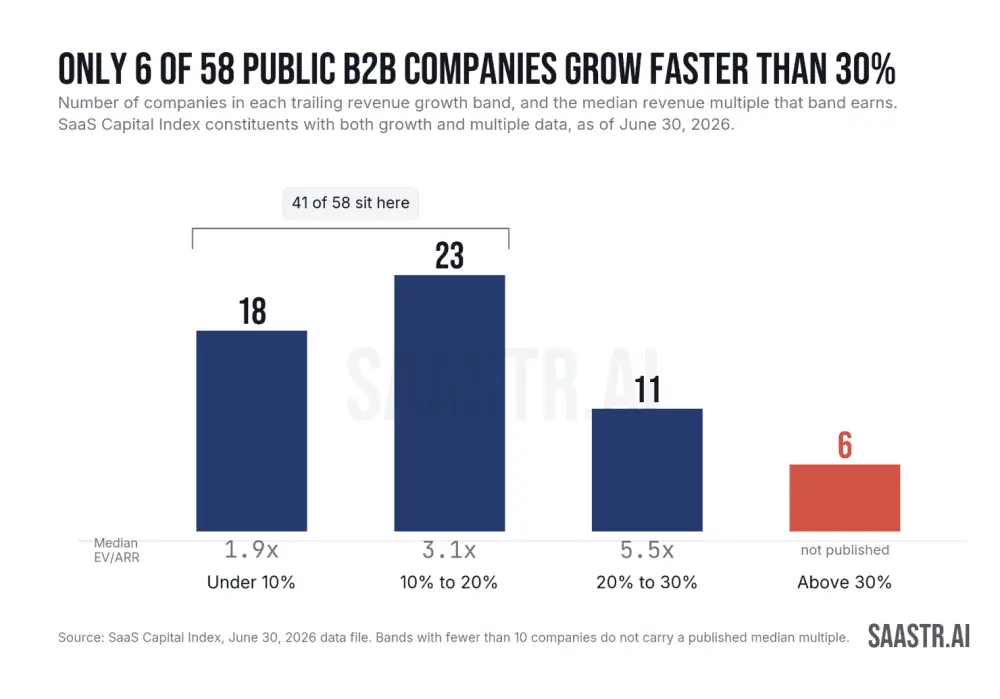
Data from the SaaS Capital Index as of June 30, 2026, illustrates a dramatic compression in revenue growth rates among public B2B constituents. The once-common cohort of companies growing at 60% or higher has effectively vanished from public markets. Instead, the distribution is heavily skewed toward the middle:
- Under 10% Growth: Heavily penalized by public markets, commanding depressed enterprise value multiples.
- 10% to 20% Growth: Representing a large swath of mature software providers.
- 20% to 30% Growth: The new median benchmark for scaling SaaS businesses.
PitchBook’s Q2 2026 enterprise comp sheet estimates median revenue growth at a modest 13.2%. A deeper dive into sector-specific performance reveals stark disparities:

- Infrastructure & Automation Leaders: DevOps, ITOps, and developer-focused platforms lead the pack with a median growth rate of 21.9%.
- Lagging Sectors: CRM, sales, marketing, customer experience (CX), collaboration, and productivity software sit firmly at the bottom, heavily burdened by traditional seat-based business models.
Private markets mirror these dynamics. SaaS Capital’s 2026 survey of private B2B companies indicates a median growth rate of 20% for bootstrapped enterprises and 25% for equity-backed counterparts. For a CEO operating at an 18% growth clip, the frustration is acute: they are performing at the market median, yet the market views that performance as a stagnation crisis.
The Valuation Penalty
The financial markets translate these growth bands into brutal valuation realities. Based on mid-2026 trading data:
- Companies growing between 20% and 30% command an average multiple of 5.5x revenue.
- Those slipping into the 10% to 20% band see their multiples drop precipitously to 3.1x.
- Firms sliding under 10% are valued at a meager 1.9x.
This mathematical cliff illustrates why a minor dip from 22% growth down to 18% effectively halves a company’s enterprise value. The existential pressure facing modern CEOs is clear: survival requires escaping the lower growth bands through radical operational reinvention before valuation compression forces their hand.
Official Statements and Industry Insights
Reflecting on the psychological and operational toll of this transition, industry veterans and investors point to specific structural failures that explain why routine AI feature releases fail to move financial needles.
Why "We Shipped AI Features" Fails to Move the Needle
According to market analysts and experienced operators, four structural roadblocks consistently prevent B2B software companies from breaking out of their growth bottlenecks:
- Flawed Pricing Units: Traditional per-seat licensing models are inherently self-defeating in the Age of AI. If an AI agent dramatically increases user productivity, fewer human seats are required to achieve the same business outcome. Consequently, charging per seat creates a product that systematically shrinks its own billing base. Sustainable growth requires transitioning to consumption-based, outcome-oriented pricing.
- Bolting Agents Onto Legacy Workflows: Adding a conversational chatbot to a screen that a human operator must still actively monitor and manage is merely an incremental feature update. True transformation involves removing the screen entirely—allowing autonomous agents to execute complex workflows from end to end without human intervention.
- Unprepared Data Layers: Enterprises routinely discover that their underlying data infrastructure is wholly inadequate for autonomous AI operations. Stale records, duplicate database entities, and unmaintained fields—ignored for years because human workers instinctively bypassed them—instantly derail autonomous agents operating in production environments.
- Misaligned Go-To-Market (GTM) Motions: Selling software outcomes to a modern budget holder requires an entirely different playbook than selling software licenses to a traditional department head. The buyer persona, the value proposition, and the sales conversation have fundamentally changed.
Addressing even one of these four pillars represents a year-long organizational undertaking. The reality that most CEOs remain stuck at the "40% complete" mark reflects the sheer magnitude of executing all four simultaneously.
The Intercom-to-Fin Blueprint
The acquisition of Intercom by Salesforce—culminating in an agreed-upon $3.6 billion valuation in mid-2026—serves as the definitive case study for a successful enterprise rebuild. Founded 15 years prior as a pillar of the SaaS era, Intercom made a massive, high-stakes bet on early large language models in 2023.
Over the subsequent four years, the company systematically rebuilt its product around an autonomous support agent named "Fin." The transformation was so absolute that in May 2026, the company officially dropped its historic moniker, renaming the entire enterprise after its flagship AI product.
Underneath the re-brand, the metrics justified the bold strategy: Intercom surpassed $400 million in total Annual Recurring Revenue (ARR), with the Fin agent alone accounting for nearly $100 million in ARR across more than 30,000 customers. Crucially, Fin agents successfully resolved an average of 76% of customer support volume end-to-end without human intervention.
The primary lesson for enterprise leaders is stark: while starting fresh with a greenfield AI native startup attracts immense venture capital fanfare, successfully rebuilding a legacy institution requires relentless execution, brand courage, and structural reinvention.
Future Outlook: The Road Ahead for B2B Leadership
As the software industry pushes deeper into the late 2020s, the macroeconomic environment remains unforgiving. For founders and CEOs, the current chapter represents arguably the most exhausting and stressful stretch of their professional careers.
Operating under the constant scrutiny of boards questioning single-digit or mid-teen growth figures—while financial media celebrates agile startups scaling to massive revenues with microscopic headcounts—takes a severe psychological toll. The temptation to relinquish control, accept a discounted private equity buyout at 3x revenue, or hand over the reins to an incoming operator is stronger than ever.
However, industry veterans caution against premature capitulation. Incoming operators who did not found the company or sit shoulder-to-shoulder with early customers often view vital operational assets—such as free distribution tiers or experimental R&D budgets—through a purely spreadsheet-driven lens. Lacking the institutional context of why foundational systems were built, replacement leadership frequently dismantles crucial growth engines in the name of immediate margin expansion, effectively killing a half-finished transformation.
The Call to Persevere
For the CEOs currently standing at the 40% completion mark of their AI rebuild, the path forward requires unyielding grit. The leaders who successfully navigate this multi-year gauntlet will not necessarily be those who started fresh with a blank slate. Instead, they will be the resilient executives who chose to endure the friction, confront their data debt, reinvent their pricing models, and refuse to surrender the keys.
Those who complete this harrowing transition will command and dominate their respective software categories for the next decade. The silent salute goes out to the founders still in the trenches: keep building, keep fighting, and finish what you started.