Executive Overview
As the retail calendar ticks relentlessly toward the official kickoff of Black Friday, the tech-buying landscape finds itself in an unusual, highly constrained equilibrium. Earlier this month, hardware analysts and deal hunters alike adopted a stark mantra: it’s high-end or nothing. For weeks, sub-$2,000 pre-built gaming rigs were either conspicuously absent or burdened by unacceptable spec compromises, forcing budget-conscious consumers into a corner where stretching for luxury builds was the only logical route to genuine performance value.
However, the retail landscape is nothing if not dynamic. A fresh wave of early-bird discounts has begun to breach the mid-range market, presenting intriguing options for gamers who refuse to cross the psychological two-thousand-dollar threshold. Notably, retailers have rolled out configurations centered around compelling mid-tier graphics cards—such as the AMD Radeon RX 9070 and the NVIDIA GeForce RTX 5070—hovering comfortably in the $1,600 to $1,700 bracket.
Yet, purchasing a mid-range system in the current economic climate is far from straightforward. Driven primarily by an aggressive, industry-wide global memory shortage caused by surging artificial intelligence (AI) infrastructure demands, RAM and storage components remain stubbornly expensive. Consequently, even these newly surfaced Black Friday deals demand careful compromise. Buyers are forced to weigh single-channel configurations, constrained capacities, and legacy memory standards against raw graphical capability. This report investigates the current state of mid-range Black Friday PC deals, breaks down the hardware trade-offs of the leading systems, and analyzes whether these discounts represent a pragmatic purchase or a necessary evil in a turbulent market.
Detailed Chronology of the Pre-Holiday Hardware Market
The trajectory of this year’s hardware promotions has deviated significantly from historical norms, defying traditional holiday pricing patterns.
Early November: The High-End Monopoly
In the opening weeks of November, the pre-built desktop market was heavily skewed toward enthusiast-tier hardware. Retailers stocked shelves and digital storefronts with high-margin, top-tier rigs boasting cutting-edge processors and flagship graphics cards. For consumers hunting for bargains under $2,000, the pickings were remarkably slim. Most sub-$2,000 options featured outdated architectures, heavily bottlenecked configurations, or disproportionate component pairings that failed to offer legitimate generational value. This prompted widespread industry consensus that early Black Friday deal-hunting was strictly a game for high-end spenders.
Mid-November: The Mid-Range Rebound
As competitive pressures mounted ahead of the official holiday rush, major retailers—including Newegg and Walmart—began adjusting their pricing strategies. By mid-November, mid-range configurations began to materialize. Systems anchored by current-generation mid-tier GPUs made their debut in the $1,500–$1,700 range.
- The AMD Configuration: Newegg introduced a Stormcraft Sirius desktop featuring an AMD Ryzen 5 9600X processor paired with an AMD Radeon RX 9070 graphics card, priced competitively at $1,600.
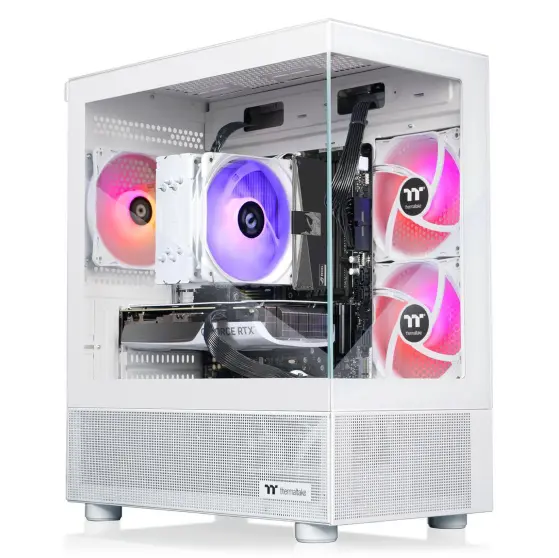
- The Intel-NVIDIA Configuration: Walmart countered with a Thermaltake LCGS system powered by an Intel Core i5-14400F processor and an NVIDIA GeForce RTX 5070, commanding a tag of $1,680 while stepping up system memory capacity.
Late November: Approaching Peak Black Friday
With the official date of Black Friday (November 27) now firmly in sight, these mid-range rigs have settled into their promotional pricing slots. Industry watchers note that while these prices represent the best possible entry points into mid-tier PC gaming for the season, they are unlikely to plummet further due to the unyielding macroeconomic pressures governing component manufacturing costs.
Supporting Context & Metrics: The Shadow of the Global Memory Shortage
To understand why a $1,600 mid-range gaming PC requires such rigorous mental gymnastics from the consumer, one must examine the broader economic realities of the hardware supply chain.
The AI Boom and Component Inflation
The primary driver behind today’s inflated component costs is the relentless expansion of artificial intelligence infrastructure. Data center operators, cloud providers, and enterprise tech giants have hoarded vast quantities of high-speed DRAM and enterprise-grade solid-state storage to fuel large language model training and inference workloads.
This insatiable corporate demand has created a severe supply squeeze for consumer-facing electronics. RAM and storage prices have climbed steadily over the past year, with little to no indication from major foundries that production capacity will pivot back toward consumer surplus any time soon.
The Real Cost of "Value"
In a stable market, a $1,600 pre-built system would typically secure a well-rounded machine featuring abundant high-speed memory, robust storage, and ample headroom for future upgrades. In the current climate, however, $1,600 buys compromises.
Market analysts emphasize that sub-$2,000 configurations invariably force manufacturers to cut corners. Buyers are routinely confronted with three primary hardware compromises:
- DDR4 vs. DDR5: Choosing older, slower memory standards to keep baseline platform costs down.
- Capacity Restrictions: Settling for 16GB of system RAM where 32GB has increasingly become the modern standard for heavy multitasking and demanding AAA titles.
- Channel Limitations: Accepting single-channel memory configurations (often a single stick of RAM) rather than optimized dual-channel kits, which impacts memory bandwidth and CPU instruction handling.
Technical Breakdown: Weighing the Leading Mid-Range Contenders
For buyers determined to acquire a system despite the market friction, two distinct pathways have emerged at the $1,600 threshold. Each comes with its own unique set of performance trade-offs.
Contender A: The Stormcraft Sirius (AMD Route)
- Price: $1,600 (via Newegg)
- Core Specifications: AMD Ryzen 5 9600X CPU, AMD Radeon RX 9070 GPU, 16GB DDR5 RAM, 1TB Gen 4.0 NVMe SSD.
Performance Analysis:
The standout feature here is the inclusion of fast DDR5 memory, ensuring the system sits on a modern platform architecture. However, the critical caveat is that the 16GB configuration appears to utilize a single-channel stick. Extensive hardware testing demonstrates that while single-channel DRAM does penalize gaming performance—particularly with CPUs possessing modest L3 cache sizes like the Ryzen 5 9600X—the real-world impact is often less catastrophic than traditional wisdom suggests.
Assuming background applications are aggressively managed, the Ryzen 5 9600X and RX 9070 pairing easily delivers fluid 60+ frames per second at 1440p resolution across the vast majority of modern, demanding titles, even without heavy reliance on upscaling or frame generation technologies. For $1,600, raw rasterization performance is exceptionally competitive.
Contender B: The Thermaltake LCGS (Intel/NVIDIA Route)
- Price: $1,680 (via Walmart)
- Core Specifications: Intel Core i5-14400F CPU (six Performance-cores), NVIDIA GeForce RTX 5070 GPU, 32GB DDR4-3200MHz RAM, 1TB NVMe M.2 SSD, 850W PSU.
Performance Analysis:
Priced slightly higher, this rig shifts the compromise from memory capacity to memory generation. Instead of fast, modern DDR5, it relies on 32GB of legacy DDR4-3200MHz RAM. For many productivity-focused users and heavy multitaskers, trading memory speed for sheer capacity is a worthwhile sacrifice. Memory frequency exerts less influence on overall gaming frame rates than raw capacity when pushing modern operating systems and background processes.
Furthermore, the inclusion of the NVIDIA GeForce RTX 5070 brings distinct advantages over its AMD counterpart, notably superior ray tracing capabilities and a more mature, feature-rich suite of AI-driven upscaling and frame generation tools.
The Upgradeability Bottleneck:
The primary drawback of the Thermaltake configuration lies in its long-term viability. Built around an Intel processor generation tied to DDR4 infrastructure, this system offers virtually no straightforward upgrade path. Upgrading to a superior processor or transitioning to DDR5 memory down the road will necessitate a complete platform overhaul—replacing the motherboard, CPU, and RAM simultaneously. Yet, given the prohibitive cost of components in the current market, accepting this limitation and treating the system as a closed, multi-year appliance is an increasingly rational strategy.
Future Outlook: What to Expect Post-Black Friday
As consumers evaluate these early-bird offerings, the burning question remains: Should you buy now, or wait for prices to normalize?
Industry forecasters suggest that waiting for a dramatic correction in PC hardware pricing through late 2025 and into 2026 is a high-risk gamble. Because enterprise demand for AI infrastructure shows zero signs of abating, semiconductor foundries will continue prioritizing high-margin server memory and enterprise accelerators over consumer-grade silicon. Consequently, the global memory shortage is projected to cast a long shadow over the PC component market for the foreseeable future.
For prospective buyers, this economic reality reframes Black Friday discounts. Rather than viewing $1,600 mid-range systems as overpriced aberrations compared to historical baselines, consumers must evaluate them against the trajectory of tomorrow’s market. If historical trends hold, these holiday discounts may well represent the financial floor for mid-tier gaming PCs for quite some time.
Buyers entering the market this season must approach purchases with clear eyes: accept the pragmatic hardware compromises—whether choosing between single-channel DDR5 or legacy DDR4 capacities—and secure a rig that meets immediate gaming needs without holding unrealistic expectations for near-term upgrade paths.