Executive Overview
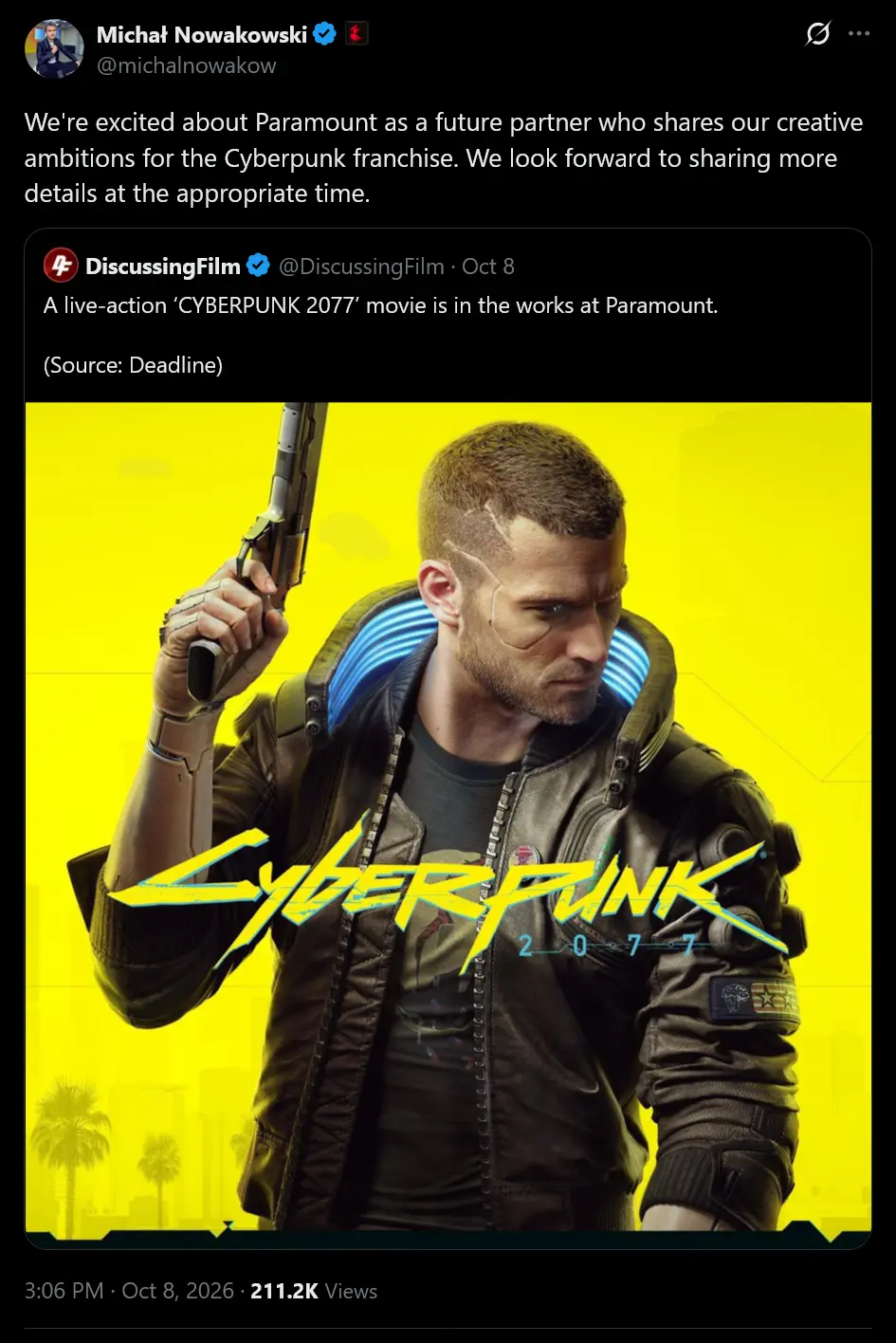
In a major development for both the gaming and cinematic industries, Paramount Pictures has officially partnered with Polish developer and publisher CD Projekt Red to develop a live-action feature film set within the expansive, neon-drenched universe of Cyberpunk 2077. The announcement, which surfaced via industry reports before being officially corroborated by studio leadership, marks a significant milestone in CD Projekt Red’s aggressive expansion of its intellectual properties beyond the confines of interactive media.
At the helm of the production is veteran producer Lorenzo di Bonaventura, a powerhouse Hollywood figure whose extensive résumé includes massive franchise builders such as the Transformers series, several G.I. Joe films, and the 2005 cinematic adaptation of Doom. While specific plot details, casting announcements, and a targeted release window remain closely guarded secrets, the partnership signals an alignment of creative ambitions between two heavyweights in their respective fields.
This upcoming live-action venture arrives on the heels of phenomenal multimedia momentum for the Cyberpunk franchise, most notably fueled by the critical and commercial success of Studio Trigger’s animated Netflix series, Cyberpunk: Edgerunners. As studios increasingly look to video game adaptations as the premier source material for tentpole blockbusters, the transition of Night City into the live-action cinematic sphere represents both a lucrative opportunity and a high-stakes creative challenge.
Detailed Chronology: From Concept to Confirmation
The path toward a live-action Cyberpunk 2077 film has been a subject of intense speculation within the entertainment industry ever since the game’s tumultuous launch in December 2020 and its subsequent, highly successful redemptive arc, culminated by the Phantom Liberty expansion. However, concrete movement on the project crystallized via exclusive reporting from industry trade publication Deadline, which detailed Paramount Pictures’ maneuvers to secure the rights in collaboration with producer Lorenzo di Bonaventura.

Shortly after the initial reports broke, CD Projekt Red co-CEO Michał Nowakowski took to social media platform X (formerly Twitter) to confirm the collaboration. Nowakowski’s statement validated months of fan theories and industry whispers, assuring the global community that the studio was aligned with a partner that respected the gritty, philosophical, and aesthetic roots of the franchise.
[Timeline of Events]
├── December 2020: 'Cyberpunk 2077' launches globally to immense sales and intense technical scrutiny.
├── September 2022: Netflix releases 'Cyberpunk: Edgerunners', revitalizing public interest in the IP.
├── September 2023: CD Projekt Red releases the critically acclaimed 'Phantom Liberty' expansion.
└── October 2026: Industry reports reveal Paramount Pictures and producer Lorenzo di Bonaventura are developing a live-action adaptation; CD Projekt Red leadership officially confirms the partnership.
While pre-production details are currently scarce, industry insiders suggest that the project is in early development, with writers and conceptual artists currently brainstorming how to distill the sprawling, open-ended nature of Night City into a linear, cinematic narrative structure.
Supporting Context & Metrics: The Evolution of Gaming Adaptations
The decision by Paramount and CD Projekt Red to bring Cyberpunk to the silver screen does not happen in a vacuum. Over the past half-decade, the cinematic landscape has undergone a seismic shift regarding how intellectual property originating from video games is perceived and monetized. Historically plagued by the "video game movie curse"—a decades-long streak of critically panned, financially disappointing adaptations—the industry has recently experienced a golden age of prestige adaptations.
Projects such as HBO’s The Last of Us, Amazon’s Fallout, and Universal’s The Super Mario Bros. Movie have shattered historical box office and viewership ceilings, proving that faithful yet creatively ambitious adaptations can capture both hardcore gamers and mainstream audiences.

For CD Projekt Red, expanding beyond video games is a proven strategy. The massive success of Netflix’s The Witcher series—alongside its animated spin-offs—demonstrated that the studio’s dark fantasy lore could translate effectively to television. However, the Cyberpunk universe presents a distinctly different set of world-building hurdles. Unlike fantasy settings built on sword-and-sorcery tropes, cyberpunk as a genre relies heavily on complex socio-economic commentary, body horror, transhumanist philosophy, and distinct visual architecture defined by corporate dystopia, cybernetic enhancements, and hyper-consumerism.
+--------------------------------------------------------------------------+
|                 The Shift in Video Game Adaptations                      |
+--------------------------+-----------------------------------------------+
| Era                      | Critical & Commercial Reception               |
+--------------------------+-----------------------------------------------+
| 1990s – 2010s            | Predominantly low-budget, poorly received     |
|                          | cash grabs ("Curse" era).                     |
|--------------------------+-----------------------------------------------+
| 2020s – Present          | High-budget, prestige television and cinematic|
|                          | blockbusters with active creator involvement. |
+--------------------------+-----------------------------------------------+
The Legacy of Cyberpunk Cinema
To understand the weight of a Cyberpunk 2077 live-action film, one must examine the cinematic lineage of the genre. While Ridley Scott’s Blade Runner (1982) and the Wachowskis’ The Matrix (1999) laid the philosophical and visual foundation for modern cyber-dystopias, the 1995 film adaptation of William Gibson’s short story Johnny Mnemonic stands out as a fascinating historical touchstone.
Directed by Robert Longo and starring Keanu Reeves—who would, decades later, immortalize the rockerboy Johnny Silverhand in Cyberpunk 2077—Johnny Mnemonic captured the frantic, analog-meets-digital anxiety of the mid-90s internet era. Featuring Reeves as a mnemonic courier carrying gigabytes of sensitive data inside his brain while evading corporate assassins, yakuza, and rogue elements, the film shares a spiritual DNA with the corporate-dominated, data-driven nightmares of Night City.
Though Johnny Mnemonic received mixed reviews upon release, it has since achieved cult classic status, particularly for its prescient warnings about data security, corporate greed, and information hoarding. The fact that Keanu Reeves has already bridged the gap between classic 90s cyberpunk cinema and modern video game blockbusters adds an ironic layer of cultural continuity as Paramount prepares its own dive into the genre.
Official Statements and Creative Vision
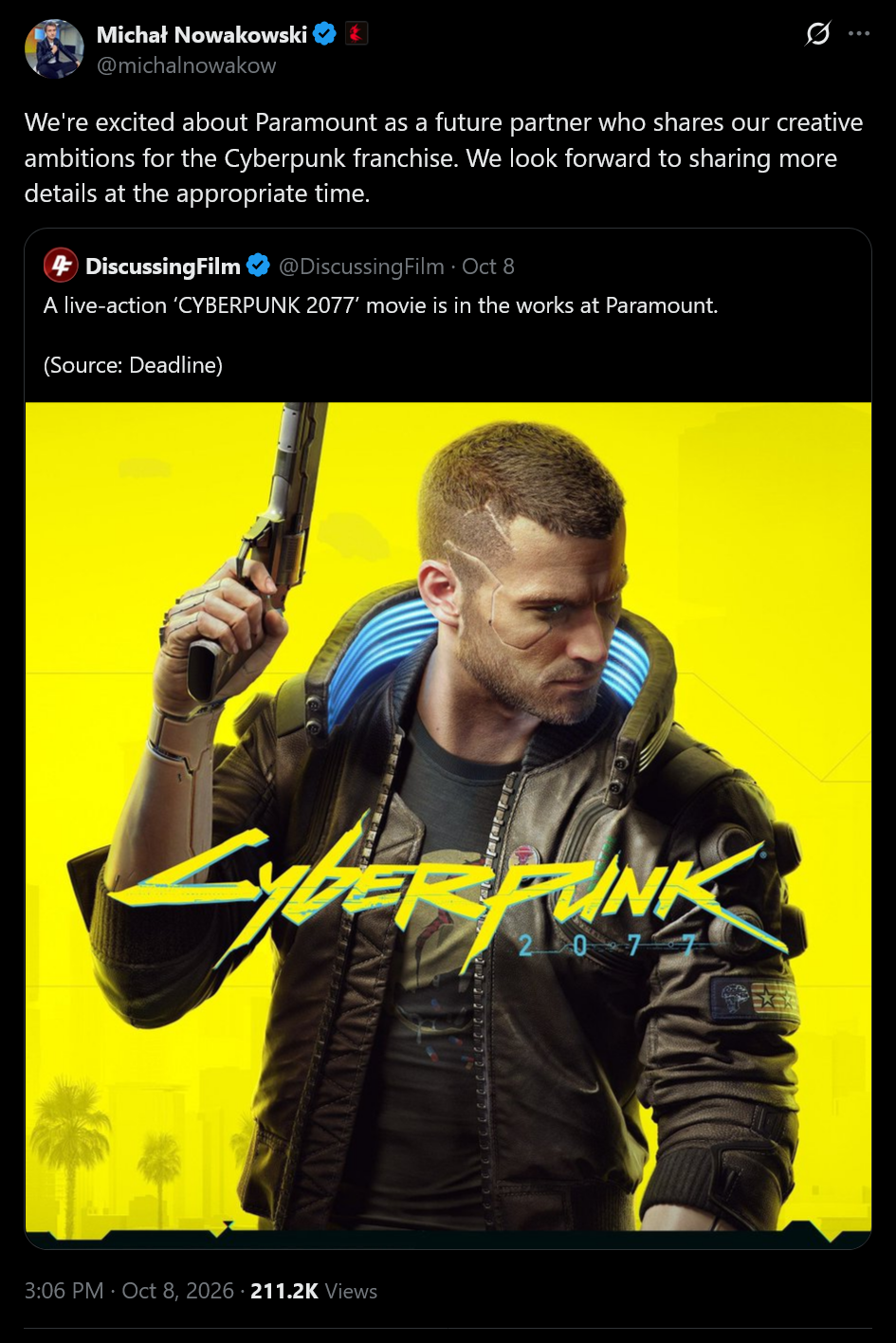
The formal confirmation from CD Projekt Red emphasized a shared creative vision between the game developer and the Hollywood studio. In his brief announcement on X, co-CEO Michał Nowakowski stated:
"We’re excited about Paramount as a future partner who shares our creative ambitions for the Cyberpunk franchise. We look forward to sharing more details at the appropriate time."
This measured approach highlights CD Projekt Red’s cautious stewardship of its brands. Following the rocky initial release of Cyberpunk 2077, the studio underwent a profound internal restructuring focused on transparency, quality control, and long-term brand equity. Consequently, any external media project bearing the Cyberpunk name is expected to undergo rigorous oversight to ensure it maintains the high standards set by the video game and Edgerunners.
Producer Lorenzo di Bonaventura brings a wealth of blockbuster experience to the table. Known for orchestrating massive tentpole properties that prioritize scale, action set-pieces, and global market appeal, di Bonaventura’s involvement suggests that Paramount envisions the Cyberpunk film as a high-octane theatrical event rather than a low-budget indie sci-fi flick.

Future Outlook: What Lies Ahead for Night City
As the project remains in its earliest stages of development, numerous critical questions loom over the production:
- Narrative Scope: Will the film adapt the specific events of V’s harrowing journey through Night City, or will it tell an original, standalone story within the established lore, much like Cyberpunk: Edgerunners did? Given the custom nature of the protagonist in the video game, an original story focusing on new characters may offer the creative freedom required for a compelling cinematic narrative.
- Tone and Rating: The source material is defined by its uncompromising adult themes, intense violence, explicit language, and deep existential dread. Whether Paramount and the producers commit to an R-rating (or equivalent) will serve as an immediate litmus test for how faithful the adaptation intends to be.
- Visual Aesthetics: Replicating the distinct, densely layered architectural style of Night City—complete with towering megastructures, neon-drenched alleyways, and grotesque body modifications—will demand immense technical and artistic vision from the production design and visual effects teams.
For now, fans of the genre have plenty of avenues to satiate their appetite. Alongside the continuous community engagement surrounding Cyberpunk 2077 and its upcoming sequel (currently codenamed Project Orion), foundational cyberpunk cinema—including the aforementioned director’s cuts of classics like Johnny Mnemonic—remains readily available across major streaming platforms.
As Paramount and CD Projekt Red press forward into pre-production, the announcement marks a thrilling new chapter for a franchise that has successfully transcended its medium to become a defining pillar of modern pop culture. Further updates regarding casting, directors, and narrative direction are expected to be unveiled as the project gains momentum.