Throughout centuries of cultural conditioning, cautionary fairy tales such as Snow White, Hansel and Gretel, and countless regional folklore traditions have cemented a singular, terrifying archetype in the global imagination: the witch. Historically depicted as a loathed, grotesque pariah dwelling on the fringes of society, the witch has long served as a patriarchal tool designed to frighten, control, and subjugate women who step outside prescribed societal boundaries.
Enter acclaimed photographer Harley Weir and visionary fashion designer Dilara Findikoglu with Witch, a breathtaking, multidisciplinary collaborative project that comprehensively upends this derogatory nomenclature. Published by IDEA, the project is a sweeping photographic epic and cultural critique. Born out of art director Matthew Scrote’s childhood memories of Romania—a landscape historically and culturally saturated in mysticism, folklore, and esoteric traditions—Weir and Findikoglu embarked on an intensive five-day expedition across eight distinct Romanian cities and rural villages.
Rather than leaning into lazy, pantomime-esque tropes, the duo immersed themselves in the living traditions of the region. They engaged with anyone and everyone they encountered, culminating in a historic meeting with Mihaela Minca, the matriarch of Europe’s most powerful clan of witches, alongside her daughters, who practice both white and black magic as a daily vocation. Populated by a diverse coven of Romanian women outfitted in Findikoglu’s signature contorting, sculptural creations and captured through Weir’s fiercely empathetic lens, Witch presents an expansive, potent, and radically uncompromised vision of modern womanhood.
Detailed Chronology: The Genesis and Execution of Witch
Phase 1: The Spark of Inspiration and Conceptualization
The genesis of Witch began long before cameras clicked in the misty valleys of Eastern Europe. It started with art director Matthew Scrote, whose childhood memories of Romania planted the seeds of mysticism, intrigue, and a deeply rooted respect for ancestral customs. Scrote shared these formative impressions with Harley Weir and Dilara Findikoglu, sparking an immediate, shared curiosity about how Eastern European esoteric traditions intersect with modern concepts of femininity and power.
Weir and Findikoglu, both operating at the very pinnacle of their respective creative fields, recognized an opportunity to subvert historical prejudice. Neither creator had extensive prior experience with formal witchcraft, yet they shared an intuitive understanding of its symbolic weight. They recognized that the historical persecution of witches was never truly about magic; it was about the systematic suppression of female autonomy, independent knowledge, and connection to the earth.
Phase 2: The Five-Day Romanian Expedition
The core of the project materialized over an intensive, five-day journey spanning eight diverse locations across urban and rural Romania. Eschewing sanitized studio environments, Weir and Findikoglu embedded themselves within the rugged landscapes and local communities of the Romanian countryside.
The journey was marked by what Weir describes as "winks from God"—serendipitous moments of profound synchronicity that dictated the flow of the project. Romania offered a rare, fascinating cultural ecosystem where pre-Christian pagan witchcraft seamlessly mingles with orthodox religious structures, creating an atmosphere that both creators describe as palpably "alive" and electrically charged.
During this expedition, the duo crossed paths with Mihaela Minca and her lineage. Documenting these women in their natural environments provided a grounded, authentic anchor for a project that otherwise flirts with the surreal. Alongside traditional practitioners, Weir and Findikoglu cast a diverse array of modern archetypes, including Antonella, a prominent Roma transgender activist, sex worker, and daughter of a witch, whose life story features prominently in the book.
Phase 3: The Styling, Fabrication, and the "Cherry Dress"
The visual language of Witch is defined by the tension between raw, organic landscapes and Dilara Findikoglu’s avant-garde sartorial creations. Incorporating authentic Romanian heritage and folk clothing sourced directly from local women—such as hand-embroidered garments and hand-crafted ruffled heirlooms inherited across generations—Findikoglu bridged the gap between historical craft and high fashion.
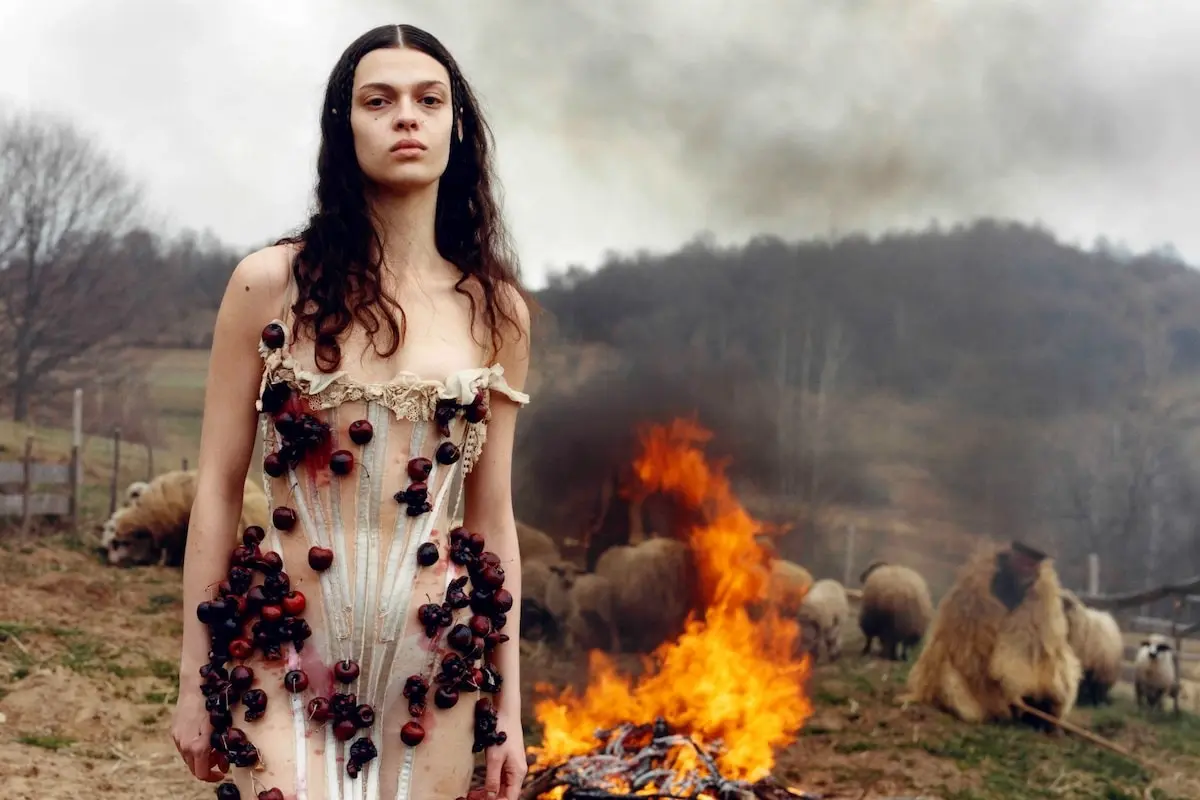
A paramount example of this collaborative alchemy is the creation of the infamous "cherry dress," immortalized in one of the project’s most striking images featuring a blazing fire and a traditional shepherd. Traditionally, the cherry serves as a tired symbol of the innocent, conforming, and naive girl. Findikoglu sought to subvert this trope entirely by engineering a "dangerous cherry dress" that embodies the volatile tension between external softness and unyielding internal power.
The dress required an intricate, multi-stage production process:
Casting: One artisan specialized in casting the individual cherries.
Fabrication: A second specialist manufactured the silicone fruit bodies.
Painting: A third artisan meticulously hand-painted each cherry to achieve hyper-realistic textures and visual depth.
Assembly: Findikoglu’s dedicated studio team applied the finished cherries by hand.
While many viewers mistake the silicone fruit for fresh produce, the garment itself was purposefully stained with the juices of real cherries during the chaotic, elemental energy of the shoot.
Supporting Context & Metrics: The Collaborative Partnership
To fully understand the visual and conceptual depth of Witch, one must examine the profound, symbiotic creative partnership between Harley Weir and Dilara Findikoglu. Their relationship bridges the gap between static image-making and wearable sculpture, rooted in mutual respect, shared passion, and a visceral rejection of creative conformity.
Collaborative Metrics and Milestones
Milestone / Event
Description / Significance
The Runway Encounter
Weir walked as a model in Findikoglu’s acclaimed fashion presentation, Venus from Chaos, marking their initial introduction and establishing an immediate, unspoken creative bond.
The Wedding Dress
Findikoglu designed Weir’s custom wedding gown, an artifact of their friendship so iconic that acquaintances frequently congratulate Weir on the dress itself rather than her marriage.
The Romanian Expedition
A 5-day, 8-city immersion across urban and rural Romania, capturing indigenous practitioners, modern activists, and remote landscapes.
Publication Partner
Published by IDEA, the renowned independent publisher known for avant-garde art and photography books.
In interviews discussing their working dynamic, the mutual admiration is palpable. Findikoglu observes of Weir’s on-set methodology: "Watching Harley using her cameras like guns… I’ve never seen a photographer like that. Watching Harley pregnant, in the Romanian countryside, climbing up the mountains and going into the weirdest spots before everybody else—it was really, really inspiring."
Conversely, Weir speaks reverently of Findikoglu’s ability to design clothing that liberates rather than restricts: "Dilara’s clothes embrace the woman without making her obedient! She loves what she does, and passion is so important to me." Weir even recalls keeping a digital folder on her phone titled ‘Wedding’ for years, containing a single image of a Findikoglu dress—a manifestation of artistic alignment that she ultimately wore when she met the love of her life.
Official Statements & Philosophical Insights
In conversations surrounding the release of Witch, Weir and Findikoglu articulate a cohesive, empowering manifesto regarding female autonomy, historical demonization, and the intrinsic relationship between women and the natural world.
On the Redefinition of the "Witch"
Addressing the cultural baggage associated with witchcraft, Dilara Findikoglu offers a striking reinterpretation:
"I don’t see a witch as a person with special powers who brews potions and casts spells, et cetera. Witchcraft is the knowledge that we all carry inside of us and the term ‘witch’ has been used to demonise women who connected to this knowledge. I feel like now there’s a sense of awakening; we are remembering these attributes, which is really exciting, actually. We’re remembering who we are, that we have our own freedom, our own potential inside us."
Harley Weir expands upon this lineage of generational female consciousness:
"I’m interested in the witch being in every woman. It’s about the lineage of female knowledge, and witchcraft obviously comes into that… As women, we’ve been taught to hide parts of ourselves, not to take up too much space or make ourselves too big. We wanted to find women who challenged that idea; women who, at another point in history, might have been persecuted for refusing to conform."
On Nature, the Body, and the Feminine Divine
The project also probes deeply into humanity’s fractured relationship with the natural world, linking patriarchal dominance over ecosystems to the historical subjugation of women.
Dilara Findikoglu notes:
"Humans are not separated from nature. I don’t see it as a separate place where you go to spend time or discover. We have seen what masculine power has done in the world, which has been really difficult to watch. Recently, I have been thinking about how we can bring in more sensitive powers to create a different direction for the world. How can we connect to nature, connect to ourselves more? And will it be better if the feminine attributes become more powerful again?"
Reflecting on her own experiences of pregnancy and her connection to the earth, Harley Weir shares:
"I’ve always been obsessed with nature. I live as a fairy in the woods at my house, with plants everywhere, and I’m always in the garden. Planting a seed and watching it grow makes me feel the most alive. Pregnancy, too, has made me think more about women and the potential of the body. It’s amazing what the body can do, how it can create life and transform itself to make space for someone new… Some of the things women’s bodies can do are truly magical. I feel that connection has been misunderstood and feared throughout history, when actually it’s something incredibly powerful."
On Beauty and Discomfort in Photography
Addressing critiques within the fashion and art industries regarding the juxtaposition of high aesthetics with difficult, serious subject matter, Weir defends her singular visual philosophy:
"I do conform in a way. I package my work with a beautiful ribbon, so that more people feel they can connect with it, and so it feels easier to approach. But really, it’s about the subject matter… I’ve definitely had people tell me not to do that, especially within fashion, because there’s this idea that beauty and seriousness don’t mix very well… But I don’t believe that. There’s beauty in everything, even in the saddest moments. Sometimes beauty allows you to approach something painful, to feel less alone in it, or to connect with an issue you might otherwise have found too difficult to look at."
Future Outlook and Cultural Legacy
As Witch launches worldwide via IDEA, its cultural footprint extends far beyond the traditional confines of a seasonal fashion photobook or an art gallery retrospective. In an era marked by shifting gender politics, rising ecological awareness, and a widespread cultural resurgence in holistic, esoteric, and non-conformist practices, Weir and Findikoglu’s collaboration arrives as a timely cultural intervention.
By reclaiming the term "witch" from centuries of patriarchal propaganda, Witch invites contemporary audiences—particularly women—to audit their own internal spaces, shedding self-imposed limitations and societal expectations of docility. The project demonstrates that high-concept fashion photography and documentary storytelling can successfully merge to challenge deeply ingrained systemic prejudices.
In the future, the framework established by Weir, Findikoglu, and Scrote may well serve as a blueprint for cross-disciplinary artistic projects that seek to unearth hidden histories, honor localized ancestral traditions, and champion unapologetic female sovereignty. As audiences engage with the book’s stark landscapes, defiant subjects, and haunting imagery, Witch stands as an enduring testament to the power of collective female memory, proving that the magic women carry within has never truly been extinguished—it has merely been waiting to be reclaimed.