Executive Overview
For Sally Schultz, a single mother of four who weathered the personal and financial turmoil of a bitter divorce, purchasing a half-acre plot of land in the unincorporated New Mexico community of Rio Rancho Estates felt like winning the lottery. Paid for with a modest $3,500 investment, the cheap, sun-baked plot of dirt offered more than just physical acreage; it represented a hard-won sanctuary. Here, she could park her trailer, plant rows of corn, squash, and vibrant green chiles, and finally provide her children with the stability they desperately needed.
That fragile peace, however, has been shattered.
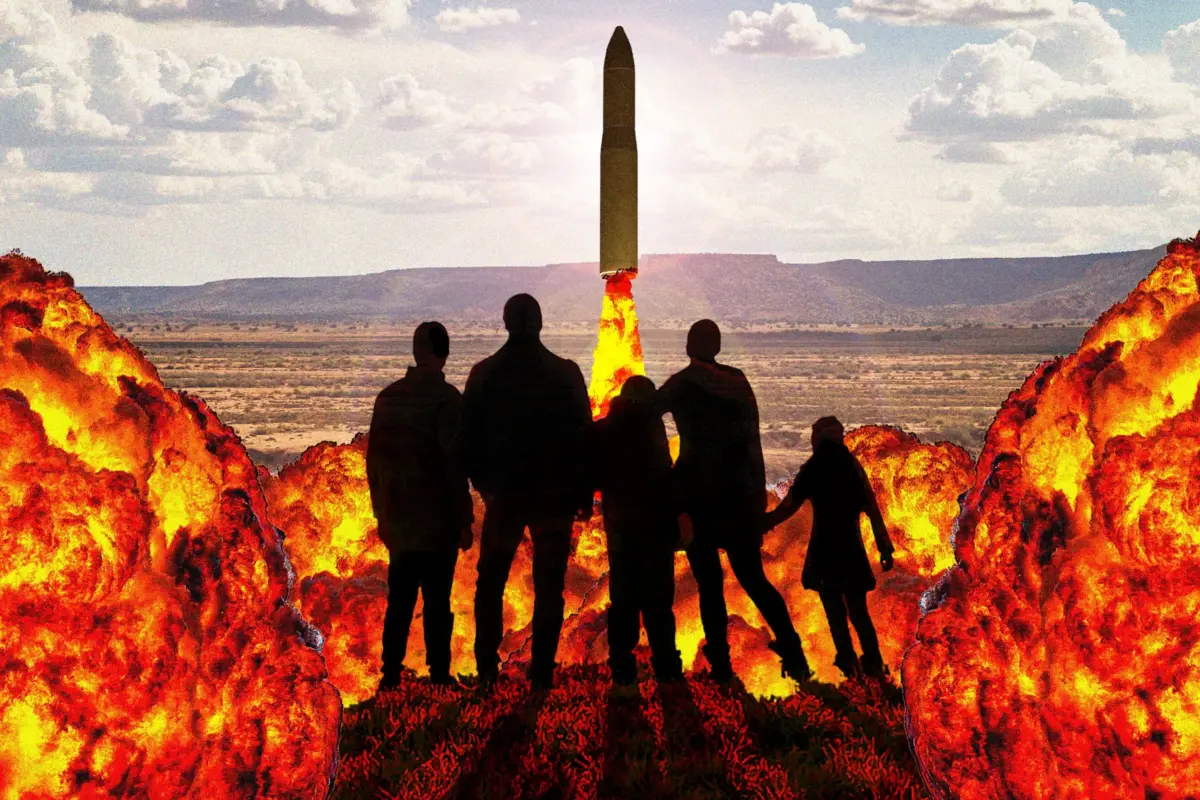
Barely a thousand yards from Schultz’s front door—and squarely within the potential blast and toxic hazard zones of roughly 450 neighboring properties—construction is rapidly wrapping up on "Project Ranger." Spearheaded by Castelion, a defense tech startup founded in late 2022 by three former SpaceX executives, the sprawling 1,000-acre site is slated to become the largest dedicated hypersonic missile manufacturing and testing facility in the United States.
As Castelion’s valuation skyrockets to a staggering $13 billion—fueled by hundreds of millions of dollars in U.S. military contracts—the human cost of this rapid military industrialization is being borne by a low-income, working-class community. Residents say they were kept completely in the dark as local and state officials fast-tracked the project behind closed doors. Now, they find themselves living in the shadow of a high-stakes munitions complex. An official hazard assessment reveals that in the event of a catastrophic chemical fire, local emergency responders would be barred from entering, leaving buildings to burn and toxic clouds of hydrochloric acid gas to drift directly over civilian homes.
Detailed Chronology: From Secretive Beginnings to Groundbreaking
The path that brought Castelion to the outskirts of Rio Rancho is a masterclass in bureaucratic maneuvering, corporate rebranding, and swift political alignment.
The Shift from Nevada to New Mexico
Long before New Mexico residents spotted soil-probing trucks rolling across the high desert in early 2025, Castelion was laying the groundwork elsewhere under a completely different corporate moniker. In August 2023, operating under the name Pallas Industrials, the company submitted an application to build a rocket motor manufacturing and testing facility in rural Churchill County, Nevada. Chief Financial Officer Andrew Kreitz signed off on plans that would see the company ground-testing rocket motors up to eight days a month.
Faced with rigorous oversight, eight pages of demanding staff analysis, and strict safety protocol requirements from Churchill County officials, Pallas Industrials abruptly pulled out of Nevada. Reemerging under its true identity, Castelion shifted its sights to New Mexico, quietly initiating soil testing and high-level state negotiations by the spring of 2025.
Bypassing Public Scrutiny
By mid-2025, the gears of state and local government were spinning rapidly in Castelion’s favor. In August 2025—months before the public was officially informed of the project—former county commissioner and newly minted Republican State Senator Jay Block appeared before the Sandoval County Commission to advocate fiercely for public financing.
The commission obliged, approving a massive $125 million package in industrial revenue bonds and passing resolutions to secure control of the state land earmarked for the mega-campus. To sweeten the deal, commissioners granted Castelion a staggering 95 percent property tax abatement and waved compensating taxes on out-of-state equipment.
It wasn’t until October 2025 that Castelion held its first public information meeting. By then, local residents realized they had been sidelined.
"All of this happened behind the scenes. By the time it was public, it was already a done deal," reflects Zachary Darden, a local resident who ran an unsuccessful mayoral campaign opposing the development.
By December 2025, high-level networking was well underway. Emails obtained via public records requests show Alberto Solís, Rio Rancho’s economic development manager, coordinating a four-day VIP trip for Castelion CFO Andrew Kreitz. The itinerary included mingling at a local Chamber of Commerce "Jingle Mingle" and meeting with the Sandoval Economic Alliance.
Shortly after, Castelion held a high-profile groundbreaking ceremony. While everyday residents living adjacent to the site were excluded from the guest list, the event drew an elite crowd of political heavyweights: Governor Michelle Lujan Grisham, U.S. Senator Martin Heinrich, State Senator Jay Block, Rio Rancho’s then-mayor Gregg Hull, and top state economic development officials.
Supporting Context & Metrics: The Scale of Project Ranger
To understand the immense economic gravity pulling Castelion into New Mexico, one must look at the meteoric rise of the defense tech startup and the broader "Arsenal of Freedom" manufacturing boom sweeping the American defense sector.
A Startup Rocketing to Valuations in the Billions
Founded just three years ago by SpaceX alumni, Castelion has quickly become a darling of Silicon Valley-backed defense technology. After hitting a Series B valuation of $2.8 billion, the company’s valuation skyrocketed to $13 billion, backed by more than $500 million in U.S. military contracts secured in just 18 months.
The company’s primary market advantage lies in its promise to produce hypersonic missiles—defined as weapons traveling at Mach 5 or faster—at a fraction of the cost of legacy defense contractors. While the U.S. Army’s primary domestic hypersonic weapon, the Dark Eagle, carries an estimated price tag of $41 million per missile, Castelion initially marketed its flagship solid-rocket-powered Blackbeard missile for a mere $384,000 per unit.
Escalating Costs and Lucrative Navy Contracts
Despite early claims of ultra-cheap mass production, financial disclosures indicate that Blackbeard’s unit costs are climbing significantly:

- January: The Navy awards Castelion a nearly $50 million contract for full-scale Blackbeard prototypes.
- June: The Navy expands the initiative, adding $23.4 million for the first 50 operational prototypes.
- August: A subsequent $90 million contract for manufacturing the same 50 units pushes total spending to $163.4 million—effectively driving the cost per missile up to $3.3 million.
- September: The Navy issues Castelion its largest contract to date: up to $200 million.
Despite these astronomical federal outlays and the release of promotional photographs, Castelion has yet to publicly release empirical performance or test data validating the operational efficacy of the Blackbeard missile.
Official Statements and Safety Hazards: The Sandia Lab Report
The central friction point between local communities and the incoming missile manufacturer centers on acute public safety risks. These concerns were brought to light by a hazard assessment report produced by Sandia National Laboratories in June 2025.
Initially facilitated through the New Mexico Small Business Assistance Program—a state initiative intended to provide local small businesses with free access to technical expertise from Los Alamos and Sandia labs—the report was later made public via Freedom of Information Act (FOIA) requests. In a glaring administrative error, the labs attempted to redact sensitive details by placing black electronic highlights over black text, leaving the entire unredacted document easily accessible via a simple copy-and-paste action.
The Worst-Case Explosion Scenario
The Sandia assessment outlines alarming worst-case scenarios tied to Project Ranger’s vast propellant storage operations:
- Ammonium Perchlorate Stockpiles: Castelion plans to store up to 250,000 pounds of heat-sensitive chemical oxidizers inside covered bunkers and magazines.
- Active Integration Facilities: Outside the bunkers, the facility is permitted to house up to 81,000 pounds of active explosive material concurrently during assembly.
- Blast Radiotaion: Sandia calculated that a detonation of the maximum allowable explosive stockpile would require a safety buffer equivalent to the length of nearly nine football fields. Such a blast could shatter large windows nearly four miles away and carry a 3.2 percent probability of causing minor eardrum damage to individuals located 400 yards from ground zero.
Toxic Chemical Plumes and "Let It Burn" Protocols
Perhaps more alarming than the explosive potential is the risk of a chemical fire—identified by Sandia analysts as the "most probable foreseeable hazardous event."
Propellants used in modern solid-rocket motors typically rely on compounds that, when ignited in an uncontrolled fire, release hazardous chemical hazes containing hydrogen chloride and chlorine gas. Both chemicals are exceptionally corrosive, capable of causing severe skin, eye, and respiratory tract burns, chemical lung damage, and rapid asphyxiation.
Internal emails uncovered through public records requests show that the Rio Rancho Fire Department determined 17 of the 26 buildings within the Project Ranger site would be deliberately abandoned to burn down in the event of a chemical fire. Due to the extreme volatility and toxicity of the materials, first responders would be strictly barred from entering the high-risk integration structures.
Furthermore, negotiations regarding critical fire-flow safety requirements were still being thrashed out between Castelion site developer Bryce Barlow, city manager Matt Geisel, and CFO Andrew Kreitz between March and May—even as heavy construction on the facility was already underway.
When code requirements were streamlined into a basic memorandum of understanding to bypass administrative delays, CFO Kreitz enthusiastically emailed:
"Great news! Saves all of us both legal bills and headaches."
Future Outlook: A Community at a Crossroads
As Project Ranger races toward its projected year-end completion and prepares for mass production, the human toll on Rio Rancho Estates is coming into sharp focus.
Recent industrial accidents across the country have underscored the very real dangers of scaling solid-propellant manufacturing. In June, a test run of an ammonium perchlorate-based rocket motor at Anduril’s Mississippi facility ended in a violent explosion. Just months prior, a chemical plant in Garden Grove, California, suffered an overheating chemical storage tank emergency that forced the emergency evacuation of over 40,000 residents.
For the residents living in the crosshairs of Project Ranger, the future is fraught with fear and uncertainty. Many who moved to Rio Rancho Estates did so specifically because the land offered an affordable refuge from economic hardship. Now, they find themselves trapped between industrial-scale defense manufacturing and the prohibitive financial realities of relocation.
"I live next door to where World War III will be manufactured," laments local resident Laura Lundberg.
For community members like Sally Schultz, whose dreams of cultivating a peaceful homestead on a half-acre of dirt have been upended by the hum of construction equipment and the threat of toxic air, the promise of American defense innovation rings hollow.
As state leaders celebrate Project Ranger as a triumph of public-private partnership and economic development, the residents of Rio Rancho Estates are left to contemplate a chilling reality: their homes, their crops, and their safety have been mortgaged in service of the nation’s next-generation military arsenal.