Executive Overview
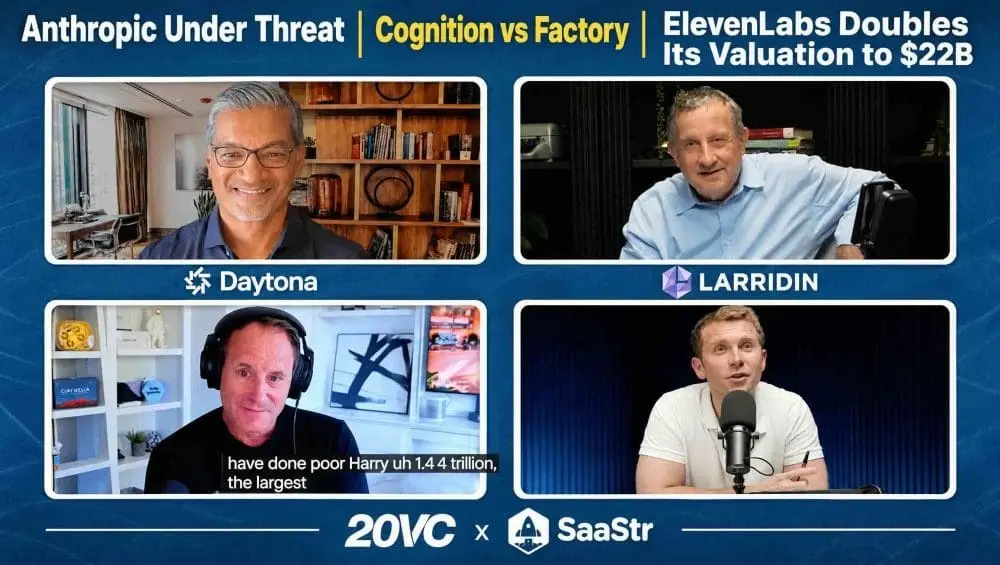
In a week defined by seismic executive departures, trillion-dollar valuations, and public venture capital warfare, the tech ecosystem found itself grappling with a shifting reality. The latest joint briefing featuring venture stalwarts Harry Stebbings, Jason Lemkin, and Rory O’Driscoll—alongside special guest Dev Ittycheria, fresh off his return to the CEO seat at MongoDB—captured an industry hurtling forward at breakneck speed.
The focal points were staggering: OpenAI surging toward a $70 billion annualized run rate; Anthropic eyeing a blockbuster November IPO near a $2 trillion valuation; a messy high-profile defection at AI startup Factory triggering a public Twitter brawl led by Vinod Khosla; and massive consolidation moves like Salesforce’s $2 billion acquisition of Listen Labs. As autonomous software agents begin to drive more than 50% of infrastructure deployments, the fundamental rules governing enterprise software, venture loyalty, and developer retention are being rewritten in real-time.
Executive Overview: The Return of Dev Ittycheria and a Market in Motion
The week’s news cycle was anchored by the sudden departure of CJ Desai from MongoDB, stepping down immediately to head Meta’s new enterprise platform under Mark Zuckerberg. In a swift pivot, MongoDB’s board turned back to Dev Ittycheria, who helmed the database giant from 2014 to 2025, scaling its annual revenue from $35 million to over $2.3 billion. Stepping into the podcast studio just one week into his second tour as CEO, Ittycheria brought a battle-tested perspective to a week defined by executive musical chairs and intense market volatility.
“Even though it was a busy week, it was great to discuss what’s happening in tech with this amazing trio and share my perspective,” Ittycheria noted. Against this backdrop, the panel dissected eleven defining stories reshaping the artificial intelligence and enterprise software landscapes.
Detailed Chronology: Key Developments and Market Movements
1. The Financial Ascent of the Frontier Labs
OpenAI’s annualized revenue is rapidly approaching $70 billion, marking a staggering 70% growth spurt since the start of the third quarter. Enterprise sales have more than doubled in the same window. According to Rory O’Driscoll, this acceleration alters the competitive narrative. While Q2 saw Anthropic growing at a blistering pace—matching roughly $11 billion in GAAP revenue against OpenAI’s $6.8 billion—OpenAI’s latest 60% to 70% quarter-over-quarter rebound provides crucial financial relief against its massive capital expenditures in compute infrastructure and Virginia data centers.
Simultaneously, financial markets are preparing for historic milestones. OpenAI is reportedly seeking to raise at least $30 billion at a $1.4 trillion valuation as a bridge to a future public offering. Meanwhile, competitor Anthropic is aggressively prepping an IPO for mid-November, targeting a roadshow the week of November 9 and a staggering valuation between $1.8 trillion and $2 trillion. If realized, these figures will establish the first private and public tech valuations crossing multi-trillion-dollar thresholds.
2. The Factory vs. Cognition Feud and the Khosla Blowup
Corporate drama peaked on September 30 when Factory CEO Matan Grinberg publicly announced he had fired board advisor Chris Degnan, alleging that confidential information had been leaked to direct competitor Cognition. Just two hours later, Degnan announced his appointment as Cognition’s new Chief Revenue Officer. Degnan—formerly Snowflake’s CRO and a year-long advisor to Factory—strongly denied the allegations, maintaining he resigned and never shared proprietary data. Cognition similarly rejected the claims.
The situation escalated exponentially when billionaire investor Vinod Khosla—whose firm, Khosla Ventures, backs both Factory and Cognition—publicly weighed in. Khosla sided with Degnan, accused Grinberg of dishonesty, and dismissed Factory as a “struggling second-tier competitor,” drawing sharp rebukes and public defenses of Factory from KV colleague Keith Rabois. The panel universally panned Khosla’s public broadside, noting it permanently damaged trust and handed competing venture firms a potent weapon during deal negotiations.
3. Consolidation, Open Weights, and Massive Tender Offers
Enterprise consolidation and model evolution continued unabated. Salesforce signed a definitive agreement to acquire three-year-old Listen Labs for approximately $2 billion. Listen Labs, which builds AI agents for market research, walked away from a signed $125 million Series C term sheet at a $1.5 billion valuation, yielding a massive win for early-stage backers Sequoia and Ribbit Capital on roughly $96 million of invested capital.
In the foundation model space, Reflection AI launched Beam, a 501-billion-parameter open-weight model claiming reasoning parity with Z.ai’s GLM-5.2 while consuming three to four times less inference compute. Concurrently, audio AI leader ElevenLabs completed a $300 million employee tender offer led by Wellington and T. Rowe Price, doubling its valuation to $22 billion in under a year.
Supporting Context & Metrics: Infrastructure, Agents, and Legal Battles
The Rise of Agent-Driven Infrastructure
The operational metrics coming out of infrastructure providers highlight a profound structural shift: autonomous software agents are no longer experimental novelties; they are primary economic actors.
- Vercel’s Agentic Shift: Vercel reported that software agents now trigger more than 50% of its deployments, up from less than 3% previously. Operating at an estimated $600 million ARR, the platform demonstrates how deeply agents have embedded themselves into software delivery workflows.
- The Token Cost Calculus: As enterprises grapple with ballooning token bills—often rivaling historic corporate software budgets—CIOs are increasingly adopting multi-model routing strategies. Rather than relying exclusively on top-tier frontier models for every task, engineering teams are balancing budgets by deploying cheaper, open-weight alternatives like Beam for routine operations, reserving flagship models solely for complex reasoning tasks.
Legal and Structural Controversies
The gold rush atmosphere has also sparked legal friction. Two former Groq engineers filed a lawsuit in Delaware Chancery Court on October 2, challenging the mechanics of a reported $20 billion transaction through which Nvidia acquired a non-exclusive license and absorbed 150 to 200 engineers via $3 billion in RSUs. The litigation targets fundamental questions regarding equity parity and the structuring of asset sales versus traditional mergers—a warning sign for founders navigating aggressive acquihire strategies.
Official Statements and Industry Insights
The debate over corporate loyalty and executive movement highlighted a philosophical divide among the podcast’s veterans.
- Jason Lemkin argued that traditional concepts of loyalty have dissolved permanently in the AI era. Observing that departing executives now frequently migrate with entire teams rather than a token few, Lemkin noted, "In the AI age, the definition of loyalty has changed. I think it’s changed permanently."
- Dev Ittycheria, drawing from his immediate experience managing executive turnover at MongoDB, pushed back on the inevitability of such friction. For Ittycheria, accountability and professional reputation remain paramount: "I’ve never seen a CRO flip from one company to a direct competitor. The reputational damage you can do long term is going to come back and bite you."
- Rory O’Driscoll emphasized the pragmatic reality of enterprise cost management in the face of escalating AI expenditures, summarizing the new corporate mandate bluntly: "I don’t care that it’s easier to just use Anthropic, dude. We need to shave $3 million off this token bill."
Future Outlook: Navigating the Trillion-Dollar Horizon
As the tech sector looks toward the close of the year, the impending public market debuts of companies like Anthropic and the delayed IPO of Oura—which pulled its $2.2 billion Nasdaq offering despite being four times oversubscribed—signal a complex and cautious IPO window.
For enterprise software leaders, the road ahead requires balancing aggressive innovation with strict cost discipline. Autonomous agents will continue to dominate software deployment pipelines, forcing marketing teams, API providers, and database architects to optimize not just for human users, but for the machine agents acting on their behalf. In this high-stakes environment, where billion-dollar valuations and public disputes unfold in real-time, agility, structural integrity, and long-term reputation will ultimately determine who survives the silicon storm.