Executive Overview
The landscape of video game regulation in Europe is undergoing its most radical transformation in decades. Pan European Game Information (PEGI), the continent’s preeminent video game age rating authority, has officially initiated a sweeping overhaul of its classification framework. Under the newly implemented guidelines, existing digital-only games and newly submitted titles containing "paid random items"—commonly known as loot boxes—are facing severe and immediate rating adjustments. Games that were once rubber-stamped with a benign PEGI 3 rating, denoting suitability for all age groups, are now being aggressively bounced straight up to PEGI 16.
This regulatory pivot marks a watershed moment for the video game industry. For decades, age ratings issued by bodies like PEGI and North America’s Entertainment Software Rating Board (ESRB) were primarily anchored around traditional, visceral concerns: graphic violence, explicit sexual content, and coarse language. However, as the monetization models of the multi-billion-dollar gaming industry evolved, regulatory bodies realized that the true threats to younger consumers were far more insidious. Modern design loops rely heavily on psychological manipulation, monetization mechanics modeled after casino slot machines, unchecked online communication channels, and retention-driving systems that target impressionable minds.
By weaponizing age classifications against these predatory digital practices, PEGI is forcing major publishers—exemplified by massive franchises like Electronic Arts’ EA Sports FC series—to fundamentally re-evaluate how their games are marketed, distributed, and consumed across Europe. Yet, this aggressive stance also exposes a widening ideological rift across the Atlantic, as North American regulators formally decline to follow suit, leaving parents on either side of the ocean with drastically different standards of protection.
Detailed Chronology: From Concept to Enforcement
To understand the weight of PEGI’s current actions, one must trace the regulatory trajectory that brought the European gaming sector to this juncture. The groundwork for these sweeping changes was officially laid out earlier this year, when PEGI formally announced the introduction of its modernized "interactive risk categories."
March 2024: The Blueprint for Change
In March, PEGI outlined an expansion of its evaluation criteria, taking direct aim at modern game design anomalies that traditional rating systems had historically failed to capture. These new risk categories encompassed:
- The purchase of general in-game content.
- The mechanics governing paid random items (loot boxes, card packs, and gacha systems).
- Unrestricted or loosely moderated online communication features.
- Systemic loops and features explicitly engineered to incentivize continuous, compulsive playing habits.
While the announcement made waves across industry circles, the true enforcement mechanism went live in June. Connor Hindle, policy manager of the UK’s Games Rating Authority (GRA)—the national administrator of the PEGI system—revealed the operational shift via professional updates. "Since June, newly submitted games have been assessed against an expanded set of criteria within the PEGI rating framework, including new criteria relating to interactive risks," Hindle stated. Crucially, he added: "As the UK administrator of PEGI, the Games Rating Authority has now begun applying these updated criteria to selected existing digital products."
The Present: The "Rating Hammer" Falls
This operational shift has transitioned from a theoretical policy update into a tangible reality for digital storefronts. Games that have spent years residing comfortably in the lowest age-appropriate tiers are finding their digital storefront badges abruptly updated overnight. The most prominent casualty of this policy transition is Electronic Arts’ dominant soccer simulation franchise.
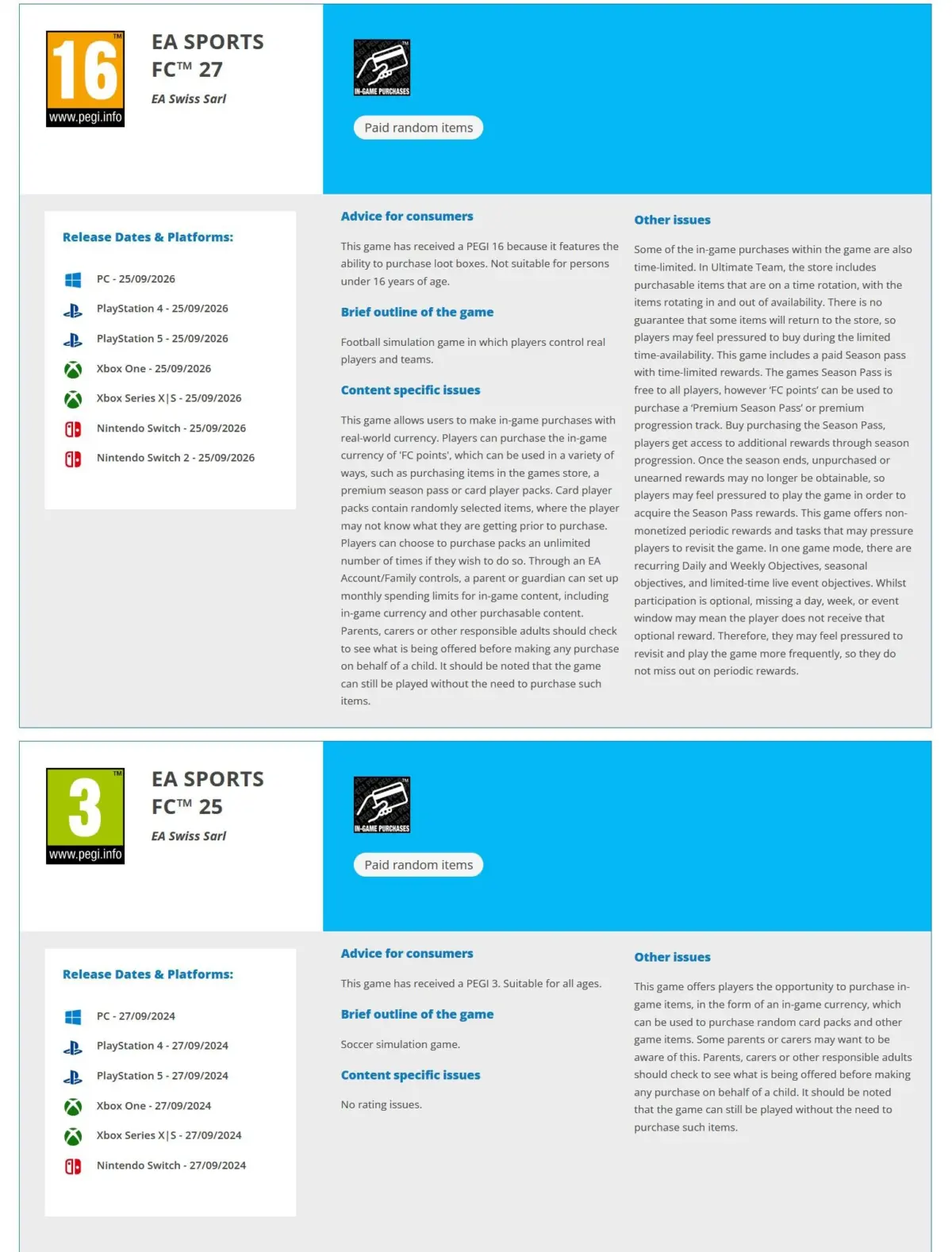
Under legacy frameworks, iterations like EA Sports FC 25 comfortably secured a PEGI 3 rating, deemed entirely safe for toddlers and children alike, with consumer notices showing "no rating issues." Fast forward to the impending release cycles, and the reality has shifted entirely. EA Sports FC 27 has been officially slapped with a PEGI 16 classification. A deep dive into the official PEGI registry reveals a starkly different breakdown: the title now carries explicit descriptors cataloging various microtransaction pipelines, including premium in-game currencies (FC Points), seasonal progression battle passes, and randomized player item packs.
Supporting Context & Metrics: The Psychology and Economics of Modern Monetization
The decision by PEGI to re-evaluate its categorization matrix is grounded in a growing body of psychological, economic, and sociological research surrounding video game monetization. For years, consumer advocacy groups, academic researchers, and governmental watchdogs have warned about the convergence of video games and gambling-like mechanics.

The Mechanics of Paid Random Items
Loot boxes and randomized card packs function on a psychological principle known as variable-ratio reinforcement schedules—the exact same psychological trap that drives slot machines and roulette wheels in physical casinos. Players pay real-world currency (converted into an abstract in-game token) for a randomized bundle of items, where the payout value is entirely unpredictable.
For developing brains, the allure of rare virtual items, elite sports athletes, or cosmetic prestige items creates a powerful feedback loop. Unlike adults, who theoretically possess fully formed impulse control and financial literacy, children and adolescents are uniquely vulnerable to the fear of missing out (FOMO) and the sunk-cost fallacy. When a multi-billion-dollar franchise like EA Sports FC introduces children to these loops under the guise of an innocent sports simulation, it normalizes gambling-adjacent behavior at an impressionable age.
The Economic Shift in Gaming
The financial incentives underpinning these mechanics explain why publishers fought so hard to keep age ratings low. Historically, the video game business operated on a "boxed product" model: a consumer paid a flat $60 (now $70) fee for a complete experience. Today, live-service models and sports titles generate the vast majority of their astronomical revenues through ongoing, in-game transactions—often referred to as "microtransactions" despite frequently generating macro-level profits.
By forcing games with loot boxes into a PEGI 16 bracket, European regulators are directly impacting the market reach of these titles. While a PEGI 16 rating does not legally ban minors from purchasing a game in every European jurisdiction, it restricts marketing campaigns, triggers parental control blocks on digital storefronts (such as PlayStation Network, Xbox Live, and Steam), and creates significant friction for parents who previously bought these games for young children without a second thought.
Official Statements and Industry Disparities
The friction caused by PEGI’s aggressive new stance has highlighted a profound regulatory fracture between Europe and North America. While European authorities are tightening the screws on monetization practices, North American counterparts are steering in the opposite direction.
The European Perspective: Prioritizing Digital Realities
European policymakers and ratings administrators view the update as a long-overdue modernization. As Connor Hindle and PEGI representatives have emphasized, the regulatory framework must evolve in lockstep with how interactive entertainment is consumed. Traditional metrics of harm—blood, gore, and explicit language—are easily identifiable by parents. A parent walking down a retail aisle can look at a box art and immediately spot a violence descriptor.
However, digital storefronts and frictionless in-app purchase systems bypass traditional parental oversight. A child can rack up hundreds of dollars in charges or develop compulsive spending habits silently from a living room couch. PEGI’s interactive risk categories aim to restore transparency to digital ecosystems, ensuring that parents are explicitly warned about the financial and psychological traps embedded within a software title before a transaction ever occurs.
The North American Divergence: The ESRB’s Stance
In stark contrast, North America’s Entertainment Software Rating Board (ESRB) has officially communicated that it will not follow PEGI’s lead.
When queried regarding the implementation of interactive risk categories, an ESRB representative made the board’s position clear: internal research and parental testing indicated that integrating "non-content related features"—such as monetization systems or communication vectors—into the core age rating itself would ultimately generate confusion for parents.

Consequently, North American ratings continue to compartmentalize these elements. For instance, EA Sports FC 27 retains an E (Everyone) rating from the ESRB. Rather than altering the foundational age bracket, the ESRB relies on supplementary content descriptors and interactive notices—such as "In-Game Purchases (Includes Random Items)" and "Users Interact"—appended to the bottom of the rating summary.
This transatlantic divergence leaves the global gaming industry in a complex compliance maze. Publishers must navigate a stringent, restrictive penalization model in Europe while maintaining a more permissive, advisory labeling system in North America.
Future Outlook: What This Means for Developers, Publishers, and Players
As PEGI’s rollout of the updated framework continues to sweep through digital catalogues, the long-term repercussions for the video game industry are coming into sharper focus.
1. The Decoupling of "Family-Friendly" and Sports Titles
For decades, sports video games occupied a unique cultural space: they were universally considered safe, wholesome, multi-generational entertainment options. Families bought games like FIFA (now EA Sports FC) or NBA 2K trusting that they were suitable for players of all ages. PEGI’s shift permanently shatters this illusion. By categorizing monetization-heavy sports simulations alongside mature-themed action titles carrying a PEGI 16 badge, regulators are drawing a hard line in the sand. Publishers will now have to decide whether to strip out randomized monetization to preserve a family-friendly rating or accept the restricted market access that comes with a higher age classification.
2. Increased Scrutiny on Digital Storefronts
Digital distribution platforms—Steam, Nintendo eShop, PlayStation Store, and Xbox Store—will face mounting pressure to enforce these age classifications more rigorously. As existing digital-only titles are systematically re-evaluated and bumped up to PEGI 16, platforms may be forced to implement stricter verification walls, parental pin requirements, and purchase caps for accounts associated with younger users.
3. A Precedent for Global Regulators?
With Europe taking the vanguard in regulating monetization as an age-safety hazard, all eyes turn to other international regulatory bodies. While the ESRB has demurred, consumer protection agencies in Asia, Australia, and South America are closely monitoring the outcomes of PEGI’s policy shift. Should European metrics prove successful in curbing predatory spending habits among minors without destabilizing the broader market, international adoption of similar interactive risk frameworks could accelerate rapidly.
Conclusion
PEGI’s decision to elevate games with loot boxes to a PEGI 16 rating is more than a mere administrative update; it is a fundamental ideological acknowledgment of how modern video games extract value from their users. By treating digital monetization and psychological retention mechanics with the same regulatory seriousness once reserved for physical harm, European authorities have sent an unmistakable message to the gaming industry: the days of hiding casino-style mechanics behind a child-friendly facade are drawing to a close.