Executive Overview
Management simulation games have long wrestled with a fundamental tension: the mechanical imperative to extract profit versus the emotional desire to curate digital ecosystems. For decades, the tycoon genre has prioritized ledger sheets, gate prices, and guest satisfaction ratings over ecological nuance. Frontier Developments’ original Planet Zoo made significant strides in shifting this paradigm by prioritizing animal welfare, yet it remained anchored in the traditional loop of building enclosures, drawing tourists, and balancing corporate budgets.
Now, with Planet Zoo 2—slated for release on October 13—the studio is attempting a bold evolution. During an exclusive, two-hour hands-on preview event with remote access to Frontier’s development builds, the most striking takeaway is not merely the graphical fidelity or the enhanced creature animations, but a profound philosophical shift toward global conservation. By introducing free-roaming wildlife preserves, deeply interconnected asset-customization suites, fully modeled interiors, and long-term multi-generational breeding mechanics, Planet Zoo 2 promises to redefine what players expect from the genre.
While questions remain regarding the depth of its economic simulation, the game’s dedication to environmental stewardship, habitat revitalization, and biome management signals a maturation for the franchise. This preview explores every facet of the upcoming title, from its ground-level perspective shifts to its sophisticated new zoological systems, offering an authoritative look at the future of virtual wildlife management.
Detailed Chronology: A Ground-Level Perspective of the East African Rift Valley
Traditional simulation games establish tone through their UI. Players are immediately greeted by top-down, isometric camera angles, floating menus, and spreadsheet-like financial overviews. Planet Zoo 2 deliberately subverts this convention from the moment the session begins.
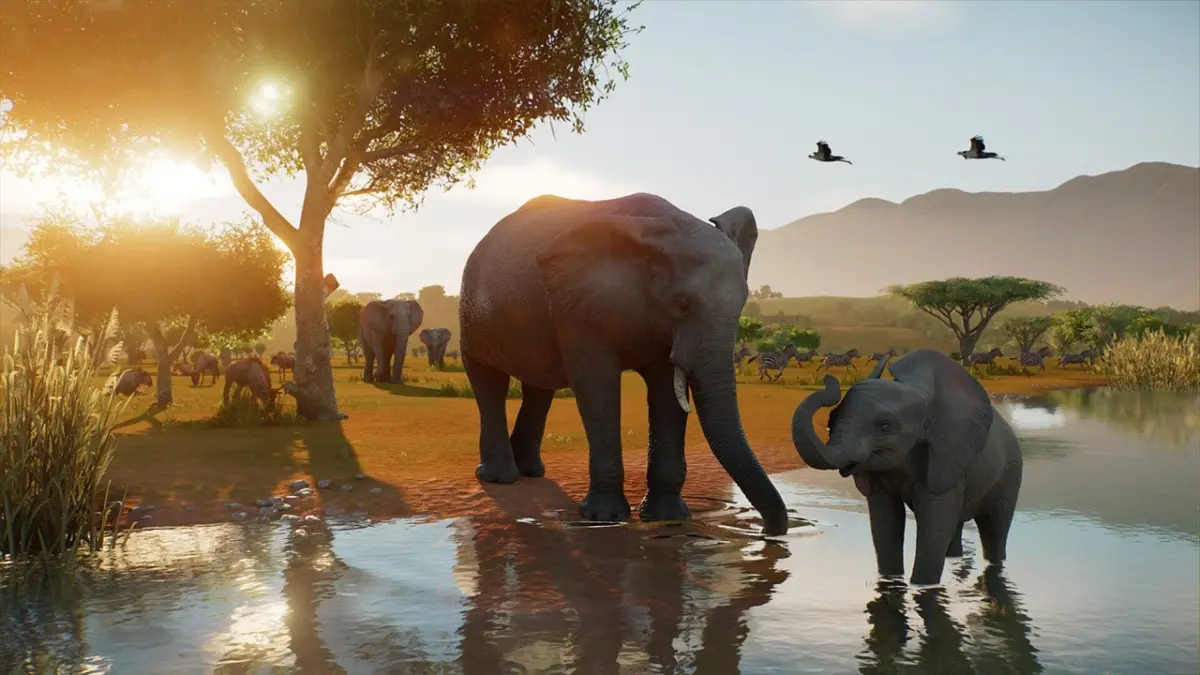
Instead of staring down at a blank grid, the preview dropped players directly onto the terrain at ground height within the lush, sun-drenched expanse of the East African Rift Valley. Operating in a first-person perspective before placing a single building or analyzing a single graph fundamentally alters the player’s relationship with the digital environment.
Immersive Exploration and Vehicular Surveys
The demo immediately integrated players into the ecosystem by placing them behind the wheel of a rugged, off-road survey vehicle. Navigating through dense, hyper-detailed grasslands and swaying foliage required a tactile approach to landscape management. Players could pull up close to herds of warthogs and zebras, though doing so carelessly would cause the wildlife to bolt. Approaching these animals successfully required crouching, moving stealthily, and utilizing onboard cameras to capture photographic data.
The graphical fidelity achieved at close range is remarkably high. Environmental textures, lighting interactions on flora, and the physical rendering of the animals themselves represent a generational leap forward for Frontier’s simulation engine. Despite the heavy visual load of rendering complex biomes with dense vegetation and roaming fauna, performance remained consistently smooth throughout the preview session.
Revitalizing Degraded Biomes
Moving beyond traditional enclosure design, Planet Zoo 2 introduces a dedicated preservation mode focused on ecosystem restoration. Managing a reserve involves evaluating irregularly shaped biomes—such as expansive savannahs or dense forests—and guiding them toward a "flourishing" status.
To achieve this state, players must cultivate specific ecological balances:
- Introducing precise percentages of native flora.
- Ensuring continuous, natural access to freshwater sources.
- Managing predator-prey ratios to prevent localized extinction events.
- Releasing captive-bred species back into the wild to bolster wild populations.
Although the demo provided unlimited funds and an East African preserve that was already in relatively stable condition, the underlying mechanics hint at a compelling gameplay loop. The challenge of taking a heavily degraded, ecologically barren landscape and nursing it back to life introduces a long-term goal that transcends the simple monetization metrics of past tycoon titles.
Supporting Context & Metrics: Systems, Architecture, and Deep Fauna
While the wildlife preserves anchor the game’s thematic ambitions, Planet Zoo 2 retains the core mechanics of traditional zoo management, funding its conservation efforts through ticket sales, captive breeding programs, and visitor infrastructure.
The Economic Simulation Debate
A lingering critique of modern Frontier tycoon games—including Planet Zoo and Jurassic World Evolution—has been the lack of a genuinely punishing economic simulation. For players who find joy in fending off bankruptcy and meticulously balancing the books, the original titles occasionally felt toothless. Because the preview restricted gameplay to an unlimited-funds sandbox state, it remains to be seen whether the developers have injected greater financial friction and macroeconomic challenge into the final release.
Unprecedented Architectural Customization
Where Frontier continues to set the gold standard is in the realm of asset detailing and architectural flexibility. Planet Zoo 2 features a staggering collection of modular construction parts. Every pillar, beam, and roof tile can be resized, rotated, combined, recolored, and remixed to manifest virtually any architectural vision.

For players who prefer not to spend hours constructing a single custom gazebo, the game offers robust pre-built design styles categorized by global motifs:
- North: Clean, minimalist, modern Nordic designs.
- West: Rugged, outdoorsy, classic North American aesthetic.
- East: Intricate, culturally inspired Asian architectural styles.
- South: Vibrant tropical motifs tailored for African and Oceanic environments.
Fully Modeled Interiors and Fluid Infrastructure
A major quality-of-life addition in Planet Zoo 2 is the introduction of fully modeled building interiors. With the exception of restrooms and medical quarantine facilities, almost every functional building can be entered in first-person view, allowing players to watch guests and staff interact within the spaces.
- Restaurants: Begin with a basic serving counter, but allow for modular expansions such as indoor seating and outdoor patios. Facilities link intuitively to ensure staff and patrons recognize them as unified zones.
- Gift Shops: Operate on the same dynamic linking system, scaling in complexity based on player design.
- Staff Break Rooms: Customizable with recreational activities and seating arrangements to maximize staff morale and efficiency.
Terrain Editing and Hydraulic Limitations
The terrain editor remains powerful, accessible, and intuitive. Players can manipulate surface textures, adjust ground roughness, and alter water turbidity and color tinting—allowing for creative (or chaotic) terrain designs. However, structural limitations persist: true flowing rivers that realistically cascade down a slope remain elusive. Water mechanics still rely on creating reservoirs and snapping them to fixed elevations, leaving descending rivers functioning more as flat, directional canals than natural mountain streams.
Advanced Zoological Mechanics and Genetics
The heart of any zoo game is its fauna, and Planet Zoo 2 delivers an encyclopedic roster of 49 species available at launch, spanning everything from delicate jellyfish to towering giraffes.
The animals possess complex statistical profiles that elevate the breeding simulation:
- Vitality: Determines dominance in combat and social hierarchies.
- Longevity: Dictates maximum lifespan within realistic biological variations.
- Fertility: Governs the probability of producing healthy offspring.
- Immunity: Measures an individual’s resistance to specific pathogens and diseases.
These traits are heritable, alongside rare phenotypic expressions, such as melanistic dark colorations in leopards. Breeding champions with optimal genetic traits requires careful, multi-generational planning and selective pairing.
Aquariums and Aviaries
Expanding beyond terrestrial enclosures, Planet Zoo 2 integrates full-fledged aquariums and aviaries directly into the base game.
- Aquariums: Water depth can be adjusted below staff access airlocks, while transparent glass tunnels can be threaded through exhibits, creating an immersive, sub-aquatic guest experience. Semiaquatic species like penguins naturally transition between land and water depending on habitat design.
- Aviaries: Utilizing a new modular construction system, players build flat boundary perimeters, place tall structural support poles, and stretch custom netting over the top to generate dynamic roof shapes. The game automatically calculates whether the enclosed airspace provides sufficient volume for avian species to exhibit natural flight behaviors.
Official Statements & Industry Reception
While formal press statements from Frontier Developments during the closed preview emphasized the studio’s commitment to environmental literacy and player agency, hands-on impressions highlight a deliberate pivot toward addressing community feedback.
Industry critics and preview participants have universally praised the tonal adjustment in campaign advisors. Gone are the relentless, groan-worthy puns and slapstick characters of previous entries; the new advisory cast strikes a more balanced, upbeat, and professional tone that respects the player’s intelligence without sacrificing accessibility.
Furthermore, Frontier has signaled that Planet Zoo 2 is designed from the ground up to reflect modern ecological values, bridging the gap between entertainment and conservation education. By treating wildlife preservation not as an afterthought, but as a core gameplay pillar, the developers are positioning the title as both an advanced management simulation and an interactive conservation platform.
Future Outlook
As the October 13 launch date approaches, Planet Zoo 2 stands poised to capture the attention of both veteran simulation enthusiasts and newcomers alike. While certain mechanics—particularly the economic depth of running a commercial park—require full-game scrutiny upon release, the sheer breadth of innovation is undeniable.
The integration of first-person exploration, breathtaking animal animations, deeply customizable architectural modules, and the revolutionary wildlife reserve mechanics make Planet Zoo 2 one of the most anticipated strategy titles of the year. Whether players choose to construct sprawling urban theme parks filled with cutting-edge aquariums or dedicate their virtual careers to restoring the fragile ecosystems of the East African Rift Valley, the horizon for tycoon gaming has never looked greener.