Executive Overview
Managing containerized applications at scale has long been a delicate balancing act for enterprise platform teams. While Amazon Elastic Container Service (Amazon ECS) has consistently provided a robust, scalable, and reliable foundation for running Docker and OCI-compliant containers, the surrounding operational overhead—specifically regarding ingress networking—has historically acted as a productivity bottleneck.
For every microservice deployed, platform and DevOps engineers have traditionally been forced to manually provision, wire together, and continuously maintain an intricate web of ancillary AWS resources. This typically involves setting up Application Load Balancers (ALBs), managing AWS Certificate Manager (ACM) security certificates, configuring AWS WAF web access control lists, and meticulously tuning security groups. As containerized estates scale from a handful of services to hundreds or thousands, keeping these resources synchronized in the face of continuous deployments, scaling events, and infrastructure updates creates a high risk of configuration drift, brittle code pipelines, and slowed deployment velocity.
To fundamentally solve this architectural friction, Amazon Web Services (AWS) has officially announced the launch of Amazon ECS Gateway, a powerful new account-level resource designed to automate and simplify ingress networking for containerized workloads. By shifting the burden of infrastructure lifecycle management directly to Amazon ECS, the gateway dynamically provisions and oversees the required networking resources inside the user’s AWS account. This marks a critical step forward in reducing operational toil, optimizing cost through intelligent resource sharing, and enforcing a clear, scalable separation of responsibilities between centralized platform engineering groups and individual application development teams.
Detailed Chronology & Implementation Mechanics
The conceptualization and rollout of Amazon ECS Gateway stem from years of direct customer feedback concerning the friction of microservice ingress management. Historically, configuration workflows required writing extensive Infrastructure as Code (IaC)—using tools like Terraform, AWS CloudFormation, or the AWS CDK—just to expose a single HTTP or HTTPS endpoint to the outside world or internal VPC networks.

Phase 1: Architectural Foundation and Setup
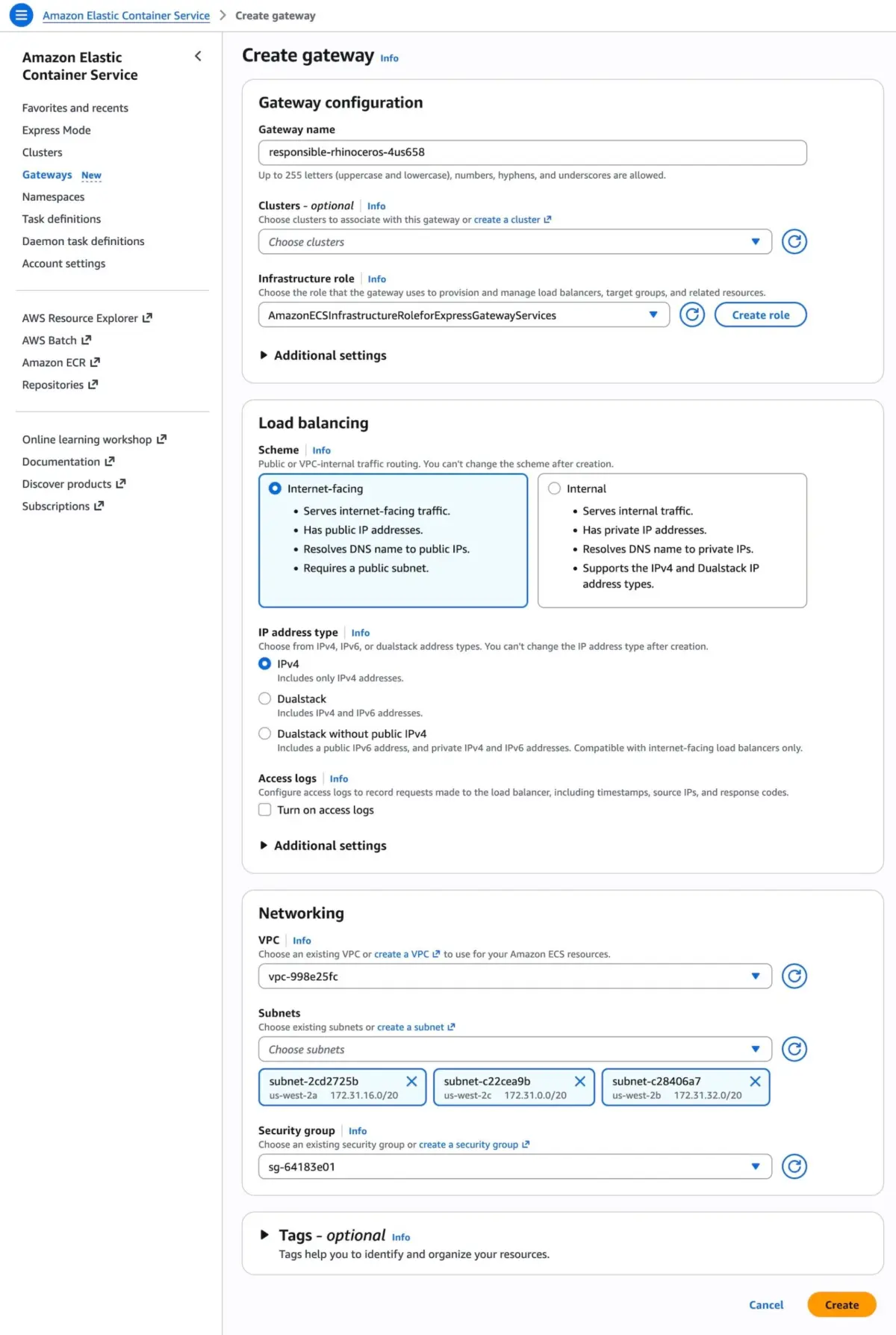
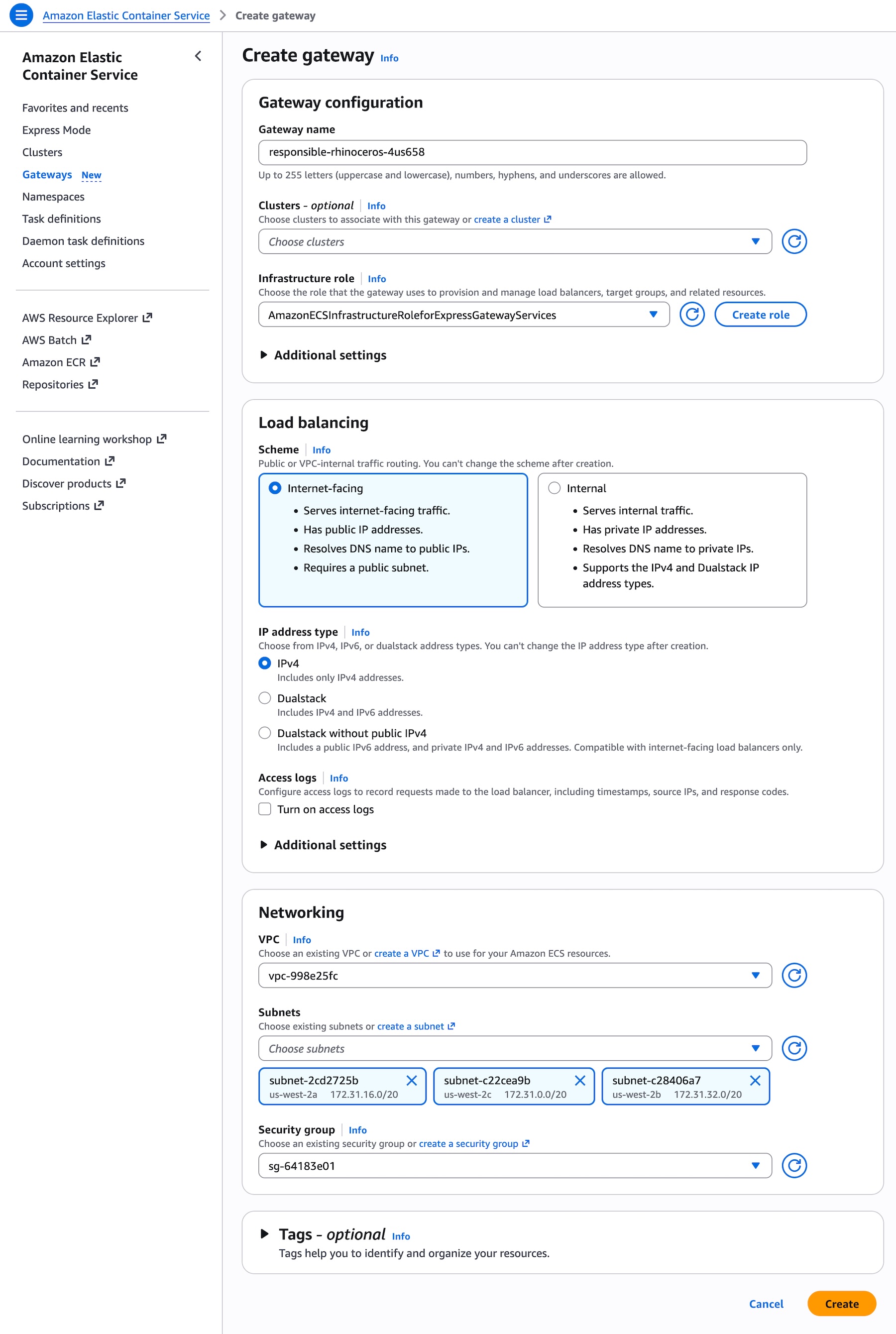
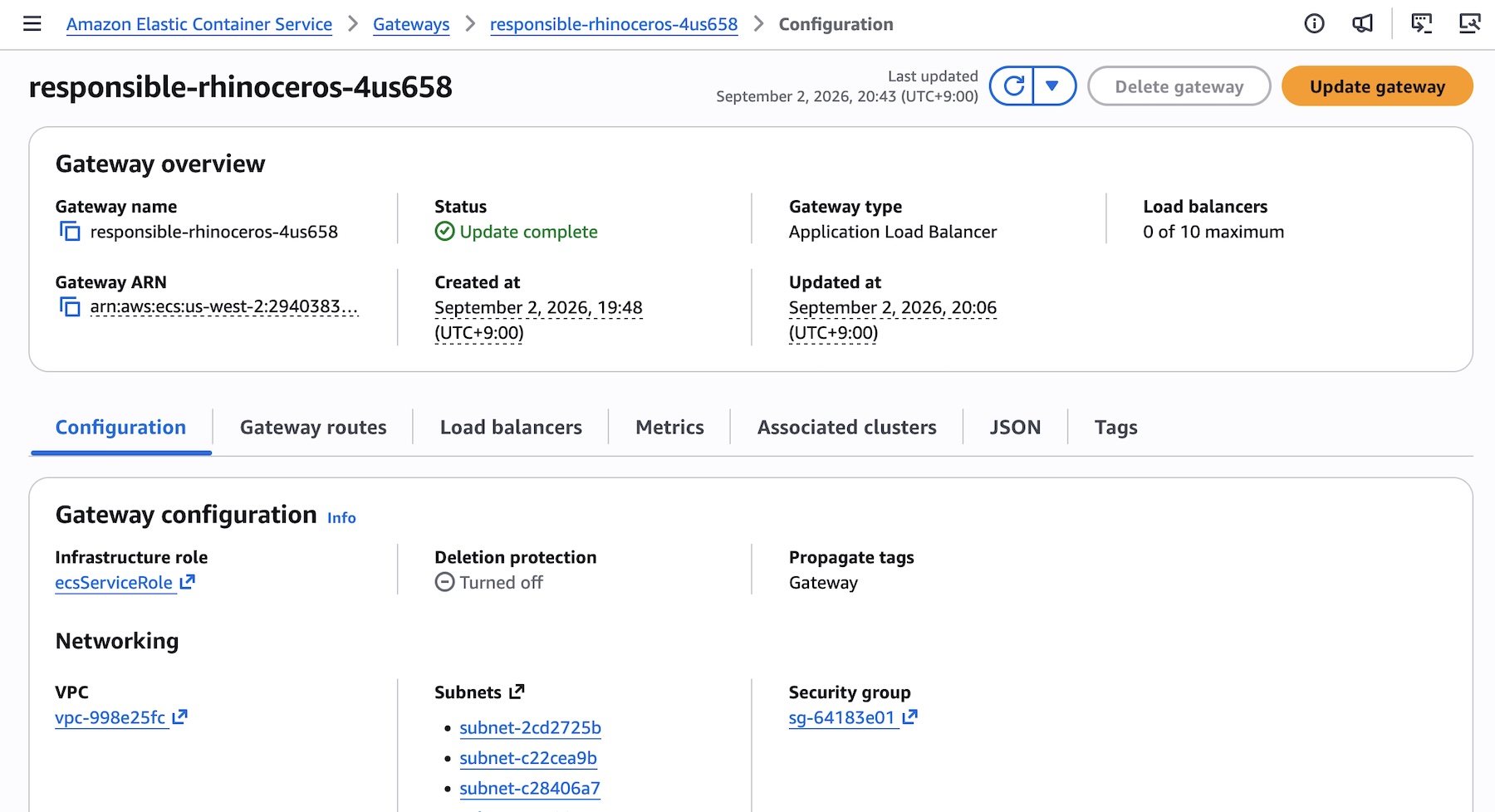
The journey with ECS Gateway begins at the platform engineering level. Through the AWS Management Console or the AWS Command Line Interface (AWS CLI), platform administrators can establish an account-level gateway by defining a unique name and assigning an Identity and Access Management (IAM) infrastructure role. This designated role grants ECS the necessary permissions to autonomously provision and govern underlying networking components—such as ALBs, target groups, and security groups—on behalf of the enterprise.
To deploy a gateway via the AWS CLI, administrators execute the CreateGateway API call:
aws ecs create-gateway
  --name my-team-gateway
  --infrastructure-role-arn arn:aws:iam::123456789012:role/ECSGatewayRole
  --configuration '
    "HostSharedAlb":
      "networkConfiguration":
        "subnets": [
          "subnet-080779f9bd887757a",
          "subnet-03d5b2fead6bc6258",
          "subnet-0861210a397d31252",
          "subnet-06539e194023cb77a"
        ],
        "ipAddressType": "ipv4"
      ,
      "scheme": "internet-facing"

  '
During this initialization phase, operators define whether the gateway handles public (internet-facing) or private (VPC-internal) traffic routing, select specific subnets, set IP address preferences, and optionally integrate AWS WAF web ACLs for robust application-layer security.
Phase 2: Cluster Association and Many-to-Many Mappings
Once the gateway exists as a dormant, un-provisioned structural entity, it must be linked to one or more ECS clusters. ECS Gateway introduces an exceptionally flexible many-to-many relationship model: a single gateway can be associated with up to 10,000 distinct clusters, while an individual cluster can support up to five separate gateway associations.

This flexibility allows platform teams to segment traffic dynamically—for instance, assigning distinct public and private gateways to the same underlying compute cluster. Associating a cluster is executed via a straightforward CLI command:
aws ecs associate-gateway-with-cluster
--gateway my-team-gateway
--cluster arn:aws:ecs:us-east-1:123456789012:cluster/my-cluster
Phase 3: Service-Level Connection and Automated Provisioning
The true innovation of ECS Gateway lies in how it handles individual microservice connections. Instead of requiring manual load balancer target group attachments, application teams simply declare a gateway connector within their service definition (CreateService or UpdateService API operations).
aws ecs create-service
  --cluster my-cluster
  --service my-api-service
  --task-definition my-api-service:1
  --gateway-connectors '[ "portName": "api", "filters": "accessTypes": ["PUBLIC"], "healthCheck": ... ]'
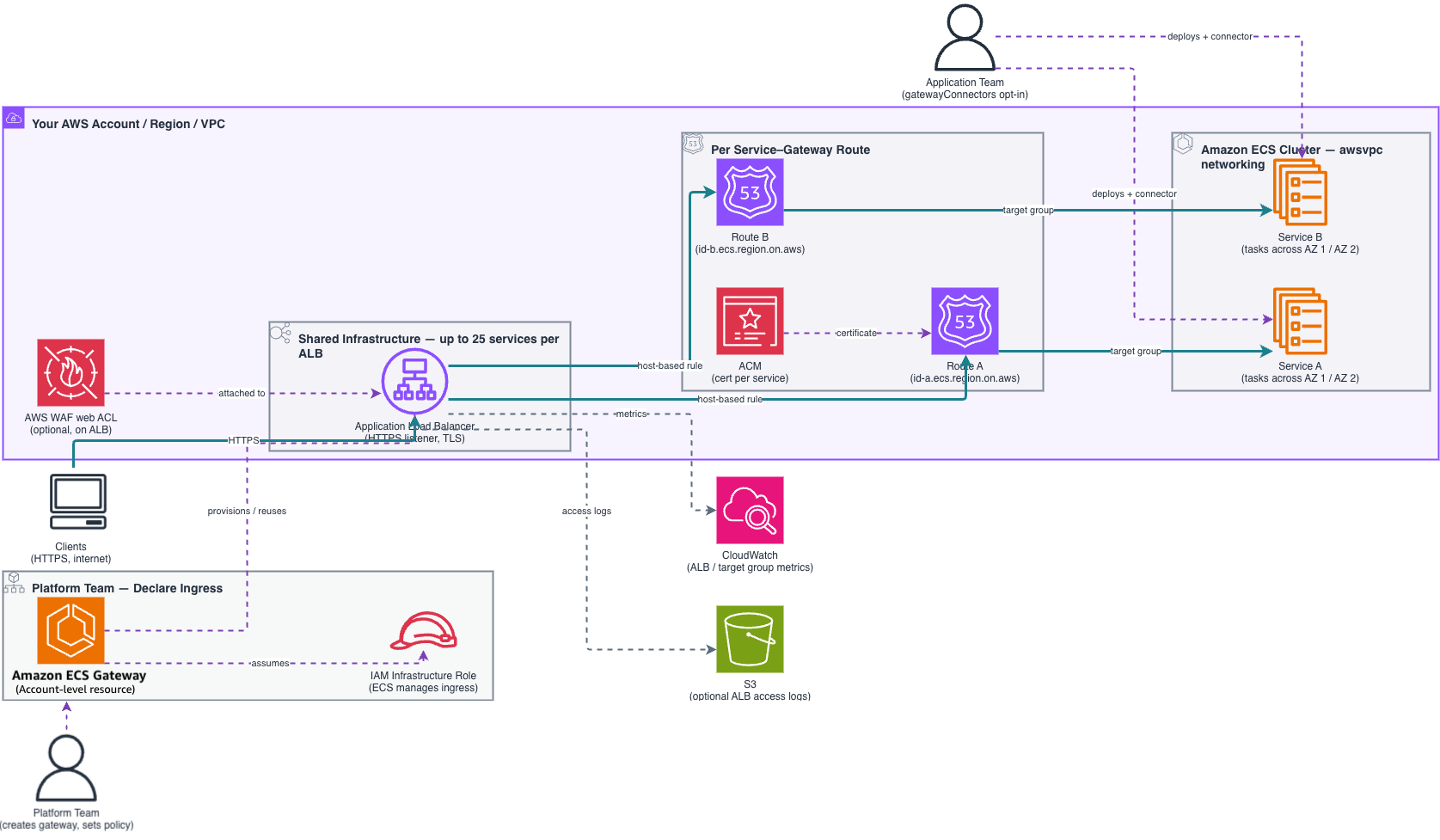
Upon deployment, Amazon ECS evaluates the cluster’s associated gateways to find a match based on access type, VPC boundaries, and Availability Zone coverage. Once matched, ECS instantly provisions the required per-service resources behind the scenes:
- An automated ACM certificate for secure transport layer security (TLS).
- A unique DNS hostname providing an immediate, production-ready endpoint.
- An ALB listener rule routing traffic matching that hostname directly to the service’s target group.
- Dedicated security groups ensuring inbound traffic is strictly permitted only from the associated ALB.
Supporting Context & Architectural Metrics
To fully appreciate the impact of Amazon ECS Gateway, one must analyze the infrastructure metrics and efficiency gains it introduces to modern cloud architectures.
Cost Optimization via Host-Based Routing
In traditional container architectures, provisioning a dedicated Application Load Balancer per microservice quickly becomes cost-prohibitive, especially for smaller services or staging environments. ALBs incur a baseline hourly charge plus Load Balancer Capacity Units (LCUs), meaning that proliferating load balancers wastes valuable budget.
ECS Gateway addresses this by leveraging host-based routing, enabling up to 25 distinct services to share a single Application Load Balancer. The system operates on a just-in-time provisioning model:
- Zero Idle Cost: No underlying load balancer infrastructure is created when a gateway is initially defined; resources are only spun up when the very first service connects.
- Automatic Scaling: As services are added and an ALB approaches its capacity limit, ECS automatically provisions an additional ALB (up to a user-defined
maxAlbCountquota). - Automated Decommissioning: When services are scaled down or deleted and an ALB is no longer utilized, ECS cleans up the infrastructure, preventing cloud waste and orphaned assets.
Migration Pathways and Incremental Adoption
For organizations with deeply entrenched legacy configurations, migrating to a new networking model can be daunting. Recognizing this, AWS engineered ECS Gateway to support incremental adoption.
If an existing ECS service already utilizes a custom-configured load balancer, platform teams do not need to execute a high-risk, cutover refactor. By calling UpdateService to append a gateway connector, engineers can run both ingress paths simultaneously. This dual-path capability allows developers to validate the stability, DNS resolution, and security posture of the ECS Gateway connection before safely deprecating and removing the legacy load balancer infrastructure.
Official Statements and Industry Implications
The release of Amazon ECS Gateway represents a fundamental shift in how cloud providers abstract infrastructure complexity for developers. Industry analysts and AWS engineering leads have emphasized the philosophy of reducing cognitive load for application developers.
"For years, platform engineering teams have spent countless hours writing bespoke automation scripts to wire up load balancers, certificates, and security groups every time a developer wanted to deploy a new microservice," notes a senior AWS cloud architect. "With Amazon ECS Gateway, we are shifting ingress management from a manual, per-service chore into a unified, policy-driven control plane managed natively by the container service itself."
By establishing a rigid structural boundary—where platform teams maintain global governance over gateways, subnets, and security baselines, while application developers simply declare intent via service connectors—organizations can achieve a true "Shift Left" development velocity without sacrificing enterprise-grade security or compliance. Furthermore, the integration of modern tooling such as the AWS MCP Server and associated AI coding plugins allows developers to programmatically generate, query, and manage ECS Gateway configurations directly from their preferred integrated development environments (IDEs) and AI-assisted workflows.
Future Outlook and Availability
Amazon ECS Gateway is available starting today across all commercial AWS Regions where Amazon Elastic Container Service is supported. Crucially, ECS Gateway incurs no additional platform service fees or licensing costs. Customers pay solely for the underlying AWS infrastructure resources that are dynamically provisioned within their accounts as services connect to a gateway—including standard Application Load Balancer hourly rates, LCU consumption, Amazon CloudWatch logs and metrics, AWS Certificate Manager certificates, and standard data transfer fees.
As cloud-native architectures continue to evolve toward higher levels of abstraction, features like ECS Gateway point the way toward a future where infrastructure management is entirely invisible to the application developer. By automating the tedious mechanics of ingress routing, certificate generation, and lifecycle synchronization, AWS has equipped platform teams to scale containerized applications faster, cheaper, and with significantly lower operational overhead.
To begin leveraging Amazon ECS Gateway, platform administrators can navigate to the Amazon ECS Console to spin up their first gateway resource, consult the official Amazon ECS Gateway Developer Guide for deep technical specifications, and provide feedback through the AWS re:Post community channels.