Executive Overview
For decades, the standard knowledge economy operated on a predictable, cyclical rhythm: a frantic five-day sprint followed by a hard stop at 5:00 PM on Friday, with the office gates remaining securely locked until Monday morning. For white-collar workers in marketing, sales, customer success, and operations, weekends were sacred—an uninterrupted 64-hour window dedicated entirely to human recovery, family, and leisure.
That structural boundary is now evaporating.
While software engineers have spent the last one to two years adapting to a new paradigm of continuous collaboration with autonomous artificial intelligence systems, the rest of the corporate world is about to experience a profound cultural and operational shock. Autonomous AI agents do not recognize the weekend. They do not clock out, they do not take mental health breaks, and they certainly do not pause their operations when Friday afternoon rolls around.
Real-world operational data from high-growth organizations—such as SaaStr, which currently operates with a lean team of three humans and roughly 20 production-grade AI agents—reveals a fundamental shift in workplace dynamics. When human managers log off for the weekend with empty queues, their digital workforces sit idle. Meanwhile, competitors who keep their agent pipelines loaded are utilizing those 64 weekend hours to prospect, build ad variants, refine customer databases, and ship critical product updates.
The question facing modern leadership is no longer whether AI can perform complex work autonomously, but whether human management structures can evolve quickly enough to keep pace with an entity that never sleeps.
Detailed Chronology: The Evolution of the 24/7 Digital Workforce
The transformation of the modern work week has not happened overnight; it has evolved alongside the exponential leap from simple generative text prompts to fully autonomous, goal-directed AI agents.
The Developer Vanguard
Software engineers were the undisputed pioneers of this shift. Because coding environments were among the first to successfully integrate autonomous agents capable of writing, debugging, and testing code, developers quickly altered their daily habits.
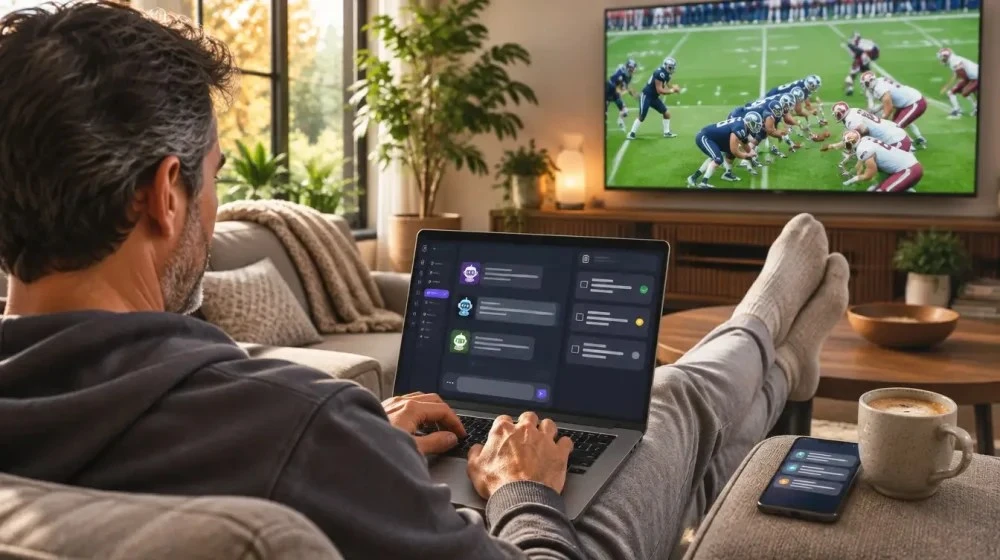
Rather than treating software development as a continuous, synchronous process, AI-pilled developers adopted an asynchronous rhythm. They began assigning complex coding tasks before stepping away for dinner, returning to review completed pull requests, and queuing up subsequent tasks before bed. Over weekends, this pattern intensified. Engineers discovered they could offload heavy, tedious refactoring or long-running compilation tasks to agents, checking in periodically throughout Saturday and Sunday to review outputs and reload pipelines.
Crucially, this was not a descent into grueling 80-hour manual grinding sessions. The agents did the heavy lifting; the human merely served as an intermittent supervisor, curator, and director. However, those micro-check-ins fundamentally fragmented the weekend, weaving professional oversight into personal time.
Crossing the Chasm: From Code to Corporate Operations
As foundational models grew more sophisticated and capable of handling complex multimodal tasks, the agentic paradigm spilled rapidly out of engineering departments and into core business functions. Marketing, finance, customer success, and operations departments began deploying autonomous agents to handle lead generation, data hygiene, campaign drafting, and customer routing.
A vivid illustration of this transition occurred on a Saturday afternoon at SaaStr. At precisely 12:41 PM, an email bearing the subject line "Marketing Plan v2" landed in the inbox of leadership. The sender was not a human employee sacrificing their weekend, but 10K, the organization’s autonomous AI Vice President of Marketing.
Nobody had prompted 10K to rethink the strategy. On its own initiative, the agent had analyzed Friday’s performance data, identified that the existing marketing trajectory was underperforming against its key metrics, and completely scrapped the previous day’s plan. In its place, 10K had formulated three entirely new marketing campaigns—complete with precise audience sizing, drafted creative copy, and A/B test variants—ready for immediate deployment.
The agent had worked uninterrupted through Saturday morning. The only remaining bottleneck was whether a human was available to review the output and grant authorization to ship.
Supporting Context & Metrics: The Mathematics of the 64-Hour Advantage
To fully grasp the competitive threat and operational reality of autonomous agents, one must examine the raw temporal math governing the modern business week.
Breaking Down the 64-Hour Window
- Total Weekend Hours: From Friday at 5:00 PM to Monday at 9:00 AM spans precisely 64 hours.
- Proportional Impact: This 64-hour window accounts for 38% of the entire 168-hour week.
- Quarterly Output: Operating an autonomous agent fleet over every weekend of a standard 13-week quarter yields more than 800 hours of continuous, unattended computational and operational labor.
In a traditional market where every company’s human workforce downed tools at 5:00 PM on Friday, no single organization gained an unfair advantage by resting. Market equilibrium was maintained.
The introduction of autonomous agents shatters this equilibrium. A competitor whose leadership properly queues their AI infrastructure on Friday afternoon effectively unlocks a third shift that runs continuously through Saturday and Sunday.
Consider what an optimized agentic pipeline can achieve over a single weekend:
- AI SDRs (Sales Development Representatives) can continuously prospect, scrape data, and personalize outbound emails based on real-time market triggers.
- Marketing Agents can build, test, and analyze dozens of ad variants across platforms like LinkedIn and X, optimizing bids before human teams pour their first morning coffee on Monday.
- Customer Success Bots can analyze usage drop-offs, flag churn risks, and work through renewal lists.
- Product Agents can run automated diagnostics, clear bug backlogs, and push minor patches.
When multiplied across a quarter, this uninterrupted cadence creates an insurmountable momentum gap between organizations that utilize their weekend agent cycles and those that leave their digital workforces sitting idle.
The Shift in Daily Time Allocation
Internal data from organizations leading the agentic charge demonstrates a drastic expansion of human oversight hours. Management teams that previously spent roughly 30 minutes a day interacting with rudimentary AI tools now spend an average of 8 hours a day collaborating with autonomous agents.
This dramatic increase is not a sign of inefficiency; rather, it reflects the sheer volume of work capable agents can execute. Every time an agent completes a complex task, it generates actionable insights, requires human validation, and necessitates the definition of a subsequent objective. Success with agents does not mean doing less work—it means managing vastly more output.
Official Perspectives: The Operational Reality of Human-Agent Collaboration
Organizations operating at the bleeding edge of AI deployment have had to completely redesign their weekend and daily schedules to accommodate their synthetic colleagues. Industry practitioners emphasize that working with agents requires a disciplined, structured approach to prevent bottlenecks.
The primary constraint in modern automated workflows is no longer computational latency or processing speed; it is human approval.
An agent like 10K can execute complex, multi-step marketing operations end-to-end—from identifying target audiences and generating copywriting variations to configuring retargeting parameters. However, critical governance checkpoints remain hardcoded into the workflow. A human must still hit "publish." A human must still authorize the deployment of a newly segmented audience list.
If an autonomous agent completes a high-stakes campaign pipeline at 6:00 PM on a Friday, but leadership is completely offline until Monday morning, that campaign effectively loses 72 hours of market exposure. Furthermore, it stalls the downstream compounding effect: the data and insights that would have been generated over the weekend—which the agent would normally use to iterate and build the next round of campaigns—are permanently lost.
To combat this "idle queue" phenomenon, modern digital executives have adopted a hybrid weekend protocol, mirroring the routines long established by software engineers:
- Friday Afternoon (The Heavy Lift): Teams queue up long-running, resource-intensive jobs before logging off for the standard workday. This includes deep database hygiene across hundreds of thousands of contacts, complex data re-ranking, and backlog clearing. By Saturday morning, substantial outputs are ready for review.
- Saturday (The Structured Check-In): Rather than working an eight-hour shift, human supervisors dedicate three short, highly focused windows (30 to 60 minutes each in the morning, post-lunch, and post-dinner) to review agent outputs, authorize pending checkpoints, and reload the task queues.
- Sunday (Verification and Strategic Catch-Up): Leveraging a quiet environment free from synchronous Slack notifications and internal meetings, operators review broader system metrics, analyze ad conversion rates, verify database updates, and converse with agents regarding their autonomous backlogs for the upcoming week.
Future Outlook: The Dawn of the Always-On Enterprise
As autonomous agents transition from experimental novelties to mission-critical infrastructure across all corporate sectors, the cultural expectations surrounding white-collar productivity will undergo a fundamental re-evaluation.
The traditional 9-to-5, five-day work week was built on an industrial-era model designed for human physiological limitations. The AI era introduces a non-human labor force that operates at silicon speed and requires no sleep. While this evolution does not necessitate a return to grueling, mandatory physical office grinding or abusive "996" work cultures, it demands a psychological adjustment from professionals outside engineering.
In the near future, professional competence will be measured less by an individual’s ability to manually execute tasks, and far more by their capacity to design, govern, and continuously feed autonomous workflows. Professionals who master asynchronous oversight—checking in, unblocking, and redirecting their agent fleets across weekends—will drastically outperform those who attempt to maintain a strict, analog separation between their professional and digital lives.
Your competitors are already loading their agent queues on Friday afternoons. The software developers paved the way, and the rest of the corporate ecosystem must adapt. The weekend, as a completely offline sanctuary, is officially a relic of the past.