Executive Overview
The debate over whether to integrate artificial intelligence into modern software is effectively over. The consensus among B2B SaaS leadership is unanimous: build with AI, or become obsolete. Yet, as the initial wave of hype settles into the grueling reality of execution, the core existential questions for tech founders remain dangerously unsettled. What metrics are supposed to measure an agentic product? And, perhaps more urgently, what prevents a general-purpose foundation model from subsuming your core utility next quarter, rendering your proprietary product entirely redundant?
For the past three years, Adam Guild, CEO of restaurant-tech platform Owner, has been running a live, high-stakes experiment to answer these very questions. Stepping onto the stage at SaaStr AI, Guild shared results that challenge foundational tenets of contemporary software development—including strategic pivots that temporarily make a company’s board deck look decidedly worse on paper.
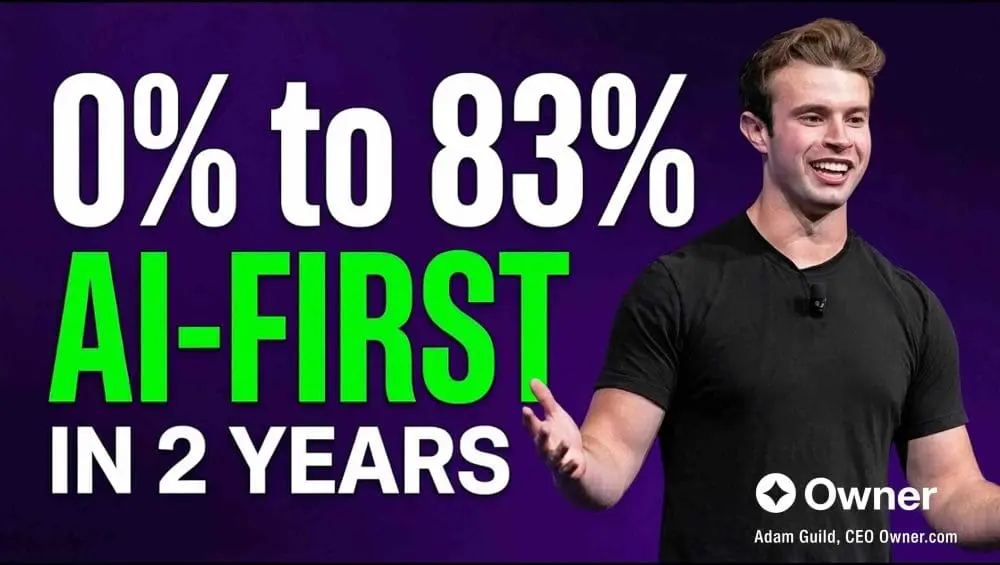
Operating as a "Shopify for restaurants"—providing centralized websites, online ordering infrastructure, and automated marketing tools—Owner crossed the $100M ARR threshold and accelerated its year-over-year growth trajectories for 2025 and 2026. The catalyst for this hyper-acceleration wasn’t incremental optimization. It was a radical structural rebuild: over 83% of Owner’s new customers now originate entirely inside a free, autonomous AI product, up from zero just two years prior.
Guild’s roadmap offers a masterclass in navigating the volatile landscape of generative AI, highlighting how legacy SaaS metrics like user engagement can actively mislead founders, why extreme product opinionation is the only true moat against foundational models, and why the ultimate test of leadership is not mandating AI adoption from a distance, but building with it firsthand.
Detailed Chronology: From Invisible Threat to the Pizza Expo Epiphany
The Two-Sided Threat That Evaded the Metrics
Between early 2023 and 2024, Owner found itself squeezed by a silent, two-front pressure cooker. On one side, low-cost competitors were commoditizing basic website building, driving down margins and accelerating churn. On the other, the foundational capabilities of large language models were advancing at a pace that threatened to turn entire SaaS categories into thin UI wrappers.
Yet, during this critical window, Owner’s traditional telemetry told a comforting story. Growth charts remained stable, net revenue retention looked healthy, and traditional pipeline indicators flashed green. Guild’s internal read, however, was stark: without a fundamental architectural shift, the company would bleed out slowly, arriving at irrelevance long before the crisis registered in quarterly financial reports. The metrics were lying, masking structural vulnerability behind backward-looking comfort.
Institutional Resistance Disguised as Discipline
Recognizing the threat was only the first hurdle; convincing stakeholders was far more difficult. Nearly every informed and heavily invested constituency within and around the company offered rigorous, logical reasons to stand pat:
- Customer Feedback: Extensive discovery interviews with restaurant operators consistently indicated they wanted incremental feature updates, not revolutionary paradigm shifts in how software operated.
- Industry Veterans: Trusted advisors and seasoned SaaS operators warned against abandoning a predictable, sales-led motion that had successfully scaled the company past tens of millions in ARR.
- Internal Stakeholders: Engineering and product teams pointed to real, burning fires in the legacy codebase that demanded immediate attention rather than speculative, high-risk AI experiments.
These objections were entirely reasonable on their own terms. Two of the three came directly from individuals whose primary professional mandate was to remain close to the customer. This dynamic exposes the most dangerous failure mode in modern technology leadership: catastrophic strategic stagnation that doesn’t feel like resistance to innovation, but rather like disciplined, prudent management.
The Breakthrough at the International Pizza Expo
The tie broke unexpectedly on the floor of the International Pizza Expo.
Guild arrived early, his laptop primed to demonstrate Owner’s standard suite of websites and digital ordering tools. When the doors opened, early attendees streamed past the booth. However, one pizzeria owner abruptly stopped, craned his neck toward the back of the display, and pulled out his smartphone.
He was scanning a promotional poster—created almost as an afterthought by one of Owner’s product managers—advertising an unpolished, highly experimental minimum viable product (MVP). The tool promised a simple value proposition: analyze everything broken about a restaurant’s digital footprint and automatically fix it using autonomous AI. There was a QR code. The visitor, a 55-year-old operator from Pennsylvania, was immediately fascinated.
Throughout the remainder of the event, the pattern repeated itself. Across dozens of interactions, independent restaurant operators bypassed traditional software demonstrations to grill the team on AI capabilities: How could it drive customer discovery? How could it systematically slash labor costs?
The contrast with traditional customer discovery interviews conducted three months prior was absolute. In the intervening months, ChatGPT had crossed the chasm into small-business consciousness. Mainstreet operators had already decided that artificial intelligence was an operational advantage they desperately wanted, long before enterprise software vendors thought to offer it. Sensing the paradigm shift, Owner pivoted entirely, temporarily shelving legacy product fires to commit resources to the new vision.
Supporting Context & Metrics: Rewiring the Go-to-Market Engine
Before the strategic pivot, Owner operated as a strictly sales-led B2B organization. The customer journey followed a traditional enterprise path: inbound lead generation, booking a discovery demo, consultations with a sales representative, handoff to an onboarding specialist, and finally, manual website construction.
The core architectural question became: How radically could this journey be compressed now that generative AI agents exist?
From "Book a Demo" to "Type in Your Restaurant Name"
Owner’s answer was the total elimination of friction: a free, zero-barrier product experience where a restaurant owner types their business name into an interface, allowing autonomous agents to execute the rest. In under five minutes, the system autonomously executes a comprehensive digital overhaul:
- Scrapes and analyzes historical online sentiment across public forums and social media.
- Extracts authentic dish spotlights directly from real customer reviews on Reddit, Instagram, and Facebook.
- Generates an optimized, highly converting visual photo gallery and detailed menus.
- Synthesizes hidden operational details, including bar and cocktail specifics.
- Produces professional video assets the owner had never previously possessed.
Demonstrating this live for a modest Thai restaurant—whose previous homepage consisted of a single snapshot of table napkins underneath the word "Welcome"—Guild watched as the system generated a fully realized, conversion-optimized digital presence in minutes. While the tech community discovered the demo via a viral post on X (formerly Twitter) generating over 2 million views, the impact within the traditional hospitality sector had been compounding quietly for over two years.
The Quantifiable Impact
The financial and operational metrics following the structural overhaul validate the shift:
- Acquisition Shift: Over 83% of new customers now initiate their entire product journey inside the automated AI tool, compared to 0% two years prior.
- Topline Acceleration: Year-to-date growth figures for 2025 and 2026 markedly outpace 2024 performance levels.
- Scale: The company continues its rapid upward trajectory past the $100M ARR milestone.
Product Philosophy: The Moat of Extreme Opinionation
Why Agents Require Opinionated Architecture
The underlying magic of an agentic user interface lies in its ability to drive a desired business outcome without demanding continuous manual configuration from the user. The core value proposition is the preservation of time and the elimination of specialized technical expertise.
However, this dynamic only functions if the underlying software maintains a rigorous point of view. If an application must pause at every juncture to ask the user for administrative direction, it ceases to be an intelligent agent; it merely functions as a digital intake form wrapped in modern typography.
Owner’s generated restaurant sites succeed because store sales measurably increase the moment the owner activates them. This performance is a direct result of encoding battle-tested best practices derived from powering thousands of restaurant storefronts and analyzing the behavioral patterns of tens of millions of digital consumers.
Insulation Against Foundation Models
A primary anxiety haunting B2B software founders is the looming threat of general-purpose foundation models. If an operator points an advanced coding model like Claude Code or Codex at a restaurant’s legacy webpage and requests a modern redesign, the resulting output will effortlessly surpass the original. Pretending otherwise is a dangerous delusion that costs founders years of strategic runway.
Yet, a general-purpose model lacks critical, contextual operational data: Which specific design components on a regional eatery’s landing page correlate with verified sales growth? Which call-to-action phrasing maximizes digital checkout conversion? Where must navigation bars be placed to drive local SEO dominance within a specific geographic market?
Foundation models train on public web corpora—much of which is inherently substandard—combined with generalized UI guidelines. Owner captures exclusive outcome data because it enforces a singular, opinionated architectural system across its entire customer base. Extreme opinionation generates proprietary outcome data, and proprietary outcome data forms an unassailable moat. Bespoke, infinitely customizable configurations yield no transferable learning, leaving products vulnerable to replication by general models.
Inverting Traditional Health Metrics
In legacy SaaS business models, dashboards rely on Daily Active Users (DAU), Weekly Active Users (WAU), and Monthly Active Users (MAU) as primary indicators of product health and customer engagement.
Guild argues that in an agentic paradigm, the inverse is often true. If autonomous agents derive value by executing business outcomes without continuous manual intervention, then every time a customer logs into the dashboard to manually correct or adjust system configurations, it represents a systemic product failure. The user is expending cognitive energy to resolve friction introduced by the software itself.
The ultimate design target is an experience so low-touch that the customer rarely needs to interact with the dashboard, trusting the system to continuously execute industry best practices on their behalf. For startups accustomed to leading board meetings with traditional engagement graphs, this shift requires careful narrative framing before metrics temporarily dip as automation deepens.
Internal Operations: Engineering the Autonomous Enterprise
The external transition toward agentic workflows forced an equally dramatic overhaul of internal software development and operational processes at Owner.
"Owen": Automating Engineering Coordination
The internal transformation began with Will, a versatile product designer and engineer who spearheaded the initial grader product. As the tool scaled, Will found himself absorbing mounting coordination overhead: updating project management systems like Linear and Notion, leading daily standups, and chasing status updates. Recognizing that this administrative drag disproportionately penalizes high-performing individual contributors (ICs), the team applied agentic logic inward, building an internal coordination agent named Owen.
Owen continuously monitors GitHub, Slack, Notion, Linear, and Google Meet transcripts via Gemini to maintain real-time team alignment without synchronous meetings. Furthermore, when a team member flags a visual bug or user interface flaw in Slack—such as bullet points rendering improperly in an agent chat—Owen directly invokes Claude Code. With full visibility into the underlying codebase, Claude immediately generates a first-draft pull request (PR). This system bypasses traditional friction points: opening a ticket, routing it to a front-end engineer, locating the relevant component, and manually shipping the fix.
Expanding the Internal Agent Ecosystem
Owner deployed additional internal builds to eliminate lossy human processes across business functions:
- The Product Insight Command Center: Aggregates qualitative user feedback and telemetry to surface precise product bottlenecks.
- AI-Native Finance & Sales Operations: Automates recurring administrative workflows to preserve high-value human attention.
- Momentum Integration: Wired directly into post-sale customer touchpoints, this tool instantly broadcasts positive customer feedback to the sales team whenever a client reports tangible revenue growth. Grounding sales representatives in continuous, verified customer success provides a potent psychological input for team conviction.
Leadership and Philosophy: Building Over Mandating
Guild’s most incisive commentary centers on executive psychology. He cautions against a common executive failure mode: issuing sweeping top-down mandates—such as threatening staff with termination if they fail to tenfold their productivity with AI—while failing to personally engage with the technology. Fear-based declarations devoid of personal leadership example consistently fail.
Describing himself as a non-technical CEO whose background involved scripting Minecraft servers rather than writing production enterprise code, Guild demonstrated personal commitment when a customer named Juliana—owner of a Oaxacan restaurant—expressed frustration over commercial photography costs. Having spent $2,000 on professional menu shots, she could not afford an encore shoot for new seasonal dishes, and her smartphone photos looked amateurish by comparison.
Within six hours over a weekend, Guild personally built Owner Photographer. The system allows operators to upload low-quality smartphone food images, select a visual style, and leverage an orchestrated chain of models to generate professional-grade assets complete with precise anti-prompts designed to eliminate the uncanny-valley artifacts that typically plague AI-generated food photography. Juliana’s blurry taco image emerged matching the exact aesthetic of her $2,000 professional portfolio. Hundreds of customers now utilize the feature, marking one of several tools Guild built personally.
The Jevons Paradox of Headcount
Addressing a central debate among tech executives, Guild rejects the premise that organizational leverage should be measured by how many fewer people are required to execute a static business plan.
Applying Jevons paradox to human capital—where increased resource efficiency drives expanded consumption—Guild argues that the correct strategic inquiry is how much more ambitious a company can become. Leveraging high-agency builders to compress a ten-year product roadmap into a single operating year represents a far more compelling application of the AI era than simply downsizing to execute yesterday’s baseline strategy with fewer resources. While competent operators hold divergent views on headcount strategy, the choice between contraction and expanded ambition remains a foundational leadership decision.
Future Outlook: Avoiding the Primary Failure Modes
Synthesizing his observations from Owner’s transformation and broader industry trends, Guild outlined five critical failure modes currently imperiling B2B software companies:
- Treating AI as a Feature Wrapper: Appending superficial chat interfaces to legacy workflows without reimagining the underlying product architecture around autonomous outcomes.
- Confusing Engagement Metrics with Product Health: Relying on legacy SaaS dashboards (DAU/MAU) that penalize automation and reward software friction.
- Yielding to Institutional Inertia: Permitting internal consensus-building and historical customer feedback to override necessary structural pivots.
- Outsourcing Technological Vision: Mandating AI adoption across teams from an executive distance without engaging in hands-on building.
- Opting for Ambition Contraction: Utilizing AI leverage purely for headcount reduction and cost-cutting rather than aggressively compressing product roadmaps to capture expansive new market terrain.
As the software industry matures past the initial shockwave of generative artificial intelligence, Owner’s trajectory offers a clear blueprint. Defensibility in the age of foundation models does not stem from hiding behind legacy moats or relying on sales-led friction; it requires leaning aggressively into extreme product opinionation, capturing proprietary outcome data, and empowering high-agency builders to fundamentally rewrite the rules of enterprise software.