Across the United States, an unprecedented wave of public pushback is challenging the rapid, unchecked expansion of artificial intelligence data centers. While technology conglomerates, hyperscalers, and economic development agencies champion these massive infrastructure investments as engines of job creation and technological dominance, local communities are raising alarm over their severe environmental footprint, escalating energy demands, and strain on public utilities. Recent polling from Gallup reveals that a majority of Americans now oppose data center construction within their immediate vicinity, driven primarily by fears of rising utility bills, resource depletion, and localized air and noise pollution.
This national tension has converged on Philadelphia, Pennsylvania, where environmental justice advocates from the community organization Philly Thrive have initiated a high-profile campaign demanding an immediate municipal moratorium on data center developments. The pushback is anchored in historical trauma: for decades, residents of the Grays Ferry neighborhood in Southwest Philadelphia lived beside the largest oil refinery on the U.S. East Coast. Having endured generations of respiratory illnesses, cancer clusters, and a catastrophic refinery explosion in 2019, community leaders refuse to allow their district to become a modern "sacrifice zone" for Big Tech’s processing power.
The battle in Philadelphia mirrors a broader systemic shift across the country. Governors and municipal leaders in states such as New York, Colorado, Indiana, North Carolina, and Nevada have enacted temporary halts or moratoriums on data center permits. As energy analysts project that AI data centers could consume more natural gas than major industrialized nations combined over the coming decade, the clash between technological ambition and local environmental sovereignty has become one of the defining policy struggles of the digital age.
Detailed Chronology
+-----------------------------------------------------------------------------------+
| CHRONOLOGY OF COMMUNITY RESISTANCE AND REGULATORY PUSHBACK                        |
+-----------------------------------------------------------------------------------+
| • Pre-2019: Grays Ferry residents suffer chronic illnesses near PES Refinery.     |
| • June 2019: PES Oil Refinery explosion forces permanent closure of the plant.    |
| • 2020–2024: Philly Thrive shifts focus from closure to post-industrial justice.  |
| • Mid-2026: Philadelphia officials identify Northeast Philly & Grays Ferry sites. |
| • July 2026: NY Gov. Kathy Hochul signs executive order pausing data center permits. |
| • Sept 2026: Philly Thrive launches "No Data Centers in Philly" rally at City Hall. |
+-----------------------------------------------------------------------------------+
The Legacy of Contamination in Southwest Philadelphia (Pre-2019)
For over a century, the Grays Ferry neighborhood in Southwest Philadelphia operated in the immediate shadow of the Philadelphia Energy Solutions (PES) refining complex. Processing up to 335,000 barrels of crude oil daily, the facility was responsible for the vast majority of Philadelphia’s toxic industrial emissions. Residents, predominantly lower-income African American families, routinely suffered from elevated rates of asthma, cardiovascular conditions, and rare cancers.
In 2018, organizers from the grassroots environmental justice group Philly Thrive began neighborhood canvassing to oppose a proposed expansion of the facility. Shawmar Pitts, a lifelong resident of Grays Ferry, joined the movement after recognizing the direct correlation between the refinery’s airborne particulate matter and the severe illnesses afflicting his immediate family and neighbors.
The Explosion and Industrial Realignment (2019–2024)
On June 21, 2019, a massive fire and series of explosions rocked the PES complex, releasing toxic hydrofluoric acid into the atmosphere and leading to the eventual bankruptcy and shutdown of the facility. The closure marked a pivotal victory for local environmental justice advocates, shifting Philly Thrive’s focus toward equitable neighborhood redevelopment and remediating soil and air pollution.
However, the human cost remained unhealed. Sonya Sanders, who grew up adjacent to the refinery and later became the board president of Philly Thrive, lost her husband to a rare form of bone cancer in 2020. Despite having no history of smoking or alcohol use, his fatal illness was attributed by community members to decades of chronic chemical exposure.
Prospective Sites and Grassroots Mobilization (2026)
In mid-2026, details emerged that the Philadelphia Planning Commission and economic developers had designated two potential zones for future hyperscale data center projects: one in Northeast Philadelphia and another in Grays Ferry, within the former PES site footprint (now rebranded as the Bellwether District). Although developers had not yet submitted formal land-use applications, the mere identification of these sites triggered an immediate response from community leaders determined to prevent another era of industrial burden.
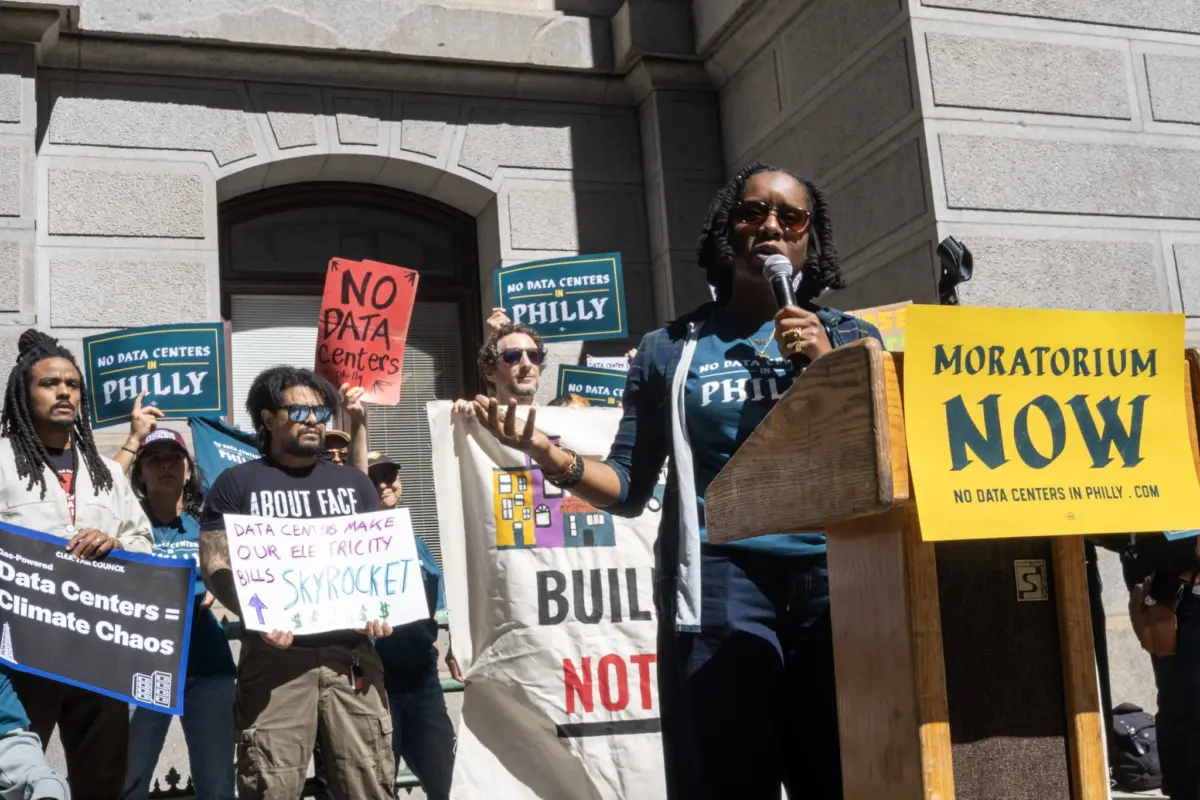
On a Monday morning in September 2026, more than 100 residents and environmental advocates gathered outside Philadelphia City Hall to launch the "No Data Centers in Philly" campaign. Demanding a comprehensive moratorium on all data center planning and zoning approvals, protesters chanted slogans audible within council chambers, signaling a unified stand against regional tech expansion.
Supporting Context & Metrics
The grassroots opposition in Philadelphia comes amid mounting national data regarding the extreme resource consumption of AI infrastructure. The transition from standard cloud computing to compute-intensive Large Language Models (LLMs) has fundamentally altered the power profile of data facilities, turning them into industrial-scale power sinks.
                      GLOBAL & NATIONAL DATA CENTER IMPACT METRICS
+------------------------------------+--------------------------------------------------+
| Metric                             | Projection / Equivalent Value                    |
+------------------------------------+--------------------------------------------------+
| U.S. Data Center Natural Gas Demand| Higher than Germany & Japan combined by 2035     |
| (BloombergNEF Forecast)            | (Nearly double projections from late 2025)       |
+------------------------------------+--------------------------------------------------+
| Daily Greenhouse Gas Increase      | +1 million metric tons of CO2 equivalent per day |
| (Data Center Power Demand)         | (~12% of total present-day U.S. emissions)       |
+------------------------------------+--------------------------------------------------+
| Natural Gas Carbon Intensity       | 60 grams of CO2 equivalent per cubic foot burned |
+------------------------------------+--------------------------------------------------+
| Global Fossil Air Pollution        | 1 in 5 deaths worldwide (Harvard Study, 2021)    |
+------------------------------------+--------------------------------------------------+
Energy Infrastructure and Fossil Fuel Reliance
According to updated projections from BloombergNEF, the international race for artificial intelligence capability will cause U.S. data center energy consumption to escalate sharply. By 2035, these facilities are expected to consume more natural gas than Germany and Japan combined—a projection that nearly doubled over a nine-month period due to accelerated GPU cluster deployments.
U.S. Greenhouse Gas Footprint Expansion
[Present Total U.S. Emissions] ========================================== 100%
[Data Center Added Footprint]  ====== 12% Additional Daily Burden by 2035
While natural gas produces fewer sulfur emissions than coal or crude oil, its baseline carbon output remains significant. Burning a single cubic foot of natural gas generates roughly 60 grams of carbon dioxide equivalent. Aggregated across thousands of hyperscale facilities, this incremental demand is projected to introduce 1 million metric tons of additional greenhouse gas pollution daily, representing approximately 12% of current total U.S. greenhouse gas emissions.
                   ELECTRICAL GRID & EMERGENCY GENERATION RISK

                  Regional Grid Under Peak Stress (Heatwave)
                                      |
                         +------------+------------+
                         |                         |
                 Residential Grid            Data Centers
               (Threat of Blackouts)    (Diverted to On-Site Backup)
                                                   |
                                                   v
                                       Hundreds of Industrial
                                      Diesel Backup Generators
                                                   |
                                                   v
                                        Spike in Ground-Level
                                       Particulate & NOx Pollution
Grid Operations and Emergency Backup Emissions
The strain extends beyond fuel lines directly to regional transmission networks. In electrical markets managed by regional transmission organizations like PJM Interconnection—which covers Pennsylvania—hyper-concentrated electrical demands threaten grid stability during peak summer heatwaves.
To safeguard regional grids against system-wide blackouts, regulatory authorities and utility operators frequently permit data centers to disconnect from the public grid during high-demand events and run on-site emergency generation units. These arrays consist of hundreds of heavy-duty industrial diesel generators. Legal analysts at the Clean Air Council point out that running these generators during intense heat waves releases high concentrations of nitrogen oxides ($NOx$) and fine particulate matter ($PM2.5$) directly into surrounding residential neighborhoods, compounding public health risks precisely when atmospheric air quality is poorest.
Official Statements
Community Advocates and Environmental Leaders
Shawmar Pitts, Managing Co-Director of Philly Thrive:
"I read the information they had on the table about how living near the refinery affects you, and I’m looking at all the sicknesses on this paper… ‘My mother has this, my sister has that, my next-door neighbor suffers from this’—every house, someone has something on that list. From that point, I was all the way in… I just think that our community standing up and fighting back is tremendous. It takes a lot of effort and a lot of people."
Sonya Sanders, Board President of Philly Thrive:
"We don’t want data centers. We don’t want the pollution, we don’t want the noise, and we know they’re not going to bring us more jobs… In my eyes, they killed him [her late husband]. The pollution killed him. I believe he would be here today if he wasn’t silently murdered, because it was the pursuit of profit that killed him."
Donna Greenberg, Philadelphia Resident and Protester:
"I’m worried about pollution. I’m worried about surveillance and the fact that they’re going to have access to information they have no business knowing, and I’m concerned that they’re going to be using water and electricity that takes away from the people and the neighborhoods who need it."
Legal Experts and Environmental Attorneys
Annie Fox, Staff Attorney at Clean Air Council:
"A typical data center planned in Pennsylvania has hundreds of diesel engines that spew air pollution, and even if they’re supposedly reserved for emergencies, the government has already said that the data center should use those rather than drawing from an overstressed electrical grid during some heat waves. We can expect that to get more frequent… Fossil fuel-hungry data centers will worsen climate change, making those heatwaves more frequent and severe."
Governmental Executives and Municipal Policy Makers
Kathy Hochul, Governor of New York:
"Progress shouldn’t arrive with a higher utility bill, depleted water supply, or noise pollution. These data centers can only be built, should only be built in places that want them."
Future Outlook
The dispute in Philadelphia is part of a broader nationwide trend, as municipal and state governments re-evaluate unchecked digital infrastructure growth.
                      U.S. MUNICIPAL & STATE DATA CENTER MORATORIUMS
+------------------------+-------------------+------------------------------------------+
| Jurisdiction           | Action Type       | Key Rationale / Scope                    |
+------------------------+-------------------+------------------------------------------+
| State of New York      | Executive Order   | Temporary halt on new major facility     |
|                        |                   | environmental permits                    |
+------------------------+-------------------+------------------------------------------+
| City of Denver, CO     | Zoning Pause      | Text amendment studying grid and water   |
|                        |                   | resource impacts                         |
+------------------------+-------------------+------------------------------------------+
| Indianapolis, IN       | Commission Action | Unanimous pause on land-use approvals    |
+------------------------+-------------------+------------------------------------------+
| Reno, NV               | Extended Pause    | Multi-year freeze extended through 2027  |
+------------------------+-------------------+------------------------------------------+
| Asheville & Charlotte, | City Council      | Local moratoriums pending municipal      |
| North Carolina         | Votes             | environmental review                     |
+------------------------+-------------------+------------------------------------------+
The Policy Rift Between Tech Expansion and Local Sovereignty
As technology companies scale up their compute infrastructure, municipal policy is becoming the primary battleground. Cities are caught between corporate promises of long-term tax revenues and immediate community concerns over grid stability, water consumption, and public health.
The administrative actions taken by New York State, Denver, Reno, Indianapolis, Asheville, and Charlotte demonstrate that local leaders are increasingly willing to halt development to re-examine zoning codes and environmental impacts. These moratoriums are designed to buy time for local governments to quantify the cumulative impacts on water tables, baseline ambient noise, and power distribution costs before granting permanent building permits.
                        FUTURE LEGISLATIVE AND REGULATORY PATHWAYS

             +-------------------------------------------------------------+
             |                 MUNICIPAL ZONING REFORMS                   |
             | Mandatory setback buffers, noise threshold limits, and      |
             | strict limits on emergency diesel generator operations.     |
             +------------------------------+------------------------------+
                                            |
                                            v
             +-------------------------------------------------------------+
             |               UTILITY & GRID COST ALLOCATION                |
             | Ring-fencing residential power tariffs to prevent consumers |
             | from subsidizing high-voltage line upgrades for tech firms. |
             +------------------------------+------------------------------+
                                            |
                                            v
             +-------------------------------------------------------------+
             |               OFF-GRID & RENEWABLE REQUIREMENT              |
             | Mandating co-located, clean generation (nuclear/solar) to  |
             | prevent fossil fuel grid draw during peak operational hours. |
             +-------------------------------------------------------------+
Legislative Outlook in Pennsylvania
In Philadelphia, members of the City Council face growing pressure from grassroots groups like Philly Thrive to introduce formal zoning legislation prohibiting high-density compute facilities near residential areas. The campaign aims to enact a binding moratorium that would prevent city agencies from issuing site permits for the Grays Ferry or Northeast Philadelphia development zones.
If passed, Philadelphia would join a growing network of industrial and post-industrial cities asserting veto power over Big Tech’s physical footprint. For historic industrial communities like Grays Ferry, the message to city planners and corporate executives remains clear: economic modernization cannot come at the expense of public health and environmental justice.