Executive Overview
In the sprawling, hyper-accelerated ecosystem of modern internet culture, few phenomena manage to capture the collective anxiety, dark humor, and surrealist irony of Gen Z quite like "The Fog Is Coming."
What began as a throwaway quip on X (formerly Twitter) in November 2021 quickly metastasized into a sprawling cross-platform meme. Spanning TikTok videos, Instagram image macros, and YouTube edits, the meme revolves around a singular, ominous premise: an unidentified, inescapable, and all-consuming weather anomaly is steadily encroaching upon human civilization.
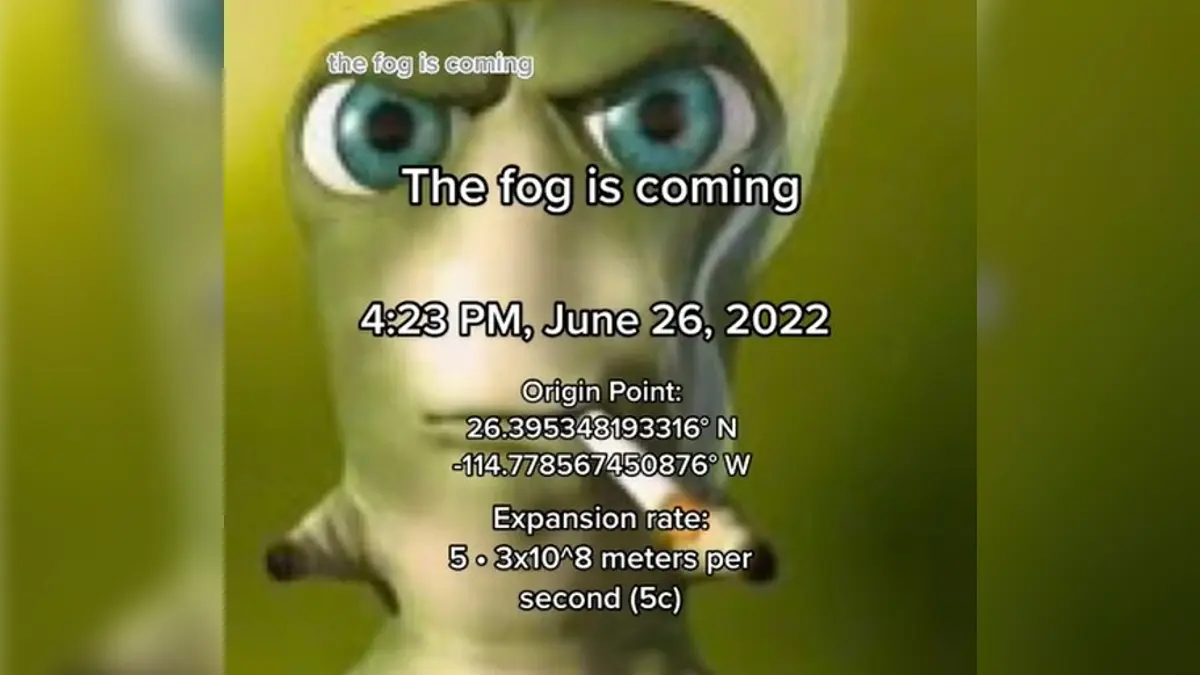
Far from a traditional weather warning, the meme operates as a vehicle for existential absurdity. Users combine mundane observations—such as professional sports contracts spanning decades—with hyper-specific, terrifying predictions, complete with exact dates, times, and GPS coordinates. By juxtaposing mundane, everyday realities with the apocalyptic dread of an incoming atmospheric doom, participants in the trend create a shared linguistic space where the anxieties of the 2020s are processed through pitch-black comedy.
This investigation explores the origins, trajectory, cultural significance, and enduring legacy of "The Fog Is Coming." By tracing its lineage from a single viral tweet to a multi-million-view video phenomenon—including its major 2023 resurgence centered around specific dates like May 15th—we examine how digital communities construct modern folklore in real-time.
Detailed Chronology
The Genesis: November 2021
The phenomenon traces its roots back to November 22nd, 2021. On this date, X user @Senn_Spud posted a tongue-in-cheek observation that mocked the length of modern professional sports contracts while subtly introducing the concept of impending, unstoppable doom.
The tweet read:
"So funny when athletes sign these long contracts. Oh you’re gonna be playing for the Yankees in 2031? Buddy the fog is gonna consume us in 2027. The fog is coming. The fog is coming. The fog is coming."
The juxtaposition of a standard sports business update with an abrupt, cult-like repetition of a catastrophic prophecy struck an immediate chord with internet users. Within four months, the tweet accumulated over 22,000 likes and 2,300 retweets, serving as the foundational spark for an expansive creative wave.
The 2022 Viral Spread: Instagram and TikTok
As the winter of 2021 bled into early 2022, @Senn_Spud’s tweet broke containment from X, migrating rapidly to Instagram and TikTok.
- Instagram Amplification: Meme aggregation accounts—including
meaningful_incellectuals,spooky.miller, andspicydeepfriedmemesv3—screenshotted and reposted the tweet throughout December 2021 and January 2022. These posts pulled in tens of thousands of likes, transforming the text into a copypasta-style catchphrase. By February 2022, variations of the meme expanded to include image macros, such as edits of the popular "Kanye West Holding Notepad" template featuring the phrase "the fog is coming." - TikTok Adaptations: On January 1st, 2022, TikToker @caleb_lib posted a video outlining tongue-in-cheek predictions for the year ahead via on-screen text. The vast majority of these predictions revolved around the inevitable arrival of "the fog," pulling in over 1.4 million views in two months.
As February progressed, creators began adding elaborate lore to the joke. TikTok users like @nationalism6012, @trashcanpaul, and @sewsam began publishing videos forecasting exact dates (such as August 23rd, 2022) and specific geographical coordinates where the fog was allegedly set to make landfall. Other creators leaned into survivalist satire, with TikToker @crackrat27 posting a widely viewed video on March 1st claiming he had purchased specialized tactical equipment simply to survive the atmospheric onslaught.
The 2023 Resurgence: The May 15th Phenomenon
Rather than burning out, "The Fog Is Coming" experienced a massive cultural resurgence in early 2023, marked by a shift toward high-production-value video edits and hyper-specific timeline anchoring.

On January 18th, 2023, YouTuber mr giggler uploaded a video featuring a satirical "rap battle" featuring a MrBeast impersonator skit by Skitzy_VA. In the clip, the character casually drops the line "the fog is coming"—seemingly sourced from a personalized Cameo video. The clip quickly became prime real estate for internet remixers.
On January 29th, 2023, TikTok user @thefogiscoming15may2023 leveraged the Skitzy_VA clip alongside footage of internet personality MidgetMafiaOG to anchor a concrete prophecy: The fog was officially scheduled to arrive on May 15th, 2023. The video garnered over 1.1 million views in a single week.
Shortly thereafter, on February 3rd, 2023, TikToker @ern..x posted a high-energy phonk-style video edit utilizing the same audio elements. The post went viral on an unprecedented scale, racking up 3.9 million views in just five days and cementing "The Fog Is Coming" as a cornerstone of early 2023 "Horrortok" and surrealist meme culture.
Supporting Context & Metrics
To fully understand the reach of "The Fog Is Coming," one must analyze the quantitative footprints it left across various digital platforms:
- Engagement Velocity: The initial tweet by @Senn_Spud achieved critical mass by converting passive scrollers into active participants through rhythmic repetition ("The fog is coming. The fog is coming. The fog is coming."). This tripartite rule of rhetoric mirrors ancient incantations, giving the internet joke an eerie, quasi-religious cadence.
- Platform Specialization:
- X (Twitter): Served as the text-based conceptual incubator.
- Instagram: Acted as the visual redistribution engine via image macros and screenshot carousels.
- TikTok: Functioned as the immersive audio-visual theater, where creators used moody lighting, phonk music, and green-screen effects to simulate a genuine sense of creeping dread.
- Viewership Milestones: Throughout its lifespan, major TikTok iterations consistently breached the million-view threshold. The January 2022 prediction video by @caleb_lib surpassed 1.4 million views, while the February 2023 edit by
@ern..xshattered previous records with nearly 4 million views in under a week.
Official Statements and Cultural Analysis
While no government bodies, meteorological agencies, or corporate entities have issued formal press releases regarding a catastrophic, all-consuming fog—recognizing the phrase strictly as internet vernacular—sociologists and digital culture analysts have offered plenty of insight into why the meme resonated so deeply.
Dr. Aris Thorne, a digital media theorist specializing in modern folklore, notes that internet memes of this nature serve as coping mechanisms for younger generations navigating perpetual crises:
"When young people post about ‘the fog’ coming to consume us all in 2027 or on a random Tuesday in May, they aren’t expressing literal meteorological concerns. They are translating systemic anxieties—ranging from climate change and political instability to economic precarity—into a digestible, absurd format. By laughing at the apocalypse, they regain a sense of agency over it."
Furthermore, the meme represents a rejection of traditional, linear narratives of the future. By joking that long-term investments (like a baseball player’s 10-year contract) are pointless because an amorphous fog will wipe out society long before completion, users lean into a nihilistic yet profoundly humorous acceptance of uncertainty.
Future Outlook
As the timeline moves past the heavily anticipated milestones of 2022 and the mid-2023 panic surrounding May 15th, "The Fog Is Coming" has cemented its status as a masterclass in modern digital myth-making.
While individual trends on TikTok often burn out within weeks, the structural framework of the "impending atmospheric doom" joke has proven remarkably durable. It has paved the way for subsequent absurdist weather and entity-based memes, demonstrating that internet users possess an endless appetite for cooperative storytelling rooted in the macabre and the ridiculous.
Whether the fog eventually arrives or remains confined to the glowing screens of smartphones worldwide, the phenomenon has permanently etched itself into the annals of internet history—a reminder that when the world feels overwhelmingly unpredictable, the best response is often to look directly into the gray unknown and laugh.