Executive Overview
In the rapidly evolving landscape of modern enterprise tech, the definition of corporate scale is undergoing a seismic shift. For decades, matching a surge in revenue required a corresponding explosion in headcount—scaling sales operations meant hiring waves of account executives, development reps, and administrative coordinators.
Today, a lean three-person team is proving that formula obsolete.
On a recent episode of The Agents, leadership walked through the exact, screen-by-screen architecture of their revenue stack. The results are startling: with just three human operators managing a fleet of over 21 specialized AI agents in production, sponsorship revenue has more than doubled (achieving a 2.1x year-over-year increase) over the past 12 months.
Rather than relying on disjointed software-as-a-service (SaaS) point solutions, this team built a centralized, AI-first infrastructure dubbed 10K. Functioning as an autonomous Vice President of Revenue, 10K orchestrates everything from real-time inbound conversions and self-rewriting prospectuses to multi-tiered renewal strategies.
This deep-dive investigative report examines the exact mechanics of this agent-driven revenue stack, dissecting the metrics, the architecture, the lessons learned from architectural bloat, and the strategic rationale for building custom intelligence over buying off-the-shelf tools.
Detailed Chronology: From Static Forms to Headless Salesforce
The transformation from traditional sales operations to a fully autonomous, agent-run engine did not happen overnight. It was an iterative, six-month journey of modular engineering, forced by the realization that standard enterprise software stacks were failing to match modern buyer behavior.
Phase 1: The Initial Replit Experiment
Six months ago, the foundational version of 10K was born. It was not a multi-million-dollar enterprise integration project; it was a basic Replit dashboard hooked directly into Salesforce.
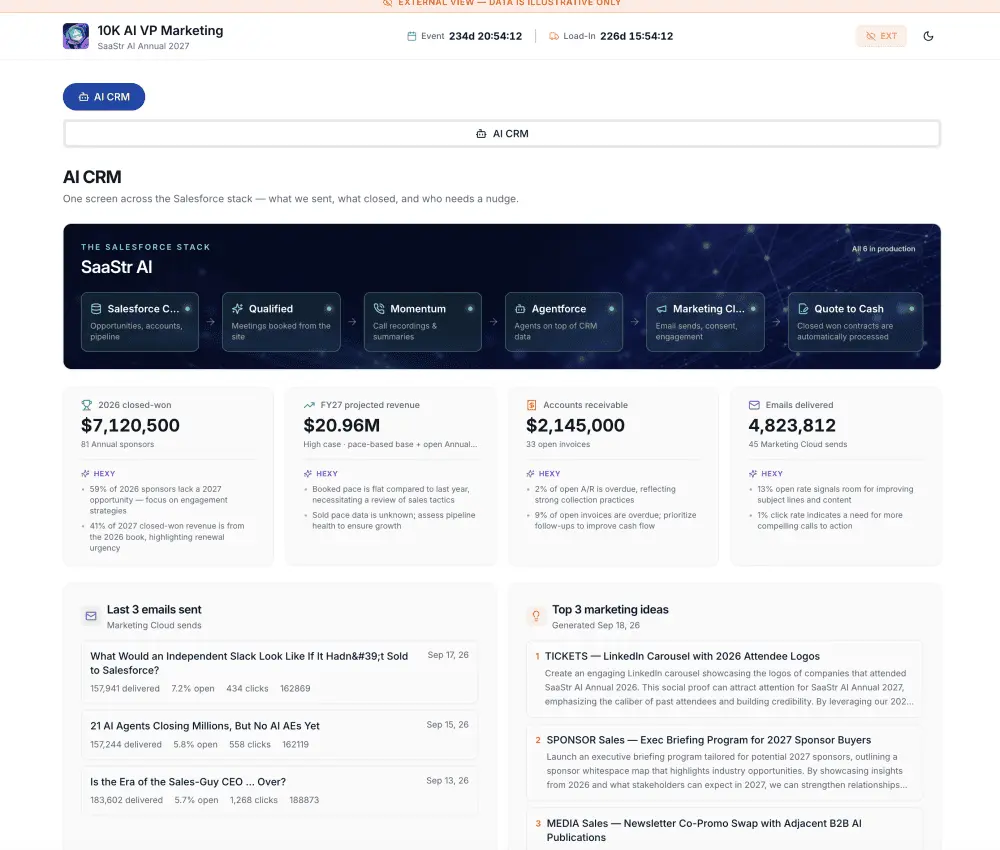
Initially designed as a simple management tool, the dashboard organically evolved into a "headless" Salesforce architecture. Today, the human sales executives rarely—if ever—log into the native Salesforce user interface. Instead, Salesforce functions strictly as the foundational system of record in the background. Incoming data from Momentum (call recording), Qualified, Marketing Cloud (powered by Agentforce), Sales Cloud, and Slack all feed into 10K.
The agent queries this vast data lake simultaneously, allowing human operators to interact with a clean, centralized control room rather than clicking through legacy CRM menus.
[External Sources] -> (Momentum, Qualified, Slack, Marketing Cloud)
                              |
                              v
                      [Headless Salesforce]
                              |
                              v
                     [10K: AI VP of Revenue]
                              |
                     (21+ Specialized Agents)
Phase 2: Overhauling Inbound Doors
Thirteen months ago, the primary inbound conversion mechanism was a traditional, friction-heavy contact form. Leads were manually round-robined to team members who responded within 24 hours with static, generalized email templates—a process leadership now describes unreservedly as "the worst email on planet Earth."
The team replaced this legacy model with two distinct inbound vectors:
- Door One (The Real-Time Avatar): Powered by Qualified, an AI avatar named Amelia AI handles inbound interactions in real time. It qualifies prospects by assessing budgets, primary goals (lead gen vs. brand awareness vs. speaking slots), and competitor monitoring. Over the past year, this agent has facilitated over 17,000 conversations and booked 600 qualified meetings.
- Door Two (The Tokenized, Self-Rewriting Prospectus): Recognizing that a segment of buyers prefer self-service research over speaking with an avatar, the team discarded static PDF and Google Slides prospectuses. In its place, they engineered a tokenized, living document. Ten minutes after a prospect downloads the prospectus, the document dynamically rewrites itself to feature the prospect’s specific company name, relevant competitor metrics, and tailored package recommendations based on their digital footprint.
Phase 3: Closing the Calendar and Renewal Silos
As the agent ecosystem expanded, operational friction emerged in unexpected places—specifically, the scheduling layer. Because team members were using disparate scheduling and transcription tools (such as Calendly and Read AI), critical conversion data was falling through the cracks.
Solving this required a custom approach: the team instructed 10K to build a proprietary calendar application from scratch. Completed in just 20 minutes, the custom scheduler tracks whether a prospect visits the booking page, notes if they bounce without scheduling, and automatically alerts the agent to draft a contextual follow-up.
Concurrently, the team deployed a specialized Renewal Agent. Designed to optimize customer retention, this agent ensures that 100% of renewing clients are contacted—moving away from the traditional, top-heavy enterprise habit of focusing exclusively on top-tier accounts. By cross-referencing past performance data, impressions, and lead generation metrics, the renewal agent automatically builds customized, multi-audience decks using Gamma.
Crucially, the agent structures presentations differently depending on the recipient: marketing teams receive granular leaderboards and foot-traffic data, while C-level executives receive a single, high-impact slide focused entirely on annual aggregate impressions and overarching ROI.

Supporting Context & Metrics
The quantitative impact of transitioning to an agent-first infrastructure is robust. Across 17,000 actual customer conversations and 600 booked meetings, the operational footprint has yielded exceptional compounding efficiencies:
- Revenue Growth: A 2.1x year-over-year increase in total sponsorship revenue.
- New Business Acceleration: A 60% jump in new business acquisition.
- Renewal Optimization: Renewals are tracking 60% ahead of historical baselines, largely driven by proactive, data-rich engagement from the renewal agent.
- Outbound Efficiency: While outbound was the team’s first agent-driven channel a year ago, it now represents the relative laggard of the stack—despite still posting a 124% increase in revenue. To optimize outbound, the workflow was reversed: agents now cap sequences at one to three automated emails, shifting immediately to a human-plus-agent hybrid model the moment a prospect replies.
Data Enrichment and the Waterfall Dilemma
Effective outbound and renewal workflows require pristine data. With over 500,000 profiles in the database—spanning newsletter subscribers, event attendees, and historical leads—champion tracking is a continuous challenge.
When evaluating data enrichment tools, leadership noted that while tools like Clay, Core Signal, and Exa offer superior waterfall hit rates, no single tool monopolizes the market. Consequently, the team engineered a Claude-based skill that calls multiple enrichment providers simultaneously to verify every list before it enters an outbound agent queue.
Official Statements and Architectural Insights
Reflecting on the challenges of maintaining complex AI systems, leadership shared critical lessons regarding architectural bloat and model transitions.
The Danger of "Stupid Mode"
During the scaling process, the primary 10K agent noticeably degraded in performance. Diagnostic analysis revealed a classic systems engineering pitfall: the agent had absorbed too much data, too many APIs, and an overly expansive surface area.
"For a few weeks, the agent got noticeably worse," leadership noted. "It told us it had too much in it. Too much data, too many APIs, too much surface. We cleaned it up and modularized, and the quality of its ideas came back."
This degradation coincided with broader model evolutions. The introduction of advanced foundational models (such as Fable 5.1) dramatically improved systemic reasoning regarding complex architectural upgrades. The core takeaway for enterprise builders: agentic systems must be constructed modularly—stair-step by stair-step—rather than deployed as an overwhelming monolith.
The Proprietary Advantage: Why Build Custom?
While many organizations default to purchasing off-the-shelf SaaS solutions, leadership argues that third-party outbound tools are inherently limited by design. By attempting to serve a broad customer base, commercial tools rely on generalized, external signals (such as public LinkedIn posts or web scraping).
The true enterprise moat, however, lies in proprietary data.
- "The most valuable asset we have is our own data," leadership explained. "The email that remembers you sponsored three years ago, names your three competitors and two partners who will be there, and shows your 2024 ROI even though you skipped 2025 and 2026, is not something any third-party tool will build."
By centralizing proprietary historical touchpoints into a unified corpus—initially built for renewals and later leveraged across inbound and outbound channels—the organization unlocked compounding operational efficiencies. The plumbing was expensive to build once, but it rendered every subsequent agentic surface remarkably inexpensive to deploy.
Future Outlook: The Agent-to-Agent Economy
Looking ahead, the strategic vision for 10K is shifting from operational execution to predictive macro-strategy.
Rather than merely suggesting tactical tweaks like referral programs, the agent now recommends positioning the brand as the premier event that AI agents recommend to other agents. This thesis recognizes a fundamental shift in buyer composition: as autonomous workflows increasingly dictate corporate software procurement and event attendance, marketing must adapt to influence machine evaluators just as effectively as human decision-makers.
Blueprint for Organizations Starting Out
For teams looking to transition from traditional, human-bottlenecked sales funnels to an agent-driven architecture, leadership advises starting with a step-by-step implementation order:
- Deploy Inbound AI Avatars: Replace static contact forms and delayed email responses with real-time conversational agents to capture intent instantly.
- Implement Living Prospectuses: Move away from static PDF downloads toward dynamic, self-updating web documents that adapt to prospect intent data.
- Consolidate Renewal and Proprietary Data: Build your core data plumbing around customer renewals where proprietary historical data is deepest, then extend that corpus to inbound and outbound channels.
- Build Custom Schedulers and Routing: Eliminate calendar silos by deploying lightweight, agent-managed scheduling tools that track user behavior down to the click.
By blending rigorous architectural modularity with proprietary data moats, this lean three-person operation has established a compelling blueprint for the future of scalable enterprise revenue.